Covenant analysis is the work of reading a bond indenture or loan agreement to establish what the issuer may do to its creditors — how much it can borrow, pay out, pledge, sell or move beyond their reach — and how the baskets and defined terms combine. Done with AI agents, it is only safe if the agent that reads a basket is never the agent that checks it: a model that misreads a definition will usually misread it the same way twice, and will say so with confidence. Botminds' Bond Covenant Analysis therefore divides the work among separate agents — one quotes every clause with its page, one turns baskets into dollars, one attacks the document the way a sponsor's counsel would, and one re-reads and recomputes everything independently — and sends every disagreement to a person.
The worked examples are sample data on fictional people and companies, run through the solution: Quillfield Capital's credit desk and Dunmore Cinemas Holdings' $650 million of 7.25% senior notes due 2031, whose 412-page preliminary offering memorandum arrived at 6:05 p.m. two days before books closed. Regulators' and researchers' words are quoted from their own texts.
One new issue, read overnight by Bond Covenant Analysis
77min
to quote 41 covenant provisions and 63 defined terms, each with section and page
40/41
quotes matched when a second agent re-read them independently; counsel ruled on the 41st
11routes
tested for value to leave: 1 open, 1 to watch, 9 blocked
What is covenant analysis, and why does one careful reader miss routes?
Covenant analysis answers one question for a bondholder: what could this issuer do tomorrow that would hurt me, and how much of it would the document allow? The answer is rarely in one clause. It sits in a covenant, the exceptions to it, the definitions those exceptions use and the cross-references between them, which is why a single reader working through 400 pages in sequence tends to find every basket and miss the route that strings three of them together.
Researchers who coded 1,240 leveraged loan agreements reached the same conclusion about the drafting: "The abundance of carve-outs and deductibles and the significant variation across contracts in their use support their importance and the sophistication that is required to interpret them" (Ivashina and Vallée, NBER w27316). The average agreement in their sample had 79 distinct carve-outs. A reader can quote all 79 correctly and still not see which ones combine.
A language model makes the problem sharper, not different. In a study of how models answer verifiable legal questions, Dahl and co-authors found that models often go along with a user's mistaken legal premise instead of correcting it, and that they cannot reliably tell when their own answer is invented (arXiv 2401.01301, not peer reviewed in this version; the study's figures are set out in is ChatGPT good for legal research?). A model asked to check its own reading inherits both weaknesses. The design answer is to make sure it is never asked.
How is bond covenant analysis done with agents? Five jobs, kept apart
Bond covenant analysis with agents splits the work a single analyst used to do into jobs that check each other: quoting, pricing, benchmarking, attacking and verifying. Each agent has one job and a written limit, and the limits are what make the result trustworthy, because the agent that produced a number is never the one asked whether it is right.
Reader, adversary, verifier: who does what in Bond Covenant Analysis, and what each never does
Agent
Reader agentReads the offering memorandum, indenture or amendment and quotes every covenant, basket and defined term with section and page, following each cross-reference.
Never: paraphrases a basket without the quote, or guesses a page it cannot read
Agent
Calculator and Benchmark agentsTurn grower and builder baskets into dollars from the latest twelve-month numbers, showing every line, and rank each basket against the firm's own peer deals.
Never: use a number they cannot cite, or change the house rubric
Agent
Adversary agentPlans routes for value to leave the way a sponsor's counsel would — drop-down, designation, priming, guarantor release — chains the baskets and prices each route.
Never: reports a route the Verifier has not confirmed, or advises the issuer side
Agent
Verifier agentRe-reads every quote and recomputes every dollar with a second model, tries to break each route, and raises any difference as a dispute with both readings.
Never: resolves its own dispute
A person decides
Legal counselRules on each disputed reading; until she does, the score cannot be published.
A person decides
Analyst, then a senior analystThe analyst reviews and submits the score and recommendation; a senior analyst approves it; nothing is sent or traded by an agent.
The reader quotes; it never paraphrases a basket
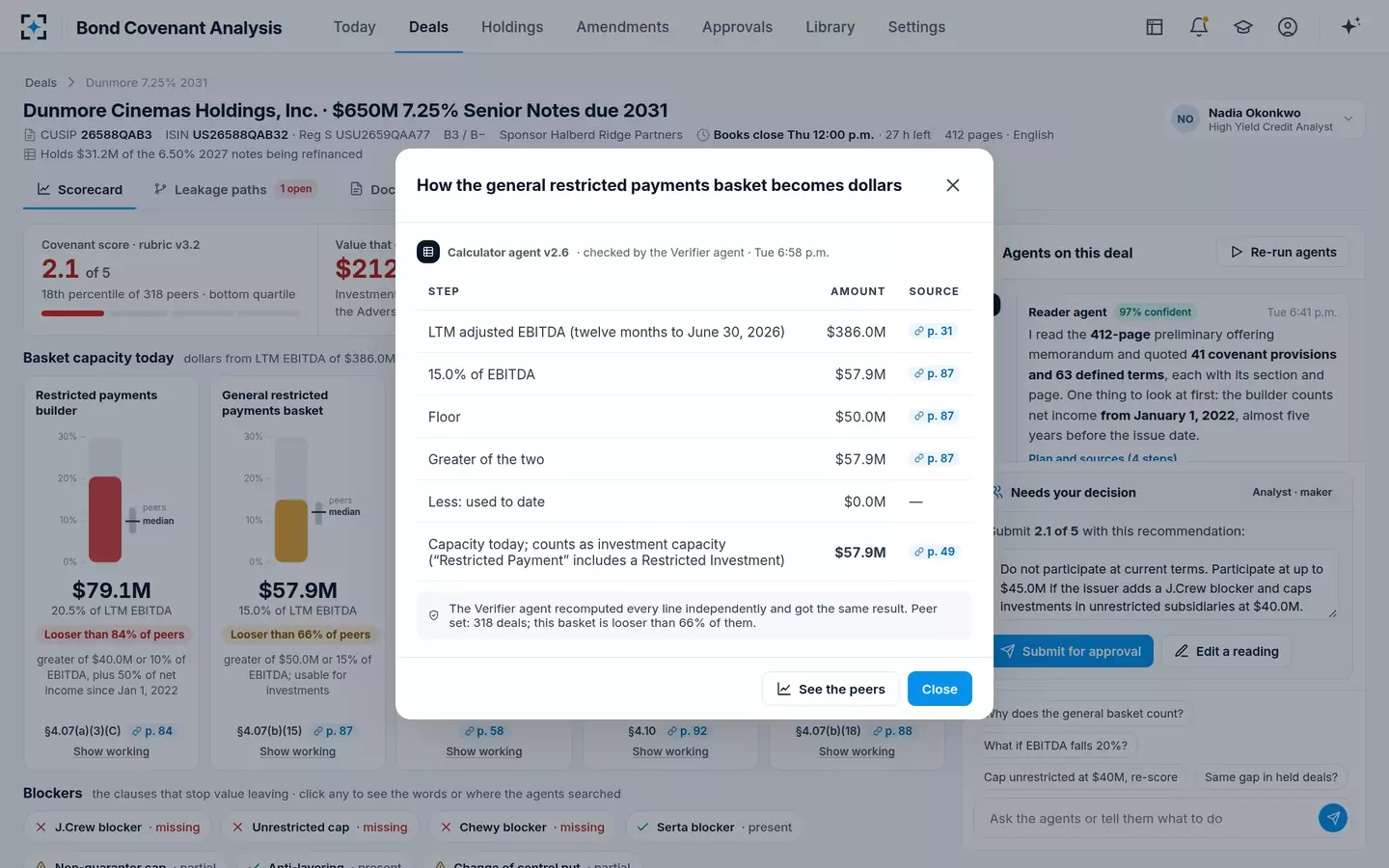
The first agent's job is narrow on purpose: find every clause that matters and quote it exactly, with section, page and document version. A paraphrase is where errors hide — "a general basket of $50 million" drops the words "or 15% of EBITDA" and the cross-reference that lets the basket fund investments — so the reader is never allowed to summarise without the quote beside it.
It is also allowed to stop. On the sample desk, Corrigan Health's offering memorandum had four unreadable pages, 311 to 314; the reader asked the syndicate desk for a clean copy and the score was held until it arrived. An agent that guesses a page it cannot read is the most dangerous kind, because its output looks exactly like a correct one.
Show working: how one basket becomes dollars, line by line
The adversary works the indenture the way a sponsor's counsel would
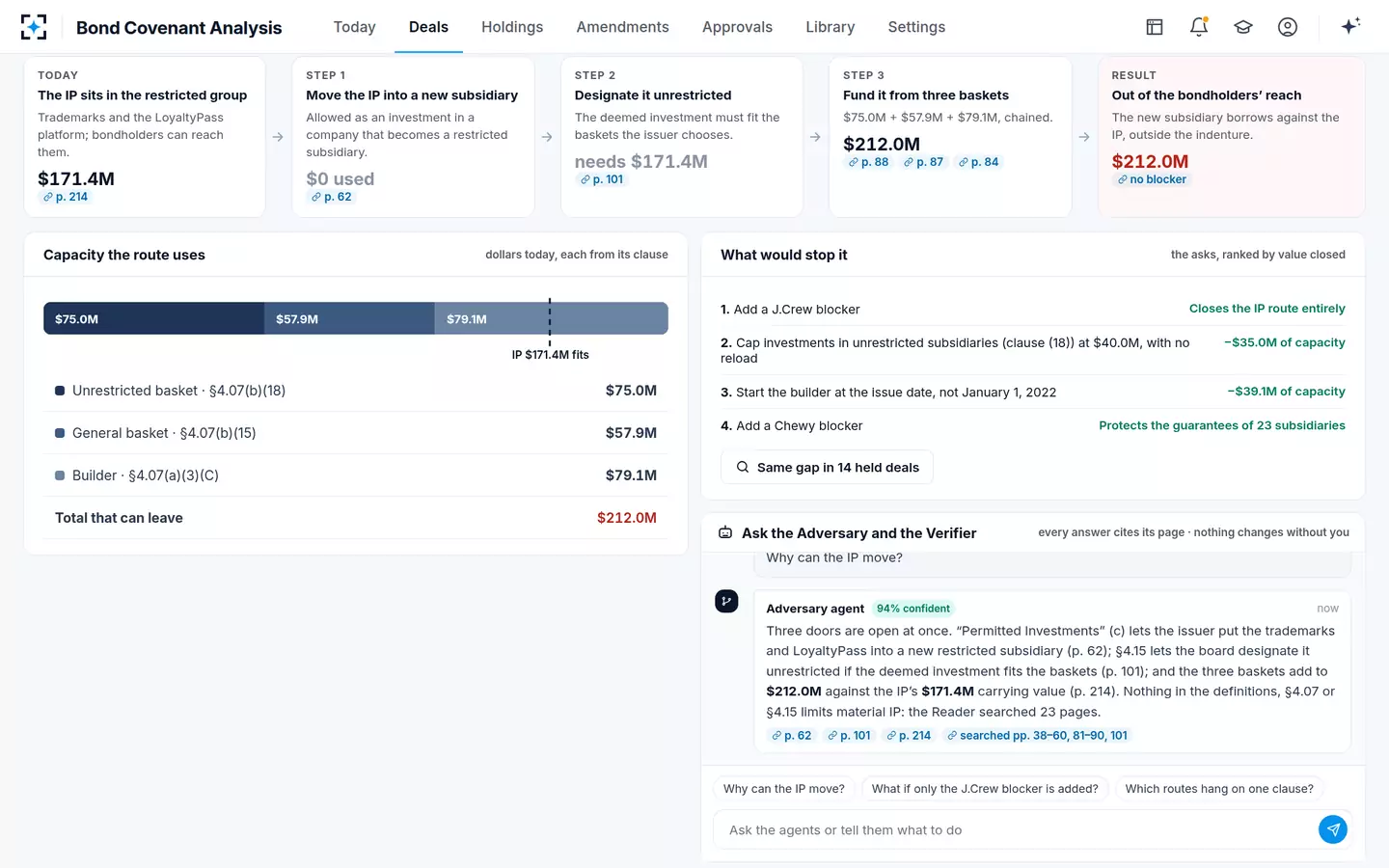
The adversary agent does what a reader does not: it starts from an outcome a sponsor might want — move the brand into a subsidiary bondholders cannot reach, put new debt ahead of the notes, release a guarantee — and searches the document for the doors that would allow it. Then it chains them and prices the route in dollars today.
On the sample deal it found one open route among eleven tested. The trademarks and a loyalty platform, carried at $171.4M, could be placed in a new restricted subsidiary, designated unrestricted, and paid for from three baskets: $75.0M for investments in unrestricted subsidiaries, $57.9M from the general restricted payments basket and $79.1M from the builder, $212.0M in all. Asked the next morning why the IP could move, it answered with pages 62, 101 and 214, and noted that nothing in the definitions limited material intellectual property: it had searched 23 pages. That route, and what it would cost a bondholder to miss it, is worked through in the covenant leakage guide.
The route, step by step, with the doors that would close it
The verifier re-reads with a second model and cannot settle its own dispute
The verifier is the checker, and its independence is the whole design: it re-reads every quote and recomputes every dollar independently with a second model, and it tries to break every route the adversary reports. Where it agrees, the analyst has two readings that match. Where it does not, it raises a dispute and stops; it never resolves its own disagreement, and a disputed reading blocks publication until legal counsel rules.
The disagreement log: what two independent readings caught on the sample desk
Dunmore 7.25% 2031 · §4.07(b)(18)
Do returns on investments reload the $75.0M unrestricted subsidiary basket above its original size?
Reading AReader: returns reload the basket, with no overall cap.
Reading BVerifier: returns restore it up to $75.0M; they do not enlarge it.
OutcomeCounsel ruled for the Verifier, 8:15 a.m. The route's dollars changed; the score was then published.
Maple Harbor 7.00% 2029 · amendments clause, p. 78
Can a majority of holders delete the liens covenant?
Reading AReader: yes; the liens covenant is not a sacred right.
Reading BVerifier: deleting it has the effect of releasing the liens, which needs 66⅔%.
OutcomeOpen. The score cannot be published until counsel rules; the consent deadline is Monday.
Dunmore · eleven routes tested
Can value leave the restricted group, and through which doors?
Reading AAdversary: one route open for $212.0M; one to watch; nine blocked.
Reading BVerifier: tried to break each route; confirmed the open one and the nine blocks.
OutcomeOnly routes both agents agree on are shown as open, each step quoted.
Agreement is not proof of correctness; two readers can share a blind spot. That is why the people at the end of the chain see the quotes, not just the matching flag, and why the sample firm tests every new agent or model version on a golden set of 240 annotated documents before it goes live. How far two human analysts agree on the same indenture, and what that says about any scoring tool, is the subject of the covenant scoring system guide.
What regulators expect when agents do the reading
No regulator has written a rule for covenant analysis by AI, but the expectations are stated, and they fit this design. FINRA's 2026 oversight report lists the risks of agents, and the first three describe a covenant reader exactly: autonomy without a person validating or approving the work, action beyond what the user authorised, and chains of reasoning too long to trace, explain or audit afterwards (FINRA, 2026 Annual Regulatory Oversight Report; the report's own wording is set against working controls in AI earnings call analysis: why the reader is never the checker). Its suggested practices are the ones this design keeps: every prompt and answer retained, the model version noted against each run, and a person reviewing what the agents produce.
FINRA's January 2026 blog adds the reason a person must stay in the loop on judgement calls: "unlike human employees, AI agents lack tacit knowledge, and they may also lack the transparency and predictability that traditional supervisory and governance practices assume" (FINRA, Observations on AI Agents). And the SEC's examiners, in their fiscal 2027 priorities, note that registrants now use what the SEC calls "super intelligence" for research and drafting among other work, and say they will check that firms still meet obligations that apply whatever the technology (SEC Division of Examinations, FY2027 priorities; the SEC's own words are quoted in how are asset managers using AI?). FINRA's report is written for broker-dealers; for an asset manager it is a description of good practice, not a rule.
How long does covenant analysis take, with and without agents?
By hand, one high yield new issue with a 400-page offering memorandum takes a credit analyst about 20 hours of covenant work in Botminds' estimate; on the sample deal the whole books window was less than two days. With the agents, the estimate is about two and a half hours of the analyst's time, most of it spent checking, asking and deciding rather than reading.
Where a new issue's covenant hours go: by hand and with the agents
- Reading clauses and definitions8 h
- Sizing baskets3 h
- Peers2 h
- Chaining routes4 h
- Memo2 h
- Sign1 h
- Review2.5 h
The hour saved matters less than which hour gets cut when time runs out. By hand, the step that gives way is chaining baskets into routes, four hours of the twenty and the first to be shortened when three new issues price in the same week; it is also the step that finds the expensive problems. With the agents, the route search runs on every deal, and the analyst's half hour goes to deciding whether the open route matters.
Buying covenant analysis software: seven tests to run first
A covenant analysis tool should be judged on documents a firm has already read by hand, against answers its own analysts trust. Demos on a vendor's chosen indenture show what the tool does when it works; the tests below show what it does when the document is hard.
Seven tests for any covenant analysis tool, on your own indentures
- Every value cites its page
Open ten baskets at random. Each should show the exact words, section, page and document version, not a summary.
- Baskets come out in dollars, with the working
A grower basket should show the EBITDA used, its date and page, the floor, the amount used and the result.
- It finds a route you know is there
Pick a closed deal where your team found a designation or drop-down route. See whether the tool finds it unprompted.
- A second reading is independent
Ask how the check is done. A second pass by the same model on the same prompt is a repeat, not a check.
- Disagreements surface, and stop the output
Plant an ambiguous clause. The tool should show two readings and wait for a person, not pick one quietly.
- It says when it cannot read
Give it a scan with missing pages. It should stop and ask, not fill the gap.
- Versions and logs are kept
You should be able to see which model, agent and rubric version produced a score signed a year ago.
Where agents fit in covenant analysis, and where they do not
Agents fit where the work is reading, arithmetic and search across long documents under time pressure: new issues in the books window, held deals re-scored when numbers or documents change, and amendments that need a redline before a consent deadline. They do not replace counsel's reading of a genuinely ambiguous clause, the portfolio manager's decision to buy or consent, or the negotiation with a bookrunner, and in Bond Covenant Analysis they are not allowed to.
Some limits are practical. A tool is only as good as the documents it can read, so a firm whose deals arrive as poor scans will spend its first weeks on copies, not scores. A book of mostly investment grade bonds with thin covenant packages gains less than a high yield or leveraged loan book, where the baskets are many and large. And a score is only comparable across deals if it is built against a library of past indentures; what a firm brings to start decides how useful the first month is.
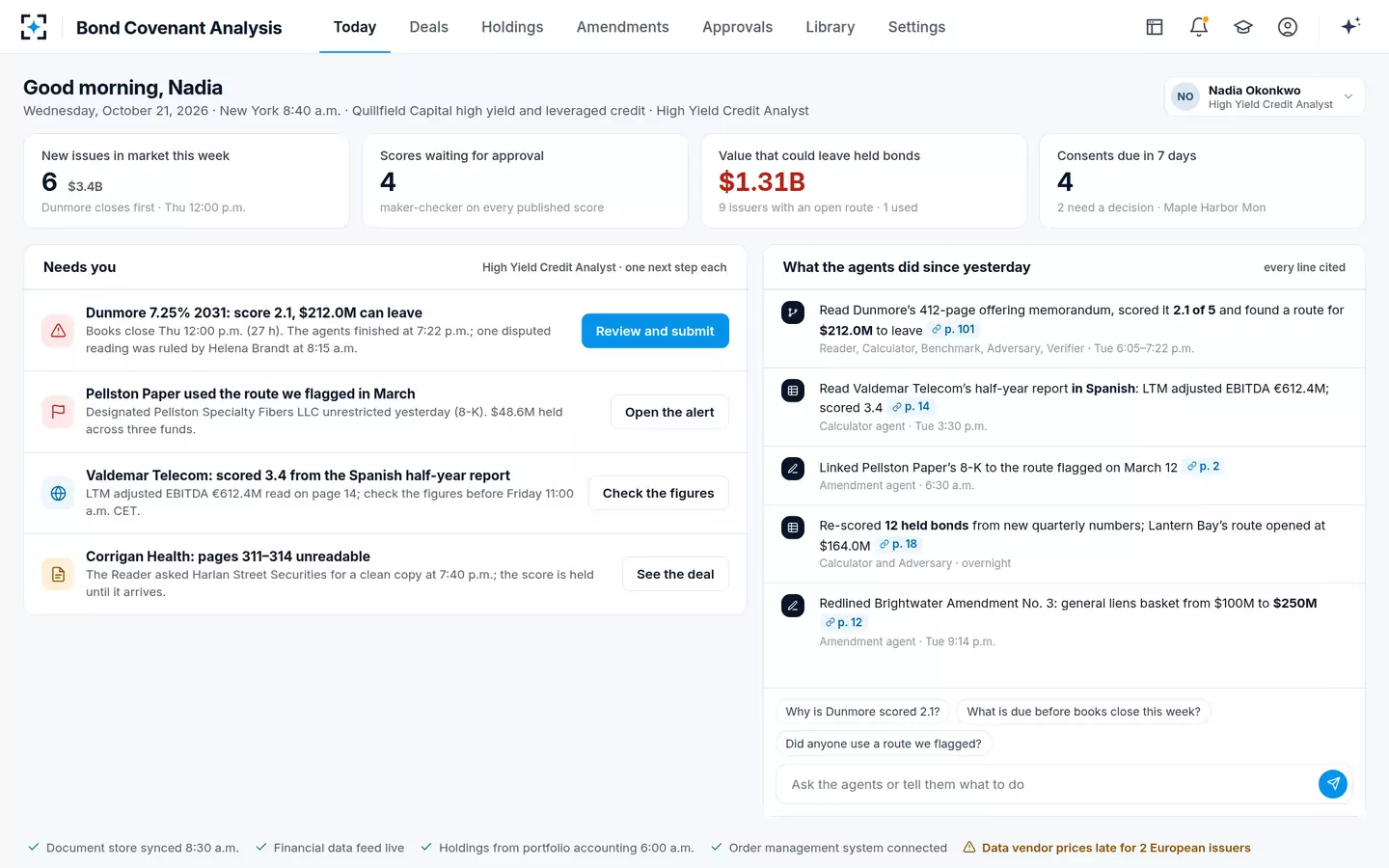
The analyst's morning: what the agents did overnight, and what needs her
Questions people ask
Can AI analyze bond covenants?
It can quote covenants, find defined terms, compute basket sizes and search for routes faster than a person, but a single model reading alone is not reliable enough to trade on. Research on legal questions found models often fail to correct a user's wrong assumptions and do not always know when they are wrong. The safe pattern is separate reader and checker agents, with people deciding the disputed readings and signing the score.
How accurate is AI on indentures?
There is no public benchmark for high yield indentures, so accuracy has to be measured on a firm's own documents against answers its analysts trust. On the sample deal, two independent agent readings matched on 40 of 41 quotes and counsel ruled on the 41st. A firm should run the same comparison on deals it has already scored by hand before relying on any tool.
What is an adversarial check in AI covenant analysis?
It is a separate agent whose job is to attack the document rather than summarise it: to plan how value could leave the bondholders, chain the baskets that allow it and price the route. A second agent then tries to break each route, and only routes both agree on are shown as open. On the sample deal, 11 routes were tested and one was open.
Who reviews AI covenant output?
People do, at three points: legal counsel rules on any reading the agents disagree on, the analyst reviews and submits the score, and a senior analyst approves it, with the head of credit research adding a second approval below a score of 2.5 or above a $150.0M route in the sample firm. The agents never publish, send or trade.
What tools do analysts use for covenant analysis?
Traditionally a PDF reader, a spreadsheet to size baskets and a house checklist, sometimes with a subscription covenant summary. Agent-based tools add quoting with page references, basket arithmetic from current numbers, comparison with the firm's own library and a search for leakage routes, with every step kept for review.