A new issue concession is the difference between the yield at which a new bond is priced and the yield the issuer's existing bonds, or comparable bonds, trade at for the same maturity — the discount an issuer pays to get a deal done. It is usually positive, sometimes several times larger in a stressed market, and occasionally negative when demand is strong or the new bond's terms are weaker than they look. For a buy-side desk it is the reward for reading a deal properly and ordering in time, and the reward is largest where reading is hardest: smaller, riskier and less familiar issuers. Botminds' Prospectus Review exists so that every launch a fund could buy gets a cited one-page credit note within the hour, rather than only the largest deals getting read.
The worked example uses illustrative numbers and a fictional sample desk, Quillfield Capital, as it runs through the solution; the research is from peer-reviewed journals and the Federal Reserve, linked where cited.
What five unread launches can cost in one week: an illustration
What is a new issue concession?
It is the price discount at which a new bond comes to market relative to where the issuer's existing debt trades, expressed as extra yield or spread. If an issuer's outstanding five-year bonds yield 6.20% and a new five-year bond prices at 6.40%, the concession is about 20 basis points, after adjusting for any difference in maturity, ranking and terms. The academic literature calls the same thing underpricing; desks also call it a new issue premium.
The Federal Reserve Bank of New York treated it as a standing feature of the market when it described the March 2020 dislocation: investment-grade issues came "at more than 50 bps above the secondary market yields of bonds of the same issuers (approximately double the usual new issue concession)", and "high-yield corporate bond issuance halted entirely between March 4 and April 16, 2020" (New York Fed Staff Report 986, 2021). When the Fed's own facility priced bonds, its rules-based method included "a ratings-based concession (or spread premium) to be consistent with market-based pricing where pricing concessions are typically higher for lower-rated issuers".
How to calculate new issue concession
Find the fair value of the new bond from the issuer's own curve, then subtract it from the new-issue yield. The hard part is the fair value: interpolate between the issuer's bonds on either side of the new maturity, adjust for ranking and security, and adjust again for any term that differs, such as a call schedule or a covenant the new bond lacks. A new secured bond priced against unsecured comparables, or a bond without a change of control put priced against bonds with one, gives a concession that is wrong before it is calculated.
The new issue concession, calculated step by step
| Step | What to take | Illustration |
|---|---|---|
| 1. New-issue yield | The re-offer yield at pricing, from the pricing term sheet; not IPT or guidance, which move | 6.375% |
| 2. Fair value | The issuer's curve at the same maturity, interpolated from its outstanding bonds and adjusted for ranking, security, call schedule and any covenant difference | 6.175% |
| 3. Concession | New-issue yield minus fair value, in basis points; negative when the deal prices through its own curve | 20 bp |
| 4. Value to the buyer | Concession × duration × allocation: a first approximation of the price gain if the bond trades to fair value, ignoring convexity and market moves | 0.0020 × 4.2 × €15M ≈ €126,000 |
An illustration of the arithmetic, with round numbers rather than market data: an issuer has unsecured bonds maturing in 2029 yielding 5.90% and in 2033 yielding 6.70%, and launches new secured bonds due 2031. Straight-line interpolation puts an unsecured 2031 bond at 6.30%. If the desk judges security worth 25 basis points, fair value for the new secured bond is 6.05%; pricing at 6.375% then offers a concession of about 32.5 basis points, worth roughly 1.4 points of price on a duration of 4.3. Change the security judgment to 10 basis points and the concession falls to 17.5. The yield is printed on the term sheet; the concession is a view, and it is only as good as the reading behind the adjustments.
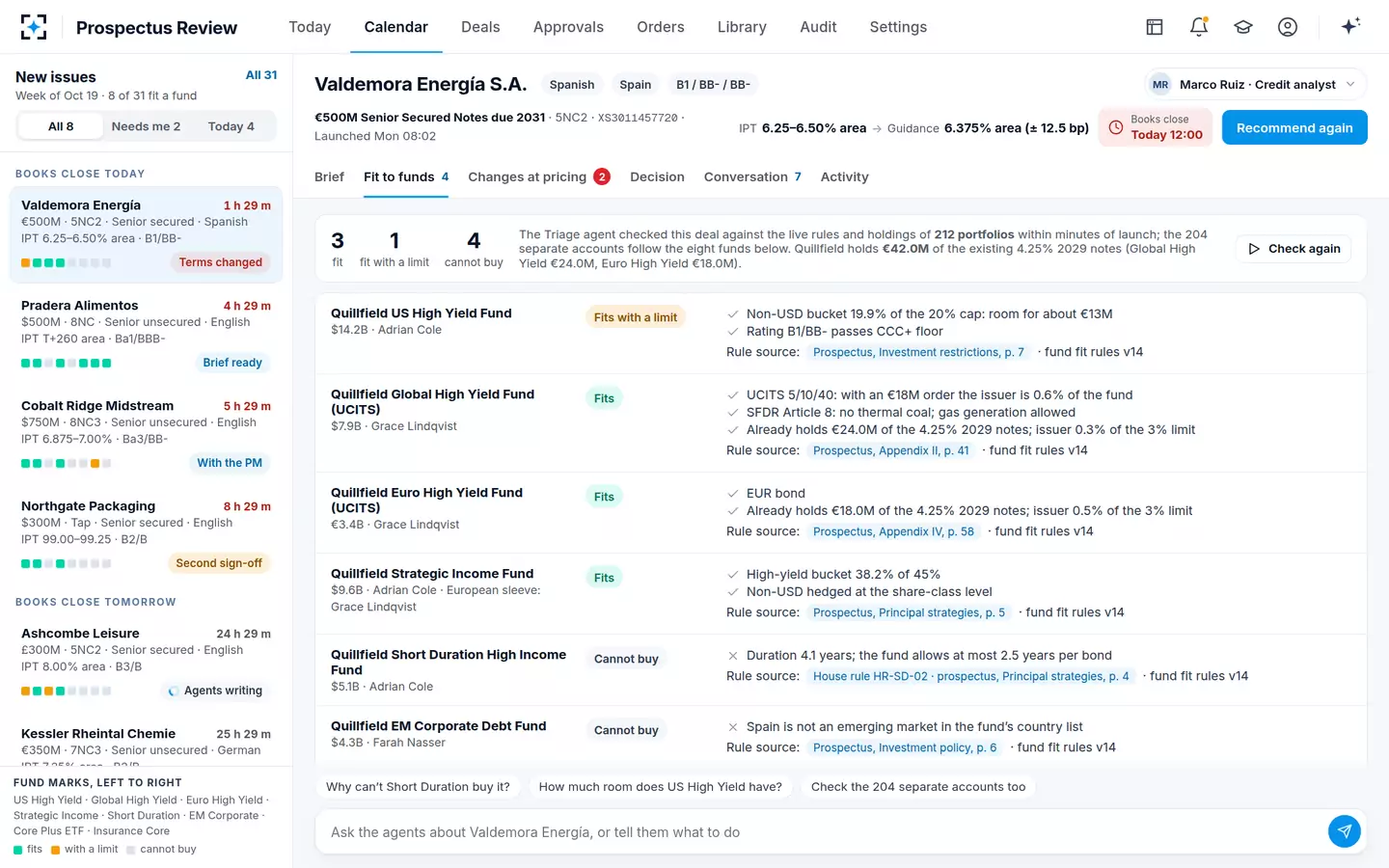
The sample deal shows why the fair-value step matters. For Valdemora Energía, a fictional Spanish generator, the Relative value agent put fair value at 6.20–6.40% against guidance of 6.375%: by our arithmetic, a concession of about 7.5 basis points at the middle of the range. Then a revised terms notice removed the change of control put, and fair value moved to 6.45–6.65%. At the same 6.375%, the concession became minus 17.5 basis points at the middle of the range. The yield on the page had not changed; the bond had.
Why do new bonds price at a discount?
Because the issuer and bookrunners need investors to do work, and pay for it. Cai, Helwege and Warga found that "underpricing occurs with seasoned debt issuers as well as debt IPOs and it is highest among riskier, unknown firms", and that "for firms that are not well known in the bond market ... underpricing arises as part of the bookbuilding process, when investment banks gather information about the bond offering" (Review of Financial Studies, 2007). The concession is partly a fee for reading.
Liquidity is the other half. A new bond's issuer pays for expected trading costs: Goldstein, Hotchkiss and Pedersen estimate that "a 10% increase in expected liquidity implies a decrease in the yield spread at issuance of between 8% and 14%" (Journal of Risk and Financial Management, 2019). And the gains are not shared evenly. Studying insurers' allocations from 2002 to 2014, Nikolova, Wang and Wu estimated first-day profits to allocated investors of about $41 billion, rising with investors' prior trading with the underwriters (Journal of Financial Economics, 2020); a later working paper using regulators' full TRACE data for 2010–2017 found that "secondary market illiquidity can drive gains from primary market allocations to far exceed underpricing" (Flanagan, Kedia and Zhou, SSRN working paper).
What the research says the concession is worth
$41B
estimated first-day profits to investors from US corporate bond allocations, 2002–2014 insurer data
2×
the usual concession, at more than 50 bp, on investment-grade deals in March 2020
8–14%
lower spread at issuance for a 10% rise in expected liquidity
What is a typical new issue concession?
There is no official series to quote. No regulator or independent study publishes a running measure of new issue concessions for high-yield bonds, and the dealer and vendor estimates that circulate are not public data. What the research supports is the shape: concessions are larger for lower-rated and less familiar issuers, larger in stressed markets — the New York Fed's "approximately double the usual" in March 2020 — and partly absorbed during bookbuilding: the first study of how corporate bond offering prices are updated found that underwriters open at a higher yield when uncertainty is greater, and that the update from initial price talk is smaller for lower-rated deals (Wang, Journal of Financial Economics, 2021).
The useful number is your own. A desk that records, for every launch it saw, the fair value at launch, the pricing yield and where the bond traded a week later has its own concession history by rating, sector and size — and a measure of what its unread deals were worth.
What is a negative new issue concession?
A new bond priced at a lower yield than its fair value: the buyer pays up. It happens when demand overwhelms supply, and it happens, less visibly, when terms change. The sample deal is an example of the second kind: priced at its guidance, it moved from a small positive concession to a negative one the moment the change of control put was removed, because the bond being sold was worth less than the one first described. A desk that compares every revised version with the preliminary sees that; one that compares only the yield does not. What changed at pricing walks through the comparison.
Is it better to buy bonds at issue or in the secondary market?
At issue, on average, if the desk can do the work in time; the research above is consistent on that. The new-issue window offers size that may never trade again in a thin secondary market, a concession that compensates for doing the reading, and an allocation that, the research suggests, rewards investors who participate consistently. The secondary market offers time, price discovery and the chance to buy after the first trades reveal demand, at the cost of the concession and often of size.
The trade-off flips when the reading cannot be done. Buying a new bond on the strength of a headline and IPT, without the description of notes, risks paying a concession for a bond whose terms were worse than assumed — the negative concession above. The secondary market, with its time to read, is then the safer place.
At issue or in the secondary market: what each gives and costs
| At issue | In the secondary market | |
|---|---|---|
| Price | Concession over the issuer's curve, usually positive | Market price; the concession has usually been traded away |
| Size | Allocation can be large, but is cut when the book is oversubscribed | Limited by what holders will sell; thin for small issues |
| Time to read | Hours, from launch to books close | As long as needed |
| Terms risk | Terms can change at pricing; must be compared | Terms fixed and public to holders |
| Information | Offering memorandum and bookrunner answers | Same documents plus trading history; for 144A bonds, public TRACE prints |
How many high-yield deals launch a week, and how many get read?
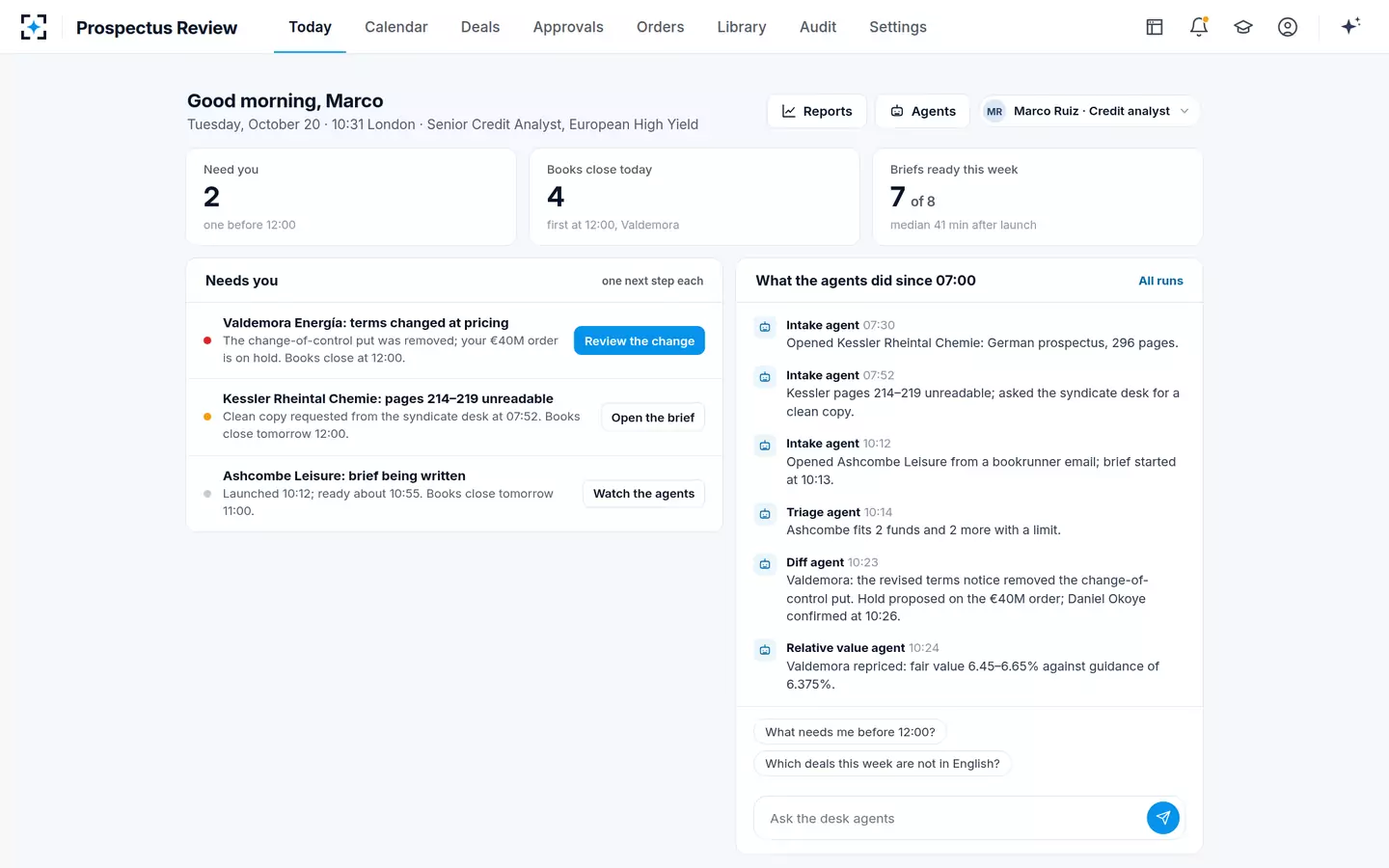
Enough that no desk reads them all by hand. The sample desk saw 31 launches in the week of 19 October; 8 fitted at least one of its 212 portfolios. With the agents checking fit first, the analysts had only those 8 to read, and cited notes were ready on 7 a median 41 minutes after launch, the eighth held up by unreadable pages. By our estimate a proper reading of one 300-page memorandum, with its one-page note, takes an analyst about six of the 11.5 hours a deal needs by hand from launch to pricing, so an analyst covering a sector gets through a handful of deals a week and reads the largest first.
One sample week of launches: what fitted, and what was read
Week of 19 October, 31 launches
- No fund could hold it · 74%
- Fitted a fund, note ready · 23%
- Fitted a fund, waiting on a clean copy · 3%
The size of the market makes the point. High-yield and unrated US corporate bonds outstanding stood at $1,772 billion at the end of 2025, up 4.7% in the year, according to the Federal Reserve (Financial Stability Report, May 2026). Each of those bonds was a new issue once, and on each a desk somewhere decided whether it had time to read it.
Every launch a fund can buy, with the books-close clock
The cost of the unread deal, and what to measure
The cost is the concession on every eligible deal the desk could not read in time, plus the cost of the deals it bought without reading closely enough to catch a weakened term. The first is visible in the illustration at the top: five unread deals with modest allocations and ordinary concessions add up to six figures in a week. The second shows up later, as a negative concession nobody priced.
Three measures make it concrete for a head of credit research. Count the eligible launches each week and the share with a cited note before guidance. Record the concession at pricing on deals bought and on deals skipped, against the desk's own fair value. And log every term that changed between the preliminary and the final memorandum, with whether it was seen before books closed. The design target for the solution is that every term change announced before books close is compared clause by clause and flagged; a pilot on last quarter's launches, scored on those measures, is set out in replay last quarter's launches before you buy. Why the smallest deals wait longest is mapped in initial price talk to books closed.
Fit to funds four minutes after launch: the list of deals worth reading
To see which of your own past launches went unread, and what they priced at, start from Prospectus Review.
Questions people ask
What is new issue premium?
Another name for the new issue concession: the extra yield a new bond offers over the issuer's existing bonds or its fair-value curve. Academic studies usually call it underpricing, because the bond is sold at a price below where it is expected to trade.
Why is the concession higher for high-yield bonds?
Because investors have more to learn and more to lose. Peer-reviewed research finds underpricing highest among riskier, less-known issuers and tied to the bookbuilding process, and the New York Fed notes that pricing concessions are typically higher for lower-rated issuers.
Does a covenant change at pricing affect the concession?
Yes, because it changes fair value without changing the yield. In the sample deal the removal of a change of control put moved fair value from 6.20–6.40% to 6.45–6.65% against an unchanged 6.375% guidance, turning a small positive concession into a negative one.
How do you measure a new issue concession after the fact?
Compare the re-offer yield with the bond's own yield after it starts trading, or with the issuer's curve at pricing. For US corporate bonds, including 144A bonds, TRACE trade prints give the after-issue prices; record your fair value at launch so the comparison is like for like.
Can a desk afford to read every deal?
By hand, rarely: our estimate is about 11.5 analyst hours for one properly read 300-page deal, from launch through pricing. Checking fit first removes most launches from the reading list; on the sample desk 23 of 31 fitted no fund.