EMMA alerts are the free email notifications the MSRB's Electronic Municipal Market Access website sends when something is posted about a municipal security you follow: you add a CUSIP, or a group of CUSIPs, to a MyEMMA profile, and EMMA tells you when official statements, continuing disclosure documents or other filings appear. They are the simplest way to track municipal disclosure, and they have one structural blind spot: an alert fires on a document that arrives, never on one that should have arrived and did not. A late annual report, past the date the obligor promised in its continuing disclosure agreement, is a credit signal in its own right, and an official statement that says the issuer complied with its continuing disclosure agreement when it did not is a second one. Botminds' Municipal Credit Analysis watches both: its Disclosure Watcher reads every filing for held obligors as it posts, compares each filing date with the obligor's own deadline, and checks each new official statement's compliance statement against the filing history before the bonds price.
The sample case on this page is fictional data from the solution: the City of Harlow Bend, Ohio, and its research analyst at Quillfield Capital. The rules and market figures come from the SEC, the MSRB and peer-reviewed research.
Municipal disclosure runs late, and the notices of lateness are few
209
days after year-end: the average for audited statements reaching EMMA in 2023, the longest on record
17.9%
of audited statement submissions from 2010 to 2023 came more than a year after year-end
3,744
failure-to-file notices submitted to the MSRB in 2023
71
issuers charged by the SEC for offering documents that misstated their disclosure compliance
How do EMMA alerts work?
EMMA alerts work per security or per group of securities, and you need a free MyEMMA profile to use them. The MSRB's guide describes the steps: enter a CUSIP in EMMA's search box to reach its security details page, add the security to your alerts, and "you are automatically subscribed to receive email notifications when primary market documents, continuing disclosure documents and variable rate security documents are posted". From the alerts dashboard you can choose which events trigger an alert for each security, "including the posting of certain disclosure documents to EMMA or the trading of that security", and to follow a portfolio, "click 'Create New Group' and enter or paste a list of CUSIP numbers" (MSRB, Using MyEMMA Alerts). The guide dates from 2016; the menu names may have changed since, but the model, a CUSIP list and a set of document types, has not.
For a fund, the practical setup is one group per portfolio or per analyst, loaded from holdings and refreshed when positions change. The MSRB's investor guide adds a related tool: on a security's page, an EMMA submission calculator shows the days between the issuer's fiscal period end and the posting of its first annual or audited filing for the year (MSRB, Using EMMA to Identify the Timing of Financial Disclosures).
What EMMA alerts cannot tell you
They cannot tell you that a filing is missing, because nothing has been posted to trigger them. They also cannot tell you whether a filing that did arrive was late, because EMMA knows when a document was posted but not when the obligor promised it. That date is in the continuing disclosure agreement, which differs from obligor to obligor.
Even EMMA's timing tool relies on the issuer. The MSRB notes that its submission calculator "relies on the period end date and disclosure category as reported by the issuer, and the MSRB takes no responsibility for independently verifying the accuracy of this information." A surveillance process that treats the absence of alerts as good news is treating silence as compliance. In the sample firm's book, the Disclosure Watcher counts 37 held obligors with late or missing annual reports in the last twelve months, 21 of them without a failure-to-file notice.
How late can a municipal annual report be?
As late as the obligor's own agreement allows, and then it is late. Rule 15c2-12 requires the continuing disclosure agreement to "specify the date on which the annual financial information for the preceding fiscal year will be provided" (17 CFR 240.15c2-12(b)(5)(ii)(C)). California's debt advisory commission describes that date as "not more than 1 year after the end of the fiscal year being reported" (CDIAC, California Debt Financing Guide). Within that limit, obligors choose, and they choose differently.
The deadlines obligors commit to: most choose 180 or 270 days
A 270-day deadline means a December year-end report can arrive in late September and be on time. That is why lateness has to be measured against each obligor's own date: the same filing day is on time for one credit and three months late for another. When the date passes, the rule requires a second filing: the agreement must provide, "in a timely manner, notice of a failure of any person ... to provide required annual financial information, on or before the date specified in the written agreement or contract" (17 CFR 240.15c2-12(b)(5)(i)(D)).
Municipal annual reports are getting later
The average delay has grown every year since 2018. The MSRB found that, excluding catch-up filings, audited financial statements reached EMMA an average of 201 calendar days after fiscal year-end from 2010 to 2023, and that "since 2018, these averages have incrementally increased from 197 days to 209 days in 2023, the highest since the MSRB began analyzing this information" (MSRB, May 2024).
Average days from fiscal year-end to audited statements on EMMA
Lateness costs investors more than patience. Studying bonds traded after EMMA's launch, Yulianti Abbas found "a significant lack of financial statement timeliness even after EMMA's establishment", and that "the closer the financial statement filing to the issuance of a new bond (postfiling delay), the lower the bond-price dispersion", an effect that held where small and large investors both traded (Public Budgeting & Finance, vol. 42, 2022). Stale information means wider disagreement about price, and the investors with the least access bear it.
What is a failure to file notice?
A failure to file notice is the filing an obligor makes on EMMA to say it has missed its own annual report deadline. The rule requires it "in a timely manner", without a fixed number of days. The SEC's count, from the MSRB's fact books, is 3,717 such notices in 2021, 3,579 in 2022 and 3,744 in 2023 (SEC, 2025), against more than 64,000 annual filings in each of those years.
The notice is useful when it exists and silent when it does not. An obligor that misses its deadline and also skips the notice leaves no trace on EMMA until the late report arrives, which is exactly the case EMMA alerts cannot catch. A failure notice that is filed can carry information too, such as when the report is expected. In the sample book, Emberfield Transit posted one on October 2 for a report 20 days overdue, with filing expected by November 30.
What the MCDC initiative found
The SEC's Municipalities Continuing Disclosure Cooperation initiative, announced in March 2014, showed how often offering documents misdescribed issuers' disclosure histories. Under it the SEC found that "from 2011 to 2014, the 71 issuers and obligated persons sold municipal bonds using offering documents that contained materially false statements or omissions about their compliance with continuing disclosure obligations"; in all it filed "143 actions against 144 respondents", including "72 municipal underwriting firms, comprising 96 percent of the market share for municipal underwritings" (SEC press release 2016-166). For underwriters, "the maximum penalty imposed is $500,000" (SEC press release 2015-220).
The initiative changed behaviour without fixing timeliness. The MSRB recorded a surge of catch-up filings: 28% of audited statement submissions in 2014 were more than a year late, against 10% in 2020. A study of 827 cities over seven years found that enforcement "has a significant impact on continuing disclosure compliance", but that "an increase in continuing disclosure compliance does not automatically increase continuing disclosure timeliness", noting that "no direct regulatory consequences exist for untimely disclosure" (Abbas and Johnson, Journal of Public Budgeting, Accounting & Financial Management, vol. 34, 2022). The check therefore falls to investors, at the moment it matters most: a new offering.
A late filing and an official statement: one sample case
Rule 15c2-12 requires a final official statement to describe "any instances in the previous five years in which each person ... failed to comply, in all material respects, with any previous undertakings" (17 CFR 240.15c2-12(f)(3)). The sample case shows how that statement and the filing history can disagree, and how little time there is to notice.
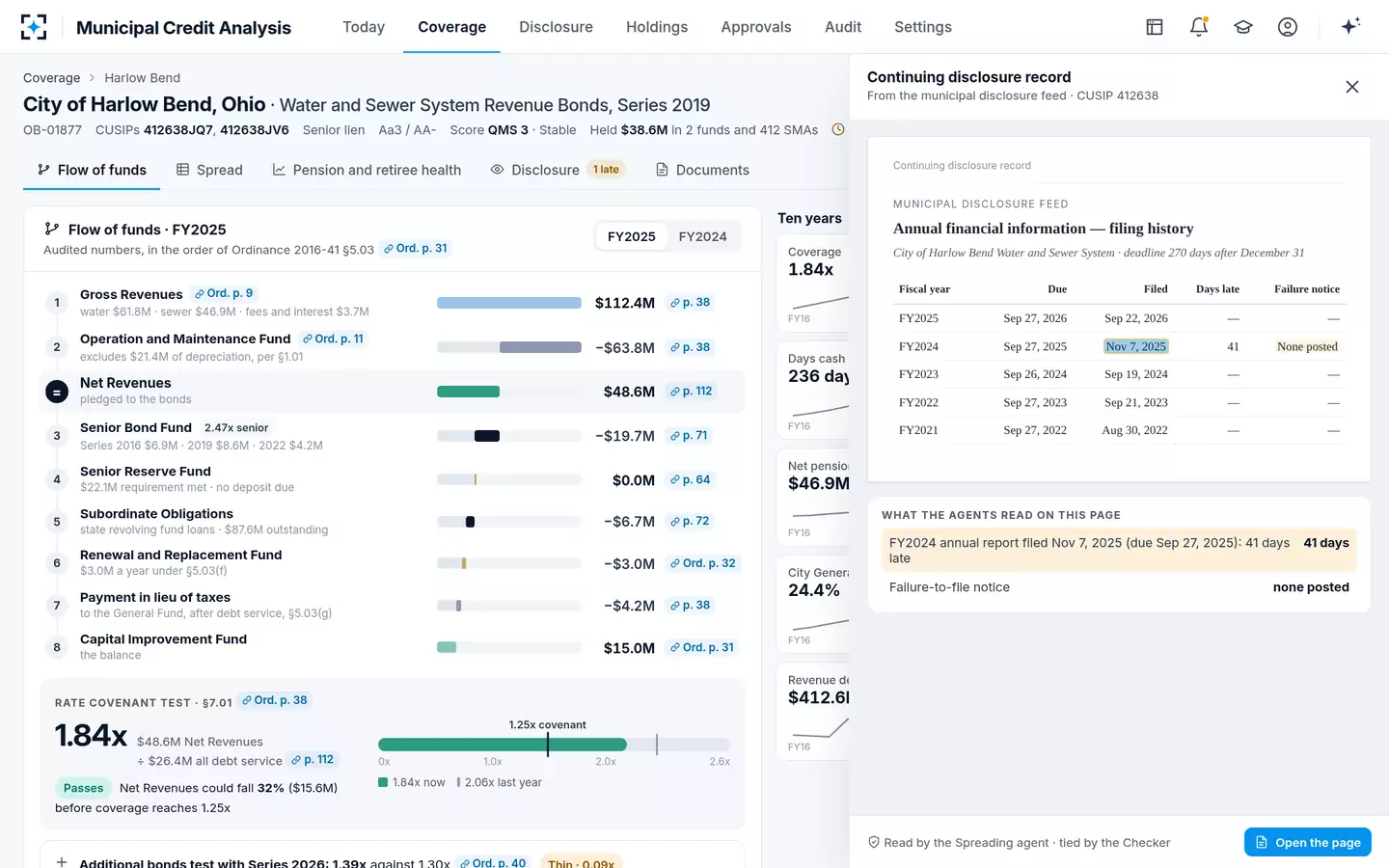
Harlow Bend's FY2024 report: 270 days allowed, 311 taken, no notice
- Within the 270-day deadline, to September 27, 2025270 d
- Late, no failure notice, to November 741 d
The facts are simple. The FY2024 report was due on September 27, 2025 and posted on November 7, 41 days late; no failure-to-file notice was posted. Eleven months later, the preliminary official statement for $92.5 million of Series 2026 bonds says the city "has complied in all material respects" with its undertakings in the past five years. The Disclosure Watcher put both pages in front of the analyst on October 20, a week before pricing.
What it did not do is decide. Whether a 41-day delay with no notice is material is a judgement, and the solution treats materiality as a proposal for the analyst. In the sample, the analyst kept the score at QMS 3, accepted the drafted move of the outlook to Negative, and added a line to her view: raise the disclosure statement with the underwriter before pricing on October 27. The Watcher never contacts an issuer or underwriter itself.
Five years of filings against the deadline the city agreed to
Building a deadline watch alongside EMMA alerts
A deadline watch adds the one thing alerts lack: the date each filing is due. Built by hand, it is a list of obligors, each with its continuing disclosure agreement's deadline, checked every day against what EMMA has received. The comparison below sets out what each approach reports.
EMMA alerts and a deadline watch: what each reports
EMMA alerts: A document posted for a followed CUSIP or group.
A deadline watch: A date passing without the document the agreement requires.
EMMA alerts: Reported only when it finally arrives, without saying it was late.
A deadline watch: Flagged the day after the deadline, whether or not a notice is filed.
EMMA alerts: Invisible.
A deadline watch: Visible: deadline passed, no report, no notice.
EMMA alerts: Reported when posted.
A deadline watch: Checked against five years of filing history before pricing.
EMMA alerts: A CUSIP list.
A deadline watch: A CUSIP list, the obligor map and each agreement's deadline.
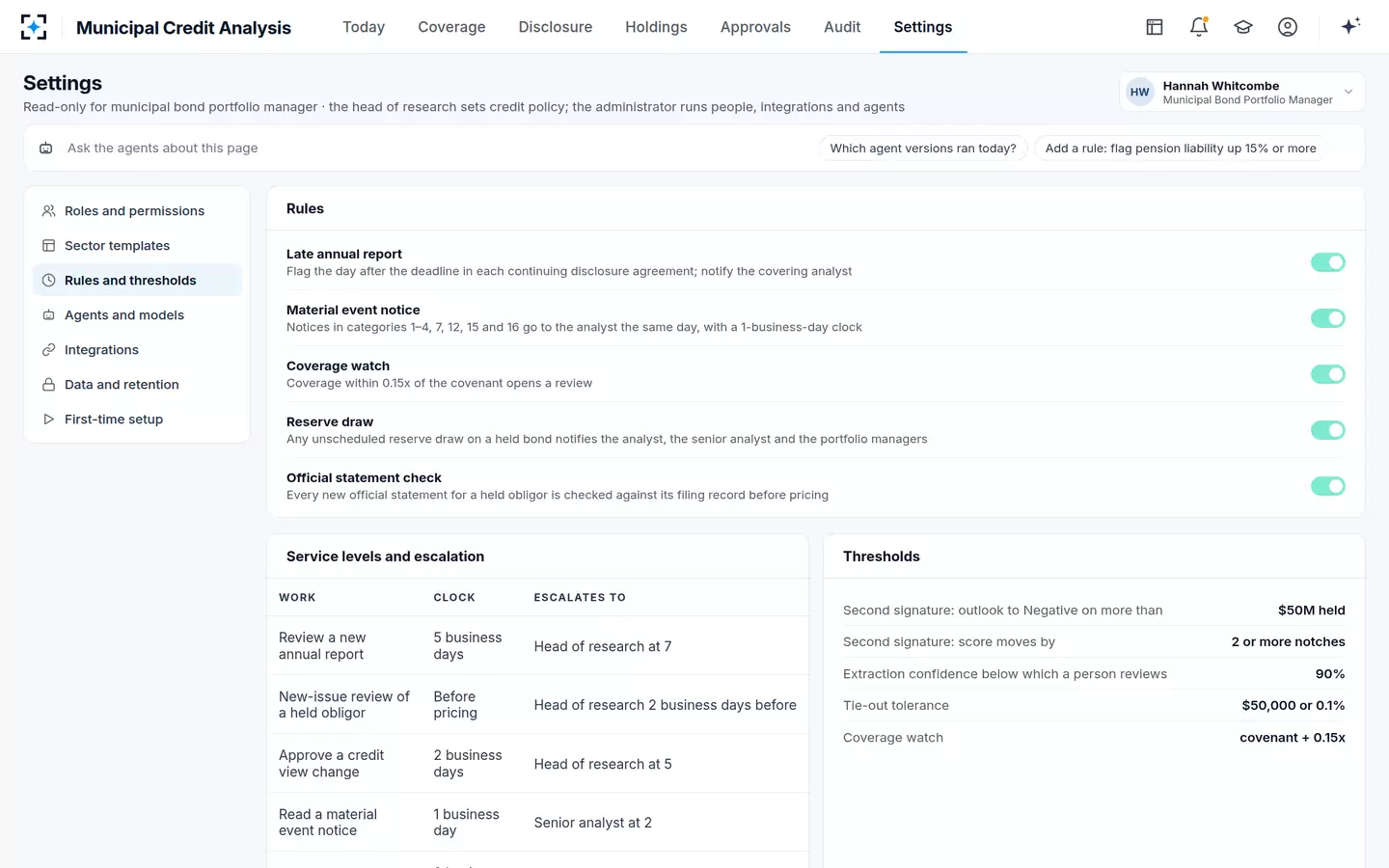
In Municipal Credit Analysis the watch is a rule the head of research sets: flag a late annual report "the day after the deadline in each continuing disclosure agreement" and notify the covering analyst, and check every new official statement for a held obligor against its filing history before pricing. Building the deadlines into an archive is covered in building your own ACFR data archive, and a missing report is only one kind of silence: a loan taken without a notice is another, covered in 15c2-12 financial obligation notices.
The watch as written rules: late reports, material notices, coverage and official statements
Questions people ask
What is EMMA MSRB?
EMMA, the Electronic Municipal Market Access website, is run by the Municipal Securities Rulemaking Board, a self-regulatory organization overseen by the SEC and Congress. It is the official repository for municipal disclosures, free to the public: official statements, annual financial filings, event notices and trade data, searchable by CUSIP and issuer.
Do EMMA alerts cost anything?
No. Alerts need a free MyEMMA profile; you add individual CUSIPs or paste a list into a group, and choose which postings trigger an email. The cost is in what the alerts leave to you: reading each document and knowing which deadlines have passed.
Can EMMA alert me to a missing filing?
Not directly. An alert needs a posting to trigger it, so a report that never arrives raises nothing; a failure-to-file notice raises an alert only if the obligor files one. Watching for missing filings needs each obligor's deadline from its continuing disclosure agreement.
What happens when an issuer misses continuing disclosure?
It must post a failure-to-file notice in a timely manner, and the lapse follows it: the next final official statement must describe failures to comply in all material respects over the previous five years. Researchers studying the MCDC initiative noted that no direct regulatory consequence attaches to untimely disclosure itself.
How do I track municipal disclosure filings for a whole portfolio?
Load the portfolio's CUSIPs into EMMA alert groups for postings, and keep a deadline list per obligor for what has not been posted. Municipal Credit Analysis does both for every held obligor, reading each filing as it posts to the disclosure feed.
Is a late filing always a bad sign?
No. Audits slip for reasons that have nothing to do with credit, and the market average is already about seven months. What makes lateness a signal is change and context: a credit that used to file early and now files late, a missing failure notice, or an offering document that does not mention it.