To read an ACFR (annual comprehensive financial report) for credit, read it in the order a credit view needs rather than the order it is printed: the auditor's opinion first, then the fund statements for this year's numbers, the notes for debt and pensions, and the statistical section for ten-year trends and coverage. The report itself can run to several hundred pages: the City of Houston's FY2025 ACFR is 362 pages long, and more than a third of its numbered pages are notes. Knowing where each number lives is most of the skill, because the sections follow the same order from city to city even when the layouts do not. Botminds' Municipal Credit Analysis works from that map: its Spreading agent reads each report into the research team's sector template, every value pinned to the page it came from, and its Checker ties the totals back before an analyst relies on them.
The map below uses Houston's FY2025 report as a public example, with its page numbers. The worked examples of what the agents read come from the solution's fictional sample credit, the City of Harlow Bend, Ohio, whose FY2025 report has 236 pages.
One large city's annual report, by the numbers
362
PDF pages in the City of Houston's FY2025 ACFR
111
numbered pages of notes to the financial statements, pages 43 to 153
28
schedule headings that read "Last Ten Fiscal Years", most of them in the statistical section
209
days after year-end, the average for audited statements reaching EMMA in 2023
What is an ACFR?
An ACFR is a state or local government's annual report: its audited basic financial statements, wrapped in an introductory section before them and supplementary and statistical information after. The Governmental Accounting Standards Board sets its content. Houston's report describes its own structure in three parts: an introductory section with "a transmittal letter, elected officials list, and organizational charts"; a financial section with management's discussion and analysis, the basic financial statements, fund statements and schedules and the auditor's report; and a statistical section that "presents multi-year financial, demographic, and other data" (City of Houston, FY2025 ACFR).
For a credit analyst the important distinction is what is audited. The basic financial statements and their notes carry the auditor's opinion. Management's discussion and analysis and the required supplementary information, including the pension schedules, are presented with the statements but marked unaudited, as is the statistical section. The numbers an analyst leans on most, ten-year coverage and debt ratios, come from that unaudited back section, which is why tying them to the audited statements is the first check.
What is the difference between a CAFR and an ACFR?
None in substance: they are the same report under an old and a new name. The GASB set the name in Statement No. 98, The Annual Comprehensive Financial Report, issued in October 2021 and effective for fiscal years ending after December 15, 2021 (GASB, pronouncements). Before that it was the comprehensive annual financial report, or CAFR.
The rename is visible in the regulators' own records. In 2018 the SEC described filings on EMMA "under the category of 'audited financial statements or CAFRs'" (SEC, 2018); by 2025 its count of the same filings used the MSRB's category "Audited Financial Statements or ACFR Submissions" (SEC, 2025). A search of older filings on EMMA, or of an issuer's website, should use both names.
The three sections, and how many pages each takes
The length is not evenly spread, and the distribution tells a reader where to spend time. In Houston's report, by the page ranges in its own table of contents, the notes and the individual fund schedules together take more than half the numbered pages, while the basic financial statements that most summaries quote take 27.
Where the pages go in a large city's ACFR
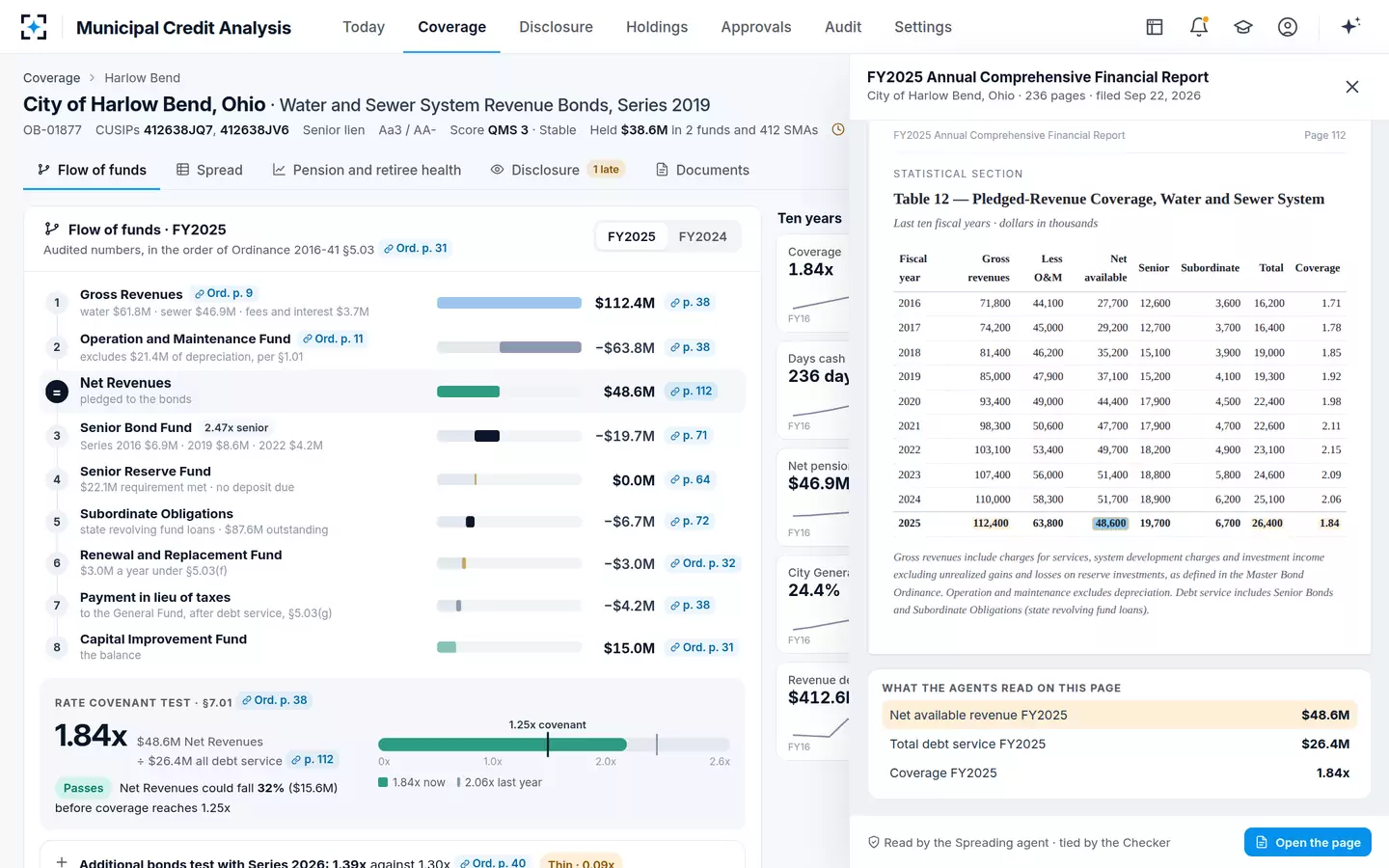
The Harlow Bend sample is smaller, 236 pages, but the same order holds. Its spread draws on the proprietary fund statement on page 38, the debt note on page 71, the reserve note on page 64, the pension note on pages 84 to 90 and the statistical section's coverage table on page 112. Each of those pages appears as a pin beside the value read from it.
Where each credit number lives
A credit view needs a few dozen numbers, and they come from a small number of places. The map below gives each one's place in a standard ACFR, Houston's page as an example, and what to watch when reading it.
The ACFR map: where each credit number sits, with Houston FY2025 as the example
| Number | Where it lives | Houston FY2025 | What to watch |
|---|---|---|---|
| Auditor's opinion | Independent auditor's report | p. 1 | Any modified opinion, emphasis of matter or going-concern language. |
| Unrestricted net position | Government-wide statement of net position | p. 16 | Read the trend, and which liabilities drive it. |
| General fund balance, unassigned | Balance sheet, governmental funds | p. 20 | Against expenditures and against the issuer's own policy minimum. |
| General fund revenues and expenditures | Statement of revenues, expenditures and changes in fund balances | p. 22 | One-time transfers that balance the year. |
| Enterprise revenues, O&M, depreciation | Proprietary fund statement of revenues, expenses and changes in net position | p. 28 | The starting point for coverage, never the coverage itself. |
| Enterprise cash and investments | Proprietary fund statement of net position; cash flow statement | pp. 26, 29 | Restricted versus unrestricted cash, for days cash on hand. |
| Debt outstanding, maturities, debt service | Long-term debt note | Notes | Direct borrowings and direct placements, shown separately since GASB 88. |
| Net pension liability, discount rate, sensitivity | Pension note; required supplementary information | pp. 160–169 | Discount rate changes and the plan's funded ratio. |
| Retiree health (OPEB) liability | OPEB note; required supplementary information | pp. 170–172 | Whether it is funded at all. |
| Budget versus actual | Required supplementary information | p. 154 | Variances the explanation leaves out. |
| Debt ratios and legal debt margin | Statistical section, debt capacity | pp. 265–272 | Ten-year direction, not one year's level. |
| Pledged-revenue coverage | Statistical section, debt capacity | p. 273 | Whether it is computed on the bond documents' definitions. |
| Tax base, top taxpayers, collections | Statistical section, revenue capacity | pp. 259–264, 269 | Concentration in a few taxpayers. |
| Population, income, employers | Statistical section, demographic and economic | pp. 274–277 | The trend behind the revenue base. |
Where is debt service in an ACFR?
In three places, each with a different job. The long-term debt note gives what is owed: each issue, its rate, its maturities and the schedule of principal and interest by year, now with direct borrowings and direct placements shown separately under GASB Statement No. 88. The fund statements show what was paid in the year. The statistical section's pledged-revenue coverage schedule sets the year's debt service against the revenues pledged to it, for ten years.
The coverage schedule is the one to read first and trust last. Houston's, on page 273, gives net pledged revenue, principal, interest and coverage for its airport, utility and convention center debt; a separate utility table on page 288 shows the coverage "under Master Ordinance", with its own definitions of revenues and expenses. Coverage is only meaningful on the bond documents' definitions, which a schedule may or may not use; the difference, on Houston's own numbers, is set out in the rate covenant guide.
The statistical section's coverage table, opened from the number read from it
How to find fund balance in an ACFR
Fund balance is on the balance sheet for governmental funds, near the front of the fund statements, broken into categories by how freely it can be spent. Houston's note defines "Committed" as usable only "for specific purposes pursuant to constraints imposed by ordinance of the City Council", "Assigned" as intended for specific purposes without meeting those tests, and "Unassigned" as "residual net resources as a positive balance within the general fund only". Unassigned general fund balance is the number most analysts use for liquidity.
The useful ratio is fund balance over expenditures, and the issuer's management discussion often gives it. Houston's MD&A reports unassigned general fund balance of $527.1 million at the end of FY2025, "approximately 16.0% of total general fund expenditures", and total general fund balance of $576.5 million, 17.5%. The notes give the yardstick: the city's "desired minimum unassigned fund balance for any given fiscal year is 7.5% of General Fund expenditures", excluding debt service and pay-as-you-go capital transfers (City of Houston, FY2025 ACFR). A fund balance ratio means most against the issuer's own policy.
Where is net pension liability in an ACFR?
In the pension note, with ten-year history in the required supplementary information that follows the notes. The standards behind them are GASB Statement No. 68, Accounting and Financial Reporting for Pensions, issued in June 2012 and effective for fiscal years beginning after June 15, 2014, and Statement No. 75, Accounting and Financial Reporting for Postemployment Benefits Other Than Pensions, issued in June 2015 and effective for fiscal years beginning after June 15, 2017 (GASB, pronouncements). Houston's pension schedules run from page 160 and its retiree health schedules from page 170.
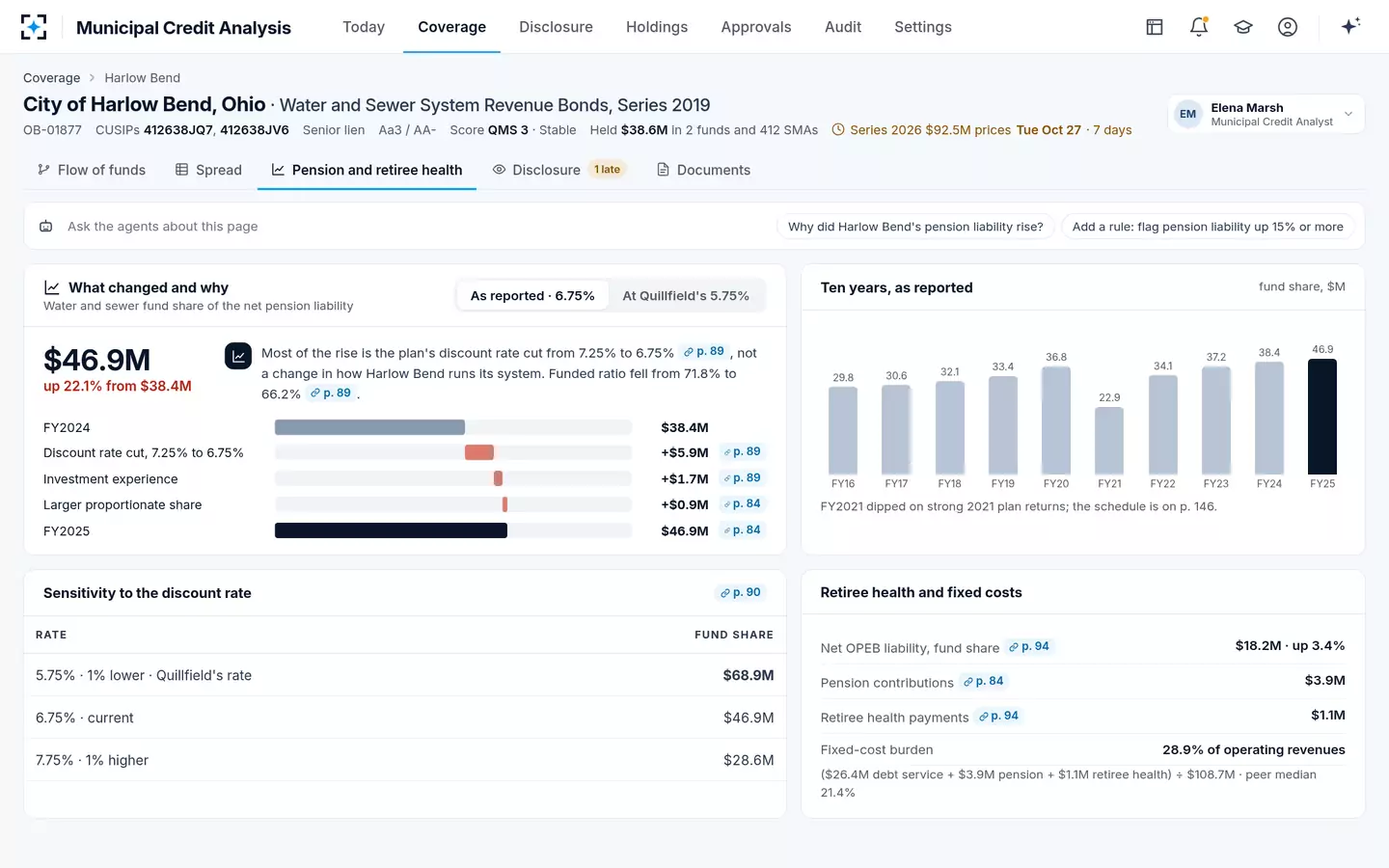
The note's most important number is often not the liability but the discount rate, and the sensitivity table beside it. In the fictional sample credit, the water and sewer fund's share of net pension liability rose 22.1%, from $38.4 million to $46.9 million. The Pension agent split the $8.5 million rise: $5.9 million from the plan cutting its discount rate from 7.25% to 6.75%, $1.7 million from investment experience and $0.9 million from a larger proportionate share. At the fund manager's own 5.75% rate, labelled as such, the liability would be $68.9 million.
Why the pension liability moved, split by cause and restated at the house rate
What is the statistical section of an ACFR?
The statistical section is the ACFR's last part: multi-year schedules, unaudited, that put the year's statements into context. The standard behind it is GASB Statement No. 44, Economic Condition Reporting: The Statistical Section, issued in May 2004. Houston's introduces itself as presenting "detailed information as a context for understanding what the information in the financial statements, note disclosures, and required supplementary information says about the City's overall financial health", in five groups: financial trends, revenue capacity, debt capacity, demographic and economic information, and operating information.
For a credit analyst it is the most efficient part of the report. Debt capacity schedules, which in Houston's words "help the reader assess the affordability of the City's current levels of outstanding debt and the City's ability to issue additional debt in the future", hold coverage and debt ratios for ten years. Operating information for a utility includes customers and consumption. One report's statistical section gives a decade of trend, which is why it is the fastest way to backfill an ACFR data archive.
How long after year end is an ACFR published?
About seven months on average, and the average is getting longer. The MSRB found that, excluding catch-up filings, audited financial statements reached EMMA an average of 201 days after fiscal year-end from 2010 to 2023, rising from 197 days in 2018 to 209 in 2023; of those filed within a year, only 2.7% arrived within 90 days and 15.4% after 270 days (MSRB, May 2024).
From fiscal year-end to a credit view: the sample credit's FY2025 report
- Audit and preparation, to filing on September 22, 2026265 d
- Average days from year-end to EMMA209 d
Two consequences follow for reading. First, an ACFR is old news on arrival: a December year-end report posted in September describes conditions eight or nine months earlier, so the analyst reads it alongside event notices and budget documents filed since. Second, the format is changing under the reader's feet. GASB Statement No. 103, effective for fiscal years beginning after June 15, 2025, limits management's discussion and analysis to five sections, requires unusual or infrequent items to be shown separately and moves budgetary comparisons into required supplementary information (GASB, Statement No. 103). A template mapped to last year's layout needs checking against the first reports filed under it.
Questions people ask
What is the first thing to read in an ACFR?
The independent auditor's report, a few pages at the start of the financial section. A modified opinion, an emphasis of matter or going-concern language changes how every number after it should be read; a clean opinion means the basic statements can be used as the base for the rest.
Is the statistical section audited?
No. Houston's, like most, is marked unaudited, as are management's discussion and analysis and the required supplementary information. That is why an analyst ties the statistical section's figures, coverage above all, to the audited statements before relying on them.
How many pages is an ACFR?
It depends on the government. Houston's FY2025 report runs to 362 PDF pages; the fictional sample city in this guide files 236. Much of any report's length is notes and fund-by-fund schedules, which in Houston's case take more than half of its numbered pages.
Where is the fund balance ratio in an ACFR?
Often in management's discussion and analysis, which may compare unassigned and total general fund balance with general fund expenditures, as Houston's does (16.0% and 17.5% for FY2025). Otherwise compute it from the governmental funds balance sheet and the statement of revenues, expenditures and changes in fund balances.
Can software read an ACFR reliably?
It can if every value it reports is pinned to its page and its totals are tied to the audited statements. In the sample credit the Spreading agent read 214 values from 236 pages; the Checker tied 212 and explained the other two, and a value it cannot tie stops the spread until a person releases it.
What changed with GASB 103?
From fiscal years beginning after June 15, 2025, management's discussion and analysis is limited to five sections, unusual or infrequent items are shown separately, proprietary funds use defined operating and nonoperating categories with a new subtotal, and budget comparisons move to required supplementary information.