An additional bonds test is the condition in a revenue bond resolution that an issuer must meet before it may issue new bonds on parity with the outstanding ones: typically, that net revenues, measured over a past period or projected for future years, cover maximum annual debt service including the new bonds by a stated multiple, such as 1.30 times. It protects existing holders from having their pledged revenues shared with new debt the system cannot afford. The pass or fail is the least of it. How close the result sits to the line, and whether it rests on audited results or on rate increases not yet collected, decides how much the new issue dilutes the old. Botminds' Municipal Credit Analysis tests the additional bonds test on audited numbers, shows any pro forma figure separately with the section that permits it, and puts the headroom in front of the analyst before the new bonds price.
The worked example is the solution's fictional sample credit: the City of Harlow Bend, Ohio, bringing $92.5 million of Series 2026 water and sewer bonds on parity with its Series 2019 bonds. The definitions and practice come from the California Debt and Investment Advisory Commission and Rule 15c2-12.
One new issue, three readings of the same additional bonds test
1.39x
on audited FY2025 net revenues, against a 1.30x test: passes, thinly
1.52x
in the official statement, adding a rate increase not yet collected
0.09x
of headroom on the audited figure: net revenues can fall about 6% before it fails
What is an additional bonds test?
California's debt advisory commission defines the additional bonds test, or additional bonds covenant, as "the financial test that must be satisfied under agreements securing outstanding revenue bonds or other types of municipal debt as a condition to issuing additional bonds or incurring additional debt" (CDIAC, California Debt Financing Guide). It sits in the bond resolution or indenture beside the rate covenant, and it applies each time the issuer wants to add debt at the same lien.
The test exists to balance two interests, in the commission's words: "investors' interest in not having revenues and assets securing the debt they hold be used to pay other debt and the public agency's need to be able to borrow on favorable terms to meet future needs." A system that will have to borrow again needs room to do it; its existing bondholders need to know the room has a floor.
How does an additional bonds test protect bondholders?
By making new parity debt prove it can be carried before it shares the pledge. Parity, in the same guide's definition, means "obligations secured on an equal basis by a pledge of revenues or an asset or pool of assets". Every dollar of new parity debt service is paid from the same net revenues as the old, so coverage for existing holders falls the moment the new bonds are issued, and the test sets how far. Corporate bonds do the same job with a ratio test on new debt, explained in high yield bond covenants, basket by basket.
The test usually reaches beyond arithmetic. The California guide notes that the issuer "must generally confirm that it is not in default on outstanding debt", and that the requirements vary with the priority of the new debt, "with the public agency allowed significantly greater flexibility if the new debt will be subordinate to the existing debt". That flexibility is why the lien of each new loan matters as much as its size, a point developed in the guide to 15c2-12 financial obligation notices.
Historical vs projected: which additional bonds test applies?
Whichever the resolution writes, and many write both. A historical test uses audited results for a recent period; a projected test uses forecast results for future years. The California guide observes that additional debt tests "may be based entirely on historical results but are generally expressed in terms of projected future performance (e.g., an ability to meet the issuer's rate covenant over the following 5 fiscal years)", and gives an example built on "net revenues over a 12-consecutive-month period, current enacted rates, and the new project and related costs".
Historical and projected additional bonds tests: what each measures, and what each can hide
Historical test: Audited net revenues for a recent fiscal year or twelve consecutive months.
Projected test: Forecast net revenues for future years, often several.
Historical test: Only what was collected in the period.
Projected test: May include adopted or planned increases, as the resolution allows.
Historical test: The auditor, for the underlying statements.
Projected test: Often an independent consultant's report, if the resolution requires one.
Historical test: Verifiable from the ACFR.
Projected test: Reflects the system that will exist when the new debt is paid.
Historical test: Can understate a system that has just raised rates.
Projected test: Rests on assumptions about demand, rates and costs that may not hold.
Can rate increases count in an additional bonds test?
If the resolution says they can, and on its terms. The California guide lists the assumptions a forward-looking test must settle, starting with "May planned but not adopted rate increases be included?" and ending with "Must the reasonableness of assumptions be supported by a report from an independent consultant?" It adds questions on "highly variable revenue sources", the interest assumed on variable-rate debt, whether bullet maturities may be assumed refinanced, and whether calculations must reflect credit or liquidity facilities that might be drawn.
The sample credit turns on exactly this. Harlow Bend's ordinance, section 7.03, sets a 1.30 times test on maximum annual debt service. On audited FY2025 net revenues of $48.6 million against $35.0 million of maximum annual debt service including the Series 2026 bonds, the result is 1.39 times. The preliminary official statement shows 1.52 times by adding $4.6 million from a rate increase effective July 2026. Section 7.03(b) allows that only with a consultant's certificate, and Appendix C provides one. Both numbers are valid under the ordinance; they answer different questions.
One test, three answers: 1.39x, 1.52x and 1.27x
The same new issue can be read three ways, and an analyst should see all three before deciding what it does to existing holders. The audited test asks whether the system as it is can carry the new debt. The pro forma test asks whether it can once the rate increase is collected. And a stress asks what happens to the covenant that governs every year after the bonds are issued, the rate covenant, if revenues disappoint.
Harlow Bend's Series 2026, measured three ways against its two lines, with today's coverage for scale
The arithmetic behind each reading
| Reading | Numerator | Denominator | Result | Against |
|---|---|---|---|---|
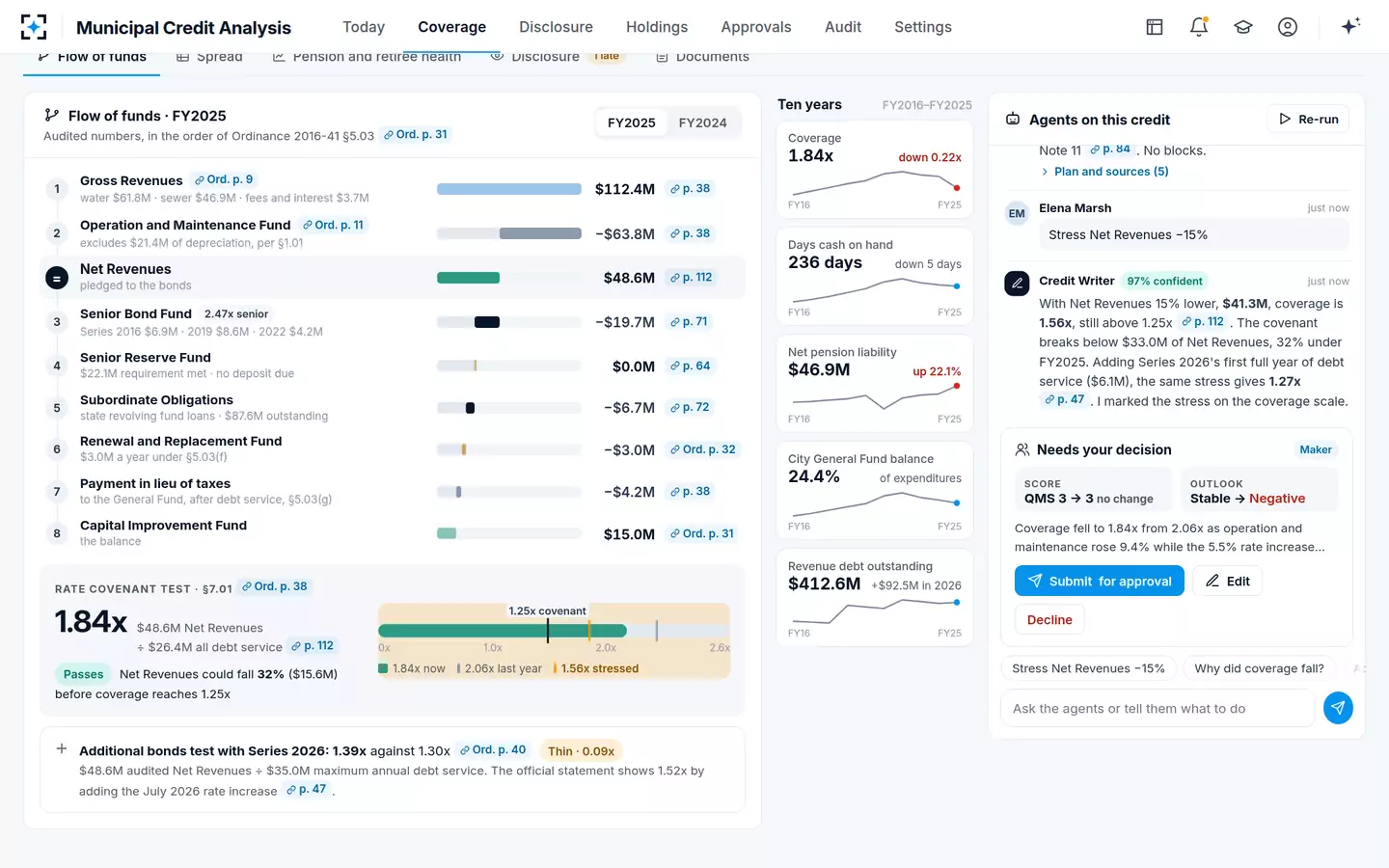
| Rate covenant today | Net revenues FY2025, $48.6M | All debt service FY2025, $26.4M | 1.84x | 1.25x: net revenues could fall 32% |
| Additional bonds test, audited | Net revenues FY2025, $48.6M | Maximum annual debt service with Series 2026, $35.0M | 1.39x | 1.30x: headroom 0.09x |
| Additional bonds test, pro forma | $48.6M + $4.6M rate increase = $53.2M | $35.0M | 1.52x | 1.30x: headroom 0.22x |
| Stress after issue | Net revenues 15% lower, $41.3M | $26.4M + $6.1M = $32.5M | 1.27x | 1.25x: still passes, by 0.02x |
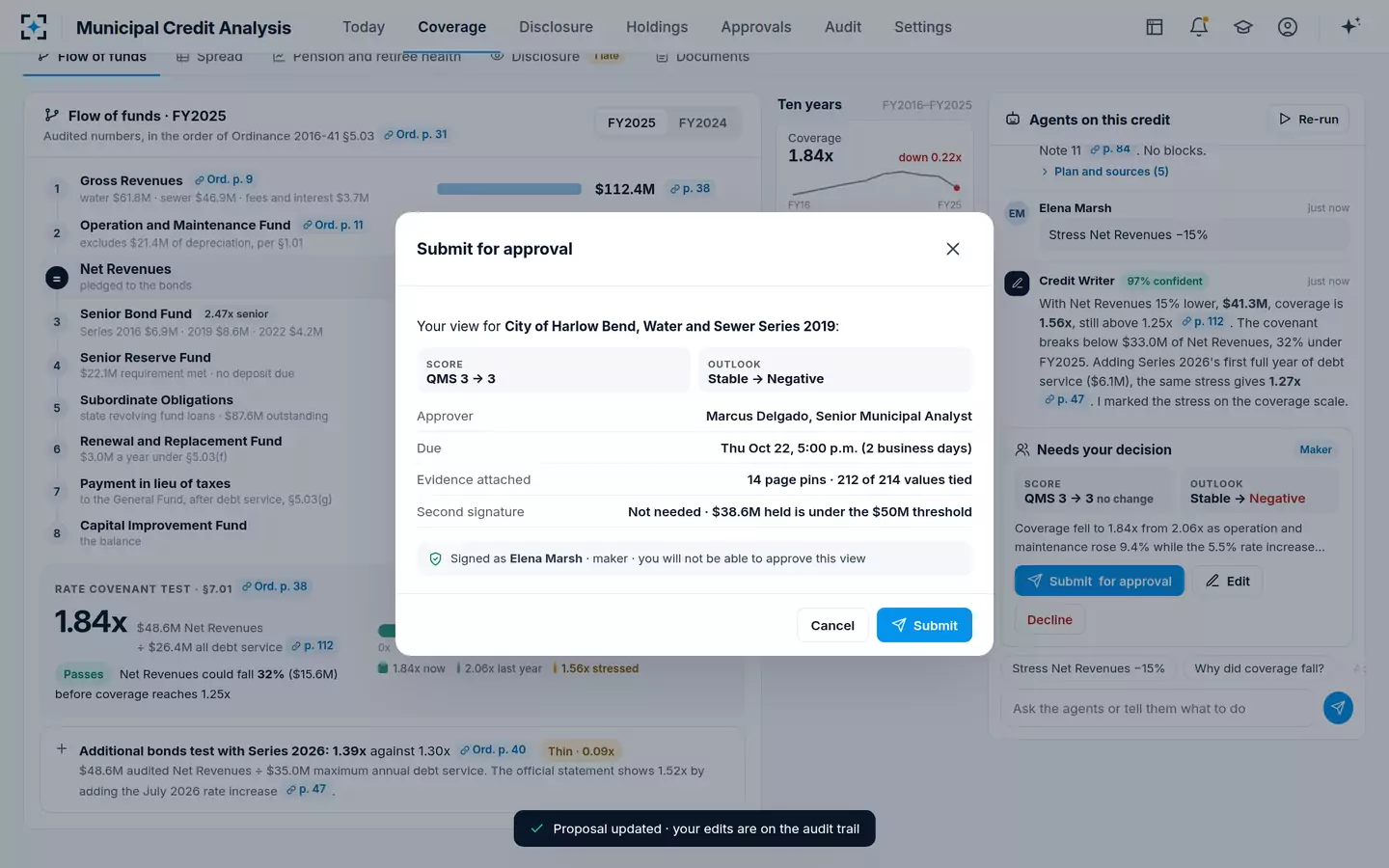
Read together, the numbers tell a coherent story. Today's coverage is comfortable at 1.84 times. The new issue clears its own hurdle only thinly on what the system actually earned, comfortably only on revenue it has not yet collected. And a 15% fall in net revenues after the issue would leave the rate covenant intact by two hundredths. That is a credit worth a closer look, not a failure, and it is why the sample analyst's drafted view kept the score but moved the outlook to Negative.
The analyst asks for a stress; the answer, the scale and the additional bonds test on one screen
What is maximum annual debt service?
Maximum annual debt service is the largest total of principal and interest due in any single future year on the debt being tested, and it is a common denominator of an additional bonds test, as in the sample credit's ordinance, because it measures the heaviest year the revenues will have to carry. Debt service schedules are rarely level: a new issue layered onto old ones can create a peak years out. Testing against the peak rather than next year's payment keeps an issuer from passing on a light year.
The same measure often sizes the reserve. The California guide notes that when one reserve fund secures several series, "maximum annual debt service on all of the bonds is generally less than the sum of maximum annual debt on each series", which is one reason issuers pool reserves. In the sample credit, maximum annual debt service including Series 2026 is $35.0 million, about a third higher than FY2025's $26.4 million of debt service on all liens.
How much room is enough?
No regulator or independent study publishes a standard margin over an additional bonds test, so the answer is a policy each research team sets and writes down. The useful way to state it is in revenue, not ratio: how far can net revenues fall before the test would fail? On the sample's audited figures, 1.30 times $35.0 million is $45.5 million, so net revenues can fall $3.1 million, 6.4%, before the test fails. On the pro forma figures, the cushion is $7.7 million, 14.5%, but it depends on collecting the increase.
Compare that with the rate covenant's 32% headroom on the same system and the asymmetry is plain: the issue is far closer to its additional bonds test than the system is to its rate covenant. The sample firm's coverage watch opens a review whenever coverage comes within 0.15 times of a covenant; at 0.09 times, the additional bonds test is inside that band. How the rate covenant itself should be computed is set out in the rate covenant guide, and where the new debt service sits in the order of payment in the flow of funds guide.
The view goes to a second analyst with the thin test in plain sight
What is a debt service reserve fund?
A debt service reserve fund is cash or a surety held by the trustee to pay debt service if revenues fall short. The California guide explains that "the bond trustee may draw upon the debt service reserve fund if other funds are not available to pay debt service", and that if a draw or a fall in investment value leaves it below its requirement, the issuer is "generally obligated to 'replenish'" it from amounts left after debt service. A new parity issue usually raises the requirement: with a common reserve, "the amount held in the reserve fund must be increased if necessary to meet the new reserve fund requirement".
For investors, a draw is news. Rule 15c2-12 lists "unscheduled draws on debt service reserves reflecting financial difficulties" among the events an issuer undertakes to notice within ten business days (17 CFR 240.15c2-12(b)(5)(i)(C)(3)). In the sample book, a fictional port's $2.1 million draw after its terminal operator stopped paying rent reached the analyst the day it posted. Harlow Bend's own reserve, a $22.1 million requirement, was fully funded with no deposit due.
Checking the additional bonds test certificate
Before a parity issue, the issuer delivers the calculation the resolution requires, and the official statement summarises it. Reading it against the resolution takes less time than reading the whole document, and it is the check most likely to change a view before pricing.
Eight checks on an additional bonds test before the new bonds price
- Which test, which section?
Historical, projected or both, and the multiple, from the resolution itself, not the official statement's summary.
- Which period?
The fiscal year or twelve months the resolution allows, and whether it is audited.
- Which revenues?
The resolution's definition of net revenues, the same one the rate covenant uses.
- Rate increases: adopted, collected or planned?
And whether the resolution allows each kind, and on whose certificate.
- Whose report?
If a consultant is required, read its assumptions on demand, costs and rates.
- All parity debt in the denominator
Including loans and direct placements on the same lien, and the new bonds' peak year.
- Variable-rate and bullet assumptions
The interest assumed on variable-rate debt and whether bullets are assumed refinanced.
- Headroom in dollars
How far net revenues can fall, audited and pro forma, before each line is crossed.
Questions people ask
What coverage is required for parity bonds?
Whatever the resolution sets; there is no standard multiple. The sample credit's ordinance requires 1.30 times maximum annual debt service, above its 1.25 times rate covenant. A team should read the number from each resolution rather than assume one.
What is parity debt in municipal bonds?
Debt secured equally with outstanding bonds by the same pledge of revenues, paid at the same step of the flow of funds. Parity debt dilutes existing holders' claim on those revenues, which is what the additional bonds test is there to limit.
Is the additional bonds test the same as the rate covenant?
No. The rate covenant is an annual promise to set rates high enough to cover debt service by a multiple; the additional bonds test is a one-time hurdle each new parity issue must clear. The California guide notes that additional debt tests "generally require projected satisfaction of the issuer's rate covenant in future years", which links them.
What happens if an issuer cannot pass the additional bonds test?
It cannot issue the new debt on parity under that resolution. It may raise rates first, borrow at a subordinate lien where the resolution allows more flexibility, or use other security; each changes what existing holders are exposed to, and each is worth reading in the official statement.
Who certifies an additional bonds test?
Whoever the resolution names. A projected test may require an independent consultant's report, one of the assumptions the California guide lists for forward-looking tests. In the sample credit the pro forma result rests on a consultant's certificate in Appendix C of the official statement, as section 7.03(b) requires.
Why do revenue bonds have an additional bonds test?
Because systems that borrow repeatedly need a rule for sharing the pledge. The California guide notes that "the ability to incur future debt payable from revenues at the same priority level as existing debt is important to revenue bond issuers", and the test is the price of that ability. Water and sewer facilities alone accounted for $46.1 billion of tax-exempt municipal issuance in 2025, by the MSRB's count (MSRB, Municipal Market Facts).