A municipal credit analyst decides whether a state or local borrower can keep paying its bonds: a city's general obligation debt, a water system's revenue bonds, a school district, a toll road, a hospital behind a conduit issue. The work is reading annual comprehensive financial reports (ACFRs), bond resolutions, official statements and event notices, rebuilding debt service coverage the way each resolution defines it, and writing a view a portfolio manager can act on. What makes the job hard is the count. In the fictional research team used on this page, eight analysts cover 4,012 obligors, about 500 each, most of them small issuers filing on their own deadlines in their own layouts, so the largest holdings get a full review and the rest get a glance. Botminds' Municipal Credit Analysis exists to change that arithmetic: its agents read, spread and check every filing for every held obligor, and the analyst's hours go to questioning the numbers and signing the view.
The examples come from the solution's sample data: Quillfield Capital, a fictional fund manager, and its analyst Elena Marsh, whose book includes the fictional City of Harlow Bend, Ohio. Market figures come from the Census Bureau, the Federal Reserve, the Municipal Securities Rulemaking Board (MSRB) and the SEC, linked where they appear.
The municipal market an analyst covers, in four public numbers
91,438
local governments in the United States in 2025, including 40,199 special districts
28,000
issuers the SEC estimates are bound by continuing disclosure agreements
62%
of 2025 tax-exempt issues were $25 million or smaller
$4.41T
of municipal securities outstanding at the end of 2025
What does a municipal credit analyst do?
A municipal credit analyst keeps an internal view of each obligor's ability to pay and tells the portfolio managers what that view allows them to buy. At a fund manager the view is usually a score and an outlook on the firm's own scale, and it feeds the approved list and the limits that the order management system enforces. The ratings agencies publish their own opinions, but a fund that owns thousands of bonds cannot simply inherit them: the analyst is paid to know more, sooner, and to explain any gap between the house view and the agencies', the discipline shadow rating: when your view and the agencies' split describes for corporate issuers.
The research is clear that ratings still move prices, which is why the internal view has to be independent of them. Studying Moody's 2010 recalibration of its municipal scale, which changed ratings without any change in the issuers, Cornaggia, Cornaggia and Israelsen found "that ratings still matter to investors and to issuers" and called for better disclosure "to mitigate mechanistic reliance on ratings" (Review of Financial Studies, 2018). A research team that copies the agency's letter adds nothing to it.
In practice the year has four kinds of work. The annual review starts when an obligor's ACFR posts to the MSRB's Electronic Municipal Market Access (EMMA) website: spread the statements into the sector template, rebuild coverage from the bond resolution, read the pension and retiree health notes, and confirm or change the view. New-issue reviews start when a held obligor's preliminary official statement appears, with a pricing date as the deadline. Surveillance runs in between, on event notices, rating changes and missed filing deadlines. And the analyst writes, because a view nobody can trace back to its evidence will not survive the senior analyst who signs it.
How many credits does a muni analyst cover?
No regulator or independent study publishes a standard number of credits per municipal analyst, so the honest answer is arithmetic: obligors held, divided by analysts, multiplied by the hours a real review takes. In the sample team, 4,012 obligors and eight analysts give roughly 500 each. Elena Marsh covers 486, and 61 annual reports arrived in her book in October alone.
The product data estimates a full review of one revenue bond obligor, done by hand, at 7.0 hours: half an hour to notice the filing and check it against the disclosure agreement, three hours to spread the ACFR into the template, an hour and a half to read the resolution and rebuild coverage, an hour on the pension and retiree health notes, and an hour to write the view and take it through review. Multiply by 486 and the book needs 3,402 hours a year. At 40 hours a week for 48 weeks, our assumption, an analyst has 1,920.
Where one full review's hours go, by hand and with the agents
By hand · 7.0 hours per obligor
- Noticing the filing and spreading the ACFR · 50%
- Reading the resolution, rebuilding coverage · 22%
- Pension and retiree health notes · 14%
- Writing the view and senior review · 14%
With the agents · 1.2 hours per obligor
- Noticing the filing and spreading the ACFR · 25%
- Reading the resolution, rebuilding coverage · 21%
- Pension and retiree health notes · 12%
- Writing the view and senior review · 42%
The arithmetic decides the job before any judgement does. A 486-obligor book cannot be read in full by one person at 7.0 hours a credit; it can at 1.2, which is 583 hours a year, with room left for the new issues and the surveillance. So the real question about a municipal credit analyst is not how many names they cover but how many they cover properly, and the honest answer at most desks is: the big ones.
How many municipal issuers are there?
There are more municipal borrowers than any other kind of bond issuer in the United States, and most of them are small. The Census Bureau counted 91,438 local governments in 2025: 3,031 counties, 19,489 municipalities, 16,184 townships, 12,535 independent school districts and 40,199 special districts (Census Bureau, 2026). Not all of them borrow in the bond market. The MSRB puts the number of state and local governments and other issuing authorities that rely on municipal bonds at an estimated 50,000 (MSRB, January 2026), and the SEC estimates that about 28,000 issuers are bound by the continuing disclosure agreements that Rule 15c2-12 requires.
Those issuers file a great deal. Based on public MSRB data, the SEC estimates that issuers submit an average of about 65,082 annual filings, 49,958 event notices and 3,680 failure-to-file notices a year (SEC, February 2025). A fund that holds a few thousand obligors sees a few thousand of those annual filings a year, spread unevenly across the calendar.
Most municipal bond issues are small: 2025 tax-exempt issues by size
Why the glance is where the risk sits
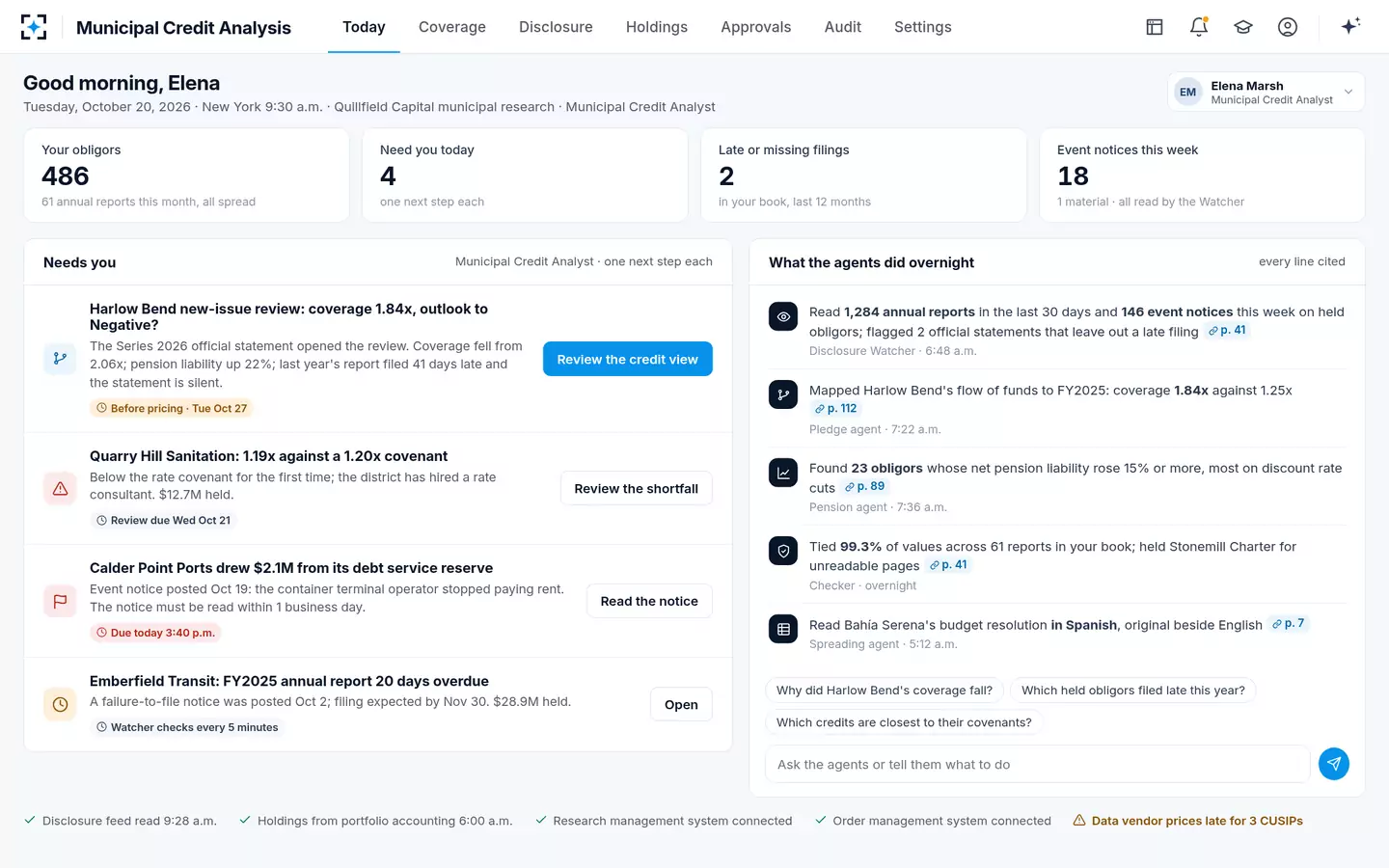
The size of a holding says nothing about how close its obligor is to trouble. A desk that reviews its largest twenty names in full and glances at the next four hundred has sorted its work by exposure, while the credit problems arrive in whatever order the issuers produce them. Elena's book on the morning of October 20 shows the pattern. Beside one large holding, a water system whose coverage has slipped from 2.06 to 1.84 times while its operating costs rose 9.4%, sit three smaller ones. A sanitation district is at 1.19 times debt service against a 1.20 times rate covenant, below it for the first time, and Quillfield holds only $12.7 million of it. A port has drawn $2.1 million from its debt service reserve. A transit agency's annual report is 20 days overdue.
Small obligors can also disclose less. Rule 15c2-12 relaxes the continuing disclosure undertaking for an obligated person with no more than $10,000,000 of outstanding municipal securities: annual information can be limited to what the obligor "customarily" prepares and makes public, plus the event notices (17 CFR 240.15c2-12(d)(2)). The thinnest file and the least attention often sit on the same name.
The market still prices those names on credit. Michael Schwert decomposed municipal bond spreads and found that "default risk accounts for 74% to 84% of the average spread after adjusting for tax-exempt status", and that the price of default risk is high "given the rare incidence of municipal default" (Journal of Finance, 2017). Defaults are rare and expensive, which is precisely the profile where a glance feels safe until the year it is not.
One analyst's morning: four credits that need her, only one of them a large holding
Municipal credit analyst vs corporate credit analyst
A corporate credit analyst and a municipal credit analyst both ask whether a borrower can pay, but almost everything around the question differs: the disclosure regime, the accounting, the clock and what happens in insolvency. The table sets out the differences that change the daily work.
Municipal credit analyst vs corporate credit analyst: what changes the work
| Corporate credit | Municipal credit | |
|---|---|---|
| How news arrives | Public companies report material events on Form 8-K, generally within four business days. | Issuers undertake, in a continuing disclosure agreement, to post notice of sixteen listed events in a timely manner not in excess of ten business days. |
| Annual financials | Filed with the SEC by the deadlines its forms set. | Posted to EMMA on the date each obligor chose in its own agreement. |
| Accounting | FASB standards. | GASB standards, and some issuers use other bases, including cash. |
| What secures the bond | The company, its assets and collateral. | A tax pledge, or a defined stream of revenues set out in a bond resolution, often with its own order of payment. |
| Insolvency | Chapter 11 or chapter 7; assets can be sold. | Chapter 9, which has no provision for liquidating the municipality's assets. |
| Size of the universe | Companies registered with the SEC, plus private and Rule 144A issuers. | An estimated 50,000 issuing governments and authorities, most of them small. |
The insolvency row explains much of the craft. In a municipal bankruptcy, the U.S. Courts explain, "there is no provision in the law for liquidation of the assets of the municipality", and in the more than 60 years since Congress created the process "there have been fewer than 500 municipal bankruptcy petitions filed" (U.S. Courts). Recovery depends less on what a court can sell and more on what the bond documents pledged and in what order. That is why the muni analyst's most specialised reading is the bond resolution, worked through in the flow of funds in municipal bonds.
What is surveillance in municipal bonds?
Surveillance is the monitoring a research team does between annual reviews, so that a credit view stays current when something happens. In municipal bonds it has four feeds: event notices under Rule 15c2-12, each obligor's annual filing deadline, rating changes, and new offering documents for held obligors.
The event notices are the obvious feed and the noisiest one. Rule 15c2-12 lists sixteen kinds, from payment delinquencies and unscheduled draws on debt service reserves to bond calls, defeasances and rating changes (17 CFR 240.15c2-12(b)(5)(i)(C)). Most of the roughly 50,000 a year are routine. A surveillance desk needs a rule for which categories reach an analyst the same day; in the sample firm's settings, the head of research has set categories 1 to 4, 7, 12, 15 and 16 to do so, each with a one-business-day clock to read it.
The deadline feed is the quiet one, and the one most often missed: a filing that should have arrived and did not raises no notice on its own. Why that absence is a credit signal, and how to watch for it, is the subject of EMMA alerts and the late annual filing.
What skills does a municipal credit analyst need?
The skills split into reading and judging, and the reading takes most of the hours. Reading means knowing where an ACFR keeps each number, how a bond resolution defines revenues and operating expenses, what a pension note's discount rate assumption does to the liability, and which disclosure obligations an issuer took on. Judging means knowing what a sector's numbers usually look like, which change is noise, and when to say so in writing to someone who will trade on it.
The reading skills are teachable and checkable, which is what makes them the part worth handing to agents under supervision. The judging skills are what a fund is paying for. A team that spends seven hours of every review reading has the experience to judge and too little time left to use it on most of its book.
The team around the analyst, and who signs the view
A credit view is never one person's decision. It is proposed by the covering analyst, approved by a senior analyst who may never approve their own, used by portfolio managers, governed by a head of research and examined by compliance. Each role needs different evidence from the same file.
Who works on one municipal credit view, and what each keeps
Today
Spreads the largest names by hand, glances at the rest, rebuilds coverage from each resolution herself.
With agents
Opens a credit file already spread, tied and mapped to the resolution, questions and stresses it, and proposes the view.
Still theirs: The proposed score, outlook and note.
Today
Signs views on spreadsheets he must trace back to the PDF himself.
With agents
Sees every figure on its page, the stress and the analyst's edits before he signs.
Still theirs: Approval, send-back or rejection, with a reason code; never his own view.
Today
Asks whether a view is current before sizing an order in a new issue.
With agents
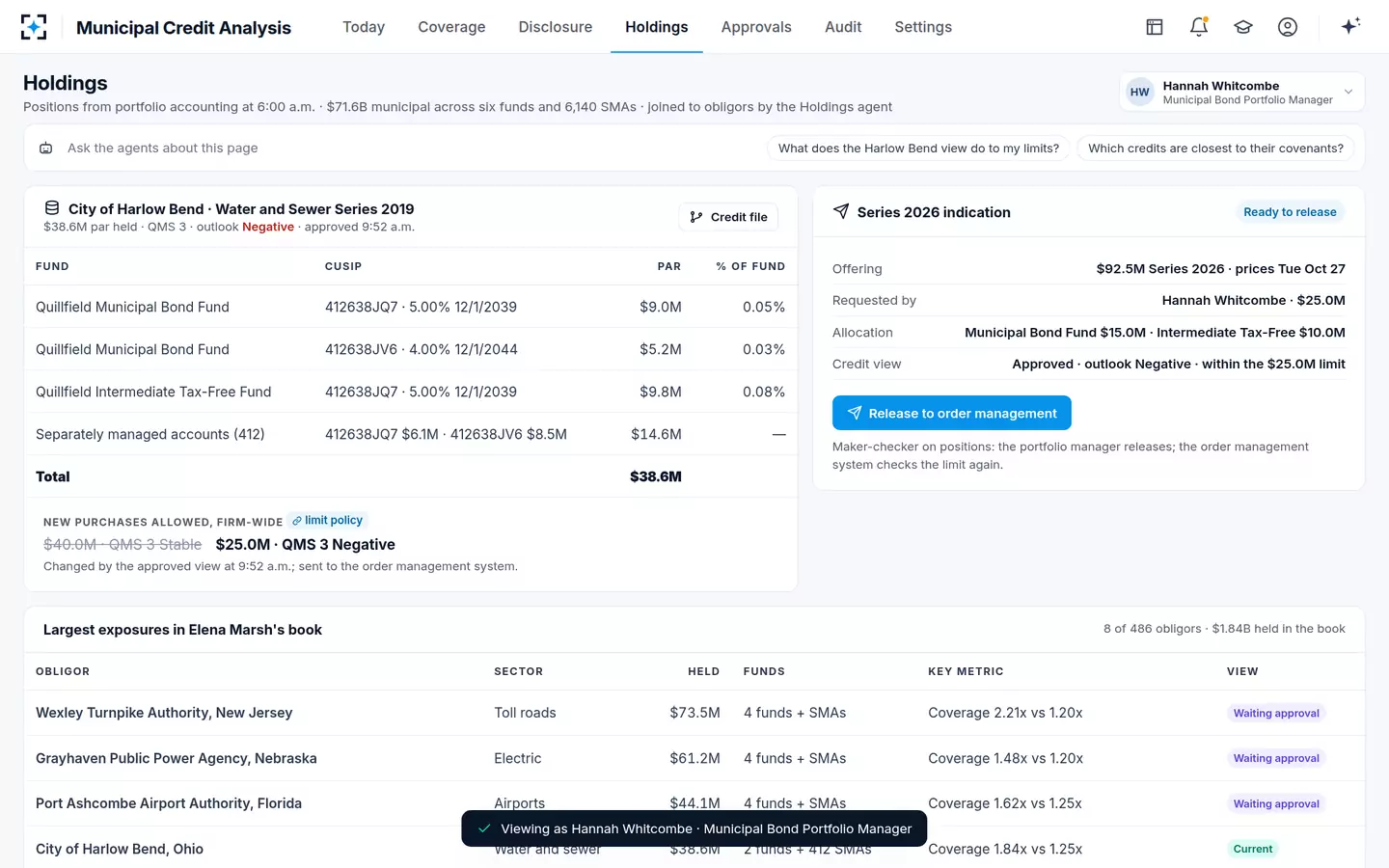
Sees the limit before and after the view, and releases an indication once it is approved.
Still theirs: Every order.
Today
Owns an approved list knowing most obligors are not spread every year.
With agents
Sets the templates, rules and thresholds analysts work to.
Still theirs: Second signature on large moves, and the research policy.
Today
Pulls emails, spreadsheets and PDFs together to show who changed a view and why.
With agents
Filters a read-only audit trail by obligor, person or agent and exports the evidence.
Still theirs: The examination file.
Where Municipal Credit Analysis changes the analyst's year
The solution's design target is that every held obligor is spread every year, about 500 per analyst on the sample team's numbers, rather than the largest names only. It gets there by giving the reading to seven agents with fixed limits. A Disclosure Watcher picks up every annual report, official statement and event notice for held obligors and compares each filing date with the obligor's own deadline. A Spreading agent reads the ACFR into the sector template with every value pinned to its page. A Pledge agent reads the bond resolution and tests coverage by its words. A Checker ties every figure to audited totals and can block a spread it cannot tie. A Pension agent explains why the pension liability moved. A Credit Writer drafts the view with every sentence cited. A Holdings agent joins positions to obligors.
What the agents may not do matters as much. None of them submits, approves or publishes a view, contacts an issuer or an underwriter, or changes a limit or an order; materiality calls are proposals for the analyst. The analyst submits, a senior analyst approves, and limits move only after approval. For the economics of covering small issuers this way, see what a municipal bond analysis tool should cost and do, and for the whole solution, Municipal Credit Analysis.
What an approved view does: the limit moves, then the portfolio manager releases her order
Questions people ask
How do muni funds monitor credits?
Through an annual review when each obligor's financial report arrives, new-issue reviews before pricing, and surveillance of event notices, rating changes and filing deadlines in between. Mutual funds alone held $835.1 billion of municipal securities at the end of 2025, by the Federal Reserve's count (Z.1, September 2026), and the monitoring they owe their shareholders scales with that.
What is a muni research team?
It is the group of analysts at a fund manager, insurer or bank who keep internal credit views on municipal obligors, usually organised by sector (general government, utilities, transportation, health care, higher education) under a head of research. Its output is a score, an outlook and a note per obligor, which set the approved list and the limits portfolio managers trade within.
Do municipal bonds default often?
Rarely, which is part of the problem. The U.S. Courts count fewer than 500 municipal bankruptcy petitions in more than 60 years of chapter 9, and Schwert's study of spreads describes "the rare incidence of municipal default". Rare, costly events are the ones a team stops looking for when it is short of time.
Is analysing a revenue bond different from a general obligation bond?
Yes. A general obligation bond rests on the issuer's taxing power, so the analysis centres on the tax base, the budget and the fund balance. A revenue bond rests on a defined stream of revenues, so the analysis centres on the bond resolution: what is pledged, what is paid first, and the coverage the resolution requires, explained further in the rate covenant guide.
Do municipal credit analysts rely on ratings?
They read them and form their own view. Research on Moody's 2010 recalibration shows ratings still move municipal prices, which is the reason a fund keeps an internal scale: its view must be its own, documented and current, rather than a copy of an agency's letter.
How many event notices does the municipal market file?
The SEC, using MSRB data, counted 57,779 event notices in 2021, 50,125 in 2022 and 41,971 in 2023, an average of about 49,958 a year. Most are routine; a surveillance rule decides which categories reach an analyst the same day.