Under SEC Rule 15c2-12, a financial obligation is a debt obligation, a derivative instrument entered into in connection with or pledged as security for a debt obligation, or a guarantee of either; municipal securities already sold with a final official statement on EMMA are excluded. Since February 27, 2019, continuing disclosure agreements have had to cover two events about such obligations: the incurrence of a material financial obligation, or agreement to terms that affect bondholders (listed event 15), and a default, acceleration, modification or similar event that reflects financial difficulties (listed event 16), each to be noticed in a timely manner not in excess of ten business days. For a bondholder the point is simple: a bank loan or direct placement can share, or even get ahead of, the revenues securing the bonds, and the notice arrives long before the next annual report shows the loan. Botminds' Municipal Credit Analysis reads every such notice for held obligors as it posts to EMMA, classifies it into the sixteen listed events with a proposed materiality, and has its Pledge agent test the new obligation against the bond resolution, for the analyst to judge.
The rule text, the SEC's adopting release and the counts come from the SEC and the MSRB; the sample credit, the City of Harlow Bend, Ohio, is fictional data from the solution.
The financial obligation rule in four numbers
10business days
the outer limit for an event notice under the continuing disclosure agreement
2019
February 27: agreements made on or after this date must cover events 15 and 16
201days
average from fiscal year-end to audited statements on EMMA, 2010 to 2023
41,971
event notices of all kinds filed in 2023, down from 57,779 in 2021
What is a financial obligation under Rule 15c2-12?
The definition has three parts and one exclusion. A financial obligation means "(A) Debt obligation; (B) Derivative instrument entered into in connection with, or pledged as security or a source of payment for, an existing or planned debt obligation; or (C) Guarantee of" either of those, and it "shall not include municipal securities as to which a final official statement has been provided to the Municipal Securities Rulemaking Board" (17 CFR 240.15c2-12(f)(11)). Publicly sold bonds are already disclosed through their official statements; the rule is aimed at everything else.
In practice that means bank loans, direct purchases of bonds by a bank or other lender, lines of credit, interest rate swaps tied to debt, and guarantees of another entity's debt. Leases were narrowed during the rulemaking. The SEC agreed that its proposed coverage of leases was too broad and limited it "to those that operate as vehicles to borrow money", because such a lease "could represent competing debt of the issuer or obligated person" (SEC, 2018 adopting release). An ordinary office equipment lease is unlikely to qualify; a lease-purchase financing of a treatment plant may.
What are listed events 15 and 16?
They are the two events the 2018 amendments added to the fourteen already in the rule. Each has its own trigger and its own qualifier, and the difference between "if material" and "reflect financial difficulties" decides which notices an analyst should expect.
Listed events 15 and 16, clause by clause
| Event 15 | Event 16 | |
|---|---|---|
| The rule's words | "Incurrence of a financial obligation of the obligated person, if material, or agreement to covenants, events of default, remedies, priority rights, or other similar terms of a financial obligation of the obligated person, any of which affect security holders, if material" | "Default, event of acceleration, termination event, modification of terms, or other similar events under the terms of a financial obligation of the obligated person, any of which reflect financial difficulties" |
| What triggers it | Taking on the obligation, or agreeing to terms in it. | Something going wrong under it. |
| Qualifier | If material, and for terms, if they affect security holders. | Only events that reflect financial difficulties. |
| EMMA category | Financial Obligation – Incurrence or Agreement (if material) | Financial Obligation – Event Reflecting Financial Difficulties |
| What it tells a bondholder | There is new debt, and possibly new covenants, liens or priority, competing for the same revenues. | A lender's rights may be about to be exercised, possibly ahead of the bondholders. |
Materiality for event 15 follows the familiar securities-law test. The SEC said the decision whether to file requires the same analysis issuers make for offering documents: whether there is a substantial likelihood that a reasonable investor would have seen the omitted fact as significantly changing the overall mix of information available, the Supreme Court's long-standing test (SEC, 2018; the test's wording is quoted in material nonpublic information examples). It declined to provide "a mechanical test for determining the materiality of a financial obligation", so the same loan can be material for a small district and immaterial for a large state.
When did the amendments take effect, and which bonds do they cover?
The amendments were effective on October 30, 2018, with a compliance date of February 27, 2019, and they reach only agreements made from then on. The SEC was explicit: "the amendments will only affect those continuing disclosure agreements entered into on or after the compliance date". For those agreements, issuers must disclose "material financial obligations incurred on or after the date" of the agreement (SEC, 2018).
That leaves a coverage gap an analyst has to map, credit by credit. An obligor whose only outstanding bonds were sold before 2019 may have no undertaking to notice a new bank loan at all. One that has issued since will have the undertaking, but only for obligations incurred after it signed. The obligor's most recent continuing disclosure agreement, not the date of the bonds a fund happens to hold, decides what notices to expect.
Do municipal bank loans have to be disclosed?
A material one does, if the obligor has signed a continuing disclosure agreement since February 2019, within ten business days through EMMA. Before the amendments, disclosure was voluntary and rare. The SEC noted that the MSRB had encouraged issuers to post direct placements on EMMA, but "despite the MSRB's efforts to encourage voluntary disclosure, the number of disclosures made using EMMA has been limited" (SEC, 2018).
The reason the SEC acted was the growth of bank lending as an alternative to bonds. In its 2025 paperwork filing for the rule, the SEC repeated that "since 2009, municipal issuers and obligated persons have increasingly used direct purchases of municipal securities and direct loans as alternatives to public offerings of municipal securities" (SEC, Rule 15c2-12 supporting statement, 2025). Federal Reserve economists studying loan-level data found that "small, more indebted, low-income, and medium credit quality counties are particularly reliant on private bank financing", and concluded that their results raise "concerns about claim dilution of bondholders" (Ivanov and Zimmermann, FEDS working paper 2018-011). The obligors that borrow most from banks are the ones a research team is least likely to review in full.
Why the notice arrives long before the ACFR
Because audited statements arrive once a year, months after the year ends, and a loan taken early in a fiscal year is not in them until the following year's report. GASB Statement No. 88, issued in April 2018, made direct borrowings and direct placements a required note disclosure. The SEC's verdict on it was that "the new guidance does not improve the timeliness of the disclosure investors and market participants will receive, nor does it cover the events" in listed event 16 (SEC, 2018).
A bank loan signed in the first month of a fiscal year: days until each document shows it
The comparison of what each document shows makes the case for reading notices as carefully as reports. The notice is late in arriving if it is late at all, and thin; the report is complete and a year and a half old.
What an event 15 notice shows, and what the next ACFR will
The event notice: Within ten business days of the loan, under the agreement.
The next ACFR: After the fiscal year closes: 201 days on average for audited statements.
The event notice: Whatever the issuer posts: often the loan agreement or a summary of amount, term, security and key covenants.
The next ACFR: The year-end balance, the security and terms in the debt note, and, under GASB 88, terms on events of default and acceleration.
The event notice: Shown only if the issuer describes the lien or posts the agreement.
The next ACFR: Described in the note, usually without the bond resolution's parity tests.
The event notice: The bond resolution: does the loan meet the additional bonds test, and what lien does it take?
The next ACFR: Nothing new about the decision taken a year earlier.
Reading a notice against the bond resolution
The question a notice raises is not how big the loan is but where it sits in the flow of funds. The SEC described the risk precisely: a bank loan agreement "could alter the debt payment priority structure of the issuer's or obligated person's outstanding securities, or give the lender a lien on assets or revenues that also secure the repayment of an issuer's or obligated person's outstanding municipal securities, diluting existing security holders' claims and adversely affecting their contractual rights" (SEC, 2018).
Loan terms add risks bonds rarely carry. California's debt advisory commission warns issuers that direct loans "contain covenants that lead to acceleration, create demands on liquidity, or contain cross-default provisions for other outstanding debt of the borrower" (CDIAC, California Debt Financing Guide). The SEC added that because of the lending relationship, bank loans "are likely to remain senior to other obligations in the debt priority queue". Each of those is a reason to read the notice the day it posts.
Five questions to put to every financial obligation notice
- What does the lender have a claim on?
The same pledged revenues as the bonds, a different revenue stream, or the general fund.
- At what lien?
Senior, parity or subordinate, under which section of the bond resolution.
- Did it pass the additional bonds test?
A parity loan is additional debt; the resolution's test, and its certificate, apply to it.
- Can it accelerate, and what triggers it?
Cross-default to the bonds, rating triggers, covenants tighter than the resolution's.
- Does it change coverage?
Add its debt service to the denominator at its lien, and re-run the rate covenant and the stress.
Is it parity debt? Look at the resolution, and the lender
Parity debt is debt secured on an equal footing with the bonds: the California guide defines parity as "obligations secured on an equal basis by a pledge of revenues or an asset or pool of assets". Bank and state loans often are. Houston's combined utility system, for example, reports $543.5 million of direct placement first lien revenue bonds placed through the Texas Water Development Board's state revolving funds, offered at subsidised rates for water and wastewater projects, issued as first lien revenue bonds alongside its publicly offered first lien bonds (City of Houston, FY2025 ACFR, note 15).
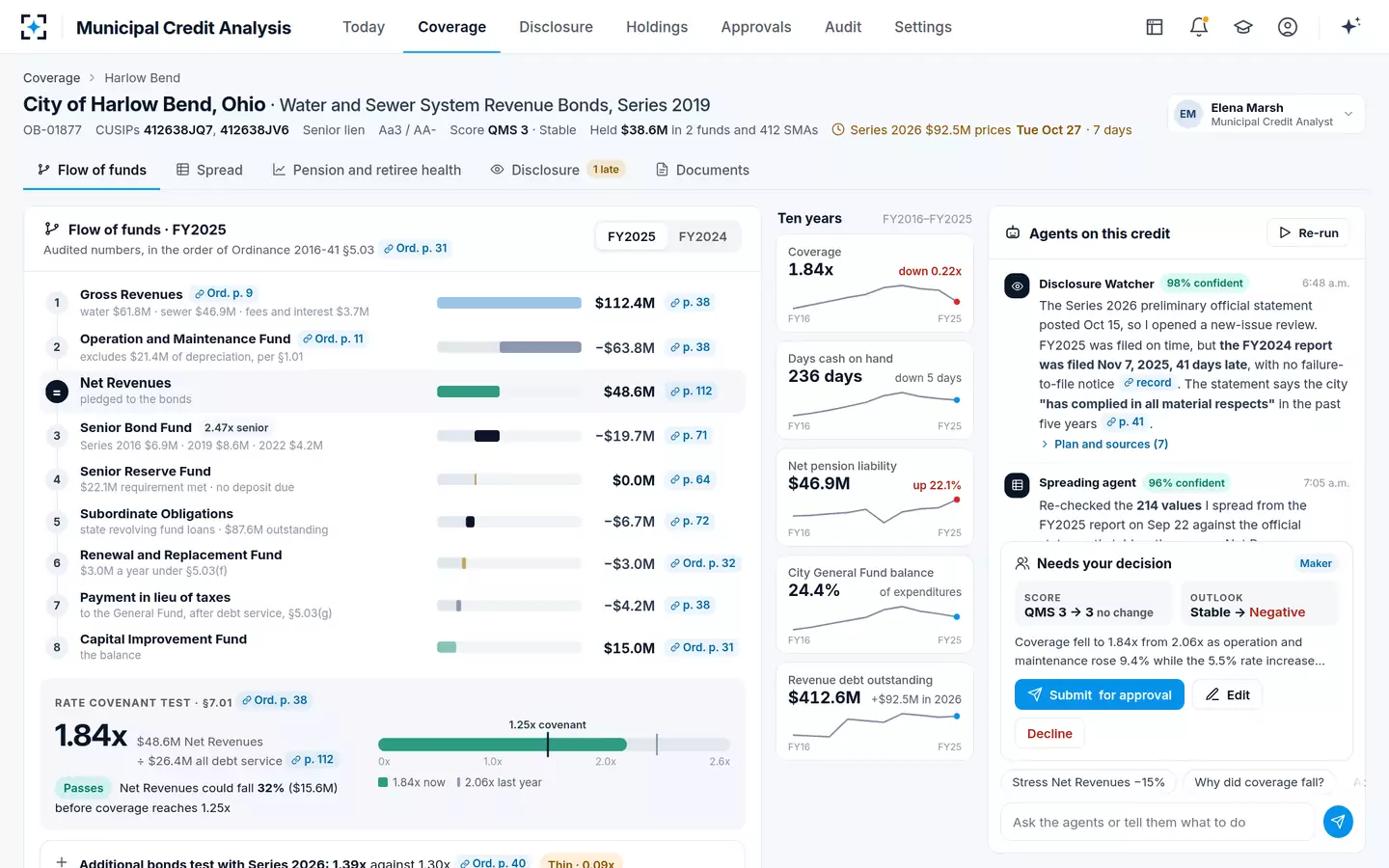
The sample credit shows the other common case. Harlow Bend's state revolving fund loans, $87.6 million outstanding, sit at step 5 of its flow of funds, after the senior bonds and the reserve: subordinate debt, which is why its senior coverage is 2.47 times and its all-in coverage 1.84 times. A new loan at the senior lien would have had to pass the additional bonds test; a subordinate one would typically face lighter conditions, a difference worked through in the additional bonds test guide and, for the order of payment itself, in the flow of funds guide.
The subordinate loans in their place in the flow of funds
How many event notices are filed, and which reach the analyst
Event notices of all kinds number in the tens of thousands a year, and most are routine: bond calls, defeasances, rating changes. The SEC's count, from the MSRB's fact books, fell from 57,779 in 2021, a year it attributes partly to the pandemic, to 41,971 in 2023 (SEC, 2025).
The continuing disclosure stream, by year: notices fell, annual filings held steady
| Year | Event notices, all categories | Annual filings | Failure-to-file notices |
|---|---|---|---|
| 2021 | 57,779 | 64,349 | 3,717 |
| 2022 | 50,125 | 64,606 | 3,579 |
| 2023 | 41,971 | 66,290 | 3,744 |
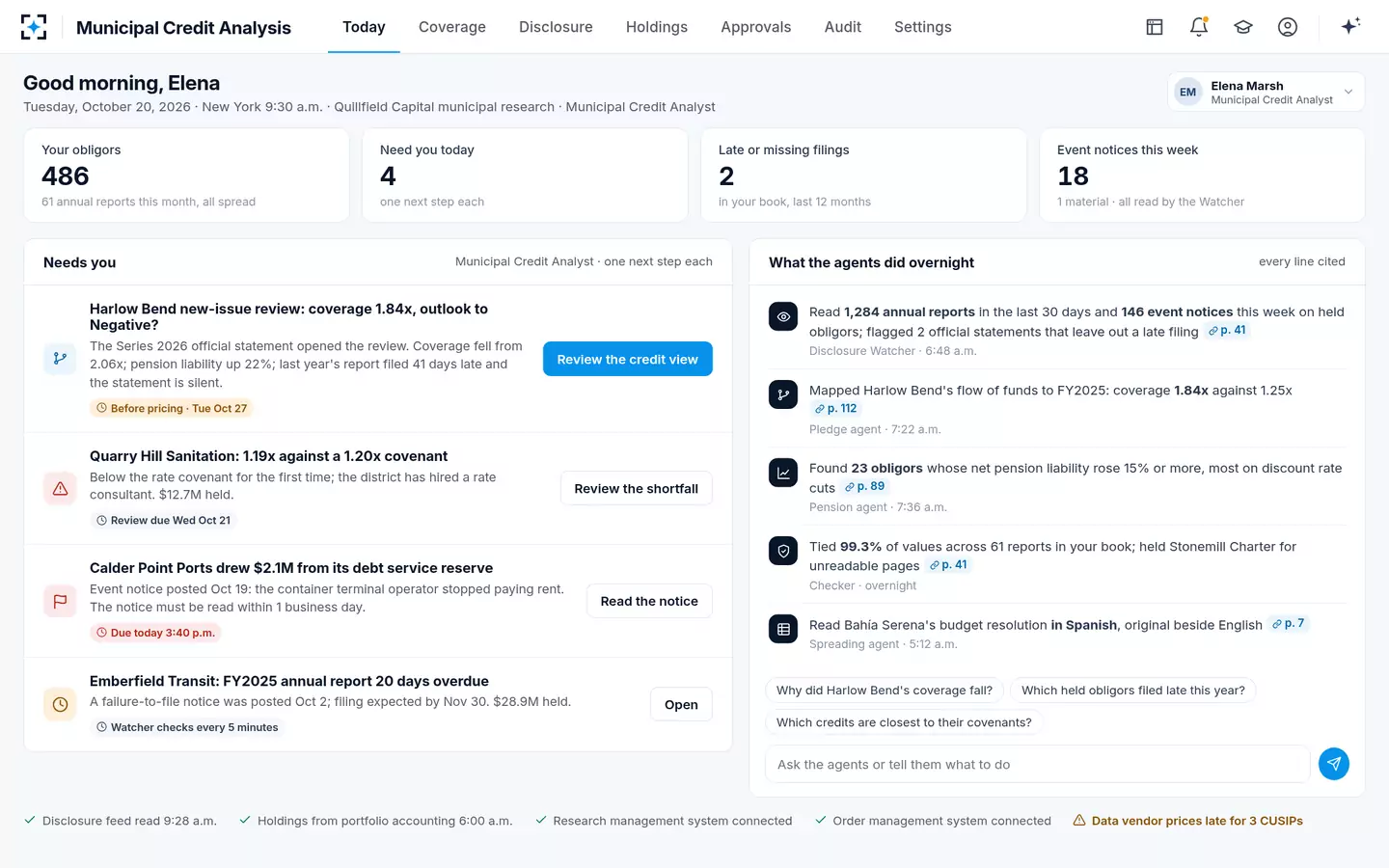
A surveillance rule decides which reach an analyst at once. In the sample firm's settings, notices in categories 1 to 4, 7, 12, 15 and 16, covering payment delinquencies, defaults, reserve and credit enhancement draws, modifications to holders' rights, bankruptcy and both financial obligation events, go to the covering analyst the same day with a one-business-day clock. The Disclosure Watcher proposes materiality; the analyst decides it.
Event notices on a held book, read as they post
Questions people ask
What is a direct placement in municipal finance?
A sale of debt directly to a bank or other lender, as a loan or a bond bought whole, instead of a public offering through an underwriter. The SEC's 2018 release groups "direct purchases of municipal securities and direct loans" under the term direct placements; they are financial obligations under Rule 15c2-12 unless sold with a final official statement on EMMA.
How many days does an issuer have to file a 15c2-12 notice?
The continuing disclosure agreement must provide for notice "in a timely manner not in excess of ten business days after the occurrence of the event". The obligation is the issuer's undertaking in that agreement; the rule itself binds the underwriters who must confirm the undertaking exists.
What is a material event notice?
The common name for a notice of one of the sixteen events listed in Rule 15c2-12(b)(5)(i)(C). Some events require notice whatever their size, such as payment delinquencies and rating changes; others, including incurrence of a financial obligation, only "if material".
Are leases financial obligations under 15c2-12?
Only leases that operate as vehicles to borrow money. The SEC narrowed its proposal after commenters objected that ordinary equipment and office leases would flood EMMA, keeping the leases that could represent competing debt.
Do the 2018 amendments apply to bonds issued before 2019?
Only through a later agreement. The amendments affect continuing disclosure agreements entered into on or after February 27, 2019, and obligations incurred after the agreement's date, so an obligor's newest agreement decides what it must notice.
What is listed event 16 in plain words?
Trouble under a loan or similar obligation: a default, an acceleration, a termination, a change of terms or a similar event that reflects financial difficulties. It matters to bondholders because a lender acting on its rights may reach the revenues first.