ACFR data, the numbers inside state and local governments' annual comprehensive financial reports, does not exist as one complete, machine-readable dataset. The reports reach the MSRB's EMMA website as documents, about 65,000 annual filings a year, each laid out by its issuer, and federal data standards for municipal filings have not yet been written. A research team that wants ACFR data for its own credits builds the archive itself: start from what it holds, map each CUSIP to the obligor that pays it, attach the bond documents and continuing disclosure agreement, pull the filing history from EMMA, and spread every report into a common template with each value tied to its page. Botminds' Municipal Credit Analysis does that build as part of going live and keeps it current as filings post; this guide sets out the steps and what the team has to bring to them.
Figures about EMMA and the filing stream come from the MSRB and the SEC. Examples of the finished archive use the solution's fictional sample firm, Quillfield Capital, with 4,012 held obligors and 11,860 held CUSIPs.
The raw material an ACFR archive is built from
431,000
audited financial statements and ACFRs submitted to EMMA from 2010 to 2023
66,290
annual filings posted to the MSRB in 2023
17.9%
of audited statements arrived more than a year after the fiscal year they cover
0
data standards yet in force for information submitted to the MSRB
Is there a database of ACFRs?
There is a repository of ACFRs, EMMA, and no complete public database of the numbers in them. EMMA holds the documents: since the SEC's 2008 amendments to Rule 15c2-12 it has been "the single centralized repository for the electronic collection and availability of continuing disclosure information about municipal securities" (SEC, 2018 adopting release), and the MSRB describes it as the official repository for municipal disclosures since 2009. Access is free. What a user gets is a PDF per filing, labelled with the period it covers and the date it was posted.
Commercial data vendors sell standardised financial fields for many issuers. How a vendor maps each issuer's statements to its fields is the vendor's method, not the bond's definitions, so a research team using them still has to test the values that matter, coverage above all, against the source. For a held book, that means the archive the team relies on is the one it can trace to EMMA, page by page.
What is EMMA, and how much does it hold?
EMMA, the Electronic Municipal Market Access website, is the MSRB's public system for municipal securities documents and data: official statements, annual financial filings, event notices and trade reports, searchable by CUSIP, issuer and state. Its volume is large and steady. The SEC, citing the MSRB's fact books, counts 64,349 annual filings in 2021, 64,606 in 2022 and 66,290 in 2023, alongside between 42,000 and 58,000 event notices a year (SEC, Rule 15c2-12 supporting statement, 2025).
Annual filings posted to the MSRB, by year: the stream an archive keeps up with
Two details of how EMMA records filings matter for anyone building on it. Each financial disclosure carries a "period end date", the end of the fiscal year it covers, and a "posted date" or "submission date", when it arrived; the gap between them is the timeliness measure (MSRB, Using EMMA to Identify the Timing of Financial Disclosures). And both dates and the document category are what the submitter reports. In its own timing study the MSRB warns that "the data rely on each submitter's categorization of the submission as either audited financial statements or annual financial information, and no attempt has been made to validate such categorization" (MSRB, May 2024). An archive should read the document, not trust the label.
Why ACFR data does not arrive structured
Because no rule has yet required it, and the law around municipal disclosure was built to limit what can be required. Rule 15c2-12 works through underwriters: they must reasonably determine that an issuer has undertaken, in a written agreement, to provide annual financial information in an electronic format the MSRB prescribes, which in practice means a searchable PDF, as California's debt financing guide notes. The Financial Data Transparency Act of 2022 told the SEC to adopt data standards for information submitted to the MSRB, and the agencies' joint standards took effect on 1 October 2026, but the joint rule changes no reporting requirement until each agency acts on it (FDTA joint rule, 2026). Where that stands is dated step by step in the Financial Data Transparency Act final rule guide.
Even a future standard would leave the archive's hardest work in place. Issuers report under GASB standards, and the joint rule notes that some use other bases, including cash accounting. A bond's coverage depends on its resolution's definitions, which no general taxonomy holds. And old reports, the ten years an analyst needs for a trend, will stay PDFs whatever the new rules require.
How to map CUSIPs to obligors
Start from positions and work back to the entity that actually pays. A CUSIP, in the MSRB's words, is "the unique nine-digit combination of numbers and letters used to identify an individual municipal security" (MSRB, Using MyEMMA Alerts). One obligor can sit behind dozens of CUSIPs across several series, and one issuer, such as a state financing authority, can sit in front of many obligors, because Rule 15c2-12 places the disclosure duty on the "obligated person": anyone "committed by contract or other arrangement to support payment of all, or part of the obligations" (17 CFR 240.15c2-12(f)(10)).
So the mapping has three levels: CUSIP to bond issue, bond issue to the security that pays it (a pledge, a lease, a loan agreement), and security to the obligated person whose annual report is the one to spread. A conduit hospital bond is the hospital's credit, not the authority's. Identifiers do not make this easier: the federal agencies writing the FDTA standards noted that CUSIP numbers, "while these identifiers are widely used, they are proprietary and not available under an open license in the United States" (FDTA joint rule), and declined to adopt an alternative instrument identifier. The archive's obligor map is the team's own work product, and it is worth keeping with its evidence.
Building an ACFR archive for a held book, from positions to tied spreads
Agent
Holdings agentJoins each morning's positions from portfolio accounting to obligors by CUSIP: 11,860 held CUSIPs to 4,012 obligors in the sample firm.
Never: reads separately managed account client names
A person decides
Research operations and analystsConfirm the obligor map where a CUSIP belongs to a conduit or pooled issue, and assign each obligor to a covering analyst and sector template.
Agent
Disclosure WatcherPulls ten years of annual reports, official statements and event notices per obligor, and each continuing disclosure agreement's filing deadline.
Never: contacts an issuer or underwriter
Agent
Spreading agent and CheckerSpread each report into the sector template with every value on its page; tie totals to the audited statements and coverage to the issuer's schedule.
Never: release a block; only a person can, with a reason code
A person decides
Head of researchApproves the templates, thresholds and rules the archive is held to, and signs off the backfill against the team's own past spreads.
What is a continuing disclosure agreement, and why it belongs in the archive?
A continuing disclosure agreement is the obligor's written undertaking, made for the benefit of bondholders, to file annual financial information and event notices with the MSRB. Rule 15c2-12 requires it to "specify, in reasonable detail, the type of financial information and operating data to be provided", the accounting principles and "whether the financial statements will be audited", and "the date on which the annual financial information for the preceding fiscal year will be provided" (17 CFR 240.15c2-12(b)(5)(ii)).
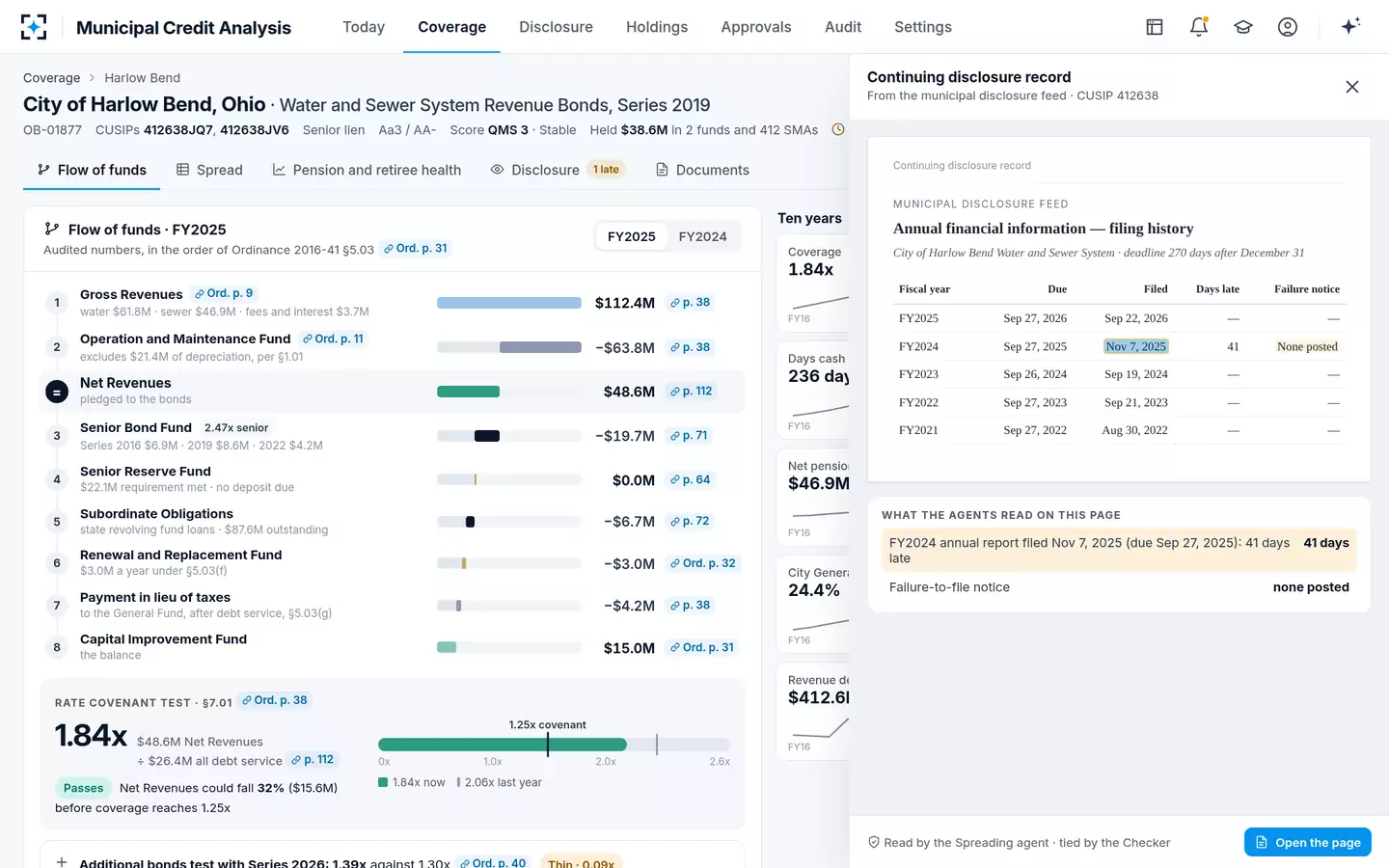
That last clause is why the agreement belongs in the archive next to the reports. EMMA shows when a report arrived; only the agreement says when it was due. Deadlines vary from obligor to obligor, so a late filing cannot be recognised from EMMA's dates alone. In the sample book, the City of Harlow Bend's agreement sets 270 days after its December 31 year end; its FY2024 report was due on September 27, 2025 and posted on November 7, 41 days late, with no failure-to-file notice. Why that matters as a credit signal is the subject of the EMMA alerts guide.
A filing history is only useful next to the deadline the obligor agreed to
What you bring on day one
An archive built from public filings still depends on inputs only the research team has. Most are documents the team already keeps; the work is gathering them in one place before the backfill starts.
What a research team brings to build its ACFR data archive
- Holdings by fund and account, with CUSIPs
The coverage universe is what you hold and what you may buy; the archive starts there.
- The obligor map you already trust
Existing assignments of CUSIPs to obligors and analysts, especially for conduit and pooled issues.
- Sector templates
The lines your analysts spread for water and sewer, general government, health care and the rest, with each line's definition.
- Score rubric and research policy
How a score and outlook are set, the thresholds that open a review, who signs what.
- A sample of past spreads, signed
Reports your analysts spread by hand, to test the agents against before they run on the book. The sample firm used 412, each signed by two analysts.
- Bond documents for revenue credits
Resolutions, indentures and supplements, often appended to official statements on EMMA, otherwise from the issuer.
- Access to the systems
Portfolio accounting, the order management system, the research management system, document management and the data vendor for ratings and prices.
Backfilling ten years, catch-ups included
A credit trend needs ten years, and a backfill has to cope with how irregular the history is. The MSRB's study of 2010 to 2023 found that, excluding catch-up filings, audited statements reached EMMA on average 201 days after the fiscal year ended, and that 17.9% of audited statement submissions came more than a year late, many of them issuers filling earlier gaps (MSRB, May 2024). Some years for some obligors will be missing, posted twice, or posted as a later document that restates an earlier one.
The statistical section of the latest report is the backfill's best shortcut. Many of its schedules run ten fiscal years: in Houston's FY2025 report, 28 schedule headings carry the words "Last Ten Fiscal Years", among them net position, fund balances, debt ratios and pledged-revenue coverage for each revenue-backed system (City of Houston, FY2025 ACFR). Spreading those tables gives the trend at once. The prior reports are then read for what the statistical section does not carry, such as pension notes and the details behind a restatement, and to check that the ten-year tables match what was originally reported.
What each obligor's entry in the archive holds
| Field | Where it comes from | Why it is kept |
|---|---|---|
| Obligor and its CUSIPs, by series and lien | Holdings, official statements, the team's obligor map | Joins positions to the right credit, including conduit issues. |
| Continuing disclosure agreement terms | The agreement, usually appended to the official statement | The filing deadline and what each annual filing must contain. |
| Filing history: period end, posted date, category | EMMA | Timeliness against the agreement; gaps and catch-ups. |
| Bond documents and supplements | Official statement appendices, the issuer | Definitions, flow of funds, rate covenant, additional bonds test, reserve requirement. |
| Spread, ten years, in the sector template | Each annual report, page by page | Trends and peer comparisons on one set of definitions. |
| Source page for every value | The report the value was read from | So any number can be checked in one step by a reviewer or an examiner. |
| Event notices, classified | EMMA | Reserve draws, defaults, new financial obligations, rating changes. |
How to get structured municipal financial data while ACFRs stay PDFs
Build it at the level you need, from the documents you can cite. For a held book, the practical route is the one above: spread each obligor's reports into your own template, tie them to the audited totals, and keep the page with every value. That gives structured data on your definitions, which is what a credit view needs, rather than someone else's fields on theirs.
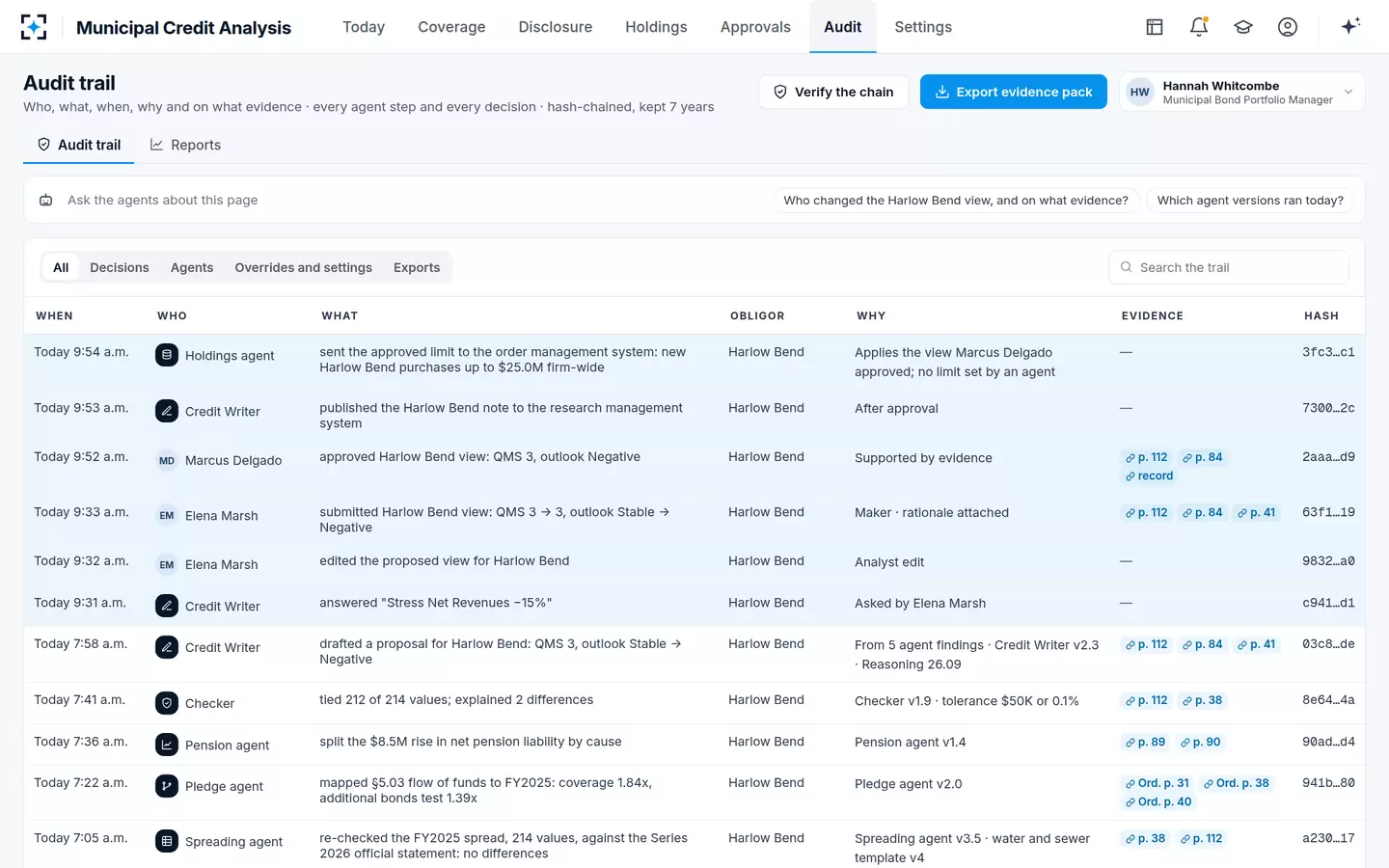
The agents change the cost of that route, not its logic. In the sample credit the Spreading agent read 214 values from a 236-page report in one pass, and the Checker tied 212 and explained the other two. Done across a book, that is an archive no vendor sells, because it holds the team's own definitions, its own obligor map and the page behind every number. How to read the reports being spread is covered in how to read an ACFR.
Every agent step and decision, with its evidence and the agent version that ran
Questions people ask
Where can I download ACFR data?
The reports themselves can be downloaded free from EMMA, by issuer or by CUSIP, and from many issuers' own websites. Values extracted from them come either from vendors' databases or from your own spreading; for a held book, the values you can trace to the page are the ones to rely on.
What is the difference between ACFR data and annual financial information?
An ACFR is the audited annual report. Annual financial information is the operating data the continuing disclosure agreement requires, of the type in the official statement, which may be filed separately. The MSRB found annual financial information reached EMMA on average 189 days after year-end, against 201 days for audited statements, from 2010 to 2023.
How many annual filings are posted to EMMA each year?
The SEC, using MSRB data, counts 64,349 in 2021, 64,606 in 2022 and 66,290 in 2023, about 65,082 a year on average. As the SEC noted in 2018, many filings are supplemental documents or several years filed at once, so counting filings is not the same as counting issuers.
What is the period end date on EMMA?
The end of the fiscal year or other period a financial disclosure covers, as the submitter reports it. EMMA sets it beside the posted date, and its submission calculator shows the days between them; the MSRB notes that it relies on the issuer's reported dates and does not verify them.
How long does a ten-year backfill take?
It depends on the book and on what the team already has. The largest part is reading reports; the statistical section's ten-year tables shorten it, and a team's own past spreads let the result be tested before anyone relies on it.
Do I need the bond documents if I have the ACFR?
For revenue credits, yes. The ACFR gives the numbers; the resolution says which of them count. Without it, coverage is computed on someone's standard definitions rather than the bond's, which is the error worked through in the rate covenant guide.