The Financial Data Transparency Act (FDTA) final rule is the joint data standards rule that nine federal financial agencies, including the SEC, published on June 25, 2026; it took effect on October 1, 2026, and on that date it changed no reporting requirement: that waits on further action by each agency. For municipal issuers the rule matters as the foundation for a second, SEC-only rulemaking that will set data standards for information submitted to the MSRB's EMMA system, and that rule had not been proposed by late October 2026. Annual comprehensive financial reports (ACFRs) therefore keep arriving as documents, in each issuer's layout, and research teams keep spreading them. Botminds' Municipal Credit Analysis is built for that reality: its Spreading agent reads tables and scanned pages, and documents in Spanish beside an English reading, into the team's template, with every value pinned to its page, whatever the eventual standard turns out to be.
The dates and quotations below come from the Federal Register, the SEC and the U.S. Code. The sample credit used to show the reading is fictional data from the solution.
The FDTA for municipal issuers, dated
2022
December 23: the FDTA is signed into law
2026
October 1: the joint data standards take effect, changing no reporting requirement
2 years
the SEC has, from the joint rule, to adopt standards for information submitted to the MSRB
What is the Financial Data Transparency Act?
The Financial Data Transparency Act of 2022 is a federal law that requires financial regulators to adopt common data standards so that the information they collect is machine-readable and interoperable. It was signed on December 23, 2022, as Title LVIII of Division E of Public Law 117-263. It works in two stages: a joint rule in which the agencies establish shared standards, then agency-specific rules in which each one applies them to the information it collects.
For the municipal market the law added a short paragraph to the Securities Exchange Act: "The Commission shall adopt data standards for information submitted to the Board", meaning the MSRB. Those standards must be compatible "to the extent feasible" with the joint standards; the SEC "shall consult market participants"; and nothing in the paragraph affects the Tower Amendment (15 U.S.C. 78o-4(b)(8)).
What did the final rule adopt?
The final rule establishes identifiers and formats, not reporting obligations. The SEC adopted it on June 8, 2026, describing it as establishing "joint data standards under the Financial Data Transparency Act of 2022" with common identifiers for entities, locations, dates, certain products and currencies, and a principles-based standard for data transmission and schema and taxonomy formats (SEC press release 2026-53).
The joint standards in the FDTA final rule
| What is identified | Standard adopted |
|---|---|
| Legal entities | ISO 17442, the Legal Entity Identifier (LEI) |
| Swaps and security-based swaps | ISO 4914, the Unique Product Identifier |
| Classification of other financial instruments | ISO 10962, Classification of Financial Instruments (CFI) |
| Dates | ISO 8601 |
| States, possessions and directionals | U.S. Postal Service two-letter abbreviations |
| Countries and subdivisions | GENC (Geopolitical Entities, Names, and Codes) country and subdivision codes |
| Currencies | ISO 4217 alphabetic codes |
| Data transmission, schemas and taxonomies | A principles-based standard: formats that, to the extent practicable, make data fully searchable and machine-readable, with schemas and metadata that define its meaning |
The rule also records what it did not do. The agencies decided against "establishing the proposed joint standard of the Financial Instrument Global Identifier (FIGI)" for identifying financial instruments, and against any joint standard for accounting and reporting taxonomies. For municipal bonds both omissions matter: an instrument identifier is how filings are matched to bonds, and a taxonomy is how numbers in a filing get their meaning.
When does the FDTA take effect for municipal issuers?
Not yet in any way that changes what they file. The joint rule's own words are unambiguous: "The joint rule is effective on October 1, 2026. At the effective date, the joint rule will not change any reporting requirements without further action by the agencies" (FDTA final rule). For information submitted to the MSRB, that further action is an SEC rulemaking under section 5823 of the Act, which must be proposed and opened for comment before it is adopted. No such proposal had appeared in the Federal Register by late October 2026.
From the statute to municipal data standards: the elapsed months
- FDTA signed to joint proposal (Aug 2024)20 mo
- Proposal to joint final rule (Jun 2026)22 mo
- Joint rule to the SEC's deadline, about mid-202824 mo
The statute's clock is specific. The SEC must issue its rules "not later than 2 years after the date on which final rules are promulgated" under the joint rulemaking, and in doing so "may scale those data standards in order to reduce any unjustified burden on smaller regulated entities" and "shall seek to minimize disruptive changes to the persons affected by those rules" (Pub. L. 117-263, section 5823(b)). For a market where most issuers are small, the scaling clause may matter as much as the deadline.
What the joint rule left to the SEC: identifiers and taxonomies
The two questions that matter most for municipal data were set aside for later. On identifiers, the agencies had considered CUSIP numbers and ISINs, and noted that "while these identifiers are widely used, they are proprietary and not available under an open license in the United States"; they proposed FIGI instead, then dropped it from the final rule after mixed comments, some of which said FIGIs were not sufficiently available for "loans and municipal bonds". On taxonomies, a commenter urged a taxonomy "developed by the GASB", the Governmental Accounting Standards Board, while the agencies noted that "some municipal issuers use non-GASB GAAP, non-FASB GAAP, or cash basis accounting" (FDTA final rule).
Even the entity identifier is awkward for munis. Commenters told the agencies that the LEI "does not properly identify the obligated parties (or component entities or specific credits thereof, which may be the sole source of repayment for the securities but may not be separate legal entities) involved in municipal securities offerings". A water system that pays its own revenue bonds is often an enterprise fund of a city, as Houston's combined utility system is, rather than a legal entity of its own, and the bonds' credit is the system's. Whatever the SEC proposes will have to solve the same obligor-mapping problem every muni research team solves by hand, described in building your own ACFR data archive.
The Tower Amendment and the municipal objections
The Tower Amendment is the 1975 provision that keeps the SEC and the MSRB from requiring municipal issuers to file documents before a sale. It reads, in part: "Neither the Commission nor the Board is authorized under this chapter, by rule or regulation, to require any issuer of municipal securities, directly or indirectly through a purchaser or prospective purchaser of securities from the issuer, to file with the Commission or the Board prior to the sale of such securities by the issuer any application, report, or document in connection with the issuance, sale, or distribution of such securities" (15 U.S.C. 78o-4(d)(1)).
Municipal commenters on the joint rule leaned on it. The agencies noted that "many municipal securities market commenters expressed opposition", that some argued the FDTA was inconsistent with "the 10th Amendment's preservation of states' rights" and an unfunded mandate, and that others argued that, because of the Tower Amendment, any data standards adopted by the SEC or the MSRB "must be voluntary for issuers of municipal securities". The agencies' answer was to defer: "decisions regarding any data standards applicable to information submitted to the MSRB can only be meaningfully addressed during the SEC-specific rulemaking."
What the FDTA will and will not change for a municipal credit analyst
What it can change: Once the SEC adopts standards, information submitted to the MSRB may have to follow them, scaled for smaller issuers.
What it cannot change: Ten years of existing filings stay as they were filed, mostly PDFs.
What it can change: An open entity identifier, the LEI, for issuers that are legal entities.
What it cannot change: The obligor behind a revenue bond, often a fund of a city rather than an entity of its own.
What it can change: Schemas and metadata that say what each reported number is.
What it cannot change: Each bond resolution's own definition of revenues, expenses and coverage.
What it can change: The joint rule sets no deadline for annual reports.
What it cannot change: Annual reports averaged 209 days after year-end in 2023; the deadline is still each issuer's own.
What it can change: How information already required is submitted.
What it cannot change: The amendments are not to be construed to require certain additional information to be collected or disclosed.
Will ACFRs be machine-readable?
Not as they are filed today, by the agencies' own definition. In proposing the joint rule, they explained that a PDF could satisfy the standard only if its data conformed to a structured specification with a reference schema and taxonomy, and they drew the line plainly.
HTML and PDF documents whose data does not conform to any such schema and taxonomy would not be considered machine-readable as that term is defined in the FDTA because the data contained in such HTML and PDF documents cannot be easily processed by a computer without human intervention while ensuring no semantic meaning is lost.
FDTA joint data standards final rule, 2026 (describing the agencies' proposal)
Most of the roughly 65,000 annual filings a year that reach the MSRB, by the SEC's count (SEC, February 2025), are exactly such documents. Whether future ACFRs will carry machine-readable data depends on the SEC's municipal rule, on how far it scales the standards for small issuers, and on whether a governmental taxonomy exists to apply to them. None of that changes the ten years of filed reports a credit trend is built on.
What is XBRL, and would municipal filings use it?
XBRL, eXtensible Business Reporting Language, is one way of marking each number in a filing with a defined meaning, and the joint rule treats it as one acceptable option rather than a requirement. In proposing the rule, the agencies listed transmission formats that could meet the standard, from CSV, XML and JSON to HTML and PDF used with a schema, and named "XML Schema Definition (XSD), eXtensible Business Reporting Language (XBRL) Taxonomy, and JSON Schema" as schema and taxonomy formats with the required properties. They therefore wrote the standard as "a list of properties rather than any specific data transmission or schema and taxonomy formats", and kept that principles-based approach in the final rule.
For municipal filings the format is the smaller question. Machine-readable numbers need a taxonomy, a dictionary of what each tag means, and the joint rule established none; the agencies noted that the example taxonomies they had floated were built for bank call reports, US GAAP and IFRS, and a commenter called them unsuitable for municipalities. A governmental taxonomy, and the decision whether issuers must use it, would come with the SEC's municipal rule.
What to do while ACFRs stay PDFs
Read them, in a way that survives the switch. A research team that spreads ACFRs into its own templates, with each value pinned to its page and tied to the audited totals, has data that a future standard can extend rather than replace: when machine-readable filings arrive, they become another source for the same template lines, checked against the same definitions.
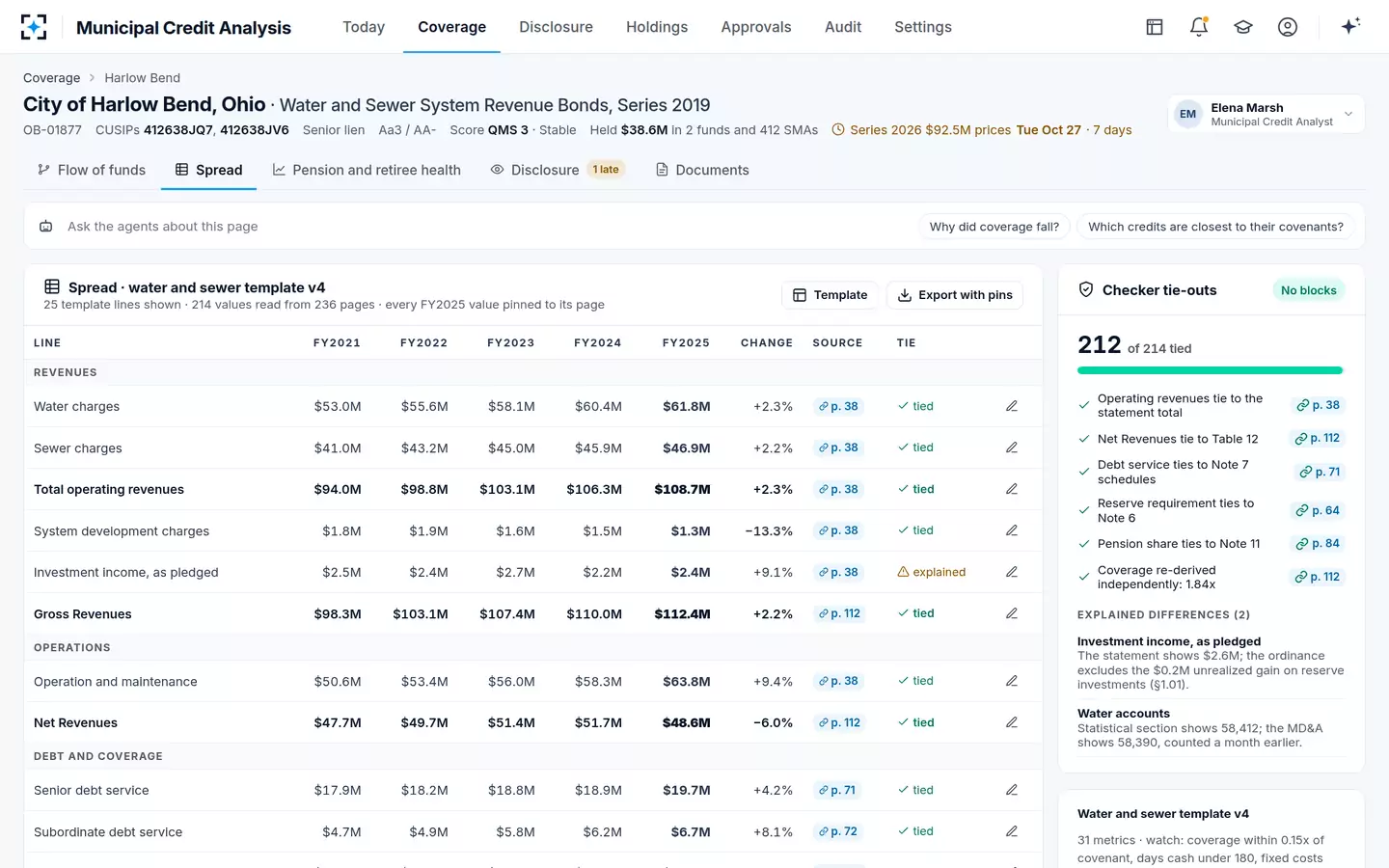
That is the approach Municipal Credit Analysis takes. In the fictional sample credit, its Spreading agent read 214 values from a 236-page report into the water and sewer template, from tables and from scanned pages, and its Checker tied 212 to the audited totals and explained two. Where a page is unreadable, the agent does not guess: it holds the value and drafts a clean-copy request for the analyst to send. Documents in Spanish, such as a Puerto Rico budget resolution in the sample book, are read with the original beside the English. How to read the reports themselves is set out in how to read an ACFR, and what a tool should do with them in the municipal bond analysis tool guide.
A spread built from PDFs, every value pinned, ready for whatever standard comes next
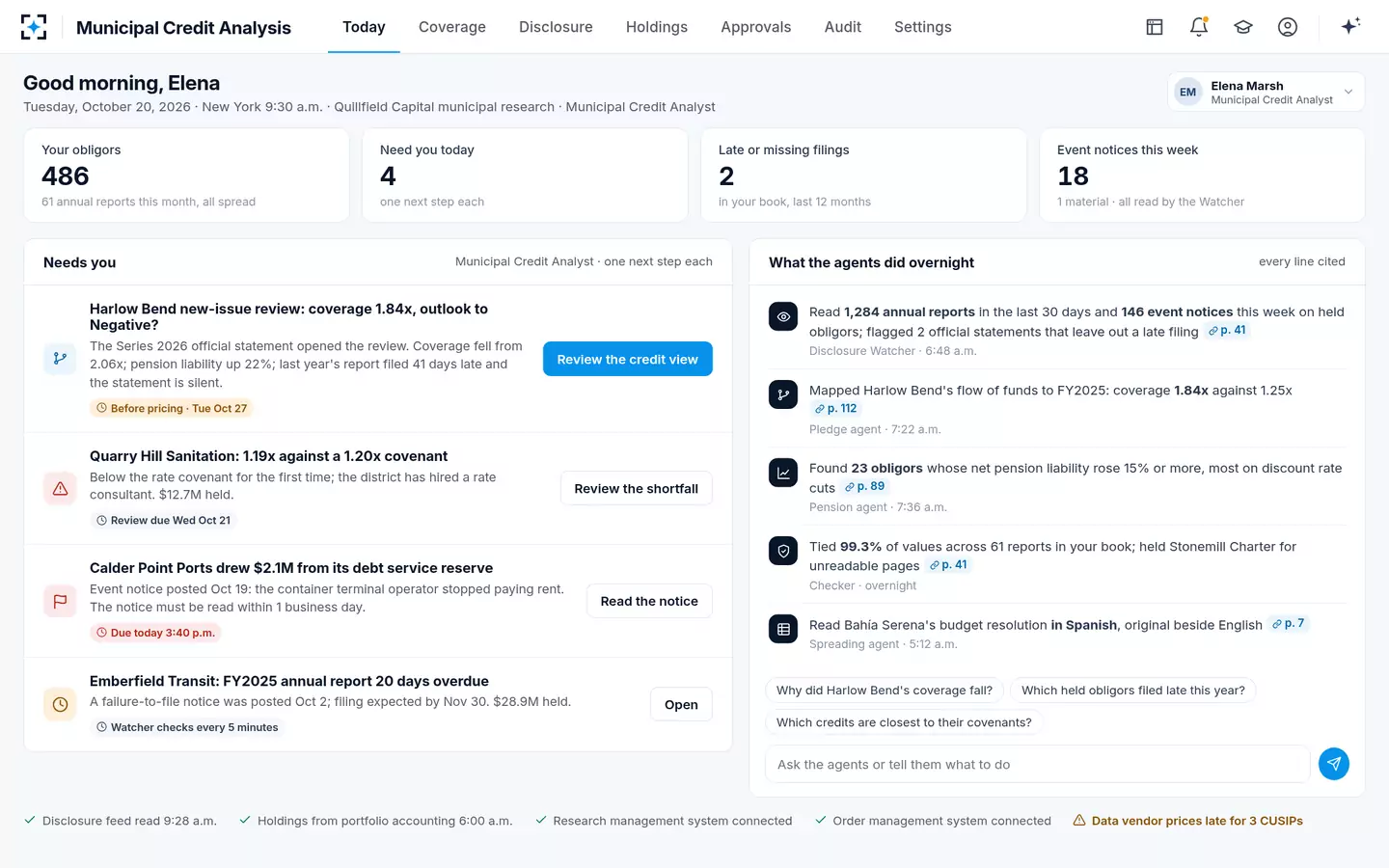
Scanned pages and Spanish documents, read overnight with the original kept beside the reading
Questions people ask
Does the FDTA apply to municipal issuers?
Indirectly, through the SEC. The Act requires the SEC to adopt data standards for information submitted to the MSRB, which is where municipal issuers' continuing disclosures go. Until that SEC rule is proposed and adopted, nothing changes in what or how issuers file.
What did the SEC finalize in 2026?
On June 8, 2026, it adopted, with eight other agencies, the joint data standards rule: identifiers for entities, swaps, instrument classes, dates, places and currencies, plus a principles-based format standard. It was published on June 25 and took effect on October 1, 2026, without changing any reporting requirement.
What is a legal entity identifier?
The identifier for legal entities defined by ISO 17442, and the joint rule's chosen entity identifier. For municipal credits it identifies a city or authority but not necessarily the system whose revenues pay a bond, a gap commenters raised with the agencies.
Will the FDTA replace CUSIP numbers for municipal bonds?
Not under the final joint rule. The agencies noted that CUSIPs are proprietary, proposed FIGI as an open alternative, then did not adopt it. Instrument identifiers are left to the agencies' own rulemakings.
Does the FDTA require new municipal disclosures?
No. A rule of construction in the Act, set out in the U.S. Code's notes, says the amendments are not to be construed to require certain additional information to be collected or disclosed. The standards govern how information already required is submitted.
When will the SEC propose municipal data standards?
No date has been announced. The statute gives the SEC two years from the joint final rule, which on our reading points to mid-2028, and requires it to consult market participants. Any proposal will be published in the Federal Register for comment before adoption.