The flow of funds in municipal bonds is the order in which a revenue bond's resolution, indenture or ordinance applies the pledged revenues: into a revenue fund, then to operation and maintenance, then to senior debt service, reserves, subordinate obligations, renewal and replacement, and finally any surplus. It decides who is paid first when money is short, and it defines the numbers in every coverage test, because coverage is the revenue left at one step divided by the debt service due at that step. Reading it is slow, legal work done once per credit and then forgotten until a problem appears. Botminds' Municipal Credit Analysis gives it to one agent, the Pledge agent, which maps each audited number onto each step of the resolution, cites the section for every step and tests coverage by the resolution's own words, for the analyst to question and a senior analyst to sign.
The worked example uses fictional sample data from the solution: the City of Harlow Bend, Ohio, and its water and sewer revenue bonds, read for the fictional fund manager Quillfield Capital. The law, the definitions and the second example, the City of Houston's combined utility system, come from public records linked where they appear.
Why the order of payment is worth reading closely
$46.1B
of tax-exempt water and sewer bonds issued in 2025, 9% of the year's tax-exempt total
1988
the year Congress kept pledged special revenues flowing to bondholders in a chapter 9 case
62.05x
coverage on Houston's "junior lien" utility bonds, which rank ahead of its "first lien" bonds at 2.19x
What is the flow of funds in a revenue bond?
The flow of funds is the set of provisions that sends each dollar of pledged revenue to a named fund in a fixed priority. California's debt advisory commission defines it as "the provisions of an indenture or bond resolution under which pledged revenues are periodically allocated in a specified priority to accounts, if any, for operating expenses, debt service, the bond reserve account, redemption of bonds before maturity, other reserves, surplus, etc." (CDIAC, California Debt Financing Guide).
The pattern is common across water, sewer, power, toll and airport credits, though every resolution words it differently. "Revenues are used first to pay O&M when due and second to pay debt service and related costs," the same guide explains. "Revenues are then applied to make required reserve fund deposits and to pay subordinate obligations. Any remaining amounts are deposited in a fund separate from the revenue fund and may be either expended for other purposes or retained." In a good year the order hardly matters, since every fund is filled. The commission's warning is about the other year: "When an issuer's source of payment is limited to revenues, however, the flow of funds becomes critical if revenues are insufficient to pay all obligations."
So the flow of funds is the first thing a revenue bond analyst should read, and it is often the last thing anyone reads closely. It sets the numerator of coverage (net revenues as the resolution defines them, not as the financial statements label them), the denominator (debt service at the lien being tested) and the cushion below the bonds (the reserve fund, and whatever subordinate payments come after them).
Where is the flow of funds? In the resolution, not the ACFR
The flow of funds is written in the bond resolution, indenture, trust agreement or ordinance under which the bonds were issued, usually in a section on the creation of funds and the application of revenues. The official statement for each new series summarises it, and the issuer's annual comprehensive financial report shows its results, but only the resolution is binding.
The ACFR is where the numbers come from and where they can mislead. Its proprietary fund statements follow governmental accounting standards; the resolution's definitions, as the California guide notes, are "based on generally accepted accounting principles (GAAP)" but modified "to exclude non-cash items". The two documents meet in the statistical section's pledged-revenue coverage schedule, which a well-prepared ACFR computes on the resolution's terms. Houston's FY2025 report, for example, computes its utility's net revenues "under Master Ordinance" on page 288, a different figure from anything on the face of its fund statements. How far apart those two can be is the subject of the rate covenant guide.
Gross vs net revenue pledge: does the difference matter?
A gross revenue pledge gives bondholders a lien on all revenues before operating costs are paid; a net revenue pledge gives them a lien only on what is left after operation and maintenance. On paper that is a large difference. In practice, the state's guide argues, it is smaller than it looks.
Gross vs net revenue pledge: what each promises, and what it delivers
Gross revenue pledge: All revenues of the system, with the issuer allowed to pay operating costs from them.
Net revenue pledge: Revenues remaining after operation and maintenance expenses.
Gross revenue pledge: "A pledge of gross revenues provides greater clarity in the event of the public agency's bankruptcy and is therefore preferable."
Net revenue pledge: Narrower on paper: only what remains once operating costs are paid.
Gross revenue pledge: Still paid first, "because payment of O&M is essential to the continued generation of revenues".
Net revenue pledge: Paid first, by the terms of the pledge.
Gross revenue pledge: A lien on special revenues stays subject to the system's necessary operating expenses (11 U.S.C. 928(b)).
Net revenue pledge: The same: operating expenses come before the bondholders' lien.
Gross revenue pledge: Coverage on net revenues as defined, despite the gross pledge.
Net revenue pledge: Coverage on net revenues as defined.
The practical lesson for an analyst is to test coverage on net revenues whatever the pledge is called, and to read the definition of operation and maintenance expenses closely, because anything that qualifies as an operating expense is paid ahead of the bonds. The California guide gives the example of "take or pay" contracts, which can count as operating expenses even though they "require large payments over time like debt", and which, being paid before debt service, can carry "a perceived risk to debt security".
Why chapter 9 makes the order of payments matter
The flow of funds survives a municipal bankruptcy for revenue bonds secured by special revenues, which is why it carries so much weight. Since 1988 the Bankruptcy Code has defined special revenues to include "receipts derived from the ownership, operation, or disposition of projects or systems of the debtor that are primarily used or intended to be used primarily to provide transportation, utility, or other services" (11 U.S.C. 902(2)(A)), and a chapter 9 petition "does not operate as a stay of application of pledged special revenues" to the debt they secure (11 U.S.C. 922(d)).
Any such lien on special revenues, other than municipal betterment assessments, derived from a project or system shall be subject to the necessary operating expenses of such project or system.
11 U.S.C. 928(b)
The federal courts' own summary draws the consequence: "Holders of special revenue bonds can expect to receive payment on such bonds during the chapter 9 case if special revenues are available" (U.S. Courts, Chapter 9 Bankruptcy Basics). The same page notes that the lien on special revenues is subordinate "to the operating expenses of the project or system from which the revenues are derived". In other words, federal law writes the first two steps of the flow of funds itself: operations first, then the bondholders. Everything after that is the resolution's.
A lien's name is not its rank
The names of liens are labels from the bond documents, and the only safe way to know who ranks first is to read the flow of funds. Houston's combined utility system is a public example. Its FY2025 ACFR describes the "First Lien Revenue Bonds" as "payable from and secured by a lien on Net Revenues of the Combined Utility, after payment of all required payments, including and not limited to, those defined as maintenance and operation expenses under Previous Ordinance, and debt service on WS Junior Lien Bonds. Therefore, the lien on Net Revenues securing these bonds is subordinate to the lien securing WS Junior Lien Bonds" (City of Houston, FY2025 ACFR, note 15).
The coverage schedule shows what that order means in numbers. The "junior lien" bonds issued under the previous ordinance were covered 62.05 times, measured on net revenues as that ordinance defines them; the "first lien" bonds were covered 2.19 times; and total coverage was 2.15 times, $1,162.6 million of net revenues under the master ordinance against $540.3 million of debt service. A model that sorted the debt by its names would have put the bonds in the wrong order and computed the wrong coverage for both. The fix is not cleverness; it is reading the section that sets the order and citing it.
One water and sewer flow of funds, step by step
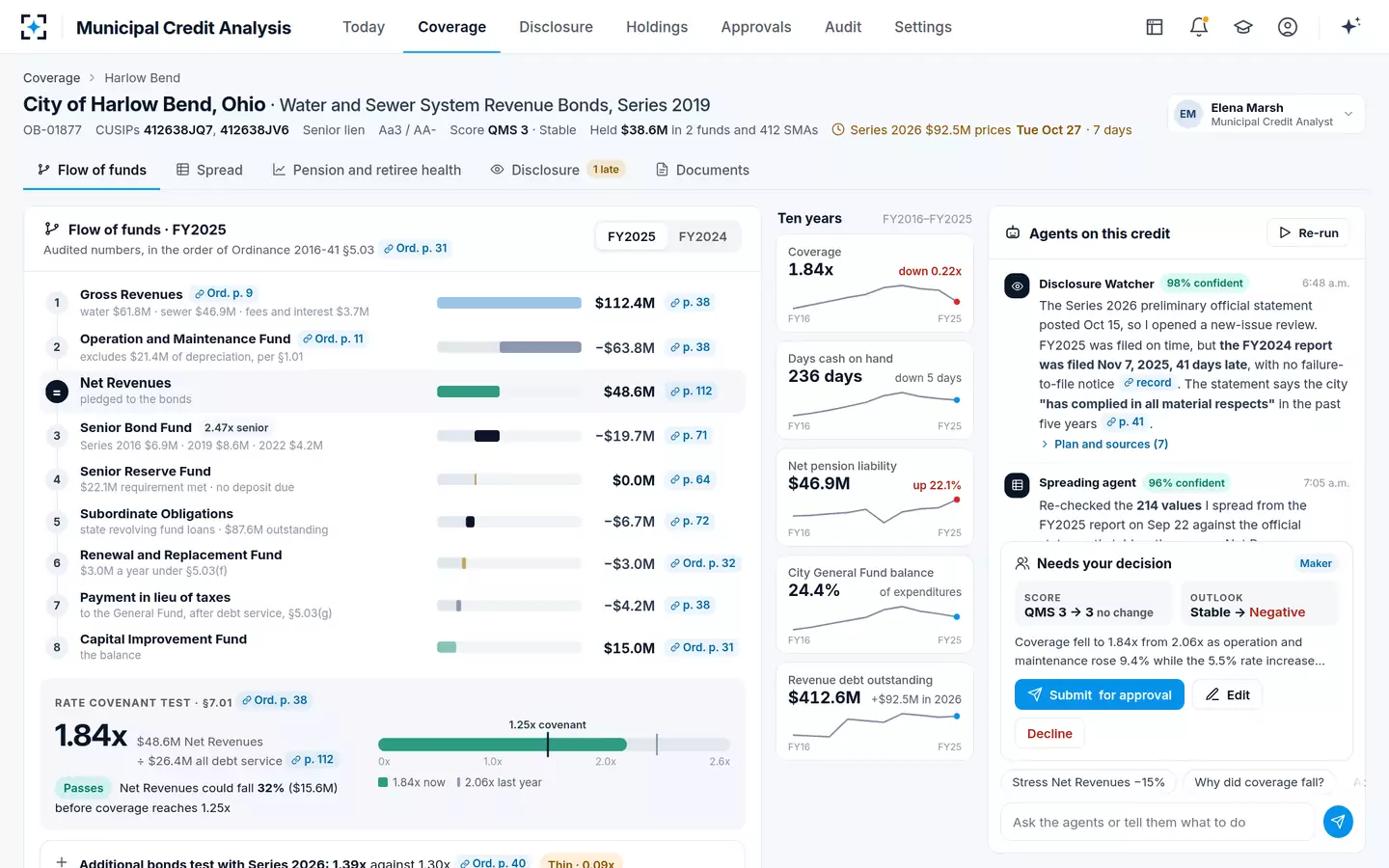
The sample credit makes the reading concrete. Harlow Bend's Ordinance No. 2016-41, section 5.03, sets eight steps for its water and sewer revenues. The table follows FY2025's audited numbers through them, with the section that governs each step and the page the number came from.
Harlow Bend's water and sewer flow of funds, FY2025, in the ordinance's order
| Step | What the ordinance says | FY2025 | What the analyst checks |
|---|---|---|---|
| 1. Gross Revenues | Charges for water and sewer service, system development charges and investment income as §1.01 defines them | $112.4M | That the $0.2M unrealized gain on reserve investments is left out, as §1.01 requires |
| 2. Operation and Maintenance Fund | Operating costs paid first; depreciation of $21.4M excluded by §1.01 | −$63.8M | What counts as an operating cost, and whether anything debt-like sits inside it |
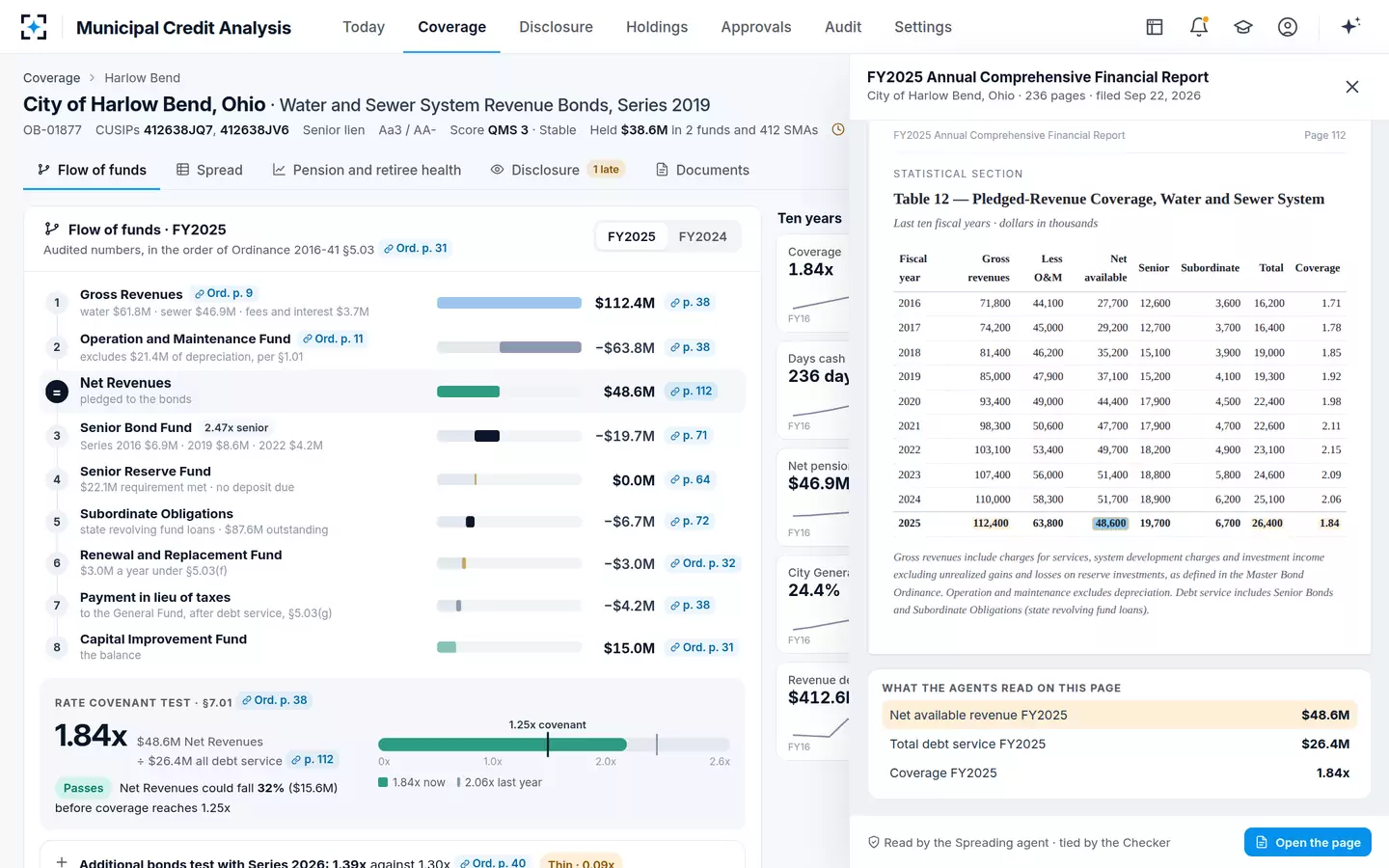
| = Net Revenues | The amount pledged to the bonds | $48.6M | That it ties to the ACFR's pledged-revenue coverage table, page 112 |
| 3. Senior Bond Fund | Series 2016, 2019 and 2022 debt service | −$19.7M | Senior coverage: $48.6M ÷ $19.7M = 2.47x |
| 4. Senior Reserve Fund | Top up to the $22.1M requirement | $0.0M | Whether the reserve is fully funded and in cash or a surety |
| 5. Subordinate Obligations | State revolving fund loans, $87.6M outstanding | −$6.7M | All-in coverage: $48.6M ÷ $26.4M = 1.84x against the 1.25x covenant |
| 6. Renewal and Replacement Fund | $3.0M a year under §5.03(f) | −$3.0M | Whether the deposit is required or discretionary |
| 7. Payment in lieu of taxes | To the General Fund, after debt service, §5.03(g) | −$4.2M | That the city's transfer sits below the bonds, not above them |
| 8. Capital Improvement Fund | The balance | $15.0M | What the system keeps for capital spending |
Two steps in the table carry most of the credit reading. The payment in lieu of taxes sits at step 7, after both liens and the renewal fund, so the city's own claim on the utility is subordinate to the bondholders; had it been listed as an operating expense, it would have come off the top and reduced coverage. And the subordinate state revolving fund loans at step 5 are why the analyst tests two coverages: 2.47 times at the senior lien, 1.84 times all-in, against a rate covenant that the sample ordinance writes on all debt service.
The credit file opens on the flow of funds, each step pinned to the ordinance and the ACFR
What the Pledge agent does, and what it may not do
The Pledge agent reads the resolution's definitions, flow of funds, rate covenant, additional bonds test and reserve requirement, maps the audited numbers onto each step, and tests coverage by the resolution's words. It is one agent in a chain, and the chain is designed so that no single reading goes unchecked.
How one flow of funds is read, mapped, tested and signed
Agent
Spreading agentReads the ACFR's proprietary fund statements, debt notes and pledged-revenue coverage table into the water and sewer template, every value with its page.
Never: guesses an unreadable value
Agent
Pledge agentReads §1.01 definitions and §5.03 flow of funds, maps each audited number to its step, and tests the §7.01 rate covenant and §7.03 additional bonds test, citing the section for every step.
Never: applies a standard ratio where the resolution defines its own; never treats a pro forma as historical
Agent
CheckerRe-derives coverage independently (1.84x), ties Net Revenues to the ACFR's Table 12 and debt service to Note 7, and explains every difference over tolerance.
Never: releases its own block
A person decides
Municipal credit analystQuestions the mapping, asks for stresses, and proposes the view.
A person decides
Senior municipal analystApproves, sends back or rejects with a reason code; never his own view.
The limits are the part to read twice. "Never applies a standard ratio where the resolution defines its own" is the rule that stops a familiar formula, operating income over debt service, from replacing the bond's own test. "Never treats a pro forma as historical" stops a projected rate increase from being counted as if it had been collected, the distinction at the heart of the additional bonds test.
Can AI read a bond resolution?
It can, if every step it reports can be traced to the section it came from and checked by someone or something else. That is a narrower claim than it sounds. Bond resolutions are long, defined terms point to other defined terms, and amendments and supplemental resolutions change the original. A model that summarises a resolution in fluent prose without citations is not reading it; it is producing something an analyst would have to check line by line anyway.
The regulators' framing of agent risk fits the problem closely. FINRA's 2026 oversight report lists, among the risks of AI agents, an agent acting beyond the scope and authority its user meant to give it, and multi-step reasoning whose outcome is hard to trace, explain or audit (FINRA, 2026 Annual Regulatory Oversight Report, quoted in full in AI earnings call analysis with a maker and a checker). A flow-of-funds reading answers both if each step carries a section citation, an independent agent re-derives the coverage, and only a person can release a block or sign the view.
Click Net Revenues and the page it came from opens, with what was read
Questions people ask
What is a bond resolution?
It is the act of the issuer's governing body that authorises the bonds and sets their terms: the pledge, the funds, the flow of funds, the covenants and the remedies. Some issuers use a trust indenture or an ordinance instead; the analyst reads whichever one the bonds were issued under, together with every supplemental resolution since.
What is a subordinate lien bond?
A bond whose claim on the pledged revenues is paid only after the senior lien's debt service has been met. Resolutions usually set lighter conditions for adding subordinate debt than parity debt, which is one reason state revolving fund loans and other later borrowings often sit there, as they do in the sample credit at step 5.
Does a general obligation bond have a flow of funds?
Not in the same sense. A general obligation bond is backed by the issuer's taxing power, usually through a property tax levy into a debt service fund, so the analysis turns on the tax base and the budget rather than on an enterprise's order of payment.
What is a renewal and replacement fund?
A fund the resolution requires to be filled after debt service to pay for replacing worn-out system assets. In the sample flow of funds it takes $3.0 million a year under section 5.03(f), after both liens; where it sits matters, because a deposit ranked above the bonds would reduce what is left for them.
What happens to surplus revenues?
Whatever remains after every required deposit goes where the resolution says, often to a capital improvement fund or the issuer's general fund. Transfers to a city's general fund should sit below the bonds in the flow of funds; an analyst checks that they are not classified as operating expenses, which would put them ahead of debt service.
How often should the flow of funds be re-read?
Whenever a supplemental resolution, a new series or a new loan could change it, and at least when the next official statement appears. A new parity loan or a change to what counts as operating expenses can move coverage without any change in the system's results.