Private side vs public side is the division a credit fund keeps between people who may receive material nonpublic information (MNPI) about borrowers, typically from lender sites, lender groups and creditor committees, and people who analyse and trade securities on public information only. The private side may see compliance certificates, projections and restructuring proposals; the public side may not, so that the fund can keep trading bonds and stocks of the same companies without misusing what its lenders know. The line is enforced by an information barrier, a restricted list and a control room that decides every crossing. Botminds' AI Credit Analysis treats that barrier as the first step of every question: its Wall agent decides what a person may read before any document is chosen, and every answer records what was not searched.
Where this guide shows the solution, it uses a fictional fund group, Quillfield: sample data on fictional people and companies. The law and the cases come from the Investment Advisers Act, SEC rules and SEC enforcement orders and releases, linked where they appear.
Who may read what in a credit fund: one matrix, three seats
SEC filings, indentures, call transcriptsPublic by definition
Public side: analysts, PMs, tradersReads
Private side: loan and special situations teamsReads
Research complianceSees all
Credit agreement filed as an exhibitPublic once filed; drafts and amendments under negotiation are not
Public side: analysts, PMs, tradersReads the filed version
Private side: loan and special situations teamsReads every version
Research complianceSees all
Lender-site material: compliance certificates, projections, lender presentationsUsually confidential under the agreement or a click-through
Public side: analysts, PMs, tradersNever
Private side: loan and special situations teamsReads; issuer goes on their restricted list
Research complianceSees all
Creditor committee and NDA materialMNPI until cleansed
Public side: analysts, PMs, tradersNever, unless wall-crossed
Private side: loan and special situations teamsReads if party to the NDA
Research complianceDecides crossings
House notes and memosMarked public or private by source
Public side: analysts, PMs, tradersReads public-marked
Private side: loan and special situations teamsReads both
Research complianceSees all
Restricted list and watch listThe control room’s record of who knows what
Public side: analysts, PMs, tradersSees the effect, not the reason
Private side: loan and special situations teamsSees the effect
Research complianceOwns it
What is public side vs private side?
The public side works only from information anyone can obtain: filings, public indentures, earnings calls, market prices. The private side has agreed to receive confidential information from a borrower, usually as a lender, and in exchange accepts limits on trading the borrower's public securities. A credit fund that does both needs people on each side and a barrier between them.
The terms are borrowed from syndicated lending, where some lenders elect to receive only public information so that their traders stay free to trade. In a buy-side credit fund the same choice is made per person and per fund: a high-yield bond team usually sits on the public side, a senior loan or special situations team on the private side, and research compliance above the wall, seeing both to supervise.
What is MNPI in fixed income?
In fixed income, MNPI is information about a borrower that is not public and that a reasonable investor would consider important, and credit funds receive it as a by-product of lending. The common sources are lender-site material such as monthly or quarterly compliance certificates, projections and lender presentations; amendment and waiver negotiations; and creditor committee work, where an adviser to the committee receives the borrower's confidential information under a non-disclosure agreement.
The value of that information is measurable. Ivashina and Sun studied institutional investors that held a company's loans and took part in loan amendments: those "institutional participants in loan renegotiations subsequently trade in the stock of the same company and outperform trades by other managers and trades in other stocks by approximately 5.4% in annualized terms" (Ivashina and Sun, SSRN working paper, later Journal of Financial Economics, 2011). Whatever the explanation, the finding is why regulators expect the barrier to be real.
What the cases and the research put on the record
5.4%
annualised outperformance of stock trades by institutions that took part in loan renegotiations
€94M
of an issuer’s bonds one adviser added while sitting on its ad hoc creditors’ committee, before signing an NDA
$685,000
fall in two CLO equity tranches the day after an adviser sold them while holding MNPI about a loan inside
$1.5M · $1.8M
civil penalties in the two settled 2024 cases; a third, litigated, was dismissed in 2025
What policies does the SEC expect for MNPI?
The SEC expects written policies that fit the way the firm actually comes into possession of MNPI. Section 204A of the Investment Advisers Act requires every adviser to "establish, maintain, and enforce written policies and procedures reasonably designed, taking into consideration the nature of such investment adviser's business, to prevent the misuse" of material nonpublic information (15 U.S.C. 80b-4a). Rule 206(4)-7 adds a compliance program, a chief compliance officer, and a review of the policies' adequacy and effectiveness "no less frequently than annually" (17 CFR 275.206(4)-7).
The phrase that decides credit cases is "the nature of such investment adviser's business". A policy written for an equity fund, built on a restricted list of issuers, does not fit a fund that sits in lender groups, joins creditor committees and trades CLO tranches. In both 2024 settled cases the charges were about policies, not insider trading: the SEC found that the written procedures did not address the specific ways the business received MNPI. As the Marathon order puts it, "there is no requirement under Section 204A or Section 206(4) that an underlying violation be found" (SEC, Advisers Act Release 6737).
Do creditor committees create MNPI?
They can, and the moment it arrives is often not the moment the fund signs anything. In the Marathon order, the fund's analysts joined an ad hoc committee of an issuer's unsecured creditors in 2020; the committee's financial adviser signed a non-disclosure agreement with the issuer in October and began receiving its confidential information, while the fund itself told the committee "that it did not wish to restrict trading" until it signed its own NDA (SEC, Advisers Act Release 6737).
Marathon and Issuer 1 in 2020: the position grew while the committee's adviser held the issuer's information
- Builds €35M of bondsMar–Aug
- Adds €94M; sells CDSSep–Nov 5
- Before the committee; issuer explores options from JulyMar–Jul
- Committee forms; adviser retainedAug–Sep
- Adviser has NDAOct–Nov 5
The order's finding was about policies, not trades. Marathon's procedures listed "serving on a creditors' committee of a restructuring" as a situation that might call for the watch list or restricted list, but the firm "did not establish, maintain, or enforce policies and procedures for monitoring or supervision specifically addressing the risk" of committee participation, including no due diligence on how the committee's advisers handled MNPI. The SEC's press release put the expectation in one sentence.
"Investment advisers who regularly enter into formal or informal relationships with companies or interact with financial advisers or other consultants who do so, including through ad hoc creditors' committees, must take into consideration those circumstances when designing their material nonpublic information policies and procedures."
Osman Nawaz, Chief, Complex Financial Instruments Unit, SEC Division of Enforcement, press release 2024-158
When the restricted list covers the issuer but not the instrument
A restricted list keyed to issuers misses instruments that carry the same credit through a structure. Sound Point managed CLOs and sat in an ad hoc lender group for a company whose loans were in those CLOs. Its insider trading policy and restricted list covered the company, but the policy "did not contain any prohibitions on trading a CLO tranche while in possession of MNPI about the underlying loans in that CLO" (SEC, Advisers Act Release 6666).
On July 30, 2019, the firm sold portions of two CLO equity tranches holding the company's loans; compliance approved the sale because its procedures did not ask whether loan-level MNPI mattered to a tranche. When the information became public the next day, the loans fell by more than 50% and the tranches by about 11%, roughly $685,000. Sound Point began pre-clearance reviews that month but adopted no written policy for them until July 2022, and none for third-party CLOs during the period, which ran to June 2024. It settled for a $1.8 million penalty; the SEC's release adds that advisers "must evaluate how their roles as lenders could expose them to MNPI that may relate to their CLO trading positions" (SEC press release 2024-106).
Two settled cases, one lesson: the policy has to follow the business
Marathon Asset Management (2024): Ad hoc creditors’ committees and their financial advisers
Sound Point Capital Management (2024): Ad hoc lender groups for borrowers whose loans sat in its CLOs
Marathon Asset Management (2024): General MNPI procedures; committee service listed as an example
Sound Point Capital Management (2024): An issuer restricted list; no rule on CLO tranches holding the issuer’s loans
Marathon Asset Management (2024): Monitoring of committee participation; diligence on advisers’ handling of MNPI
Sound Point Capital Management (2024): A written pre-trade review until July 2022; nothing for third-party CLOs until June 2024
Marathon Asset Management (2024): Censure, cease-and-desist, $1.5M penalty
Sound Point Capital Management (2024): Censure, cease-and-desist, $1.8M penalty
Silver Point: alleged, and dismissed
The third case shows how a wall can be bypassed through a person rather than a document, and it ended without a finding. In December 2024 the SEC sued Silver Point Capital, alleging that a long-time consultant sat on an ad hoc creditors' committee for Puerto Rico's defaulted bonds, received MNPI from a confidential mediation, and had "more than five hundred calls with firm employees, including those who actively traded such debt", while the firm bought "over $260 million of Puerto Rico bonds" (SEC press release 2024-209).
On April 4, 2025, the SEC announced the dismissal of the action. The allegations were never proven, and the case should not be read as a finding against the firm. Its lesson for design is narrower: a barrier that sorts documents but not conversations leaves a route open.
What is a wall crossing?
A wall crossing is a controlled, recorded decision to bring a public-side person over to the private side for a specific purpose, such as voting on an amendment or evaluating a restructuring proposal. It is requested, approved by compliance, and usually puts the issuer on that person's restricted list until the information is cleansed, made public or goes stale.
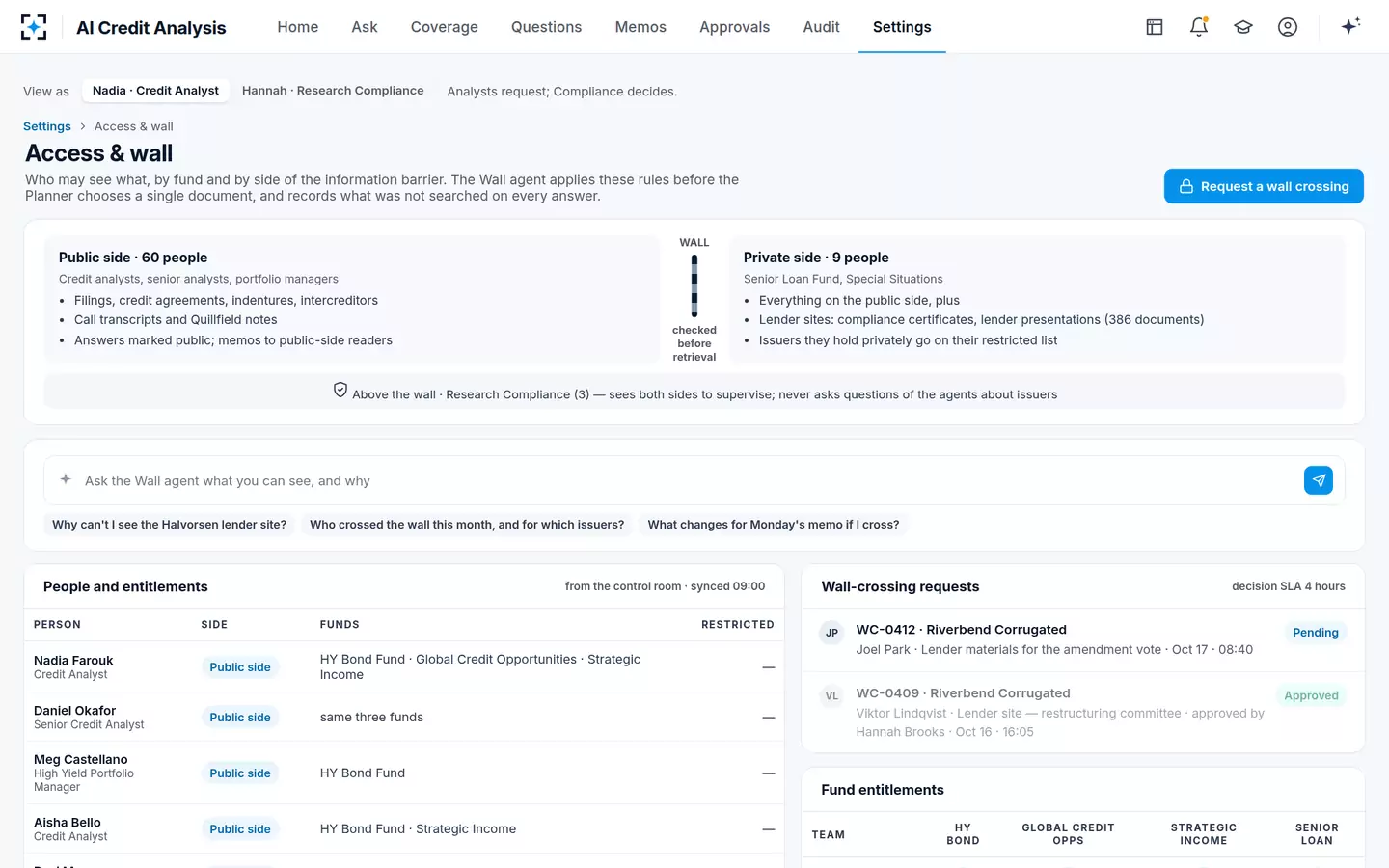
In the sample, wall crossings are requested inside the solution with their restricted-list effect shown, and Research Compliance decides each one against a four-hour target. One pending request asks for lender materials for an amendment vote; an earlier one, approved, brought an analyst over for a restructuring committee.
The wall, the people on each side, and the crossings compliance decides
Can a credit analyst see private lender information?
Only if she is on the private side or has been wall-crossed for that issuer, and then the issuer usually goes on her restricted list. A public-side analyst who covers the company's bonds should not see its compliance certificates, even if a colleague two desks away receives them every quarter.
That is harder to guarantee than it sounds when research runs on shared tools. A search index, a shared drive or a chatbot that has ingested lender-site material can surface it to anyone who asks the right question. The control has to sit in front of the search, not in a policy document beside it.
What happens if MNPI crosses the wall?
Compliance treats it as an incident: the person and often the desk are restricted in the issuer, trading is reviewed, and the firm documents what was seen and when. Whether there is a legal violation depends on whether anyone traded on it, but the policy failure exists either way, which is exactly what the 2024 cases were about.
The cost of finding out late is visible in the orders. After the news broke, one of Sound Point's counterparties demanded rescission or a price reduction of about $350,000 and threatened litigation; the firm paid in full. Marathon restricted trading on the day it signed its NDA, after weeks of building a position while its committee's adviser held the issuer's information. In both, the controls existed on paper and missed the specific route.
Why a research tool must enforce the wall itself
A research tool that reads across the firm's documents is a new route across the wall unless it applies the wall before it reads. In AI Credit Analysis the Wall agent applies the control room's wall list, the restricted list and fund entitlements to the person asking, before the Planner chooses a single document. For a public-side analyst, lender sites are not searched, and the answer says so: in the sample question, "6 public sources searched, lender sites not searched".
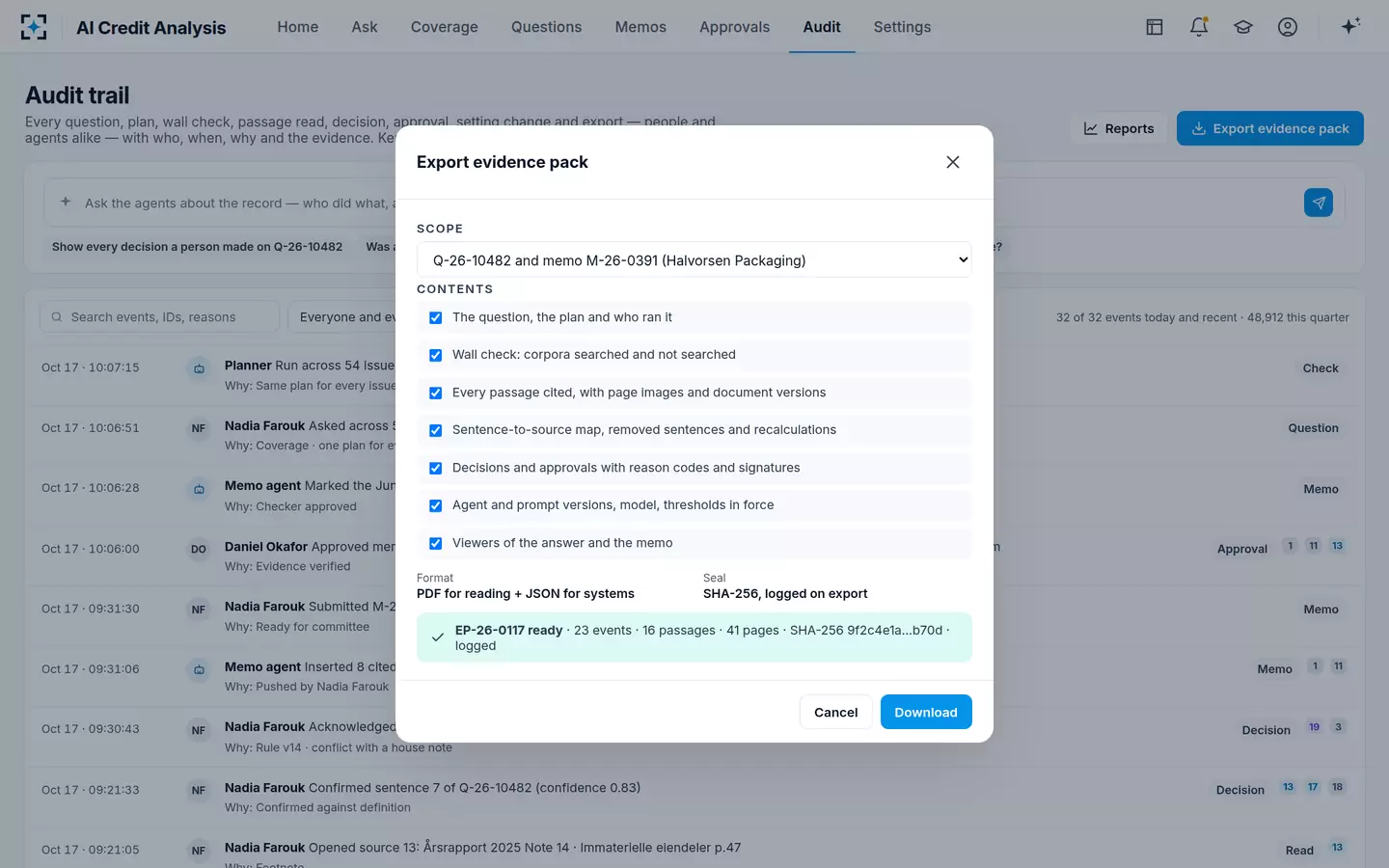
Two details matter for an examiner. First, the agent never reveals what private material says; a public-side user learns only that something exists that she cannot see, and can request a crossing. Second, every wall check is logged under the firm's Section 204A policy with the person, the fund, the sources searched and the sources not searched. How the same answer reaches the other seats on the desk is in the buy-side credit analyst's desk, and why a general chatbot cannot do this is in ChatGPT for credit analysis. The controls themselves are on the AI Credit Analysis page.
Every wall check on the audit trail, exportable for an examiner
Questions people ask
What is an information barrier?
A set of controls that stops material nonpublic information held by one group from reaching another: physical and system separation, a restricted list, a watch list, and a control room that approves crossings. Section 204A requires advisers to have written policies reasonably designed to prevent misuse of such information.
What does "cleansing" mean in a restructuring?
Public disclosure, usually by the issuer, of the material information creditors received, so that they can trade again. The terms are set in the non-disclosure agreement; until the information is cleansed, the creditors who signed usually stay restricted.
Is a credit agreement MNPI?
Not once it is public. A credit agreement that is material to an SEC-reporting issuer is filed as an exhibit; drafts, amendments under negotiation, lender presentations and compliance certificates are typically confidential and belong on the private side.
Do bond funds have restricted lists?
Funds that receive MNPI should, and the Sound Point order shows why the list must cover instruments, not just issuers: a CLO tranche carrying a restricted borrower's loans was sold while the borrower was on the list.
Does every credit fund need a private side?
No. A fund that never lends, never joins lender groups or committees and never accepts lender-site access can stay entirely public. Many choose to, accepting less information in exchange for freedom to trade.