Automated credit analysis tools are software that takes over part of a credit analyst's reading and arithmetic: spreading and data tools that pull figures from filings, research assistants from data vendors that answer questions from the vendor's own content, and agents that read the fund's own documents, including credit agreements as amended, indentures and house notes, and cite every sentence. A head of credit research choosing among them is really choosing how to buy more deep answers per analyst, and the fourth option, hiring, belongs in the same comparison. Botminds' AI Credit Analysis is the third kind, and this guide prices all of them on one analyst's book so the trade-off is visible.
The book belongs to Nadia Farouk, a fictional credit analyst at a fictional fund group, Quillfield, covering 54 issuers: sample data on fictional people and companies. Wages come from the Bureau of Labor Statistics. The hours per question are our estimate for one priming-capacity question on a sponsor-owned high-yield issuer, including the senior analyst's review; every other assumption is stated where it is used, so you can replace it with your own.
Three years of deep questions on a 54-issuer book: analyst time, by hand and with agents
What are automated credit analysis tools?
Automated credit analysis tools fall into three families, distinguished by what they read. Spreading and data tools read financial statements and fill templates; they answer "what are the numbers?". Research assistants from data vendors read the vendor's own content, its news, transcripts, filings and analyst notes, and answer questions in chat. Agents that work on the fund's own documents read the credit agreement as amended, the indentures, the intercreditor, foreign filings and the fund's own house notes, and answer the questions those documents decide.
FINRA's survey of broker-dealers found the same direction of travel: the most common generative AI use among its member firms is summarising long documents and extracting specific facts from them, which FINRA files under "Summarization and Information Extraction" (FINRA, 2026 Annual Regulatory Oversight Report). The survey covers broker-dealers, not asset managers, but the task is the same one a credit desk spends its days on.
Where an analyst's hours go on one deep question
Most of the hours in a credit question are spent finding and applying documents, not judging them. The estimate below splits one priming-capacity question, can new debt be put ahead of our notes, into six steps, by hand and with the agents reading first.
Where 18.5 hours go on one priming question by hand
By hand · 18.5 hours (estimate)
- Finding the agreement, every amendment, indentures, filings, call · 16%
- Applying amendments, tracing defined terms · 32%
- Basket arithmetic at today’s EBITDA · 16%
- Foreign filings and the call · 11%
- Writing the memo with citations · 16%
- Senior review and sign-off · 8%
With the agents · 1.8 hours (estimate)
- Finding documents · 6%
- Amendments and definitions · 17%
- Arithmetic · 11%
- Foreign filings and call · 11%
- Memo · 28%
- Senior review · 27%
The shape matters more than the total. By hand, applying amendments, tracing definitions and working the basket arithmetic take almost half the time; with the agents, more than half of what is left is the memo and the senior review, the parts that should take a person's time. That is the test of any tool: whether it removes the retrieval, or just moves it.
How many issuers can one credit analyst cover?
No regulator or labour survey publishes a figure, and coverage is a choice of depth as much as of names. The arithmetic above makes the choice explicit. If each of 54 issuers gets four deep questions a year, one after each quarterly or annual report, that is 216 questions; at 18.5 hours each, it is 3,996 hours a year, about 1.9 analysts' worth of time at 2,080 hours each, before initiations, calls and meetings.
No desk actually spends that; it asks fewer deep questions and accepts thinner coverage on some names. The real cost of doing it by hand is therefore the questions not asked: the amendment no one traced before the committee, the 10-Q that cut EBITDA and with it a basket. In the sample, one issuer's ratio debt capacity fell from $160 million to $41 million after its 10-Q, and the change surfaced overnight because a watched question was re-run.
Option 1: hire another analyst
Hiring adds judgement as well as hours, which no tool does. It is also the most expensive way to buy reading. The Bureau of Labor Statistics puts the median wage of financial and investment analysts at securities and investment firms at $124,370 in May 2025, and the top 10% of the occupation earned more than $180,860 (BLS). Three years of one median wage is $373,110 before bonus, benefits, recruitment and the months a new analyst needs to learn the book.
A second analyst on the same book also splits it: each reads half the issuers, and neither sees the cross-issuer pattern. In the sample, one follow-up question about the whole book found two more issuers whose IP blocker misses a non-guarantor subsidiary. That kind of answer depends on one reader seeing the whole book, not on headcount.
Option 2: a research assistant from a data vendor
A vendor's research assistant is quick to deploy and good at the public, generic part of a question: the latest filing, the call transcript, the news. Vendors don't publish prices for these assistants, so the cost is your quote. The limit is what they read. They answer from their own content, not from the fund's indentures, its conformed credit agreements, its house notes or its information barrier.
Which of the six steps each kind of tool can take on
A vendor's research assistant: Public filings and transcripts in the vendor’s library.
Agents on the fund's own documents: Your document management, filing feeds and transcript feed, including lender-site material for private-side users.
A vendor's research assistant: Only if the vendor holds the agreement and every amendment, and only as the vendor parsed them.
Agents on the fund's own documents: Reads the agreement as amended and traces defined terms; flags undefined or conflicting terms.
A vendor's research assistant: Rarely at today’s EBITDA as the agreement defines it.
Agents on the fund's own documents: Computes each basket at the defined EBITDA; a checker recomputes within 0.5%.
A vendor's research assistant: Depends on the vendor’s coverage and translation.
Agents on the fund's own documents: Original language beside the English; below 0.90 translation confidence a person checks first.
A vendor's research assistant: Not read.
Agents on the fund's own documents: Read, and conflicts with a house note block the memo until acknowledged.
A vendor's research assistant: Not applied: the vendor does not know your wall.
Agents on the fund's own documents: Wall list, restricted list and fund entitlements applied before anything is read.
Option 3: agents reading your own documents
Agents shrink the retrieval and arithmetic steps and leave the judgement where it was. In AI Credit Analysis the sample priming question was answered in 96 seconds, eight sentences cited to 16 passages in 9 documents, and the analyst's real work was one sentence below the confidence line. Asked across the whole book, one question returned 51 cited answers in 6 minutes 40 seconds and sent 3 to a person, each with its reason.
One question across 54 issuers: 51 answered, 3 sent to a person
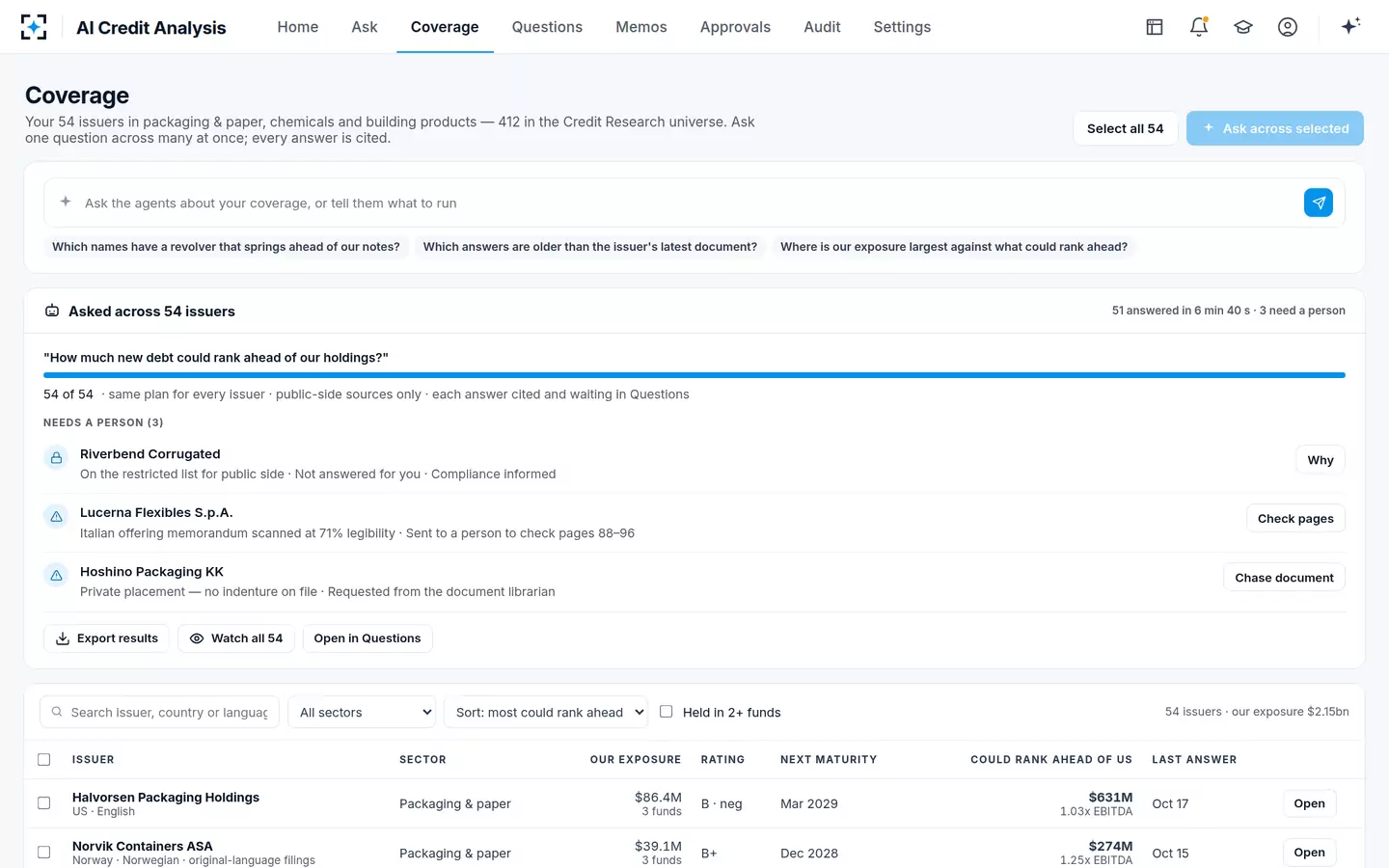
The exceptions are part of the price. A tool that reads your documents is only as good as your documents: a private placement with no indenture on file, or a scan at 71% legibility, will not produce an answer, and should not. Budget the document librarian's time to close those gaps.
How much does credit analysis software cost?
Vendors in this market quote case by case, so the honest way to compare is to price what you can measure, analyst time, and set each licence quote against it. On the estimate above, the deep questions on one 54-issuer book cost about $717,000 of analyst wages over three years by hand and about $70,000 with the agents reading first. The difference, about $647,000 per analyst over three years, is the ceiling a licence and its implementation must sit well under.
The three-year arithmetic for one analyst's book, with every assumption shown
| Line | By hand | With agents | Basis |
|---|---|---|---|
| Deep questions a year | 216 | 216 | 4 per issuer × 54 issuers (assumption) |
| Hours per question | 18.5 | 1.8 | Our estimate, split above |
| Analyst hours a year | 3,996 | 389 | Questions × hours |
| Analyst hours, three years | 11,988 | 1,166 | × 3 |
| Wage cost, three years | $716,800 | $69,700 | × $59.79 an hour, BLS May 2025 median |
| Licence and implementation | — | Your quote | Not published |
| Records to keep | Five years for the records Rule 204-2 lists | Same, exported on demand | 17 CFR 275.204-2(e)(1) |
The line most budgets leave out: proving what was read
The cost of a credit view does not end when the memo is signed; it ends when someone can show, years later, what it rested on. Rule 204-2 requires an adviser to keep the books and records it lists for "not less than five years", the first two in an appropriate office (17 CFR 275.204-2(e)(1)). The CFA Institute's standard adds that the medium is no excuse: "The nature or format of the information does not remove members' and candidates' responsibility to maintain a record of information used in their analysis or communicated to clients" (CFA Institute Standard V(C)).
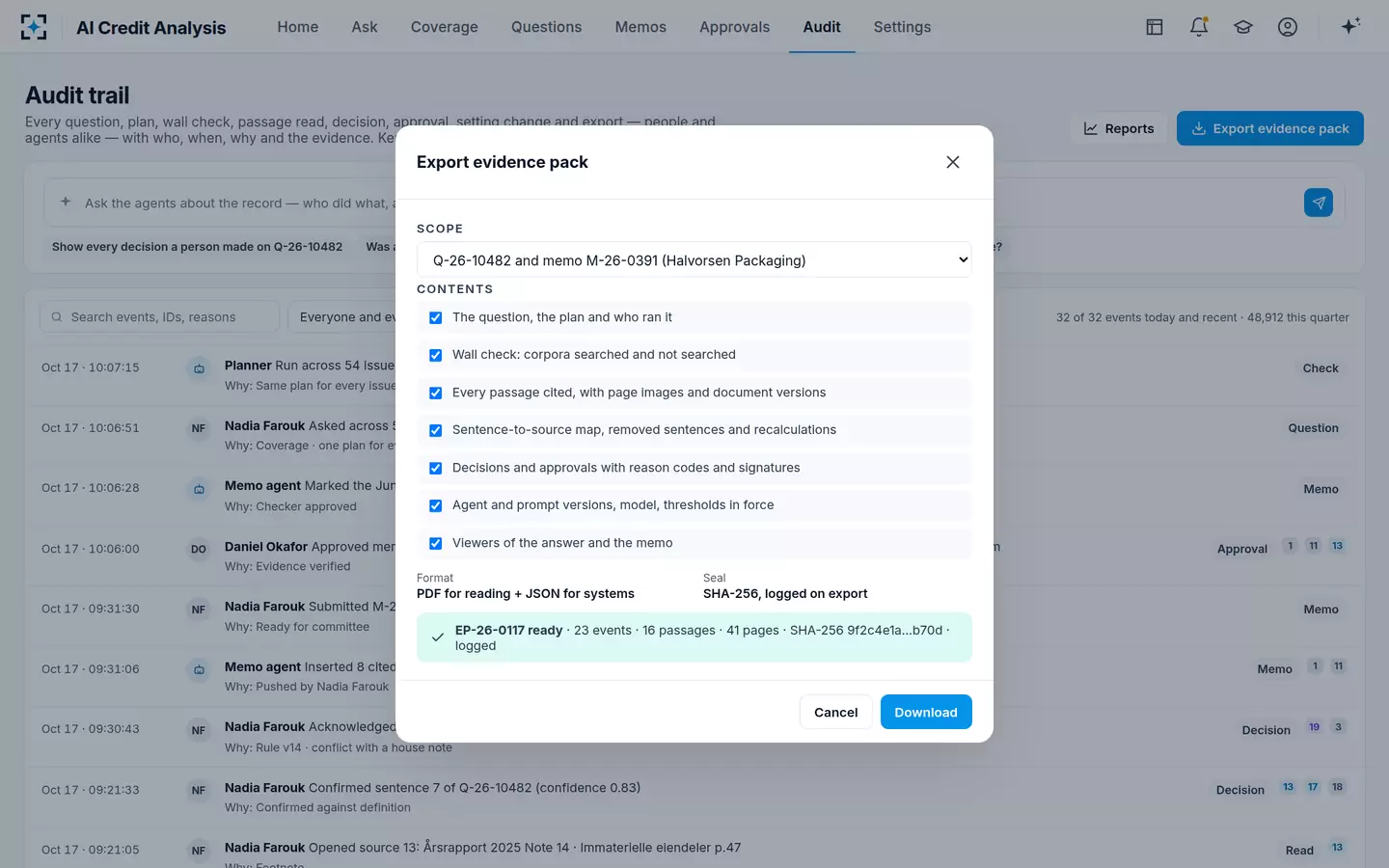
By hand, that evidence is a folder of PDFs, emails and a spreadsheet nobody can re-run. With the agents, each question, plan, passage read, decision and approval is kept, and an evidence file for any answer exports in one step. That line rarely appears in a business case and often decides the second year's budget, after the first exam request.
The evidence behind one memo, exported in one step
How to justify AI spend in credit research
Justify it on hours you can count and questions you can name, not on a vendor's percentage. The formula below turns the estimate into a business case a chief operating officer can check, term by term.
The ROI of automating credit analysis, term by term
Analyst hours released
(hours by hand − hours with agents) × deep questions a year
Measure both sides on your own past questions in a pilot; the sample estimate is 18.5 against 1.8 hours.
Head of credit research
Value of an hour
× loaded hourly cost
BLS gives a wage floor of $59.79 an hour at the 2025 median; your loaded cost with bonus and benefits is higher.
Finance
Questions now asked
+ deep questions a year you could not staff before
Name them: watched questions re-run after every amendment and 10-Q, cross-issuer questions across the book.
Portfolio managers
The system’s own cost
− licence − implementation − pilot hours
Including the document librarian’s time to load agreements, amendments and house notes.
COO
Build vs buy a credit research platform
Building means owning the reading, the checking and the controls. The reading is the easy part to prototype and the hard part to make dependable: amendments applied in order, defined terms traced, arithmetic recomputed, citations re-read against the current version. The controls are what an examiner asks about: the wall applied before reading, maker and checker, a second signature to change a threshold, records kept for years. A team that builds should budget for those, not just for the model.
Buying means checking that the product does all of them on your documents. A two-week pilot on your own notes sets out how to test that, and what a general chatbot gets wrong on filings covers the cheapest option of all. AI Credit Analysis is built from your requirements and documents, and the setup it needs is on the solution page.
Questions people ask
Do credit analysis tools read our own documents?
Some do, many do not. Vendor research assistants answer from the vendor's content; tools built for a fund's own documents read its agreements, indentures and house notes. Ask each vendor to answer one of your past questions from your own amended credit agreement and show the page.
What does a credit research assistant tool cost?
Vendors don't publish prices for these assistants; they quote by seat or by firm. Compare quotes against measured analyst hours: on the sample estimate, analyst time on deep questions for one 54-issuer book is about $717,000 over three years by hand.
Is automated credit analysis accurate enough to rely on?
Only with checks a person can see. In AI Credit Analysis a separate checker recomputes every figure within 0.5%, removes uncited sentences and sends any sentence below 0.85 confidence to the analyst; in the sample house 6.4% of sentences reach a person.
Can automation replace a credit analyst on a high-yield book?
No: it replaces reading and arithmetic, not judgement or signatures. The analyst still decides low-confidence sentences and writes the recommendation, and a senior analyst still signs before a portfolio manager reads.
How long before automated credit analysis pays back?
It depends on how many deep questions the desk asks. On the sample estimate, each deep question releases about 16.7 analyst hours, about $1,000 of wages at the BLS median, so payback is the licence and implementation cost divided by that figure times your yearly question count.