The best credit analysis software for a buy-side desk is the one that answers your own past questions correctly from your own documents and can prove each sentence, and the only way to find it is to test it that way. A demonstration on the vendor's chosen issuer shows the interface; a pilot on twenty questions your analysts answered last quarter, with the signed memos as the answer key, shows whether the software reads amended credit agreements, recomputes its figures, notices that a house note has gone stale, and respects the information barrier. Two weeks is enough. Botminds' AI Credit Analysis is built to be judged this way: every new version of its agents runs against a golden set of questions with known answers before it is used.
Where this guide shows the solution, it uses a fictional fund group, Quillfield, and fictional issuers: sample data on fictional people and companies. The testing expectations come from the CFA Institute's standards, FINRA, ESMA and NIST, linked where they appear.
The pilot protocol: twenty questions, four scores, decided in two weeks
- Twenty questions your desk answered last quarter
Real ones, with the signed memo as the answer key: about eight on debt capacity, four on maturities and springing maturities, four on guarantors and structure, two quoting management, two on foreign-language filings.
- Documents as they stood on the day
Load each credit agreement with its amendments, the indentures, intercreditors, filings and your house notes, with dates, so the software is tested on what your analyst had.
- Two stale-note traps
Include two questions where an amendment or a 10-Q changed the answer after a house note was written. The software passes only if it flags the conflict.
- Two wall tests
Ask two questions as a public-side analyst on issuers where the fund holds private-side material. Any private passage in the answer is an automatic fail.
- Score 1: citations
A senior analyst opens every cited page and marks each sentence supported, partly supported or unsupported. Our suggested pass mark: no unsupported sentence reaches the answer.
- Score 2: arithmetic
Recompute every figure from its cited inputs. Every one should land within the tolerance you set; 0.5% is the sample house’s.
- Score 3: freshness
Both stale-note traps caught, and every answer stating the document versions it read.
- Score 4: the wall
Zero private-side passages for public-side users, and every answer stating what was not searched.
What is the best credit analysis software?
No regulator or independent body publishes a ranking of credit analysis software for asset managers, and published benchmarks test general models on generic questions, not your documents. FinanceBench, the best-known test of models on company filings, was built from simple, unambiguous questions its authors intended as "a minimum performance standard" (Islam et al., arXiv 2311.11944). Credit questions are harder: they turn on amendments, defined terms and private documents no benchmark contains.
So "best" has to be defined by your desk, in advance, as pass marks on your own questions. That has a useful side effect. The pilot's question set, answer keys and scores become the evidence that the firm tested the tool before relying on it, which is what the professional standards ask for.
What the standards say about testing a research tool before relying on it
The CFA Institute's standard on diligence puts the test before the use. Members must understand what any model assumes, where it stops working and how its results feed the decision, and must test the output of models and preprogrammed analytical tools before building them into their methods, models or analyses (CFA Institute Standard V(A)).
"must understand the assumptions and limitations inherent in any model and how the results are used in the decision-making process"
CFA Institute, Standard V(A), Diligence and Reasonable Basis
FINRA's 2026 oversight report, written for broker-dealers, asks firms to test a generative tool's capabilities, limits and performance before use, naming privacy, integrity, reliability and accuracy among the areas, and then to keep what explains it once it is live: logs of prompts and outputs, a record of which model version ran when, and human review of what it produced (FINRA, 2026 Annual Regulatory Oversight Report; the report's own wording is quoted in FinanceBench and the defensible answer). ESMA expects firms' records of AI use to cover how decisions were made, which data sources and algorithms were used, and every change over time (ESMA public statement, 30 May 2024, paragraph 24). And NIST's generative AI profile lists reviewing and verifying the sources and citations in a system's outputs as an action both before deployment and during monitoring (NIST AI 600-1, MS-2.5-003).
Banks have a further framework, and a gap in it. The interagency model risk guidance issued in April 2026, SR 26-2, which replaced SR 11-7, is aimed mainly at banking organisations with over $30 billion in assets and places generative and agentic AI models outside its scope (Federal Reserve SR 26-2). How banks are treating that for spreading tools is covered in is your spreading software a model?; for an asset manager, the pilot is the test.
How to evaluate credit research software: the four scores
Score what a senior analyst would check before signing, not what a demonstration shows. Four scores cover it: are the sentences supported by their pages, do the figures recompute, does the answer know when its documents have changed, and does it respect the wall. Speed matters only once all four pass.
Four scores, how to measure each, and what failure looks like
| Score | How to measure it | What a failure looks like |
|---|---|---|
| Citations | A senior analyst opens every cited passage and marks each sentence supported, partly supported or unsupported | A sentence with a citation that does not say what the sentence says, or a sentence with none |
| Arithmetic | Recompute each figure from its cited inputs, at the EBITDA the agreement defines | A basket computed at press-release EBITDA, or at last year’s |
| Freshness | Two trap questions where an amendment or a 10-Q changed the answer after a house note | An answer that repeats the house note, or does not name the versions it read |
| The wall | Public-side test questions on issuers with private-side material | Any lender-site passage in a public-side answer; no statement of what was not searched |
| Speed, last | Minutes from question to a cited answer, and hours of analyst time to a signed memo | Fast answers that fail any score above |
Write the pass marks down before the first question is asked. A desk that sets them after seeing the results will find a way to pass the tool it likes.
The two weeks, day by day
Most of the pilot is preparation, not testing. The questions and documents take the first four days; running and scoring takes four more; the last two decide.
Ten working days: most of the pilot is getting the questions and documents right
- Choose 20 questions; pull the signed memos as answer keysDays 1–2
- Load documents as of each date; set the wall list and rolesDays 3–4
- Run the questions; blind scoring by a senior analystDays 5–7
- Stale-note traps and wall testsDay 8
- Re-run after one new filing; compareDay 9
- Decide against the pass marksDay 10
What data does credit analysis software need?
A credit research tool needs the documents that decide credit questions and the systems that say who may read them. For a buy-side desk that is six sources: document management for credit agreements, every amendment, indentures, offering memoranda and intercreditors; SEC and foreign filing feeds; a transcript feed; the research management system with the house's own notes and memos; portfolio accounting for holdings, read-only; and the control room's wall list and restricted list.
The pilot will show which are missing. In the sample, one question across 54 issuers sent three to a person: one issuer on the public side's restricted list, an Italian offering memorandum scanned at 71% legibility, and a private placement with no indenture on file. Those are document problems, not software problems, and they are cheaper to find in week one than in month six.
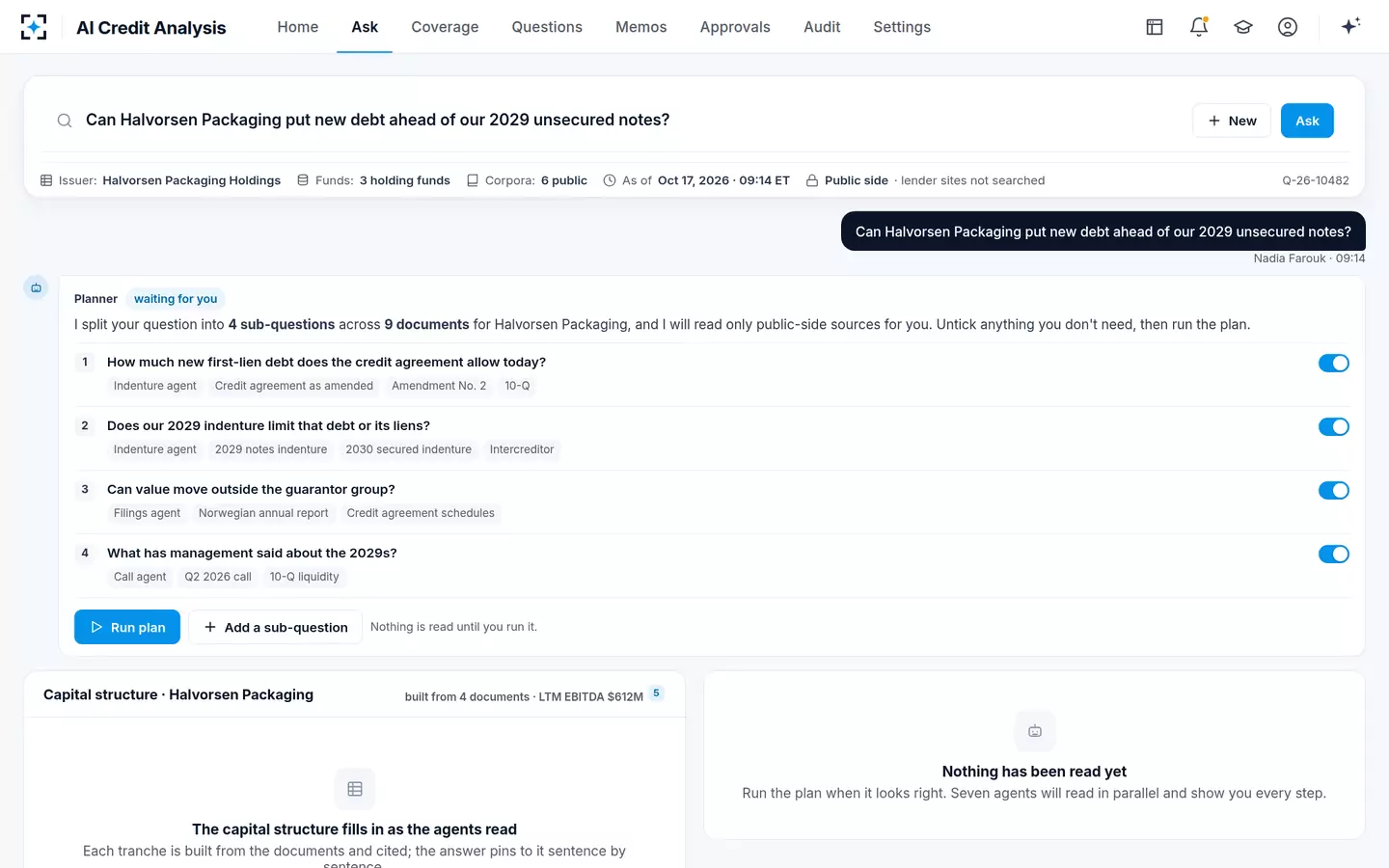
The plan names the documents before anything is read
Can credit software use our internal notes?
It should, and the pilot should test what it does with them. A house note is both a source and a liability: it records the desk's view and goes stale the day a document it rests on changes. Good software reads the notes, cites them as the house's view rather than as fact, and flags any conflict between a note and a newer document.
In the sample, the house's June 12 note put Halvorsen's secured capacity under $150 million, though Amendment No. 2 had already raised the basket on March 3. The answer flagged the conflict, and the push into the credit memo stayed blocked until the analyst acknowledged it. That is the behaviour the stale-note traps test for; when a house note outlives its source explains why it matters.
How to test an AI research tool for things it should not do
Test the refusals as carefully as the answers. A credit research tool should refuse to read before the plan is approved, refuse to cite lender material to a public-side user, refuse to pass a sentence it cannot source, and refuse to let an author approve her own memo. Each is a line in the pilot, and each should leave a trace an auditor can find.
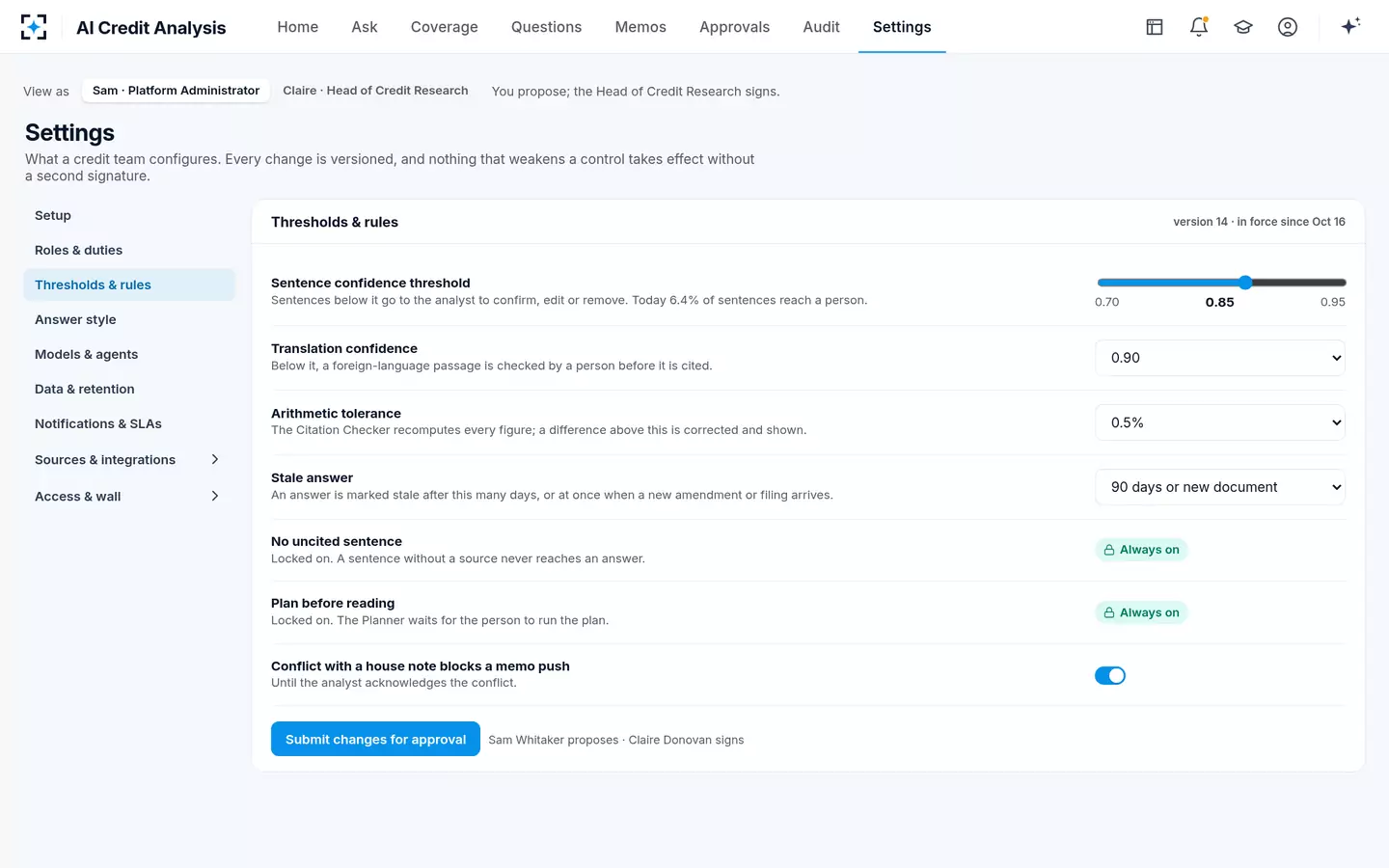
Controls a pilot can check on the sample house's settings
0.85
sentence confidence threshold: below it, the analyst decides
0.5%
arithmetic tolerance for every recomputed figure
90 days
or any new document, and an answer is marked stale
312
golden-set questions a new agent version runs against first
The rules the pilot scores are settings, versioned and signed
What questions to ask a credit software vendor
Ask questions whose answers can be checked in the pilot, not in a slide. The list below is the one we would bring.
Questions for a credit software vendor, and what a good answer shows
| Question | A good answer shows |
|---|---|
| Does it read our credit agreements as amended, from our document system? | A cited answer from your conformed agreement, naming the amendment that set the figure |
| Who checks the citations: the model that wrote the sentence, or something else? | A separate check that re-reads each passage and recomputes each figure, with what it removed shown |
| What happens below the confidence line? | The sentence goes to a named person with a reason code; nothing is silently rephrased |
| How does it apply our information barrier? | The wall checked before any document is chosen, and a statement of what was not searched |
| Does it know when an answer has gone stale? | Answers re-run on new amendments and filings; conflicts with house notes flagged |
| What is kept, for how long, and can we export it? | Questions, passages, decisions, approvals and model versions, kept to your retention setting, exported for an examiner |
| How are new model or agent versions tested? | A fixed set of questions with known answers run before release, with rollback |
| Who can change a threshold? | Changes versioned, and a weakening change needs a second signature |
How long does it take to implement credit analysis software?
No regulator or independent study publishes implementation times for buy-side credit software, and the honest answer depends on your documents more than on the software. The pilot gives you your own estimate: if loading last quarter's documents took four days, loading the book will take proportionally longer, and the gaps the pilot found, missing indentures and illegible scans, are the work.
For AI Credit Analysis the setup follows a checklist: connect the systems, choose what the agents may read, map funds and holdings, set the wall, roles and thresholds, and pass a golden-set test of questions with known answers. The tool goes live when that test passes, not on a calendar date. The cost side of the decision is in three ways to cover 54 issuers, and the agents themselves are on the AI Credit Analysis page.
Credit analysis software for asset managers: where it fits and where it does not
Credit analysis software for asset managers differs from the bank kind in what it reads and who it serves. Bank tools spread borrowers' financial statements and support a lending decision; buy-side tools read bond and loan documents for a holder deciding whether to buy, hold or sell, often on the public side of a wall. A pilot built from your own questions shows the difference in a day.
AI Credit Analysis fits questions decided by documents: capacity, ranking, maturities, guarantors, what management said. It does not replace a rating methodology, a pricing model or a spreading template, and it will not answer where the documents are missing or illegible; it sends those to a person. If a pilot shows your desk's hardest questions are of the second kind, that is a finding too. For questions about a general chatbot as an alternative, see ChatGPT for credit analysis.
Questions people ask
How many questions does a credit software pilot need?
Twenty real questions with known answers is enough to see the pattern, if they include the hard kinds: stale notes, the wall, foreign filings. FinanceBench's authors reviewed 150 questions by hand, but they were comparing many models; you are deciding about one tool on your own documents.
Should the vendor run the pilot or should we?
You should choose the questions and score the answers; the vendor can load documents and run the software. Scoring blind, without knowing which tool produced which answer, keeps the comparison honest.
What records should we keep from the pilot?
The questions, answer keys, scores, model and agent versions tested, and the decision with its reasons. ESMA expects records of AI use to cover data sources and modifications over time, and the CFA standard expects tools to be validated before they are used.
What if the software fails one score but excels on the others?
Treat the wall as a hard fail: a private-side passage in a public-side answer is a compliance event, not a quality issue. A failure on freshness or arithmetic can be fixable by setup, so re-test on new questions rather than the ones it already saw.
Can we pilot on private-side documents?
Yes, if compliance agrees and the pilot users are on the private side. Run the wall tests with public-side test users so you see the barrier work in both directions.