High yield credit research is the analysis of companies rated below investment grade, and their bonds and loans, for investors who need to know whether the company will pay, how much can be put ahead of them, and what they recover if it does not. In practice, much of it turns on one number that appears twice. Management presents an adjusted EBITDA on the earnings call; the indenture and credit agreement define their own Consolidated EBITDA, with their own add-backs, and that contractual figure sizes every "greater of" basket and every ratio test that decides how much new debt the company may take on. The two are often different, and the covenant capacity a fund cares about follows the second. Botminds' AI Credit Analysis reads the definition in the documents and computes each basket at the EBITDA the agreement defines, and its Citation Checker corrects any figure that slipped in from a press release.
The examples use a fictional issuer, Halvorsen Packaging, and the fictional Quillfield funds that hold its 2029 notes: sample data on fictional people and companies. Where an illustration needs simpler numbers, it says so. The rules come from the SEC's Regulation G and staff interpretations, and the research from NBER and the Federal Reserve, linked where they appear.
The high-yield market, and how far an EBITDA definition can stretch
$1.77T
high-yield and unrated US corporate bonds outstanding at the end of 2025, up 4.7% in a year
$263B
in high-yield mutual funds at the end of 2025, up 13% since the end of 2019
12
modifications to the standard definition of EBITDA in the average credit agreement studied
What is high yield credit research?
High yield credit research is credit analysis where the documents matter as much as the numbers, because the issuers are leveraged and the protections are negotiated. The Federal Reserve counts $1,772 billion of high-yield and unrated corporate bonds outstanding at the end of 2025, beside $1,549 billion of leveraged loans (Financial Stability Report, May 2026), and a Federal Reserve staff note puts high-yield mutual funds at $263 billion (FEDS Note, August 2026).
For the analyst covering those issuers, a quarter brings three kinds of reading: the filing, the call, and the documents that turn both into capacity. The filing gives GAAP numbers; the call gives management's adjusted view; the indenture and credit agreement say which of those adjustments count when the company wants to borrow more. Research that reconciles the three every quarter catches the headroom nobody announced.
Adjusted EBITDA on the call vs Consolidated EBITDA in the indenture
They answer different questions. Adjusted EBITDA on the call is management's view of the earning power of the business, chosen to persuade. Consolidated EBITDA in the indenture is a contract term, negotiated at issuance, that decides what the company is allowed to do. The first can change with the slide deck; the second changes only by amendment or consent.
Two EBITDAs, side by side
Adjusted EBITDA on the earnings call: Management, in each release or presentation.
Consolidated EBITDA in the indenture: The issuer and its first investors, at issuance; changed only by amendment or consent.
Adjusted EBITDA on the earnings call: Showing earning power to investors.
Consolidated EBITDA in the indenture: Sizing baskets and ratio tests: how much debt, liens and payments the company may make.
Adjusted EBITDA on the earnings call: For SEC registrants, Regulation G: a GAAP comparison and a reconciliation, and no misleading presentation.
Consolidated EBITDA in the indenture: The contract. Its content is negotiated, not regulated; MD&A may have to discuss it where the covenant is material to liquidity.
Adjusted EBITDA on the earnings call: Restructuring and one-time charges, non-cash items, sometimes projected savings.
Consolidated EBITDA in the indenture: Often the same and more, such as pro forma cost savings for a set period, each with its own cap or none.
Adjusted EBITDA on the earnings call: The release, the slides, the transcript.
Consolidated EBITDA in the indenture: The definitions section, usually long; amendments can change it.
Adjusted EBITDA on the earnings call: Compares it with the reported figures and the last quarter.
Consolidated EBITDA in the indenture: Recomputes every basket and ratio test at it, every quarter.
What is adjusted EBITDA in high yield, and what may it be called?
Adjusted EBITDA is EBITDA with further items added back or taken out, and the SEC's staff insists the label say so: a measure computed differently from EBITDA as the Commission described it must not be called EBITDA and needs a distinguishing title, with Adjusted EBITDA as the staff's own example (C&DI 103.01). Regulation G defines a non-GAAP measure as one that excludes amounts included in, or includes amounts excluded from, the most directly comparable GAAP measure (17 CFR 244.101).
The staff also draws a line on substance: "Presenting a non-GAAP performance measure that excludes normal, recurring, cash operating expenses necessary to operate a registrant's business is one example of a measure that could be misleading" (C&DI 100.01). That line binds what an SEC registrant presents publicly. It does not bind the definition in a privately negotiated indenture.
What is Consolidated EBITDA in an indenture?
Consolidated EBITDA is the indenture's or credit agreement's own defined term: typically net income of the issuer and its restricted subsidiaries, with specified items added back, used to compute the leverage and coverage ratios that govern new debt, liens and payments. It is written by lawyers, not accountants, and it can be long. Ivashina and Vallée found that "the average contract allows for twelve modifications to the standard financial definition of EBITDA", giving pro forma cost savings as an example (NBER Working Paper 27316). How that figure sizes the baskets a company can pay out of is worked through in the restricted payments covenant.
Two features make it hard to compute from the outside. It covers only restricted subsidiaries, so a subsidiary designated unrestricted drops out of the figure. And where an add-back is capped as a share of EBITDA, the definition has to say whether the cap is measured before or after the add-back, which changes the answer. Their study is of loan agreements; an indenture's definition has to be read on its own terms, which is why the analyst reads the one in the document rather than assuming.
How add-backs move the number: an illustration
Take an illustrative issuer, not the sample, whose management presents Adjusted EBITDA of $500 million on the call. Before adjustments, EBITDA is $360 million. Management adds back $40 million of restructuring and non-cash charges and $100 million of projected cost savings. The indenture allows the charges in full but caps cost savings at 12.5% of EBITDA before those savings, $50 million. Consolidated EBITDA is $450 million.
Illustration: what the indenture keeps from $500 million of Adjusted EBITDA on the call
Adjusted EBITDA on the call · $500M
- EBITDA before adjustments, $360M · 72%
- Charges the indenture also adds back, $40M · 8%
- Cost savings within the indenture’s cap, $50M · 10%
- Cost savings above the cap, $50M: excluded · 10%
The $50 million gap is a tenth of management's number. At a 4.0x ratio-debt test it is $200 million of borrowing capacity that the call implies and the indenture does not allow. Run the other way, an indenture whose definition is broader than management's presentation allows more debt than the call suggests, which is the case a bondholder should worry about more.
How do add-backs affect covenants?
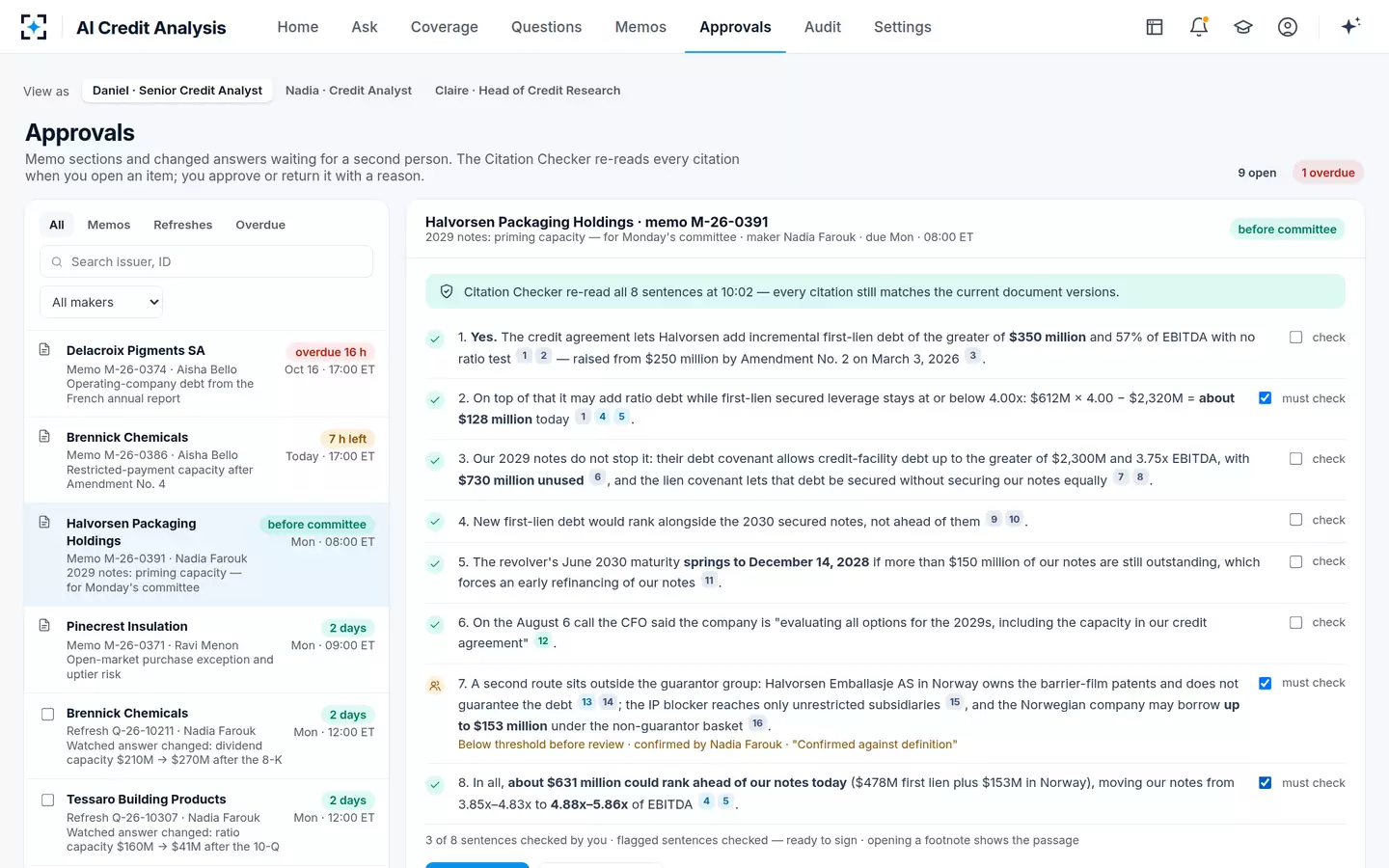
Every dollar of Consolidated EBITDA is multiplied by every ratio and percentage in the document. In the sample, Halvorsen's credit agreement allows first-lien ratio debt while secured leverage stays at or below 4.00x, so each $10 million of Consolidated EBITDA adds $40 million of ratio-debt capacity; at $612 million of EBITDA that capacity is about $128 million today. The free-and-clear basket is the greater of $350 million and 57% of EBITDA; at $612 million, the $350 million floor binds, and the 57% grower takes over only above about $614 million.
How the sample's baskets respond to EBITDA, as the documents define it
| Basket | Formula in the document | At $612M EBITDA | At $520.2M (−15%) |
|---|---|---|---|
| First-lien free-and-clear (credit agreement) | Greater of $350M and 57% of EBITDA | $350M (floor binds) | $350M |
| First-lien ratio debt (credit agreement) | 4.00 × EBITDA less secured debt of $2,320M | ≈ $128M | $0 |
| Non-guarantor subsidiary basket | Greater of $150M and a share of EBITDA | $153M | $150M floor |
| Credit-facility debt (2029 indenture) | Greater of $2,300M and 3.75x EBITDA | $2,300M, $730M unused | $2,300M floor |
| Total that could rank ahead of the notes | Sum of the first three | ≈ $631M | $500M |
That is why the denominator matters more than any other input. In the sample, the first draft of the answer used an EBITDA figure from a press release; the Citation Checker recomputed the ratio-debt figure at the defined EBITDA and marked the sentence as recalculated, and the senior analyst had to check it before he could approve the memo.
The recalculated sentence the senior analyst must check before signing
Why do high yield bonds have incurrence covenants?
Because bondholders cannot renegotiate every quarter. A bank lender with a maintenance covenant tests the borrower each quarter and can reprice or demand repayment after a breach; widely held bonds typically use incurrence covenants instead, which apply only when the company takes an action, such as borrowing, granting a lien or paying a dividend, and ask whether it may. Nothing is tested while the company stands still.
That design puts the weight on the definitions. An incurrence test is usually a ratio computed pro forma for the new action, so whether the company may borrow depends on Consolidated EBITDA as defined, on the day it borrows. A research note that tracks reported EBITDA but not the defined figure can say a company is "near its limit" when the documents say it has room. The bond-specific covenants themselves are covered in the separate series on bond covenant analysis.
How to read a high yield earnings call
Read it for three things the filing does not give: the adjusted figures and how they were built, what management says about the capital structure, and what it does not say. For SEC registrants, Regulation G requires a non-GAAP figure made public to come with the most comparable GAAP measure and a reconciliation, and when the figure is given orally on a call or webcast, that requirement is met if the information is "provided on the registrant's Web site at the time the non-GAAP financial measure is made public" and the call says where (17 CFR 244.100, Note 1).
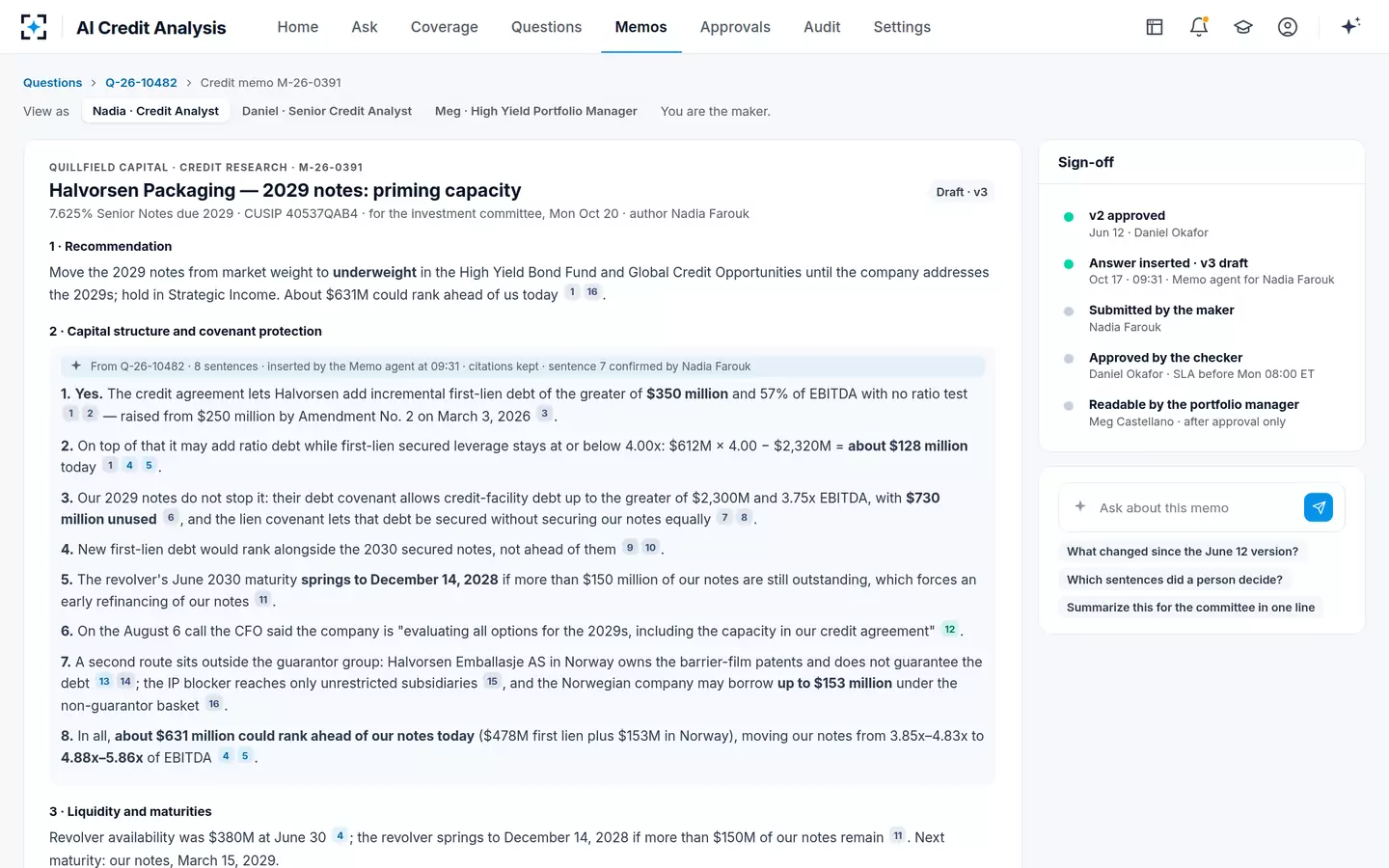
Regulation G reaches only registrants. A high-yield issuer that files no reports with the SEC is not one, so its calls may carry no reconciliation at all. The rules on who may hear what on a call are in Regulation FD explained for analysts. In the sample, the Call agent quotes management exactly, by speaker, and never states intent as fact: on the August 6 call the CFO said the company is "evaluating all options for the 2029s, including the capacity in our credit agreement", and the memo cites the transcript for it.
The CFO's words on the call, quoted exactly in the memo
What is pro forma EBITDA?
Pro forma EBITDA restates EBITDA as if a transaction, such as an acquisition, a disposal or a cost programme, had happened at the start of the measurement period. In a covenant definition it usually also allows expected cost savings or synergies from the transaction, sometimes only for a set number of quarters and sometimes capped. The adjustments are legitimate in principle and generous in practice, which is why the cap and the time limit, if any, are the clauses to read first.
For research, pro forma EBITDA needs a date. Savings that were projected when a deal closed should either show up in reported EBITDA within the window or drop out of the defined figure when it closes. A quarterly reconciliation is where a fund finds out which. Covenant add-backs in bank loans, line by line, are the subject of EBITDA add-backs in a covenant calculation, a separate series for lenders.
Reconciling the two EBITDAs every quarter
The reconciliation is a fixed routine, and its output is a capacity figure with its sources, not a view. Done by hand on every issuer every quarter, it rarely happens; done by agents, it runs when the filing arrives, and the analyst reads the change.
The quarterly two-EBITDA reconciliation, step by step
- Start from the GAAP figures
Operating income, depreciation and amortisation from the 10-Q or 10-K, for the trailing four quarters.
- Take management’s adjustments from the reconciliation
Each item of Adjusted EBITDA from the release or the website reconciliation; note any figure given only on the call.
- Apply the indenture’s definition item by item
Which adjustments it allows, which it caps, which it excludes; for the restricted group only.
- Check the time limits
Pro forma savings allowed only for a set period drop out when it ends.
- Recompute every basket and ratio test
Each "greater of" basket and each ratio test at the defined EBITDA, and the total that could rank ahead.
- Compare with the house note
Flag any sentence in the existing note that rests on the old figure, and have it re-approved.
What does a high yield analyst do with the gap?
Reports it, in dollars of capacity and turns of leverage, and recommends. In the sample, the analyst's memo states that about $631 million of new debt could rank ahead of the 2029 notes today, moving them from 3.85x–4.83x to 4.88x–5.86x of EBITDA, and recommends moving the notes to underweight in two funds and holding them in a third. Every figure in that sentence is computed on the defined EBITDA and cited.
The gap between the two EBITDAs is not a warning sign by itself; it is a measurement. What makes it a signal is direction and speed: an indenture figure growing faster than reported earnings, or a call figure that keeps adding new categories. The ratios behind the sentence are traced in financial ratios used in credit analysis, and the tranches in capital structure analysis. The whole answer is on the AI Credit Analysis page.
Questions people ask
Is Consolidated EBITDA always higher than reported EBITDA?
Usually, because it adds back items reported EBITDA keeps, but not always: it covers only the restricted group, so profits at unrestricted subsidiaries are left out. The only way to know is to compute it from the definition.
Do covenant EBITDA figures appear in SEC filings?
Sometimes. SEC staff guidance says a company may be required to disclose a covenant measure such as "Adjusted EBITDA" in MD&A if the credit agreement and the covenant are material and the information is material to understanding its liquidity, even though such a measure would otherwise be restricted.
What is run-rate EBITDA?
EBITDA restated as if recent changes, such as cost savings, price increases or a new contract, had been in place for the whole period. In covenant definitions it is a form of pro forma adjustment, and the clauses that limit it are the ones to read.
What is a "greater of" basket?
A permission sized as the greater of a fixed dollar amount and a share of EBITDA or assets, so it grows with the company and never falls below the floor. In the sample, the first-lien basket is the greater of $350 million and 57% of EBITDA.
Why do high yield analysts listen to earnings calls if the documents decide capacity?
Because the call says what management intends to do with the capacity. In the sample, the CFO's words about "evaluating all options for the 2029s" told the analyst that the capacity the documents allow might be used.