A credit analysis report is a written assessment of an issuer's ability and willingness to pay its debt, with a recommendation: for a buy-side credit fund, usually a house note or credit memo covering the business, the capital structure and the protection the documents give each instrument, liquidity and maturities, and what to do with the position. Its weakness is time. Every sentence rests on a page of a credit agreement, an indenture, a 10-Q or a call, and when a new amendment, filing or call changes that page, the report keeps saying what it said. Botminds' AI Credit Analysis is built around that problem: each sentence carries the document version it was read from, a new document marks the dependent answers stale, and a conflict with a house note blocks a memo until a person acknowledges it.
The example is a fictional issuer, Halvorsen Packaging, and the fictional Quillfield funds that hold its bonds: sample data on fictional people and companies. The filing deadlines and record-keeping rules come from SEC forms and rules, EU law and the CFA Institute's standards, linked where they appear.
One house note against the documents around it: wrong from the day it was written
- Amendment No. 2 raises the free-and-clear basket to the greater of $350M and 57% of EBITDAMar 3 → Aug 5
- 10-Q: $600M of 2029s outstandingAug 5 → mid-Oct
- Before the noteMar 3 → Jun 12
- June 12 note in force: secured capacity under $150MJun 12 → mid-Oct
What is a credit analysis report?
A credit analysis report sets out why a reader should expect an issuer to pay, or not, and what that means for a specific instrument. On the sell side it is published research; at a rating agency it is the analytical file behind a rating; on the buy side it is the house's own note or memo, written for portfolio managers and an investment committee, and its conclusions become positions.
The buy-side report has one feature the others share less: it is used long after it is written. A portfolio manager sizing a position in October reads the note from June because it is the house view. If the note is wrong, the size is wrong, and nobody may know which sentence carried the error.
What should a credit analysis report include?
A credit report should include the recommendation, the evidence behind it, and enough of the sources that a second reader can check it. For a high-yield issuer that usually means a recommendation by fund, the business and its industry, financial condition and the ratios that matter, the capital structure with each tranche's rank, the covenant protection each instrument has and what the documents still allow, liquidity and maturities, and what management has said. The memo in the sample follows that order.
Regulation sets a floor for one kind of fund. For a money market fund's eligible securities, the SEC requires the credit analysis to consider, to the extent appropriate, financial condition, sources of liquidity, the ability to react to future events, including repaying debt under severe stress, and the strength of the issuer's industry (17 CFR 270.2a-7(a)(11); the rule is read line by line in Rule 2a-7 and minimal credit risk). A fund that is not bound by the rule can still use the four headings as a checklist.
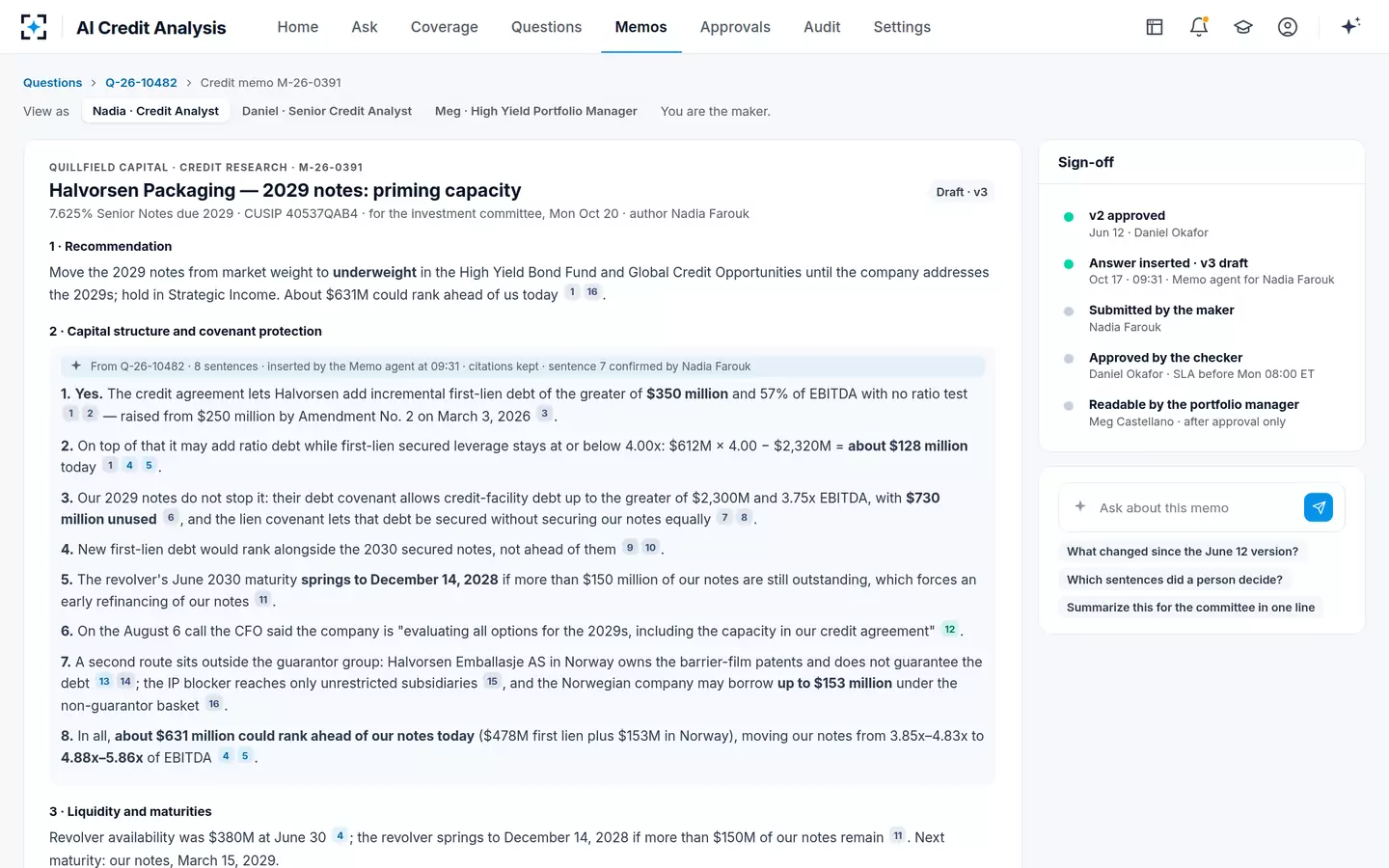
A credit memo in the sample: recommendation first, every sentence cited
Why a credit report goes stale: the documents that arrive after it
A credit report goes stale because issuers keep filing. A US registrant must report most material events on Form 8-K "within four business days" (SEC Form 8-K, General Instruction B.1), including, under Item 1.01, entry into a material definitive agreement or "any amendment of such agreement that is material to the registrant". Quarterly reports follow on Form 10-Q, due 40 days after quarter-end for large accelerated and accelerated filers and 45 days for all other registrants (SEC Form 10-Q, General Instruction A.1).
How fast a report's sources can change
4business days
to file an 8-K for a material amendment to a credit agreement
40–45days
after quarter-end for a 10-Q, depending on filer status
Material
the 8-K test for an amendment is materiality to the issuer: one it judges immaterial may never be filed
The third figure is the uncomfortable one. Item 1.01 reaches amendments that are "material to the registrant", and the issuer makes that judgement. A change to a basket that matters a great deal to a bondholder's rank may not matter to the issuer's equity story. Lenders receive amendments through the agent and the lender site; a public-side bondholder may see it only in a later 10-Q exhibit, if at all. A report's freshness depends on which side of the wall its author sits.
The June 12 note: wrong on the day it was written
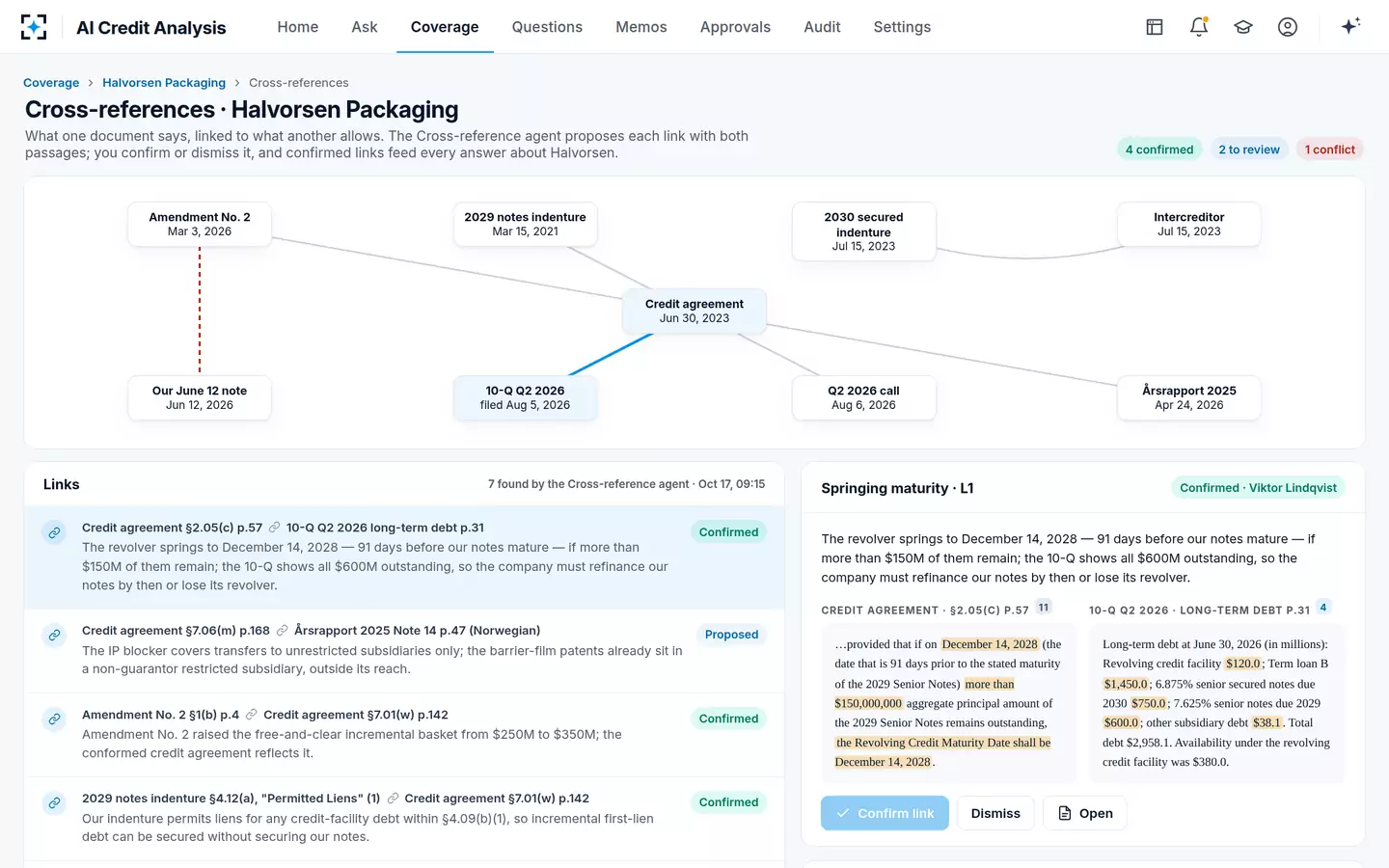
Stale notes are not only old notes. In the sample, the house note of June 12 put Halvorsen's secured capacity under $150 million, but Amendment No. 2 had raised the free-and-clear incremental basket from $250 million to the greater of $350 million and 57% of EBITDA on March 3, three months earlier. The note was written after the amendment and missed it.
It stayed the house view for four months. Then, before an investment committee, the portfolio manager asked whether Halvorsen could put new debt ahead of the funds' 2029 notes. The agents read the credit agreement as amended and found about $631 million could rank ahead; the Cross-reference agent flagged the conflict with the June 12 note; and the push of the new answer into the memo stayed blocked until the analyst acknowledged the conflict. When the senior analyst approved the new memo, the June 12 note was marked superseded.
The house note linked, in red, to the amendment it missed
Which pages each sentence of a report depends on
A report is stale when any page one of its sentences rests on has changed, so the useful map is sentence by sentence. The table maps the sample memo's main sentences to their sources and to the event that would make each one stale.
The sample memo, sentence by sentence: what each rests on and what would make it stale
| Sentence | Rests on | Goes stale when |
|---|---|---|
| First-lien basket: greater of $350M and 57% of EBITDA | Credit agreement as amended through Amendment No. 2 (March 3, 2026) | Any further amendment, or a new EBITDA figure |
| About $128M of ratio debt at 4.00x | LTM EBITDA $612M and $2,320M of secured debt from the Q2 10-Q | The next 10-Q, or any new secured borrowing |
| 2029 indenture allows $730M more credit-facility debt | 2029 notes indenture (March 15, 2021) and the 10-Q | A supplemental indenture, a consent, or new facility debt |
| Revolver springs to December 14, 2028 | Credit agreement §2.05(c), p.57; 10-Q debt note, p.31 | The notes outstanding fall to $150M or less, or the revolver is amended |
| What the CFO said about the 2029 notes | Q2 2026 call, August 6 | The next call or an 8-K on a refinancing |
| Norwegian subsidiary holds the patents and guarantees nothing | Årsrapport 2025, p.47 (April 24, 2026) | A new annual report, or the subsidiary joins as a guarantor |
How often should credit research be updated?
On two clocks: whenever a document a report depends on changes, and on a fixed cycle in case nothing obvious did. The rules that exist for funds use both. The SEC's money market fund rule requires "ongoing review of whether each security ... continues to present minimal credit risks" (17 CFR 270.2a-7(g)(3)). The EU's money market fund regulation requires that "all credit quality assessments shall be reviewed at least annually" and a new assessment "when there is a material change that could have an impact on the existing assessment" (Regulation (EU) 2017/1131, Article 19(4)).
Most credit funds are bound by neither, and set their own policy. In the sample house, an answer is marked stale after 90 days or as soon as a new amendment or filing arrives for that issuer, whichever is first; the faster setting is 30 days. The CFA Institute's standard gives the reader's side of the same test: among the criteria for judging whether research is sound is its "date/timeliness" (CFA Institute Standard V(A)).
What is a house view in credit research?
A house view is the fund's own approved opinion on an issuer or instrument, the one portfolio managers are expected to use unless they record a reason not to. It is usually the latest approved note or memo. Its strength is consistency across funds; its weakness is that it can outlive its evidence, because nobody re-reads an approved view until something forces it.
That is why the house view needs the same version discipline as the documents. In the sample, the approved memo carries its version history, v2 approved June 12 and v3 drafted in October, and a portfolio manager reads only approved text. The previous view is not deleted; it is marked superseded, with the reason.
How to update a credit report after an amendment
Start from the amendment, not from the report. Read what it changed, find every sentence that rests on those sections, recompute anything sized on them, and only then rewrite. The checklist below is the order we would follow by hand; it is also the order the solution follows.
Updating a credit report after an amendment, in order
- Conform the agreement
Apply the amendment to the agreement in order, so every later reading is of the agreement as amended.
- List the sections it touched
Baskets, definitions, maturities, guarantors, permitted liens. A change to a definition can move a covenant the amendment never mentions.
- Find the dependent sentences
Every sentence in the report, and in other notes, that cites one of those sections.
- Recompute at today’s numbers
Re-size each basket at the EBITDA the agreement defines, from the latest 10-Q.
- Flag the conflict with the old view
State what the previous note said and why it no longer holds, so a reader can see the change.
- Re-approve, and supersede
A second person checks the changed sentences; the old note is marked superseded, not deleted.
How long should you keep research records?
Keep them for the longest period any rule or standard that applies to you requires, and keep the reviews that changed nothing, not just the ones that moved a position. The CFA Institute's standard is explicit on the second point: its record-keeping rule covers reviews that end with the position unchanged as much as decisions to buy or sell (CFA Institute Standard V(C); how that standard shapes a written thesis is covered in how to write an investment thesis you can test every quarter). A stale note that someone checked and left standing is a review; so is the check that found it wrong.
Retention periods that can apply to credit research
| Source | What it covers | Period |
|---|---|---|
| SEC Rule 204-2(e)(1) | The books and records the rule lists for registered advisers, including records supporting recommendations presented in communications | Not less than five years, the first two in an appropriate office |
| SEC Rule 2a-7(h)(3) | A money market fund’s written record of its credit risk determinations | Not less than three years from the latest review |
| EU MMF Regulation, Article 21 | Documentation of internal credit quality assessments, including complete assessment histories | At least three complete annual accounting periods |
| CFA Institute Standard V(C) | Records supporting research and investment actions, including reviews that changed nothing | Local rules and firm policy; absent both, at least seven years recommended |
The CFA guidance is the one that fills a gap: "In the absence of regulatory guidance or firm policies, CFA Institute recommends maintaining records for at least seven years." The sample house's seven-year setting follows it; the solution offers five, seven or ten years, and records under legal hold are never deleted.
What makes a credit report stale?
A credit report is stale when a page it rests on has changed, whether or not anyone has noticed. The common causes are an amendment, a new 10-Q or 10-K that moves EBITDA and with it every basket sized on EBITDA, a refinancing or repurchase reported on an 8-K, a new annual report from a foreign subsidiary, or a management statement that contradicts the last one. Age alone is a weak signal; a report from last week can be stale and one from last year can be fine.
The practical test is therefore a dependency test, which a person cannot run across a full coverage list by hand. In the sample, overnight re-runs of 12 watched questions changed three answers after new documents: one issuer's restricted-payments capacity rose after an amendment, another's ratio debt capacity fell from $160 million to $41 million after a 10-Q, and a third's collateral package changed on an 8-K. Capital structure analysis, line by line shows the same dependency idea applied to every tranche, and the two-week pilot uses stale-note traps to test any tool for it. Watching the issuers themselves between notes is a separate job, covered in who watches every issuer between quarters. The full workflow is on the AI Credit Analysis page.
Questions people ask
Is there a credit analysis report template?
No standard one; most funds use their own. A workable order is recommendation, business and industry, financial condition, capital structure and covenant protection, liquidity and maturities, and management, which mirrors the four factors the SEC's money market fund rule asks a credit analysis to consider.
What is the difference between a credit memo and a credit analysis report?
Usage varies. On the buy side, a credit memo is often the shorter, decision-focused document for a committee, and the credit analysis report the fuller house note it draws on. Lending desks use "credit memo" for the approval document; how to write a commercial credit memo covers that kind.
Should a credit report cite page numbers?
Yes, for every figure and every claim about what a document allows. A citation with the document version lets a second reader check the sentence in minutes and lets the firm find every sentence that depends on a page when that page changes.
Who should approve a house credit note?
Someone other than the author. In the sample, the author cannot approve her own memo, a senior analyst checks the flagged sentences and signs, and only then can a portfolio manager read it.
Does a 10-Q always change a credit report?
No, but it always changes the inputs. A new quarter moves last-twelve-months EBITDA, and every "greater of" basket sized on EBITDA moves with it, so each capacity sentence needs recomputing even if the conclusion holds.