A commercial credit memo is the written case for a loan: what the borrower asks for, how it will repay, what secures it, where it breaks the bank's policy and what grade the risk deserves. It is written by a credit analyst after the financial statements are spread, and it is read by an underwriting manager, an approver or a loan committee, and later by examiners. It is hard to write well because each section has to be built from documents in the file and stay consistent with the spread while the deal keeps changing. Botminds' Credit Memo Automation drafts the memo in the bank's own template from the approved spread and the deal file, with every number cited to its page. This guide sets out what each section must contain, whether a person or an agent writes it.
One warning for anyone who searched "how to write a credit memo": in accounting, a credit memo is a note that reduces what a customer owes, the kind QuickBooks or SAP issues. This guide is about the other one, the credit memorandum a bank writes before it lends.
No regulator publishes a commercial credit memo template. One federal text comes close: the SBA's standard operating procedure for 7(a) loans lists what "the Lender's credit memorandum and analysis must address". Read alongside what OCC examiners look for in a loan approval package, it gives a skeleton any bank can use, SBA lender or not.
What the rules ask a credit memo to prove
3years
of historical financials plus an interim, for an existing business under SBA 7(a)
1.15×
minimum business debt service coverage for SBA 7(a), and 1:1 on a global basis
4
things the OCC expects an approval package to give decision makers
85%
supervisory loan-to-value limit for improved property; a bank sets its own limit at or below it
What is a credit memo in commercial lending?
A credit memo, also called a credit memorandum, credit write-up or credit presentation, is the document a credit decision is made on. It turns the file into an argument. The safety-and-soundness guidelines ask that loan documentation "Identify the purpose of a loan and the source of repayment, and assess the ability of the borrower to repay", and that underwriting consider "the financial responsibility of any guarantor, the nature and value of any underlying collateral, and the borrower's character and willingness to repay". In most banks those words are met in the memo.
It is not the spread. The spread is the arithmetic, and the memo is the judgment written around it. Liberti and Petersen describe what committees need from it: decision makers have "limited time and attention to devote to each decision", so they "need the information to be boiled down to what is important" (NBER, 2018). The memo carries both kinds of information: the numbers that can be checked, and the text an approver has to trust. That text includes management's plans, the industry and the reasons a risk is acceptable.
What should be included in a credit memo? What the SBA and OCC require
The SBA's list is the most complete, and it took effect in its current form on 1 October 2026. The OCC's list is shorter and tells you what examiners will test. Together they cover almost every section a commercial memo needs.
The SBA requires the memo to address "the Applicant's ability and likelihood to repay the loan from the cash flow of the business and past performance". It must cover the history of the business and the depth of its management, three years of financials plus an interim, and personal credit reports for owners and guarantors. It must include EBITDA with a "Justification for additions and subtractions to cash flow", including "Distributions for S-Corp taxes", and global cash flow. It also asks for a pro forma balance sheet, ratios against industry, "Analysis of working capital adequacy, at a minimum over the next 12 months", collateral, insurance, the reasons for any refinancing, and liens, judgments and litigation. The memo closes with the "Lender's rationale for recommending approval". It also sets the rule every memo implicitly answers: if cash flow does not give reasonable assurance of repayment, "the loan request must be declined, regardless of the collateral available".
What a credit memo must cover, condensed from the SBA and OCC lists
- The business and its management
Nature and history of the business, time under current management, depth of the team and who runs it day to day.
- Repayment from cash flow
Historical cash flow after the new debt, EBITDA and every add-back or deduction justified, including distributions for taxes.
- Global cash flow
The borrower with its guarantors and affiliates, against their combined obligations.
- Projections, if history does not cover the debt
With the assumptions, the reasons for growth or cost cuts, and a comparison with industry trends.
- Balance sheet, ratios and working capital
Pro forma at close, ratios against prior years and the industry, and working capital for at least twelve months.
- Collateral and guarantors
What secures the loan and what it is worth, and each guarantor's ability to support it.
- Risks and mitigating factors
The OCC asks for "a comprehensive analysis of key credit risks and mitigating factors".
- Previous transactions and performance
For an existing customer, how earlier credits performed.
- Support for the approval and the risk rating
The rationale for recommending approval and the grade, with exceptions identified and mitigated.
The OCC's version, in its June 2026 lending booklet, is four lines. Examiners judge whether the approval package gives decision makers "a thorough analysis of the borrowers' and guarantors' sources of repayment". They check that it includes "information about previous and related transactions and performance". They look for "a comprehensive analysis of key credit risks and mitigating factors", and for "appropriate support for the credit approval, risk rating, and accrual treatment" (OCC, 2026). The older Rating Credit Risk booklet names the failure examiners write up when the memo falls short. Its name is "inadequate financial analysis": the approval documentation "lacks sufficient analysis of financial trends, primary and secondary repayment sources, industry trends, and risk mitigants" (OCC).
The twelve sections of a commercial credit memo, and the document each is written from
A workable memo has a section for each question an approver asks, in the order they ask it, and each section has documents it must be written from. Banks name and order the sections differently. The twelve below are the sections of the sample template used throughout this guide. Each row names the question the section answers and the documents a reviewer should be able to trace it to.
Twelve sections, each with its question and its sources
| Section | The question it answers | Written from |
|---|---|---|
| 1 · Request and recommendation | What is asked, for what purpose, and do we approve? | Term sheet, spread, credit policy |
| 2 · Borrower and management | Who are they, and can they run this business through a bad year? | Prior memo, call reports, organisational documents |
| 3 · Industry and market | What could hurt this business from outside? | Backlog and customer reports, call reports, industry data |
| 4 · Financial analysis | What do three years and an interim show, and why? | Audited and interim statements, tax returns, the spread |
| 5 · Business and global cash flow | Does cash flow cover the new debt, with the owners included? | Spread, K-1s, personal returns, debt schedules |
| 6 · Collateral | If cash flow fails, what is the secondary source worth? | Appraisal, field exam, equipment quotes, environmental report |
| 7 · Guarantors | Can and will the owners support the loan? | Personal financial statements, brokerage and bank statements, returns |
| 8 · Structure, covenants and pricing | How is the bank protected and paid for the risk? | Term sheet, spread, pricing model |
| 9 · Policy exceptions | Where does the deal break policy, and why is that acceptable? | Credit policy, spread, appraisal |
| 10 · Key risks and mitigants | What could go wrong, and what limits the damage? | Every section above, each with its own source |
| 11 · Risk grade | What grade, and why each factor scores as it does? | Scorecard, prior memo, spread |
| 12 · Conditions | What must be true before and after closing? | Term sheet, exceptions, mitigants |
Writing to that table changes how a draft reads. A sentence such as "management is experienced" has no source and fails the test. "Daniel Brennick, 61, owns 62% and is the key person; Laura Brennick-Ortiz, who owns the rest, runs operations; key-man life insurance of $5M is assigned to the bank" points to documents a reviewer can open. The names come from the sample deal used below. The second sentence is also the one an approver can weigh.
A commercial credit memo example: the financial analysis, written from the spread
The financial analysis section is where most memos fail, because they restate the spread instead of explaining it. A spread already shows that EBITDA was $6,050,000. The memo's job is to say why it is that number and not another, which adjustments were made and on what evidence, and what the trend means for repayment. The OCC's phrase for the failure is a memo that "lacks sufficient analysis of financial trends" (Rating Credit Risk).
Take the sample deal that runs through this guide. Between the second and third versions of the spread, trailing EBITDA fell from $6,105,000 to $6,050,000 because the analyst removed a one-time insurance gain. That $55,000 is small, but it is exactly the kind of figure an examiner tests: an add-back or a deduction that moves coverage, written down with its reason or not at all. The SBA makes it a requirement: the memo must give "Justification for additions and subtractions to cash flow", and it names non-recurring income and unfunded capital expenditures among them (SOP 50 10 8.1).
The same financial analysis, restated and then explained
Restates the spread: TTM EBITDA was $6,050,000.
Explains the spread: TTM EBITDA to 30 June 2026 is $6,050,000 after removing a one-time insurance gain of $55,000 (spread v3; June interims). Recurring margin is the figure to lend on.
Restates the spread: Cash available for debt service is adequate.
Explains the spread: After unfinanced capex of $640,000, tax distributions and other distributions, $3,880,000 is available against pro forma debt service of $2,430,581: 1.60x against a 1.25x minimum.
Restates the spread: Leverage increased.
Explains the spread: Senior debt to EBITDA rises to 2.97x pro forma from 1.71x a year ago because the equipment and real estate loans are new money; it falls as $930,000 of term principal amortises in year one.
Restates the spread: The borrower can service the debt.
Explains the spread: Coverage depends on distributions staying at their current level, which is why distributions are limited above 3.00x leverage.
Three habits produce the right-hand column. Name the period and the version of the spread every time a figure appears, because a memo that mixes the fiscal year with the trailing twelve months is the most common inconsistency reviewers find. Give every adjustment its document. And end each paragraph with the consequence for repayment, since that is the only reason the paragraph is there.
Writing the recommendation first: the executive summary a committee reads
Write section 1 last and put it first. The recommendation is the paragraph every approver reads, and some read little else. It should state, in one paragraph, the amount and purpose, the source of repayment with its coverage against the policy minimum, the secondary source, the number of policy exceptions and that each is mitigated, the proposed grade, and who must approve.
Take a sample credit as it runs through the solution. Halvern Bank & Trust, a fictional bank, is renewing and extending credit to Brennick Precision Components, a fictional CNC machining shop and a customer since 2014. The request is $19,000,000 across a renewed $8,000,000 revolving line, a $6,800,000 equipment term loan and a $4,200,000 real estate term loan. Every person and company named in the example is invented. The recommendation the agents drafted, after a late change to the owners' tax distributions, reads:
"Approve $19,000,000 … Repayment is from operating cash flow of $3,213,000, covering pro forma debt service 1.32x against the 1.25x minimum. Global coverage with the guarantors is 1.18x, below the 1.20x minimum; with other distributions suspended it is 1.35x. Leverage is 2.97x against the 3.00x maximum. Three policy exceptions are mitigated. Proposed risk grade 5 — Acceptable."
Recommendation paragraph from the sample memo, spread v4
Every number in that paragraph is a figure from a later section, and each must match it exactly. That is the weakest point of a hand-written memo: the summary is written last, from memory and from the spread, and it is the first place a stale number survives a change. The page on following one number from a K-1 to the committee's DSCR traces how a single change moved this paragraph.
Risks and mitigants: one risk, one mitigant, one source
A risk section is useful when each risk is specific to this borrower and each mitigant is something the bank can verify or enforce. Generic risks ("economic downturn") and generic mitigants ("experienced management") take up the reader's attention and tell an approver nothing. The OCC adds a rule worth repeating to junior writers: "receiving a high yield on a loan with otherwise liberal underwriting is generally not a sufficient mitigating factor" (OCC, 2026). Price is not a mitigant.
A mitigant an approver can rely on, and one that only sounds like it
Sounds like a mitigant: Long-standing relationship with a major customer.
Is a mitigant: Largest customer is 27% of sales, under a sole-source supply agreement to 2029, with $12.4M of its orders in backlog (backlog report; call report, 29 Sep).
Sounds like a mitigant: Strong, experienced owner.
Is a mitigant: Owner is 61; the co-owner, Laura Brennick-Ortiz, runs operations; $5M key-man life insurance assigned to the bank.
Sounds like a mitigant: Management has a plan for the expansion.
Is a mitigant: Machines arrive January to March 2027; the work is already contracted and outsourced at $2.1M a year; advances only against delivered machines.
Sounds like a mitigant: Owners are committed to the business.
Is a mitigant: Other distributions of $480,000 suspended until global coverage is at least 1.25x for two consecutive quarters; a condition in section 12.
A good test for each row: could the underwriting manager confirm the mitigant without asking the analyst? If it cites a page, a covenant or a condition, yes. If it relies on the analyst's opinion of the owner, it belongs in section 2 as an assessment, not in section 10 as a mitigant.
Policy exceptions and the risk grade: the two sections examiners test hardest
Exceptions and the grade are where examiners compare the memo with the bank's own rules, so both need the policy section, the actual, the limit and the reason. The OCC says examiners "should expect to see exceptions clearly identified in the loan approval documentation along with mitigants that justify the decision to approve the loan". For real estate, the interagency guidelines go further. An exception to a loan-to-value limit "should be supported by a written justification that clearly sets forth all of the relevant credit factors", kept in the permanent loan file, and significant ones reported to the board (12 CFR 34).
Each exception in the sample memo follows the same four-part form: the limit broken and the policy section, the actual against the limit, the mitigant with its sources, and who approves it. The first reads "Real estate loan to value above policy · 77.8% vs 75% · Policy §5.1". The mitigant cites the appraisal: the plant is cross-collateralised with the equipment and all business assets, both owners guarantee without limit, and it has been owner-occupied since 1996.
Exceptions and the proposed grade in Credit Memo Automation
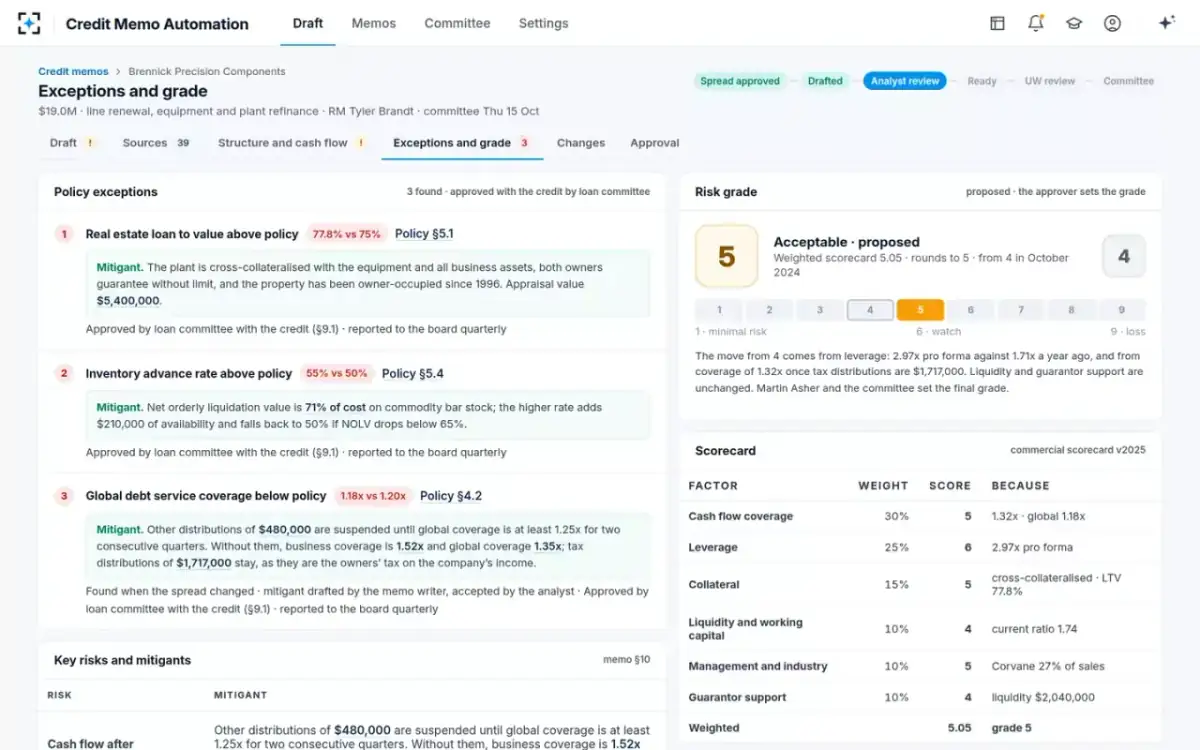
Look at the scorecard's last column: each factor's score has its reason, such as 2.97x pro forma for leverage.
The grade section needs the same discipline. In the Federal Reserve's study of the fifty largest banks, "most banks require some sort of written justification of the grade as part of the loan approval package" (Treacy and Carey, 1998). A justification that names each factor and its evidence is the one that survives an examiner's comparison. In the sample, the move from grade 4 to 5 is explained by leverage of 2.97x pro forma against 1.71x a year earlier, and by coverage of 1.32x once the K-1 tax distributions were in.
Where the analyst's days go, and what Credit Memo Automation drafts
By hand, most of a memo's time after the spread goes to moving numbers and re-describing documents, not to judgment. Our estimate for a typical middle-market memo puts about three days between an approved spread and a memo ready for review. Pasting tables and describing the borrower, guarantors and collateral take half of that.
Where three days of credit memo writing go (our estimate)
By hand · about 3 days
- Pasting spread tables · 25%
- Describing borrower, guarantors, collateral · 25%
- Testing structure against policy · 17%
- Risks, mitigants, grade rationale · 17%
- Updating numbers after a change · 8%
- Review and questions back · 8%
Credit Memo Automation takes the mechanical share. Six agents read the deal file and write every section in the bank's template while the analyst watches. A file reader indexes each figure with its page. A spread and cash flow analyst computes coverage and stress cases from the approved spread, and a memo writer drafts the sections. A policy checker tests every limit, a risk grader proposes a grade, and a consistency checker keeps the memo in step when the spread changes. In the sample, the first draft ran to 14 pages with 113 numbers, each tied to its page. The design target is a cited first draft the same day the spread is approved.
A drafted memo: the spread, the template and every source
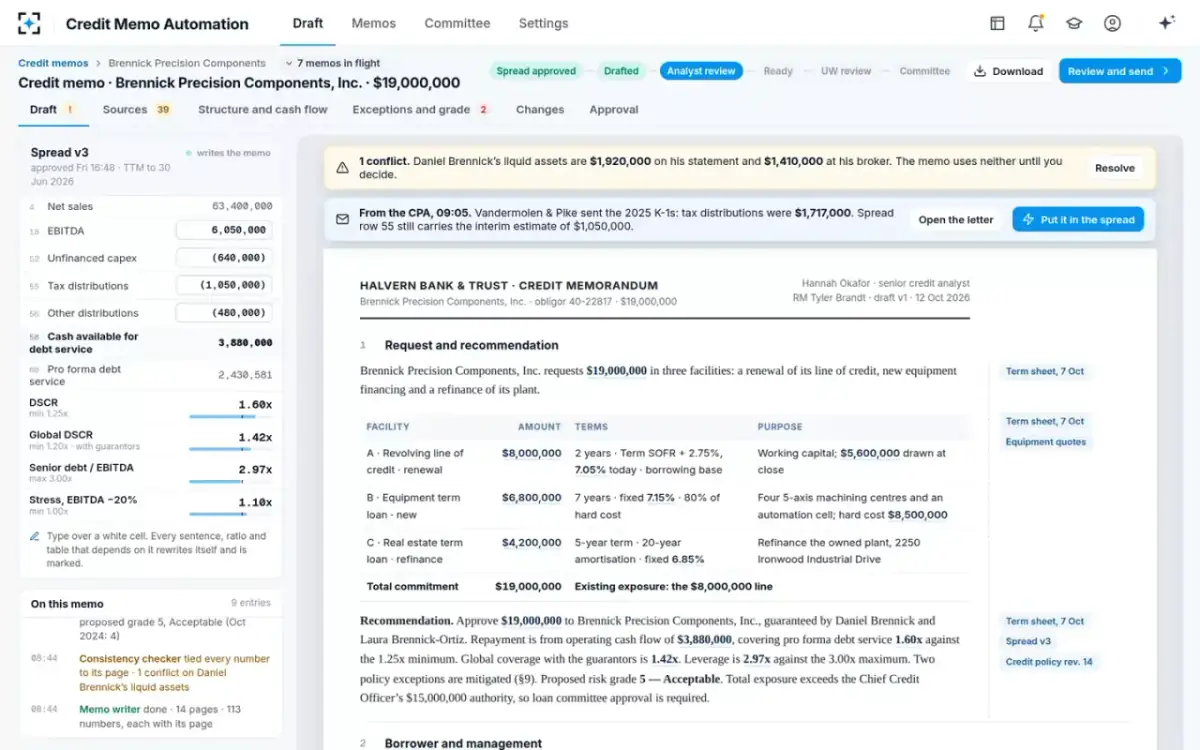
The judgment stays with the analyst. The agents use neither figure when two documents disagree, and the analyst chooses. The policy checker lists exceptions but never approves one. The grade is a proposal. The analyst accepts every change before the memo goes to the underwriting manager. How the drafting and checking are split, and why, is on why the AI that drafts the memo should not check it. A reader judging tools should start with the twelve questions to ask first. To see the whole sample memo screen by screen, start from Credit Memo Automation.
Questions people ask
How long should a commercial credit memo be?
As long as the risk needs and no longer. The OCC's test is that "the level of analysis should be commensurate with the level of risk". A small, clean renewal can be a few pages; the sample $19,000,000 credit with three exceptions runs to 14. Length that comes from pasted tables rather than analysis does not help the approver.
Who writes the credit memo, the analyst or the relationship manager?
It varies by bank. In the Federal Reserve's study of the fifty largest banks, risk ratings were "initially assigned either by relationship managers or the credit staff". A bank that separates the roles gives the memo to a credit analyst, so that the person who sells the loan is not the only one who writes the case for it. The relationship manager still supplies the request, the term sheet and much of the borrower knowledge.
What is the difference between a credit memo and a credit approval memo?
Banks use the terms loosely. Usually the credit memo is the analyst's full analysis and recommendation, and the approval memo or approval sheet is the shorter document the approver signs, recording the decision, conditions and any exceptions approved. Many banks put both in one document with an approval page at the front.
Should the memo include projections?
When the credit relies on performance that history does not show, yes. For Standard 7(a) loans, the SBA requires detailed projections with their assumptions for start-ups, new businesses and other applications based on projections, showing coverage of at least 1.15 within two years of funding; and where the latest full year and interim do not show sufficient coverage, two years of projections with the assumptions that justify relying on them. For a renewal, compare last year's projections with this year's actuals; the projections-against-actuals table shows how.
Is there an SBA credit memo template?
No. The SBA lists what the memo must address but leaves the format to the lender, and for 7(a) Small and SBA Express loans it lets lenders use their own internal credit memoranda. Those smaller loans add one requirement of their own: the memo must state why credit is not available elsewhere.
Does a credit memo have to discuss the owners' personal credit?
For SBA 7(a) loans, yes: the lender must "review and analyze" the personal credit reports of the owners and guarantors and discuss any credit issues, and on a non-delegated loan include a report dated within 90 days. Most banks ask the same of guarantors on conventional credits, because guarantor support is one of the four things an approval package must analyse.