Credit memo automation means software drafting the commercial credit memorandum from the approved spread and the deal file, and to start it writing in your bank's voice, bring five things: your credit memo template, your credit policy with its limits and approval authorities, your risk-rating scorecard and grade scale, the stress cases you run, and a sample of recently approved memos with their spreads and deal files. Each controls a different part of the draft. The template decides the sections and their order. The policy decides what counts as an exception and who approves it, and the scorecard decides how the grade is proposed. The past memos are the answer key for testing the result. Botminds' Credit Memo Automation takes these as settings rather than code, and goes live once it has passed its checks on your own files. This guide sets out each input and what to check before handing it over.
Five inputs, and what each decides in the draft
12
sections in the example bank's memo template, each with its sources
8
rules in the example bank's settings, from the memo template to approval authority
6
weighted factors in the sample scorecard behind every proposed grade
1
approved spread and deal file of your own, used to show the result before anything else
What is credit memo automation?
It is the drafting of the credit memo, and the checking that keeps the draft true to the file, done by software instead of by hand, with the decisions left where they were. The work it takes is the work around the judgement: moving spread tables into the template, describing the borrower, guarantors and collateral from their documents, testing the structure against each policy limit, and updating every dependent number when a figure changes. By our estimate that is most of the three working days a middle-market memo takes after the spread is approved.
What credit memo automation takes over, and what stays with the bank's people
Automated in Credit Memo Automation: Reading the deal file and tying each figure to its page.
Kept by people: Choosing between documents that disagree, with a reason.
Automated in Credit Memo Automation: Coverage, global coverage and stress cases from the approved spread.
Kept by people: Approving the spread; judging whether the numbers make sense.
Automated in Credit Memo Automation: Every section in the bank's template, each passage cited.
Kept by people: Accepting each change; the recommendation goes out under the analyst's name.
Automated in Credit Memo Automation: Testing every limit and listing exceptions with section, actual and limit.
Kept by people: Approving or declining each exception within authority.
Automated in Credit Memo Automation: Scoring the scorecard and proposing a grade with reasons.
Kept by people: Setting the grade.
Why Credit Memo Automation needs your documents, not a generic template
A memo is judged against the bank's own rules, so a draft built on someone else's rules is wrong in ways that are hard to see. Examiners check that new loans are underwritten "within the parameters of the bank's lending policies" and that "exceptions to policy were appropriately identified and approved" (OCC, 2026). A coverage ratio of 1.22x is a pass at a bank with a 1.20x minimum and an exception at one with 1.25x. Only the bank's own policy can say which.
No regulator publishes a commercial memo template. The SBA's 7(a) list of what "the Lender's credit memorandum and analysis must address" is the closest federal text (SOP 50 10 8.1), and credit unions must adopt a written commercial loan policy covering "The level and depth of financial analysis necessary" (12 CFR 723.4). Everything else, the order of sections, the voice, what goes in the summary, is the bank's own. That is why the template is the first thing to bring. The section-by-section skeleton is set out in how to write a commercial credit memo.
Who in the bank owns the credit memo template, policy and scorecard?
Usually credit administration, the chief credit officer and the risk-rating or loan-review team, in that order; the inputs are owned by different people, and getting them early is most of the work of starting. Credit administration usually owns the template, the chief credit officer the policy and the authority matrix, and a risk or loan-review team the scorecard. The analysts hold the past memos and the files behind them.
Who brings each input
Today
Keeps the memo template, its section guidance and the examples analysts copy from.
With agents
Hands over the template and any section rules; changes to it later are versioned and on the change log.
Still theirs: The template and its revisions.
Today
Owns the credit policy, the exception rules and the approval authority matrix.
With agents
Supplies the policy version in force and the limits to test; the agents never waive or approve an exception.
Still theirs: Policy, authority and every exception decision.
Today
Maintains the scorecard, the weights and the grade definitions.
With agents
Supplies the scorecard; the risk grader proposes a grade with a reason per factor, and the approver sets it.
Still theirs: The grading standard.
Today
Write the memos the bank considers good, and know which ones are.
With agents
Pick recently approved credits with their spreads and files, to draft and compare against their own memos.
Still theirs: The memo, every acceptance, the send.
What does an AI need to draft credit memos? Each input and what it controls
Each input maps to specific behaviour in the drafted memo, and knowing the mapping tells you what to check before handing it over. A template with no section for global cash flow will produce a memo without one. A policy that sets a 75% loan-to-value maximum for owner-occupied real estate will flag 77.8% as an exception. A scorecard that weights coverage at 30% will drive the grade accordingly.
Your inputs, mapped to the parts of the memo they control
| Input | What it controls | In the example bank | Check before handing it over |
|---|---|---|---|
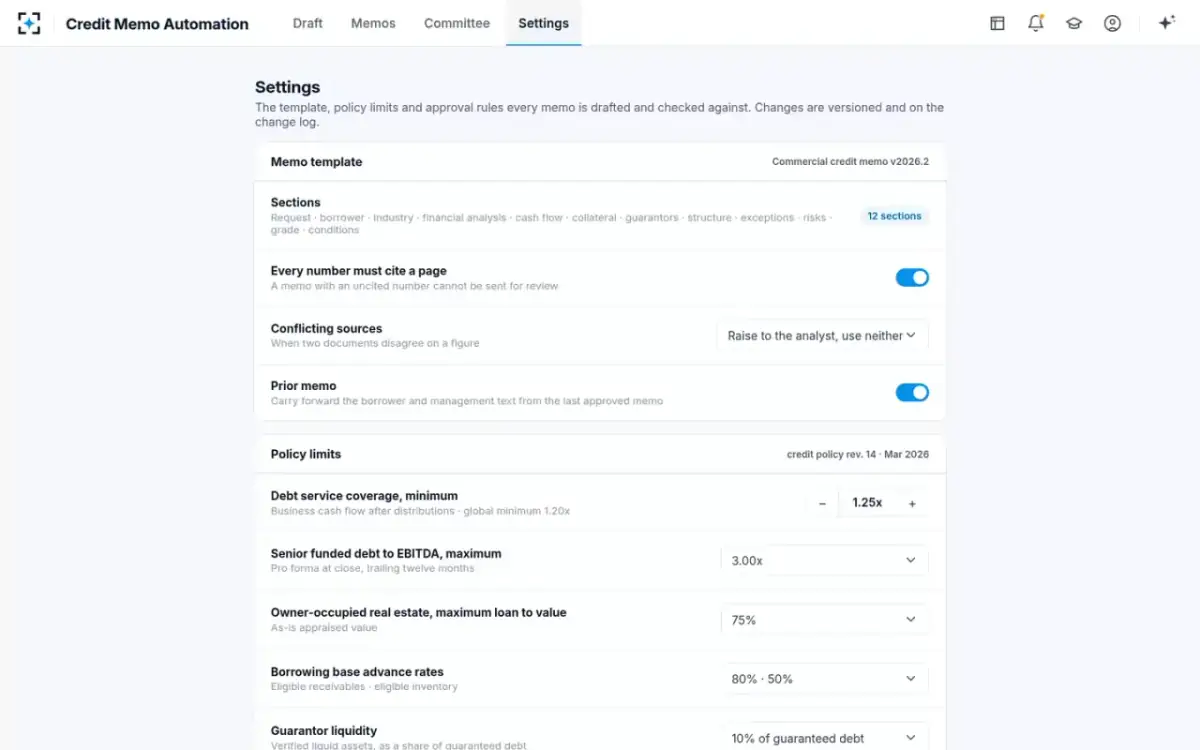
| Memo template | Sections, order, headings, the recommendation format | Commercial credit memo v2026.2, 12 sections | Every section names the documents it is written from |
| Credit policy limits | The policy test and the exception list | Coverage 1.25x, global 1.20x; leverage 3.00x; owner-occupied LTV 75%; advance rates 80% and 50%; guarantor liquidity 10% | The version in force, with section numbers the memo can cite |
| Approval authority | The approval path printed with the memo | Underwriting manager review; CCO to $15,000,000; loan committee above | Limits by amount, grade and exception, as the policy states them |
| Scorecard and grade scale | The proposed grade and its reasons | Six factors, weights 30% to 10%, a 1–9 scale | Factor definitions precise enough to score from the spread and file |
| Stress cases | The downside analysis in every memo | EBITDA −10% and −20%; rate +200 bps | Cases your committee actually asks about |
| Past memos with spreads and files | The test of the result, and the carry-forward text for renewals | The October 2024 memo for the sample borrower | Recent, approved, and representative of your mix |
The template and policy as settings in Credit Memo Automation
Your credit policy: limits, exceptions and who approves them
The policy is the input with the most consequences, because it decides what the memo must flag. Bring the limits the memo tests: coverage, global coverage, leverage, loan to value, advance rates and guarantor liquidity. Bring the exception rules and the authority matrix. Bring the version in force, with section numbers. The OCC notes that "Policies often include outer limits, with procedures or guidelines including more granular instructions or inner targets" (OCC, 2026). Decide which of the two the memo should test against, and say so.
The exception rules matter as much as the limits. The Federal Reserve's manual says "The reason for the exception should be detailed in writing and submitted for approval to a designated authority" (CBEM §2010.1). For real estate, the interagency guidelines want "a written justification that clearly sets forth all of the relevant credit factors" (12 CFR 34). In the example bank, each exception the policy checker lists carries its section, the actual, the limit, a mitigant with sources and who approves it. Exception 1, real estate loan to value at 77.8% against 75%, cites policy section 5.1.
What data do you need to automate credit memos? Past memos as the answer key
Past memos do two jobs. For a renewing borrower, the last approved memo is a source: borrower and management text can be carried forward, marked as such, and last year's figures compared with this year's. For the bank, a handful of recent memos with their spreads and deal files are the test. Draft each one again and compare it with what your analyst wrote. Then change one figure and see whether everything that depended on it moved.
The minimum to start, and the set that makes the first month count
Minimum to start: The current template, as a document.
Better start: The template with section guidance, and two memos your credit officers consider exemplary.
Minimum to start: The credit policy in force.
Better start: The policy with section numbers, the authority matrix, and the exceptions your committee approved last year.
Minimum to start: The grade scale.
Better start: The scorecard with factor definitions and weights, and how grade changes are explained today.
Minimum to start: One recently approved spread and deal file.
Better start: Five to ten recent approvals across your mix: a renewal, a new credit, one with exceptions, one with guarantors.
Minimum to start: One analyst to accept and send.
Better start: An analyst, the underwriting manager who reviews, and a credit officer to judge the exceptions and grades.
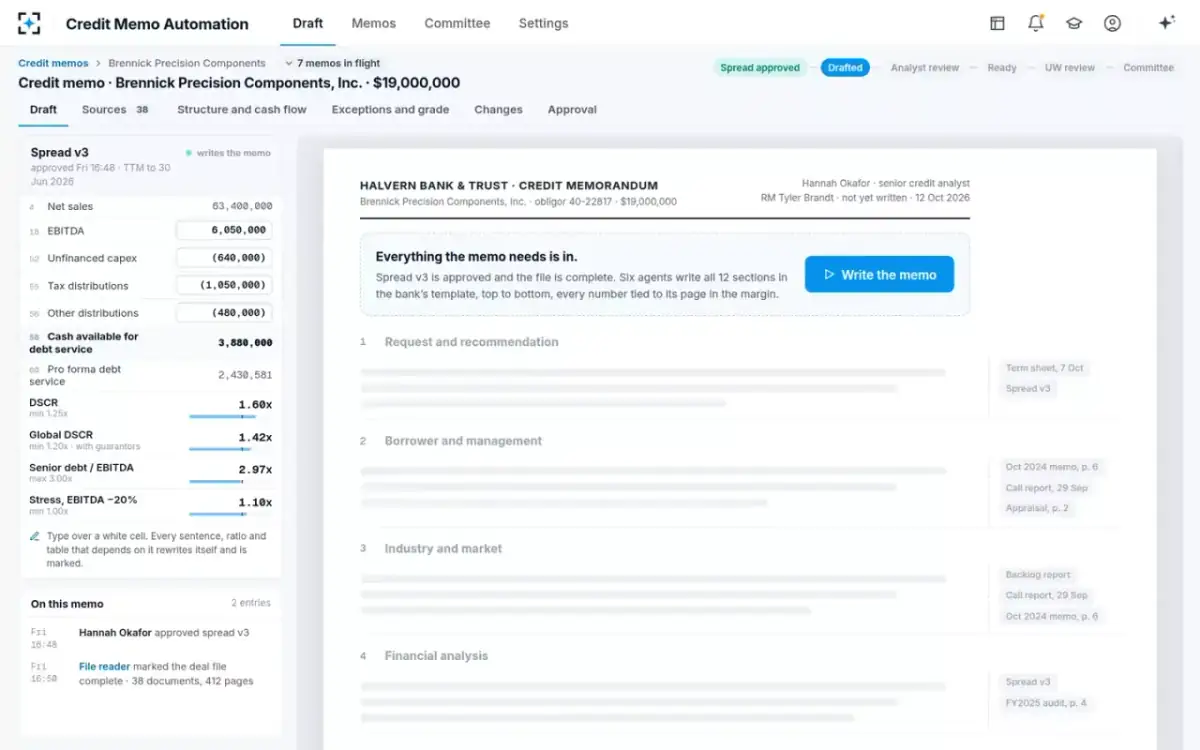
The sample memo shows what that comparison looks for. On the fictional Brennick credit, the drafted memo ran to 14 pages with 113 numbers, each tied to its page. One guarantor conflict was raised, and two policy exceptions were found before any change. When the owners' tax distributions moved, a third exception was added. A pilot on your own files should report the same counts, and the guide to twelve questions to ask before an AI writes your credit memos sets out how to score them.
Spread approved, file complete, every section's sources shown
How long does it take to implement credit memo automation?
As long as it takes to gather the inputs and pass the first comparison on your own files; the configuration itself is settings, not a build. Credit Memo Automation is set up from the template, policy and scorecard, shown first on one of your own approved spreads, and goes live once it has passed its checks on your files. The order below is what usually decides the calendar.
Going live with credit memo automation, step by step
| Step | What happens | Who | Done when |
|---|---|---|---|
| 1 · Gather | Template, policy in force, authority matrix, scorecard, stress cases, five to ten recent approvals with spreads and files | Credit administration, CCO, loan review, analysts | Every input is the version in force |
| 2 · Configure | Template sections, citation rule, conflict rule, carry-forward, limits and authorities entered as settings | Credit administration with the vendor | Each setting traced to its policy section |
| 3 · First draft | One recently approved spread and file drafted end to end | An analyst and the underwriting manager | Every number cites a page; exceptions match the analyst's |
| 4 · Compare | The other approvals drafted, one figure changed on each, results counted | Analysts, reviewer, a credit officer | Counts agreed with the second line |
| 5 · Live | New credits drafted as they reach an approved spread; analysts accept and send | The credit team | Measured against your own spread-to-memo baseline |
A readiness checklist for credit memo automation
Before the first draft on your own files
- Template, current version
With every section and, where you have it, the guidance analysts follow.
- Credit policy in force, with section numbers
Limits, exception rules and the approval authority matrix.
- Scorecard, weights and grade definitions
Written justification of the grade is common practice; give the factors precise definitions.
- Stress cases your committee expects
Which downside, which rate shock, and the minimum each must meet.
- Your rule for conflicting documents
Raise to the analyst, use the most recent verified document, or use the lower figure and note it.
- Carry-forward choice for renewals
Whether borrower and management text comes forward from the last approved memo, marked.
- Five to ten recent approvals with spreads and files
Including at least one renewal and one with exceptions; your analysts' memos are the answer key.
- Named people
The analyst who accepts, the reviewer who checks and the officer who judges exceptions and grades.
Written grade justification is long-standing practice. The Federal Reserve's study of large banks found that "most banks require some sort of written justification of the grade as part of the loan approval package" (Treacy and Carey, 1998). Precise factor definitions are what let a proposed grade carry real reasons. The whole sample deal, from approved spread to committee, is on the Credit Memo Automation page.
Questions people ask
Can we keep our own credit memo template?
Yes. The template and its sections are a setting: the example bank uses a 12-section commercial template, and yours can have more or fewer. Changes to it are versioned like any other setting.
Does credit memo automation replace credit analysts?
No: it changes where their days go. By our estimate, the roughly three days an analyst spends after the spread fall to about half a day, the largest part of it review and answering questions, because pasting tables, re-describing documents and updating numbers after a change are what the agents take. Choosing between documents, accepting changes and owning the recommendation stay with the analyst.
What happens when our credit policy changes?
The limits are settings tied to a policy revision, so a new revision is entered once and every later memo is tested against it. Changes to settings are versioned and on the change log, so a memo can always be read against the policy in force when it was drafted.
What if our template has no section for something examiners expect?
The draft will not have it either, so fix the template first. The common gaps are global cash flow, prior transactions and performance for renewals, and a stated reason for each grade factor, all of which examiners look for in an approval package.
Do we need a pilot before going live?
Yes, on your own files. The draft of a recent approval, compared with the memo your analyst wrote and then changed by one figure, is the test that shows whether the settings match your policy and template. The evaluation guide sets out how to score it.