An AI that drafts a credit memo should not be the thing that checks it, for the same reason a loan officer does not approve his own credit. A checker that shares the drafter's assumptions repeats its mistakes. Research on large language models finds the same limit in machines: without outside feedback, a model asked to review its own answer rarely improves it and sometimes makes it worse. Botminds' Credit Memo Automation is built on that separation. One agent writes the memo in the bank's template. Separate agents tie each number to its page, test the structure against policy, keep the memo consistent with the spread and propose a grade. People accept every change, decide between conflicting documents, approve exceptions and set the grade. This guide sets out why that split matters and what it catches.
"Separation of duties, a fundamental internal control for all banking operations, is particularly important in lending activities involving disbursement of funds. Banks have incurred losses that could have been prevented by separation of duties."
OCC, Lending and Loan Portfolio Risk Management, June 2026
What is the maker-checker principle in banking, and why does it apply to AI?
Maker-checker, also called the four-eyes principle, means the person who prepares a piece of work is never the one who signs it off. Lending separates roles because the person closest to a deal has reasons to see it favourably. The OCC's new lending booklet calls separation of duties "a fundamental internal control" and asks examiners whether a bank's structure "minimizes the potential for improper funds disbursement or the altering of loan records". It applies the same logic to approval: "The involvement of an independent loan approval authority (such as a senior credit officer or credit risk management team) whose primary goal is credit quality can introduce more objectivity to the loan approval process" (OCC, 2026).
The incentive problem is well documented. In the Federal Reserve's study of risk rating at the fifty largest banks, "Ratings are initially assigned either by relationship managers or the credit staff", and "All institutions evaluate the performance of RMs—and thus set their compensation—on the basis of the profitability of the relationships in question" (Treacy and Carey, 1998). A model has no bonus, but it has a subtler bias. It is inclined to agree with text it has just produced.
Can AI check its own work? What the research says
Not reliably, on its own: the evidence is that a model reviewing its own output without new information is a weak control. A study presented at ICLR 2024 tested "intrinsic self-correction", where a model is asked to review and fix its answer using nothing but its own judgment. The authors found that models "struggle to self-correct their responses without external feedback, and at times, their performance even degrades after self-correction" (Huang et al.). The study used reasoning benchmarks, not credit memos. The mechanism carries over: a checker with the same information and assumptions as the writer adds little.
The U.S. Treasury describes the failure in plain terms: generative AI "can be susceptible to 'AI hallucinations,' producing confidently stated but incorrect output" (Treasury, 2024). In a memo, a hallucination looks like any other sentence: a liquidity figure from the wrong statement, a coverage ratio from an old spread, a mitigant no document supports. What catches it is external feedback, a check against something the drafter did not produce: the source page, the spread, the policy limit.
Asking the drafter to check itself, against an independent check
The drafter re-reads its draft: Re-reads the sentence; it still looks right.
A separate check against the source: Opens the cited page; the value is not there, so the number cannot stand.
The drafter re-reads its draft: Picks one, often the one it used first, without saying so.
A separate check against the source: Raises both side by side; neither is used until a person chooses.
The drafter re-reads its draft: Describes the ratio; may not compare it with policy.
A separate check against the source: Tests every limit in the bank's policy and lists the exception with its section.
The drafter re-reads its draft: Updates the passage it was asked about.
A separate check against the source: Finds every dependent number and passage and marks each change.
The drafter re-reads its draft: Accepts it.
A separate check against the source: Waits for the analyst to accept or undo it.
Six jobs in a credit memo, and why each sits with a different agent
A credit memo contains six different kinds of work, and each needs a different kind of check. Reading documents is extraction, and its check is the page. Computing coverage is arithmetic on the approved spread, checked against the spread. Writing is drafting, checked against its sources. The policy test needs the policy, and the grade needs the bank's scorecard. Keeping everything in step after a change is a dependency problem. Giving each job to its own agent, with written limits, means no agent marks its own homework.
Who drafts, who checks and who decides in Credit Memo Automation
Agent
File readerReads every document in the deal file and indexes each figure with its page; 1,906 figures on the sample deal.
Never: Never keys a number it cannot point to on a page; raises conflicts, never resolves them.
Agent
Spread and cash flow analystComputes ratios, business and global cash flow, pro forma debt service and the stress cases.
Never: Uses only the spread version the analyst approved, and never changes it.
Agent
Memo writerDrafts each section in the bank's template from the spread, the file and the prior memo.
Never: Never writes a number or claim without its source; says when it carries text forward.
Agent
Policy checkerTests coverage, leverage, loan to value, advance rates and guarantor liquidity against policy; lists each exception.
Never: Never waives or approves an exception.
Agent
Risk graderScores the scorecard and proposes a grade on the bank's 1–9 scale with a reason per factor.
Never: Proposes only.
Agent
Consistency checkerWhen a figure changes, finds every dependent number and passage, has them redone and marks each change.
Never: Never accepts its own changes; never edits a locked section.
A person decides
Credit analyst, underwriting manager, approverAccept changes, choose between documents, review the memo, approve exceptions and set the grade.
The design choice that matters most is that the memo writer cannot write a number without a source. That turns citation from a habit into a requirement the other agents can test. A number with no page is not a weak sentence to be polished; it cannot go to review at all. The readiness check before sending counts them: on the sample memo, 130 of 130 numbers cited a page.
What an AI credit memo tool does today, and what to look for
Tools sold as "AI credit memo" software do one of three different jobs, and a buyer should know which before comparing prices. Some are general writing assistants that draft prose from whatever an analyst pastes in. Some are lending platforms that fill a memo template from fields already in the system, the way a mail merge does. A smaller group read the deal file themselves, draft the analysis, and check the draft against the file and the policy. The three carry very different risks.
Three kinds of AI credit memo tool, and what each leaves to the analyst
| Writing assistant | Template filled from fields | Agents that draft and check | |
|---|---|---|---|
| Where numbers come from | Whatever is pasted in | The platform's fields, as keyed | The documents, each figure with its page |
| Narrative sections | Fluent, uncited | Boilerplate or blank | Drafted from cited sources |
| Two documents that disagree | Not noticed | Whichever was keyed | Raised; neither used until a person chooses |
| Policy test and exceptions | None, unless asked | Ratio checks on keyed fields | Every limit tested; exceptions listed with section |
| A figure changes after drafting | Regenerate and re-edit | Refresh the fields; prose stays stale | Dependent numbers and passages found and marked |
| What the analyst still checks | Every number and sentence | Every sentence | The marked changes, the conflicts and the judgement |
What to look for follows from the table: citations to the page for every number, conflicts raised rather than settled, a policy test that is a separate step from the drafting, changes that propagate and wait for acceptance, and written limits on what the software may decide. Twelve questions to ask credit memo software turns these into a buyer's script, with a one-change test to run on your own files.
How accurate is an AI credit memo? Measure it on your own files
No regulator or academic study has published an accuracy rate for AI-drafted credit memos, so the only number worth having is one a bank measures itself. Accuracy in a memo is not one figure. A draft can quote every number correctly and still miss an exception, or be right on Monday and stale by Tuesday after a spread change.
Five counts that measure an AI-drafted credit memo
| Count | How to measure it | What a good tool scores | Sample memo |
|---|---|---|---|
| Numbers without a source | Every figure in the draft with no document and page behind it | Zero, enforced | 0 of 130 when sent |
| Numbers that do not match their source | Open a random sample of cited pages and compare | Zero in the sample | Checked by the reviewer, not the drafter |
| Stale numbers after a change | Change one spread figure; count dependants left unchanged | Zero | 12 updated, 3 paragraphs rewritten |
| Exceptions missed | Compare with the exceptions your analyst listed | Zero | 2 found at draft, 1 more after the change |
| Conflicts settled silently | Seed two disagreeing documents; see what the draft uses | Zero: both raised | Liquidity conflict raised at 08:44 |
The counts matter because the failure the research describes is fluent and confident. A memo that "reads well" proves nothing; a memo in which every number opens to its page, and in which a seeded conflict was caught, proves something specific.
What the checkers caught on one sample credit memo
On the sample credit, the checks found three things the draft alone would not have shown. Take a sample credit as it runs through the solution: Brennick Precision Components, a fictional machining shop, asking Halvern Bank & Trust, also fictional, for $19,000,000. Every person and company in the example is invented, and the times are from the memo's change log on Monday 12 October.
Three catches on one memo, and who made each decision
| Caught | By | What it found | Who decided |
|---|---|---|---|
| 08:44 · conflicting documents | Consistency checker | Daniel Brennick's signed statement shows $1,920,000 of liquid assets; his later brokerage statement shows $1,410,000. | The analyst chose the brokerage figure at 08:52, with the reason logged. |
| 08:44 · two policy exceptions | Policy checker | Real estate loan to value 77.8% against 75%; inventory advance rate 55% against 50%. | Listed with mitigants; approved by loan committee with the credit. |
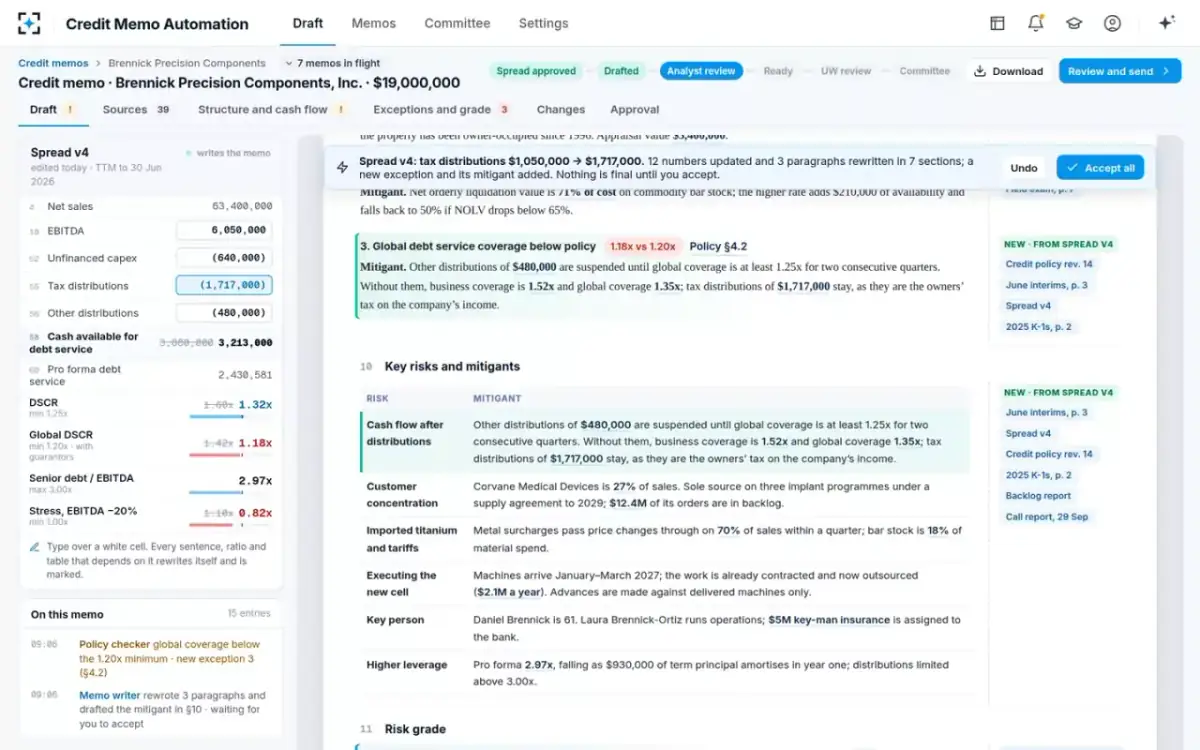
| 09:06 · a third exception after a change | Policy checker, after the consistency checker re-ran the memo | Global coverage fell to 1.18x against a 1.20x minimum once the K-1 tax distributions were in. | The analyst accepted the mitigant at 09:08; committee approves the exception. |
The change log: agents propose, people accept
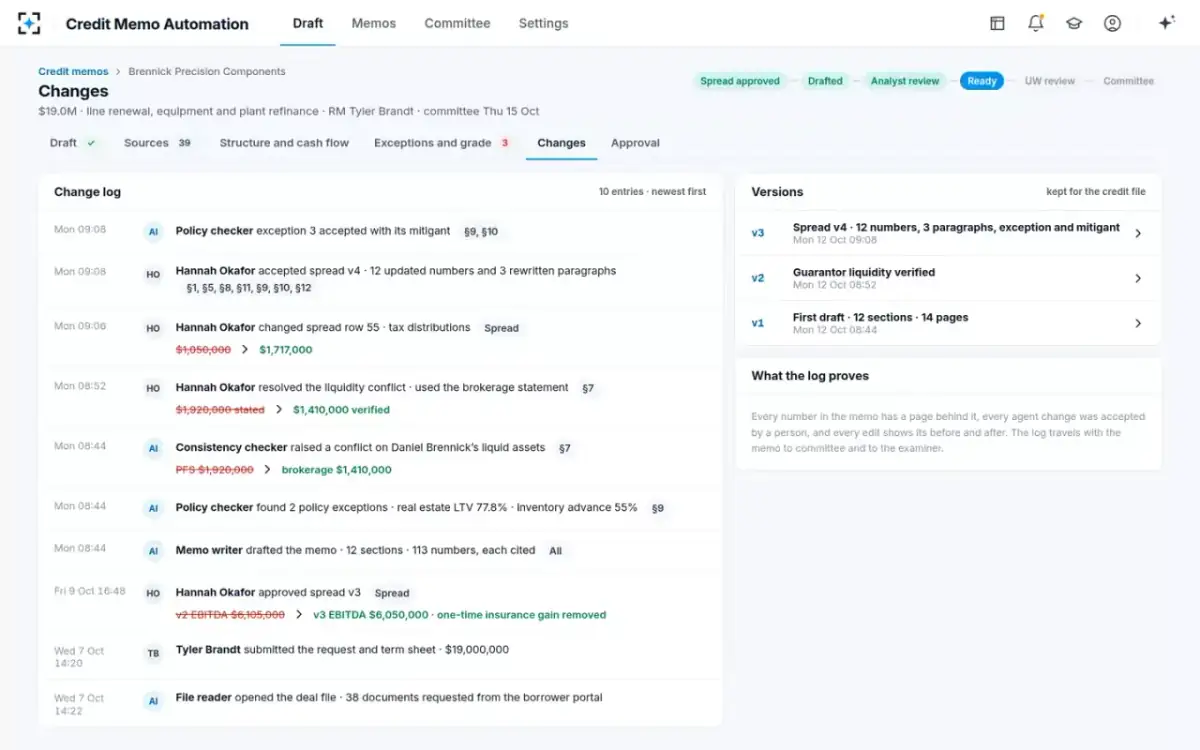
The AI and HO initials show who made each entry: agent or analyst.
The liquidity case shows why "use neither" is the right default. A drafter left alone would have used the figure it read first, the signed statement, and the memo would have overstated guarantor liquidity by $510,000. It would still have passed the policy test, which is why nobody would have noticed. Combined guarantor liquidity with the verified figure is $2,040,000 against the $1,900,000 policy requires. A silent pass is the kind of error that reaches committee.
What stays with people: acceptance, exceptions and the grade
Three decisions never move to an agent: accepting what goes in the memo, approving a departure from policy, and setting the risk grade. In the solution these are limits written into each agent and settings the bank controls, not conventions. Agent changes are marked in place and wait for the analyst, who can accept them number by number or all at once, or press Undo. The policy checker lists each exception with its section, the actual, the limit and who approves it. The risk grader proposes a grade with the reason for each factor, and the approver sets it. Memos lock 24 hours before committee.
A new exception, its mitigant and its sources, marked for acceptance
What an examiner will ask about an AI-drafted credit memo
Examiners will ask the questions they ask of any memo, plus who is accountable for the parts a machine wrote. The OCC describes current bank use of generative and agentic AI as "generally limited to specific use cases with guardrails and human-in-the-loop accountability to manage risk" (Semiannual Risk Perspective, Spring 2026). The revised model-risk guidance of April 2026 says that "Generative AI and agentic AI models are novel and rapidly evolving. As such, they are not within the scope of this guidance" (OCC Bulletin 2026-13). Buying the tool does not move the duty. The use of third parties "does not diminish or remove banking organizations'" responsibilities to operate "in a safe and sound manner" (2023 guidance).
The Federal Reserve's Vice Chair for Supervision has drawn the line where credit memos sit. AI with "more direct impact on credit decisions affecting individual customers" presents "more substantial legal compliance challenges than other AI use cases" (Bowman, July 2026). A memo drafted by agents and decided by people sits on the safer side of that line, provided the bank can show the split. NIST's voluntary framework names the functions a bank should be able to evidence: "GOVERN, MAP, MEASURE, and MANAGE" (NIST AI RMF).
What a memo from Credit Memo Automation can show an examiner
130of 130
numbers citing a page when the memo was sent for review
12+ 3
numbers and paragraphs the agents changed after the K-1s, each accepted by the analyst
3
exceptions listed with section, actual, limit and mitigant; none approved by an agent
3
memo versions kept for the credit file, each tied to the spread version behind it
How to test that evidence before buying is the subject of twelve questions to ask before an AI writes your credit memos. The number-by-number path of the change in the table above is on one number's trip from a K-1 to the committee's DSCR. The sample memo is on the Credit Memo Automation page.
Questions people ask
Can AI write a credit memo?
It can draft one, section by section, from the spread and the file, if every number and claim is tied to its source and checked by something other than the drafter. Whether to approve the credit, accept a policy exception or set the grade remains a decision for people with authority under the bank's policy.
Is an AI that drafts credit memos a model under model-risk guidance?
The revised interagency guidance of April 2026 places generative and agentic AI outside its scope and excludes "simple arithmetic calculations, such as those found within spreadsheets" from its definition of a model. The agencies have said they will ask for comment on AI separately. Until then, banks govern these tools through their own AI, third-party and internal-control frameworks.
Do regulators allow AI in credit decisions?
No federal rule forbids it, and none exempts it from existing law. The OCC reports banks using generative and agentic AI with "human-in-the-loop accountability", Regulation B still requires a statement of reasons when credit is denied, and the bank remains responsible for a third party's tool as if the work were done in-house.
Will AI replace credit analysts?
Not the judgement part of the job. An AI credit memo tool takes the pasting, re-describing and re-checking; the analyst still decides between conflicting documents, accepts each change and owns the recommendation. The Bureau of Labor Statistics counted 64,390 credit analysts in May 2025, and the work that remains is the work examiners test.
What does an AI credit memo tool need from the bank?
The memo template, the credit policy with its limits and approval authorities, the risk-rating scorecard, the stress cases and a set of recent approved memos with their files. What to bring to credit memo automation lists who owns each and what it controls.