To calculate global DSCR, add the business's cash available for debt service to the guarantors' net personal cash flow, then divide by the business's debt service plus the guarantors' own debt service, including what they owe on other guarantees. The interagency definition is exactly that: global coverage is "inclusive of the cash flows generated by both the borrower(s) and guarantor(s), as well as the combined financial obligations (including contingent obligations)" (2023 policy statement). The arithmetic is simple; the hard parts are counting each dollar once and keeping the result current, because cash flow sits at the top of a long chain in a credit memo. Coverage, global coverage, the stress cases, the exception list, the grade and the recommendation all depend on it. Botminds' Credit Memo Automation writes the memo from the approved spread and the deal file and cites every number to its page. This guide works the calculation, then follows one K-1 figure through a sample memo to show where numbers drift when people carry them by hand.
What one corrected figure did to one credit memo
$667k
more in tax distributions once the CPA's 2025 K-1s replaced the interim estimate
12
numbers updated in the memo, and 3 paragraphs rewritten
7
of the memo's 12 sections touched by the one change
1
new policy exception, global coverage of 1.18x against a 1.20x minimum
How to calculate global DSCR, step by step
Work in four steps: business cash available for debt service, the guarantors' net personal cash flow, the combined debt service, and the ratio. The example below uses round, invented numbers for one owner-guarantor of an S corporation, so that each step can be checked by eye.
Global DSCR for an illustrative S corporation and its owner, in four steps
| Step | What goes in | Result | Where it comes from |
|---|---|---|---|
| 1 · Business cash available for debt service | EBITDA $2,000,000, less unfinanced capex $250,000, tax distributions $450,000 and other distributions $300,000 | $1,000,000 | Business statements and returns; fixed-asset schedule; K-1s |
| 2 · Guarantor's net personal cash flow | Distributions received $750,000 and rental income $40,000, less personal income tax $450,000 and living expenses $180,000 | $160,000 | Personal return; K-1s; personal financial statement |
| 3 · Combined debt service | Business debt service including the new loan $800,000, plus personal and contingent debt service $70,000 | $870,000 | Debt schedule; term sheet; credit report; contingent liability schedule |
| 4 · Global DSCR | ($1,000,000 + $160,000) ÷ $870,000; business DSCR alone is $1,000,000 ÷ $800,000 | 1.33x | Against the bank's global minimum |
The OCC's commercial real estate handbook describes what goes into the personal side. Global analyses "may require integrating cash flows from business financial statements, tax returns, and Schedule K-1 forms for multiple partnerships, limited liability companies, and corporations", should consider "required and discretionary cash flows from all activities and any actual or contingent liabilities", and should use "Realistic projections of such expenses as personal debt payments, property and income taxes, and living expenses" (OCC, Commercial Real Estate Lending). Living expenses are the term analysts most often leave out, and they are the reason a guarantor with a large income can still add little to global coverage.
Global DSCR vs DSCR, and what a good global DSCR is
Business DSCR asks whether the company can pay its own debt; global DSCR asks whether the company and its owners together can pay everything they owe. A deal can pass one and fail the other in either direction. A strong owner with outside income can lift a thin business, and an owner who draws heavily or guarantees other debts can drag a healthy business below the line.
A good global DSCR is whatever clears the bank's own policy minimum with a cushion that survives the stress case. There is no regulatory number for conventional loans. For Standard 7(a) loans, the SBA requires business coverage of at least 1.15 "and 1:1 on a global basis" (SOP 50 10 8.1). The sample bank in this guide sets 1.25x for the business and 1.20x global. The OCC adds a warning for strong guarantors: global analyses "should be performed despite the presence of significant liquid assets", because those assets "may be needed to fund other actual or contingent liabilities" (OCC).
How do you avoid double counting in global cash flow?
Follow each dollar of distributions: subtract it where it leaves the business and add it where it arrives with the owner, never both added. The error is common because the business spread and the personal return come from different documents and often from different analysts. On a pass-through borrower the owner's return shows the K-1 income and the distributions, and either can be added to a business figure that already contains the same cash.
The same borrower, counted once and counted twice
Distributions counted twice: Cash flow before distributions: $1,750,000.
Distributions counted once: Cash flow after all distributions: $1,000,000.
Distributions counted twice: Net personal cash flow of $160,000, which already includes the $750,000 of distributions received.
Distributions counted once: Net personal cash flow of $160,000, including the $750,000 received.
Distributions counted twice: $1,910,000: the $750,000 appears on both sides.
Distributions counted once: $1,160,000.
Distributions counted twice: 2.20x, which hides a borrower near the minimum.
Distributions counted once: 1.33x.
A memo can show the reviewer that it counted once. Put the distribution figure on both sides of the global table with the same source, so that the subtraction and the addition can be matched line for line, and state the method in a sentence. In the sample credit below, tax distributions are the line that moved late, which is why their source matters as much as their size.
Why one figure in a credit memo touches a dozen others
Because the memo's conclusions are built on cash flow, and cash flow is a sum of figures from different documents. Treacy and Carey put the order of priority plainly: "Financial statement analysis is central to appraising the likely adequacy of future cash flow and thus the ability of the borrower to service its debt" (Federal Reserve Bulletin, 1998). The OCC's examiners look first at the same place: "Shortfalls in cash flow or debt service coverage are usually the most obvious indications of a problem credit" (Rating Credit Risk). Change one term of the cash-flow sum, and every ratio and judgment downstream moves with it.
For pass-through borrowers the most mobile term is the owners' tax distributions. An S corporation or partnership generally pays no federal income tax of its own, so it commonly distributes cash to its owners to pay theirs. The SBA names the adjustment among the items a memo must justify: "Distributions for S-Corp taxes" (SOP 50 10 8.1). Interim statements estimate it, and the final figure comes with the CPA's work, often late.
Take the sample credit as it runs through the solution. Brennick Precision Components, a fictional CNC machining shop, asks its bank for $19,000,000 across a renewed line, an equipment loan and a real estate loan. Its spread, approved on Friday, carried tax distributions of $1,050,000 from the interim statements. On Monday at 09:05, three days before loan committee, the CPA's 2025 K-1s put them at $1,717,000.
The first hop is a choice between two documents, and the memo should say which one it used. The interim statements and the K-1s describe the same item at different stages of finality. The later, third-party figure wins, but only once someone decides so and writes the reason down. In the solution the CPA's letter arrives as a source of its own, the 2025 K-1s at page 2. A banner shows that spread row 55 "still carries the interim estimate of $1,050,000" until the analyst puts the new figure in.
The trip, hop by hop: who moves the number at each step
A person decides
Credit analystReads the CPA's 2025 K-1s and types $1,717,000 into spread row 55, replacing the interim estimate. Only a person changes the approved spread.
Agent
Spread and cash flow analystRecomputes cash available for debt service, coverage, global coverage and the stress cases from spread v4.
Agent
Consistency checkerFinds every number and passage in the memo that depended on the old figure and has each recomputed or rewritten, marked in place.
Never: Never accepts its own changes.
Agent
Policy checkerRe-runs the policy test: global coverage now breaks the 1.20x minimum, so it lists a new exception with its section, actual and limit.
Never: Never waives or approves an exception.
Agent
Memo writerDrafts the mitigant and the new risk, and rewrites the recommendation, each passage cited.
A person decides
Credit analystReads the marked changes and accepts them, number by number or all at once, or presses Undo.
A person decides
Underwriting manager and approverClick any number to see its page; the approver sets the grade and decides on the exception.
What is cash available for debt service? Hop 2: spread row 55
Cash available for debt service is what the business has left for lenders after the spending and payouts the bank decides to deduct; here it is a four-term sum, and the K-1 moves one term. On spread v3 it was $3,880,000. With tax distributions at $1,717,000 it is $3,213,000, a fall of exactly the $667,000 difference, because nothing else in the sum moved.
Cash available for debt service, the sum the K-1 changed
EBITDA
$6,050,000
Trailing twelve months to 30 June, spread v3; a one-time insurance gain was removed in v3.
Audited and interim statements
Unfinanced capital expenditure
− $640,000
Capital spending not paid for by new debt.
Spread row 52
Tax distributions
− $1,717,000
Was − $1,050,000 from the interims; the CPA's 2025 K-1s set it.
Spread row 55 · 2025 K-1s, p. 2
Other distributions
− $480,000
Distributions above the owners' tax.
Spread row 56
A reviewer checking this hop by hand needs three pages open: the K-1, the spread and the memo. The common drift here is not arithmetic. It is a memo that quotes $3,880,000 in the financial analysis and $3,213,000 in the cash-flow section because the two were edited at different times.
Hops 3 to 5: DSCR, global coverage and the stress case
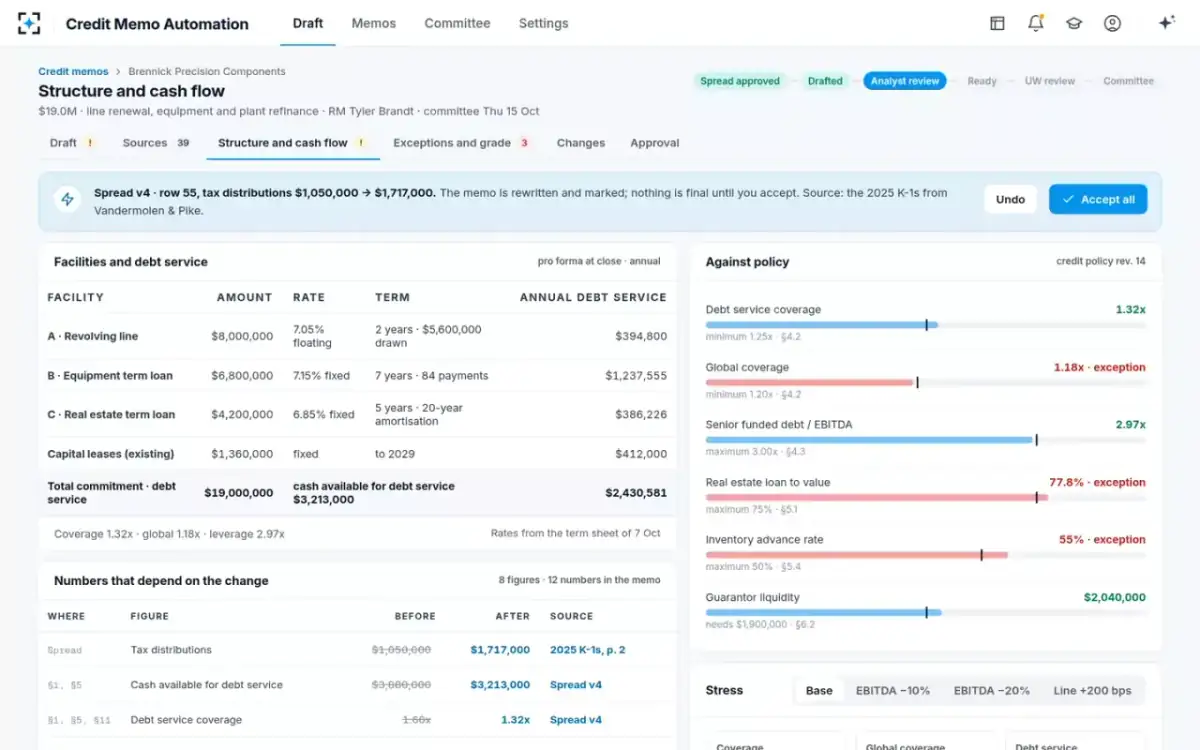
Three ratios divide by the same pro forma debt service of $2,430,581, so all three fall together. Business coverage falls from 1.60x to 1.32x, still above the 1.25x policy minimum. Global coverage, which adds the guarantors' cash flow and their personal debt service of $318,000, falls from 1.42x to 1.18x, below the 1.20x minimum. The stress case with EBITDA 20% lower falls from 1.10x to 0.82x.
Spread v4 in Credit Memo Automation: the memo rewritten and marked
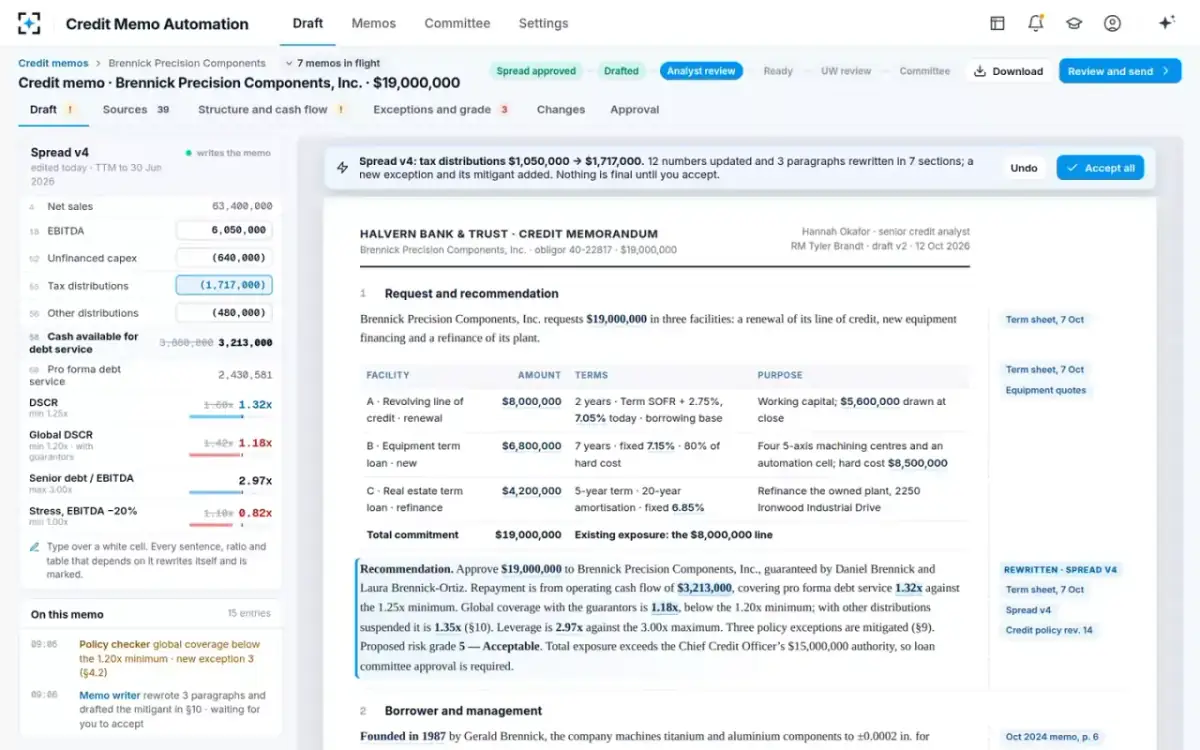
The coverage covenant in the draft structure, at least 1.25x tested quarterly, had a cushion at close of 0.35x on spread v3. At 1.32x it is 0.07x (our arithmetic). That changes how the structure section reads, not only its numbers. A seven-hundredths cushion on a quarterly test is a covenant the borrower can trip in its first bad quarter. The structure section is one of the seven the change reached.
Hop 6: a new policy exception and the mitigant written for it
When a ratio crosses a policy limit, the number stops being a figure and becomes an exception that needs approval. The OCC's examiners "should expect to see exceptions clearly identified in the loan approval documentation along with mitigants that justify the decision to approve the loan" (OCC, 2026). In the sample, global coverage at 1.18x against the 1.20x minimum in policy section 4.2 became exception 3, beside the two the first draft already had.
The mitigant has to restore what the exception breaks, and its numbers have to come from the same spread. The draft mitigant suspends the $480,000 of other distributions until global coverage is at least 1.25x for two consecutive quarters. Without them, business coverage is 1.52x and global coverage 1.35x. Tax distributions of $1,717,000 stay: they are the owners' tax on the company's income, and the shareholder agreement requires them. The suspension becomes a condition in section 12, and section 10 gains a new risk, cash flow after distributions. Both passages are marked "New · from spread v4" with their sources, the credit policy, the June interims, spread v4 and the K-1s.
Hop 7: the grade and the recommendation the committee reads
The last hops are the ones an approver reads first. The risk grader's scorecard weights cash-flow coverage at 30%, and its stated reason now reads "1.32x · global 1.18x". The proposed grade is 5, Acceptable, from 4 in the October 2024 memo. The grade rationale explains the move by leverage of 2.97x pro forma against 1.71x a year earlier, and coverage of 1.32x once the K-1 tax distributions are in. The recommendation paragraph now quotes $3,213,000, 1.32x, 1.18x and 1.35x with suspended distributions, and three mitigated exceptions instead of two.
Every number the K-1 moved, before and after
| Figure | Spread v3 | Spread v4 | Where in the memo |
|---|---|---|---|
| Tax distributions | $1,050,000 | $1,717,000 | Spread row 55 · source 2025 K-1s, p. 2 |
| Cash available for debt service | $3,880,000 | $3,213,000 | §1 recommendation, §5 cash flow |
| Debt service coverage (min 1.25x) | 1.60x | 1.32x | §1, §5, §11 grade |
| Global coverage (min 1.20x) | 1.42x | 1.18x | §1, §5, §9 exception 3 |
| Stress, EBITDA −20% | 1.10x | 0.82x | §5 stress cases |
| Coverage with other distributions suspended | not needed | 1.52x · global 1.35x | §9 mitigant, §10 risk, §12 condition |
| Policy exceptions | 2 | 3 | §9, §1 |
How do banks check the numbers in a credit memo? A one-minute test
By tracing a sample of figures to their pages and their dependants, and a reviewer can do it quickly only if the memo already holds its source and its dependants. The safety-and-soundness guidelines ask that documentation "Enable the institution to make an informed lending decision and to assess risk, as necessary, on an ongoing basis" (12 CFR 30, Appendix A). An underwriting manager who has to reopen the spread and the file to find where 1.32x came from is doing the analyst's work again.
Click a figure, see its page and every section that cites it
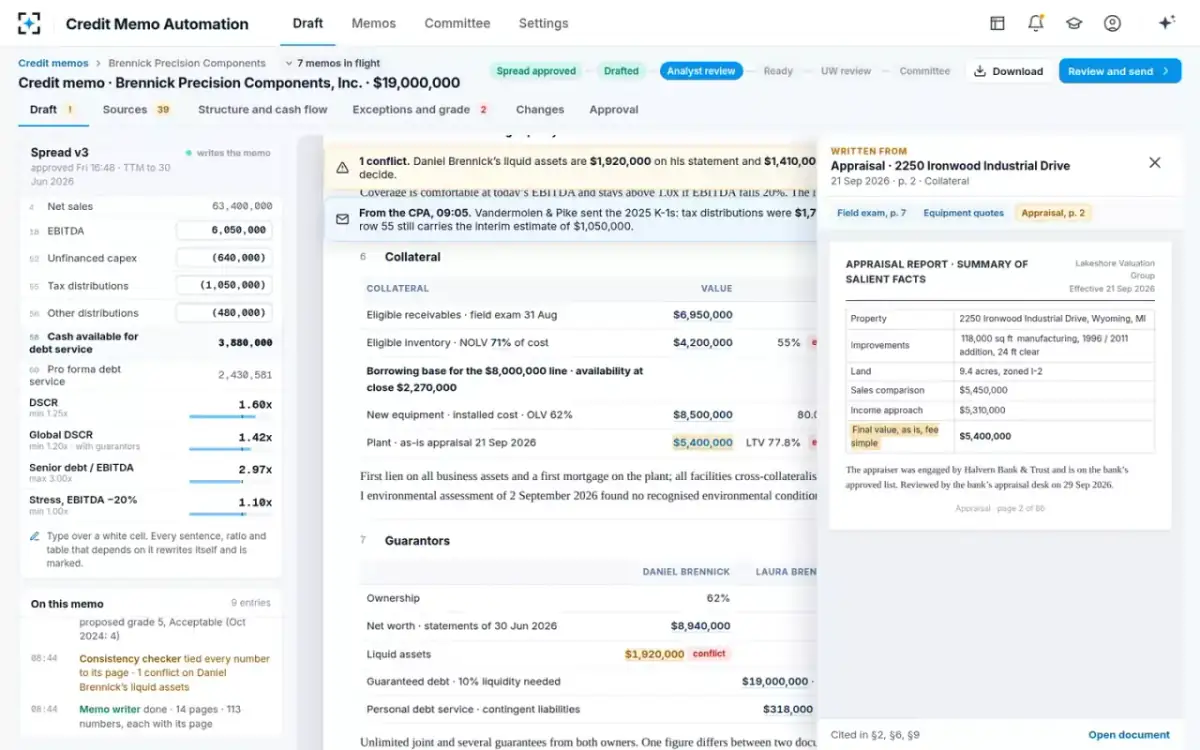
The footer is the part reviewers use most: Cited in §2, §6, §9.
A one-minute check on any number in a credit memo
- Open its source
The document, the page and the line. A number with no page is an assertion, not evidence.
- Check the source is the latest
An interim estimate, an unsigned statement or an appraisal before review can each be superseded.
- List where else it appears
The summary, the analysis and the grade often quote the same figure; they must agree.
- Follow it one step downstream
A cash-flow term moves coverage; coverage moves exceptions, covenants and the grade.
- Check the policy test was re-run
A ratio that crossed a limit needs an exception, a mitigant from the same spread version and an approver.
- Read the change log
Every edit by an agent or a person, with before and after, so you know which version you are approving.
In the sample, all seven pre-send checks passed before the memo went to the underwriting manager, including "Every number cites a page" at 130 of 130. The underwriting manager can still disagree with a number, and that is the point. She starts from its page, not from a search. The control design behind this, with separate agents drafting and checking, is set out in why the AI that drafts the memo should not check it. The week this change landed in is on what a credit memo waits on. The whole sample memo is on the Credit Memo Automation page.
Structure, limits and the table of moved numbers in Credit Memo Automation
Questions people ask
Why do tax distributions affect DSCR?
Because they leave the business before debt service is paid. For an S corporation or partnership, cash paid to owners for their personal tax on the company's income is not available to the bank, so the example bank's cash-flow sum subtracts it from cash available for debt service. The SBA requires a memo to justify that adjustment.
Is a 1.20x global DSCR minimum a regulatory requirement?
No. For conventional loans the minimums are the bank's own, set in its credit policy; the 1.25x and 1.20x in this guide belong to the sample bank. The SBA is the exception for its loans: Standard 7(a) requires at least 1.15 for the business and 1:1 globally.
Should a guarantor's liquid assets count in global cash flow?
Not as cash flow. Liquidity is tested separately, against a policy minimum such as the sample bank's 10% of guaranteed debt, and the OCC asks for a comprehensive global analysis even when a guarantor holds significant liquid assets, because those assets may be needed for other obligations.
What are contingent liabilities in a global cash flow analysis?
Obligations a guarantor may have to pay but does not pay today, chiefly guarantees of other borrowers' debt. The interagency definition of global coverage includes them, and examiners ask whether a guarantor can meet "the total number and amount of guarantees currently extended", not only the one in front of them.
How often should global DSCR be recalculated?
At least at each annual review and at every renewal or modification, and whenever new personal statements or returns arrive. A global ratio built on last year's personal return can be wrong in either direction long before the business ratio moves.