Credit memo software drafts the commercial credit memorandum a bank writes before it lends, and the right way to evaluate it is to make it pass the tests an examiner would put to the memo. Can every number be traced to a page? Are exceptions identified with their mitigants? Is the grade supported? Does the change log show who changed what? A demonstration on clean sample data answers none of these. A demonstration on one of your own approved spreads, with one figure changed halfway through, answers most of them. Botminds' Credit Memo Automation is one such tool. It drafts the memo in the bank's template from the approved spread and the deal file and cites every number to its page. These questions apply to it and to any alternative. Each comes with what a good answer sounds like and the red flag to listen for.
The three tests behind the twelve questions
4
things the OCC expects every loan approval package to give decision makers
1
question examiners ask of every decision: was the documentation sufficient, and the approver authorised?
0
reduction in the bank's responsibility when the work is done by a third party's tool
What examiners test in a credit memo, and why it decides the questions
Software that drafts memos inherits the standard the memo is held to. The OCC's 2026 lending booklet tells examiners to determine "if the documentation and analysis are sufficient to make an informed credit decision, and that the approver had sufficient authority". Its four expectations of an approval package cover the repayment sources, prior transactions and performance, risks and mitigants, and support for the rating (OCC, 2026); how to write a commercial credit memo sets them out with the sections they shape. A tool either helps a memo meet those tests or makes them harder to meet, and every question below traces back to one of them.
The bank keeps the responsibility either way. The interagency third-party guidance says the use of third parties "does not diminish or remove banking organizations'" responsibilities "to ensure that activities are performed in a safe and sound manner and in compliance with applicable laws and regulations" (2023 guidance). And the specific risk of generative AI is the one a memo cannot afford: output that is "confidently stated but incorrect" (Treasury, 2024).
What questions should a bank ask a credit memo software vendor?
Twelve questions, in four groups
- Evidence · Does every number in the draft cite a page, and can a memo be sent with an uncited one?
The answer should be a hard rule, not a default the analyst can ignore.
- Evidence · What happens when two documents disagree?
A signed statement against a later bank statement is routine. Listen for whether the tool chooses silently.
- Evidence · Does it write in our template, and does it mark text carried from the last approved memo?
Reused text is how stale facts survive renewals.
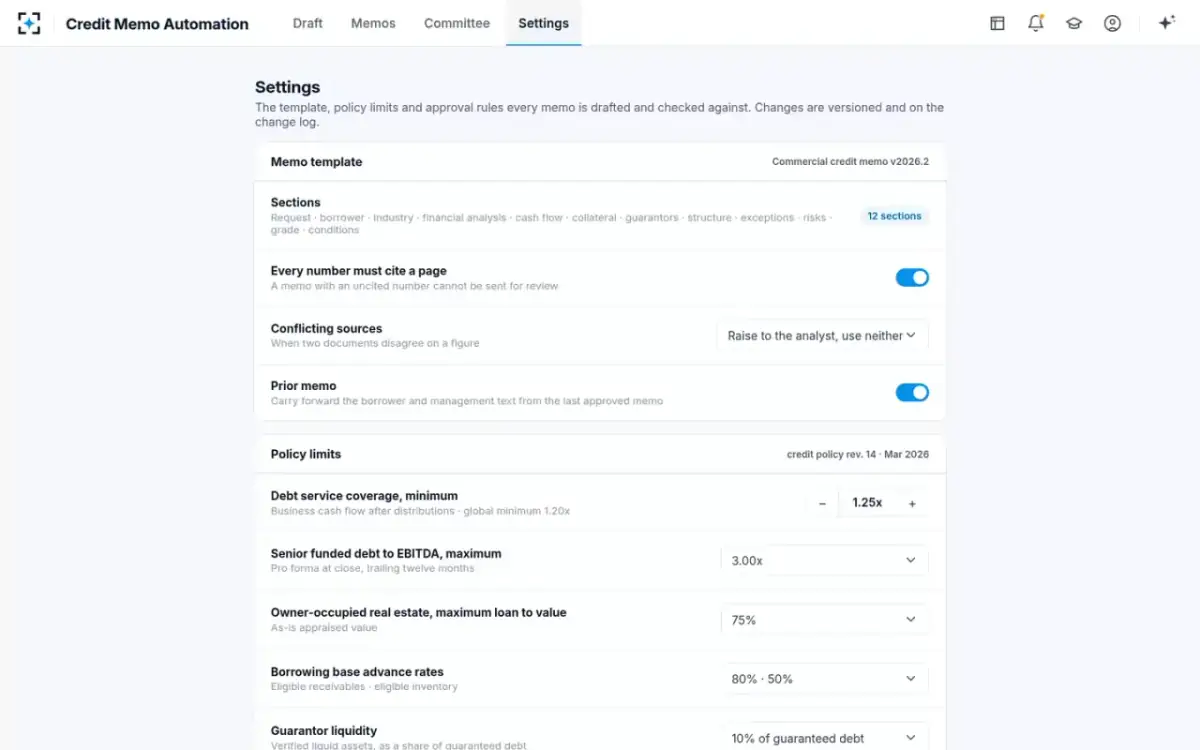
- Policy · Does it test the structure against our credit policy, limit by limit?
Coverage, global coverage, leverage, loan to value, advance rates, guarantor liquidity: each against your number.
- Policy · How does it list exceptions?
Each with its policy section, the actual, the limit, a mitigant with sources, and who approves it.
- Policy · Who sets the risk grade, and what reasons come with it?
A proposal with a reason per scorecard factor; the approver sets the grade.
- Change · When one figure changes, does it find every number and passage that depends on it?
Ask to see it on a figure with long dependencies, such as tax distributions.
- Change · Does it ever change the spread the analyst approved?
It should use only the approved version, and never alter it.
- Change · Are its changes marked, and does anything become final without the analyst?
Number by number acceptance, all at once, and an undo.
- Accountability · Is every edit, by agent or person, kept with before and after?
With each version kept for the credit file and a lock before committee.
- Accountability · What can the agents never do?
Written limits: never approve or waive an exception, never set the grade, never accept their own changes.
- Accountability · Will you prove it on our own files before we commit?
One of our approved spreads and deal files, drafted and then changed, measured by us.
What red flags should a bank watch for in a vendor demo?
Answers that describe intentions instead of showing the screen. The table gives the answer to listen for and the warning sign in each group. The right-hand column is how Credit Memo Automation answers on its sample deal, so a reader can hold this page to the same standard.
Good answers, red flags, and Credit Memo Automation's answers
| Group | Good answer | Red flag | Credit Memo Automation, sample deal |
|---|---|---|---|
| Evidence | Every number is cited to document and page; a memo with an uncited number cannot be sent; conflicts are raised and neither figure is used until a person chooses. | "The model is very accurate." Citations on some numbers, or only on request. | 113 numbers in the first draft, each with its page; 130 of 130 cited when sent; one conflict raised on a guarantor's liquidity. |
| Policy | Every limit tested against your policy; each exception with section, actual, limit, mitigant and approver; grade proposed with reasons. | Exceptions described in prose; a grade with no factor-level reasons; any agent that can approve. | Three exceptions with sections 4.2, 5.1 and 5.4; grade 5 proposed from a scorecard of 5.05, with a reason for each factor. |
| Change | One spread change finds every dependent number and passage, re-runs the policy test and marks each change for acceptance. | "Regenerate the memo" as the answer to any change; edits that become final on their own. | One change to tax distributions: 12 numbers and 3 paragraphs in 7 sections, a new exception and mitigant, accepted by the analyst. |
| Accountability | A log of every edit with before and after; versions kept; written agent limits; a pilot on your files. | Logs only of user actions; no limits in writing; a pilot only on the vendor's data. | Change log of agent and person edits; three versions kept; memos lock 24 hours before committee. |
Writing assistant vs credit memo software: three questions that tell them apart
Questions 2, 7 and 11 most often expose the difference between a general writing assistant and software built for credit. A writing assistant drafts text from whatever it is given. A memo tool has to keep a memo true to a file that keeps changing, under a policy it may not override.
An evasive answer, and one you can test
Evasive: The AI uses the most reliable source.
Testable: Both figures shown side by side; neither used until the analyst chooses; the choice and reason on the change log. Show me.
Evasive: You can regenerate the memo in seconds.
Testable: Every dependent number and passage found, recomputed or rewritten, and marked; here is the list of what changed and where.
Evasive: The AI is a co-pilot; people stay in control.
Testable: Written limits per agent: never approves or waives an exception, never sets the grade, never accepts its own changes, never edits a locked section.
"Regenerate the memo" deserves particular suspicion. A regenerated memo is a new memo. Every paragraph the analyst edited, every judgment she added, has to be found and re-applied, and nothing tells the reviewer what moved. The guide to following one number from a K-1 to the committee's DSCR shows what a targeted update has to reach.
What should credit memo software do when two documents disagree?
Stop and show both, then let a person choose and record why. Disagreement is routine in a commercial file: a guarantor's signed statement and a later brokerage statement, an interim estimate and a CPA's final figure, an appraisal and its review. A tool that silently picks one is making a credit judgement nobody approved, and usually picking the figure it read first.
The sample deal shows why this matters more than it looks. A guarantor's signed statement of 30 June listed $1,920,000 of liquid assets; his brokerage statement of 31 August showed $1,410,000 after a $520,000 withdrawal. Either figure cleared the sample bank's guarantor-liquidity test, so a tool that used the first would have overstated liquidity by $510,000 with no warning. Credit Memo Automation offers a bank three rules for this, set once in its settings: raise the conflict and use neither figure until the analyst chooses, use the most recent verified document, or use the lower figure and note it. Ask any vendor which rules it supports, which is the default, and where the choice is logged.
A conflict raised in Credit Memo Automation, neither figure used
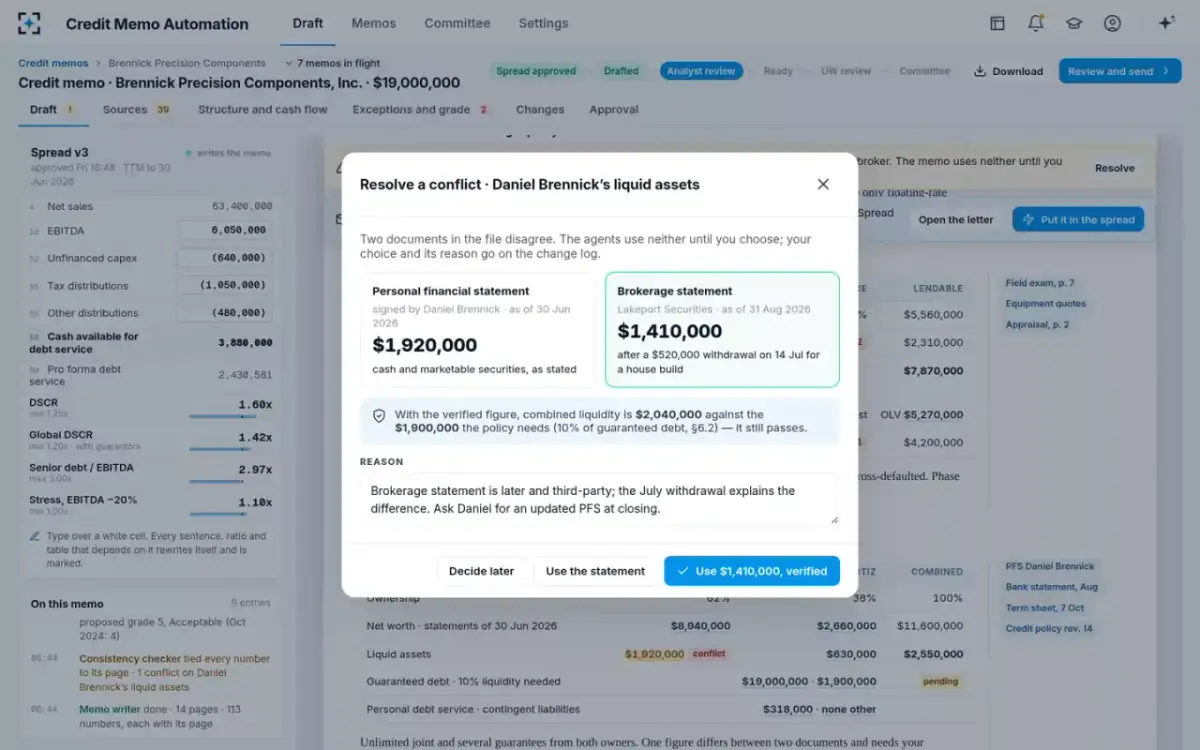
The line that matters to a buyer: it still passes. A silent choice here would never have been caught.
How do you run a pilot of credit memo software? Start with the one-change test
Start small and on your own files: ask for a demonstration on one of your own recently approved credits, then change one figure. Bring the approved spread, the deal file, your template and policy, and the final memo your analyst wrote. Let the tool draft. Then change a figure with long dependencies, such as tax distributions or a guarantor's liquidity, and count. How many numbers moved? Did any section keep the old figure? Did the policy test re-run? Was each change marked for acceptance? Your analyst's memo is the answer key.
One spread change, every dependent number marked
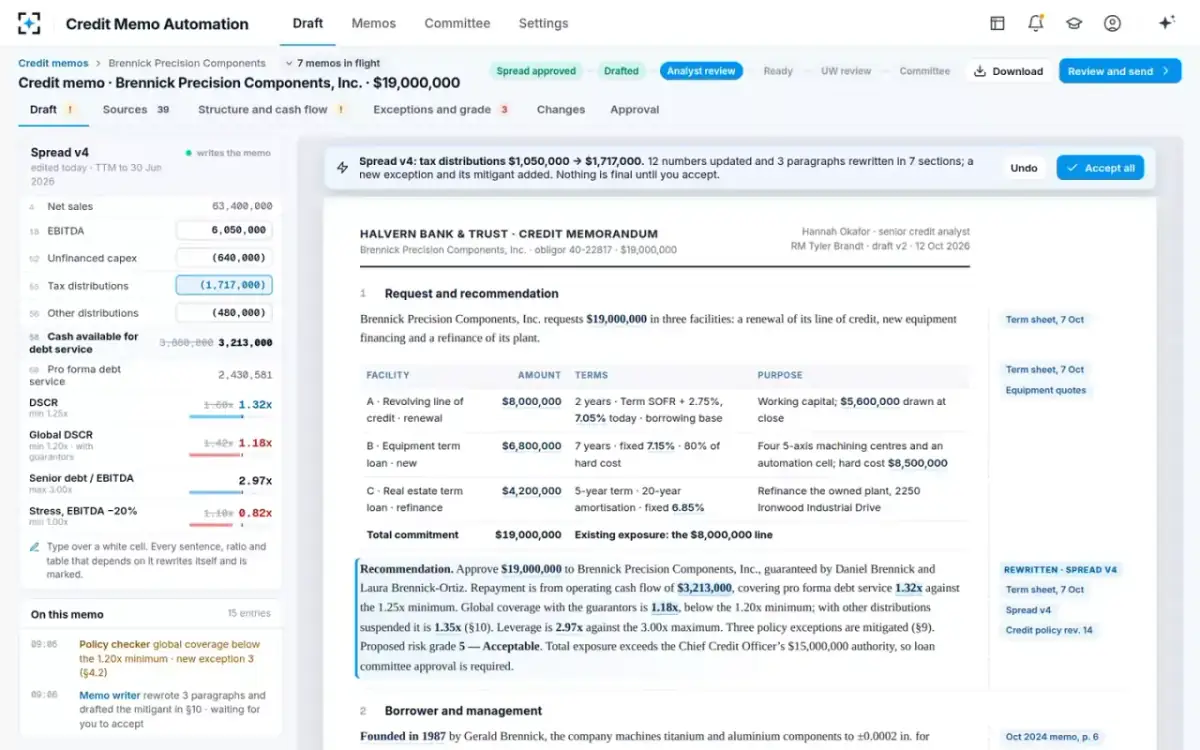
Read the banner's count, then check it against your own: that is the test.
Score the result on four counts: numbers without a page, numbers that should have moved and did not, exceptions the policy test missed, and changes that became final without the analyst. On a well-built tool the first, third and fourth should be zero. The second is the one to watch on long dependency chains. A tool that cannot show these counts on your own file has not yet shown that it can be trusted with your next one.
A pilot extends the same test across a sample that looks like your book. Five to ten recent approvals is enough to start if the set includes a renewal, a credit with policy exceptions, one with guarantors whose statements disagree, and one where a late document changed the numbers. Measure four things on each: the counts above, the analyst's hours from approved spread to a memo ready for review, the reviewer's questions sent back, and every place the analyst rewrote the draft's judgement. The last count is the one vendors rarely ask for and the one that tells you where the tool's limits are.
Does credit memo software need model validation?
Probably not as a model under the 2026 interagency guidance, but it still needs governing, and risk management and audit should get the vendor's answers in writing. The guidance defines a model as "a complex quantitative method, system, or approach that applies statistical, economic, or financial theories to process input data into quantitative estimates", and excludes "simple arithmetic calculations, such as those found within spreadsheets" and "deterministic rule-based processes". The revised model-risk guidance of April 2026 states that It also says that "Generative AI and agentic AI models are novel and rapidly evolving. As such, they are not within the scope of this guidance", and the agencies plan a request for information on AI (OCC Bulletin 2026-13). Coverage ratios and policy tests are arithmetic and rules; the drafting is generative. Banks therefore govern these tools through their own AI, third-party and internal-control frameworks. The OCC describes current bank practice as use "with guardrails and human-in-the-loop accountability" (Spring 2026). NIST's voluntary framework gives a common structure for the evidence: "GOVERN, MAP, MEASURE, and MANAGE" (NIST).
Template, citation rule and policy limits as settings in Credit Memo Automation
Two more questions belong with the second line. First, can declined credits be explained? A business applicant over $1 million in revenue may ask for "a written statement of the reasons for adverse action" within 60 days (Regulation B). A memo whose reasons are cited to the file makes that statement easy to write. Second, does the grade hold up against examiners' own? They "review a sample of loans and compare internal bank ratings with those assigned by OCC staff" (Rating Credit Risk). A proposed grade with a reason per factor is easier to defend, and to overrule, than a bare number. The case for keeping drafting and checking in separate hands is set out in why the AI that drafts the memo should not check it. What to bring to a pilot is listed in your memo template, past memos and credit policy. The sample deal is on the Credit Memo Automation page.
Where Credit Memo Automation fits, and where it does not
It fits a bank that already writes commercial credit memos to a template, has a written credit policy with numeric limits, and approves its spreads before the memo starts. Credit Memo Automation drafts from that approved spread and the deal file; it does not spread statements itself, set policy, or decide credits. Its agents read the file, compute coverage and stress cases from the approved spread, draft every section, test the structure against policy, propose a grade and keep the memo consistent when a figure changes. The analyst accepts each change, chooses between conflicting documents and sends the memo; the approver decides exceptions and sets the grade.
It is the wrong tool for decisions a bank wants made without a memo at all. Small loans that a bank approves by score are a different problem, and the FDIC found automated approval rare in any case: fewer than one bank in thirty uses a credit-scoring system to auto-approve loans (FDIC). The design target for the solution is a cited first draft the same day the spread is approved; on the sample deal, the analyst typed a late tax-distribution figure into the spread at 09:06 and accepted the marked changes, a new exception among them, at 09:08. What a bank needs to bring is set out in what to bring to credit memo automation.
Questions people ask
What is credit memo automation software?
Software that drafts the credit memo once the financial statements are spread: request, borrower, industry, financial analysis, cash flow, collateral, guarantors, structure, exceptions, risks, grade and conditions. The better tools cite every figure to its source and keep the memo consistent with the spread as the deal changes.
Can credit memo software spread financial statements too?
Some tools combine spreading and drafting; others, including Credit Memo Automation, start from a spread the analyst has already approved. Either way, ask which spread version every number in the memo came from, and whether the memo software can ever change it. It should not.
Can credit memo software approve loans?
It should not, and a buyer should ask for that limit in writing. Approval within authority, exceptions to policy and the final grade are decisions examiners trace to a named person; software can propose, test and draft, and leave each of them visibly with that person.
Who in the bank should evaluate credit memo software?
The people who will be accountable for its output: an underwriting manager and two analysts for the drafting, the chief credit officer for the policy test and grading, credit administration for the template, and risk management and vendor management for the third-party and AI questions. Bring them in before the pilot, not after.
How long does it take to implement credit memo software?
Mostly as long as it takes to gather the template, policy, scorecard and a set of past memos with their files, and to run the first comparison on them. The setup guide lists each input and who owns it.