To get a business loan fast from a bank, hand over a complete file before the term sheet, ask which committee date the credit is aimed at and when the memo locks for it, and settle the likely conditions while the memo is still being written. A small, simple loan can then be decided by one officer within days; a larger credit is decided at the first committee meeting its written credit memo reaches. Everything else in the wait is the bank's own work, and the part it controls most directly is that memo: Botminds' Credit Memo Automation drafts it from the approved spread and the deal file with every number cited. For the business, the point of speed is money. An expansion starts sooner, outsourced work comes in-house sooner, and an early no leaves time to go elsewhere.
What speed is worth, and where borrowers go to get it
46%
of small employer firms that sought financing did so to pursue an expansion or new opportunity, a need with a date attached
29%
of small-business credit applicants sought financing from online fintech lenders, up from 17% five years earlier
57%
of applicants at small banks were fully approved, more than at any other lender type
60%
of online-lender borrowers found the actual cost higher than expected, against 37% at small banks
How do you get a business loan fast from a bank?
By removing the reasons a credit waits: a missing document, an unknown deadline and a condition discovered at the vote. None of them needs the bank to loosen its standard, and a borrower can act on all three before the first meeting with the relationship manager.
Send the whole file at once. A commercial credit memo is written from three years of business returns or statements, a current interim, a debt schedule, and for each owner who will guarantee, a signed personal financial statement, personal returns and evidence of the liquidity it claims. The analyst cannot finish the global cash flow until the last of these arrives, and the one that most often arrives late is the owners' final K-1s. If the CPA has finished the returns, send the K-1s with them; if it has not, say when it will, so the bank can plan the memo around interims and know which figures will move.
Ask for the committee date and the lock. Approval above an officer's authority goes to a committee, and committees meet on fixed dates set by the bank's policy, not by regulation. Each meeting has a deadline before it, after which a memo waits for the next one. Knowing that date tells the borrower when its own documents must be in, and turns a vague "two or three weeks" into a plan.
Settle the conditions early. A distribution limit, a guarantee, a borrowing-base change or a covenant level is easier to agree before the vote than after. A credit sent back by the committee for a condition the borrower would not accept costs a full meeting cycle.
Size the request to the cash flow. A request the cash flow cannot cover at the bank's minimum coverage either shrinks or goes up the approval chain with a policy exception, and an exception needs a written mitigant. In the Federal Reserve Banks' 2025 survey, only 42% of applicants received the full amount they sought (SBCS, 2026). A borrower that has run its own coverage at 1.25x knows which side of the line it is on.
How fast can you get a business loan at a bank?
A small, simple loan can be decided within a day at many banks; a larger credit is decided at the first committee meeting its memo reaches. Survey data on how long banks take, and how the wait grows with loan size at small and large banks, is set out in the guide to how long it takes a bank to approve a business loan. What matters from the borrower's side is why the larger credit takes longer: it needs a written credit memo, often an appraisal and guarantor analysis, and approval above an individual's authority. The OCC notes that "Large loans and loans with elevated risk characteristics generally require higher levels of approval", and that committee approval "can slow a bank's responsiveness" (OCC, 2026). A memo that misses a committee's deadline waits for the next meeting. Why the memo is the step that most often misses, and what it waits on, is on how long commercial underwriting takes.
Demand is moving towards the larger credits. In the Federal Reserve's July 2026 survey of senior loan officers, banks reported "stronger demand for C&I loans from large and middle-market firms and basically unchanged demand for C&I loans from small firms" (SLOOS, July 2026). Those are the credits that go to committee.
What is a faster loan decision worth to the business?
Whatever the borrower earns, or stops paying, from the thing it is borrowing for, for each week the decision comes sooner. A business usually borrows for something with a date attached. In the Federal Reserve Banks' 2025 survey, firms most often sought financing "to meet operating expenses (56%) or to pursue an expansion or new opportunity (46%)" (SBCS, 2026). An operating need waits on payroll and suppliers; an expansion waits on a seller, a lease or an equipment maker's delivery slot. In both cases the borrower is paying, in money or opportunity, for each week the bank takes.
Take a sample credit as it runs through the solution. Brennick Precision Components, a fictional CNC machining shop, asks the fictional Halvern Bank & Trust for $19,000,000. The request covers a renewed $8,000,000 line, a $6,800,000 loan for four 5-axis machining centres and an automation cell, and a refinance of its plant. The machines arrive between January and March 2027. Until they do, the work they will take on is "already contracted and now outsourced", at $2.1M a year.
That gives a rough measure of the borrower's stake. $2.1M a year of outsourced work is about $40,000 a week (our arithmetic). The borrower's actual saving from bringing it in-house is some part of that, after its own running costs. If a later approval delays the machine order, each week of delay costs the borrower that part. The relationship manager in the sample put the borrower's question simply: can the memo still go Thursday?
The borrower's two weeks: making the committee, or missing it
- Term sheet to spreadWed 7 to Fri 9 Oct
- MemoMon 12 Oct
- To committeeThu 15 Oct
- Term sheet to spreadWed 7 to Fri 9 Oct
- Writing and rework by handMon 12 to Thu 15 Oct
- Waiting for the next meetingone more week, if weekly
Are online lenders faster than banks for business loans?
Often, and borrowers pay for it: a borrower who cannot wait has somewhere else to go, and more of them are going there. Among small firms that applied for a loan, line or cash advance, "The share of applicants that sought financing at online fintech lenders has increased over the last five years, from 17% in the 2020 survey to 29% in the 2025 survey" (SBCS, 2026). The same survey shows what speed elsewhere costs. Sixty percent of borrowers from online lenders found the actual cost higher than expected, against 37% at small banks and 32% at large banks.
Borrowers who found the actual cost of credit higher than expected, by lender
Banks win on the outcome. "Applicants that sought financing at small banks were more likely to be fully approved (57%) than those that sought financing from other lenders", and "Credit union and bank applicants were more satisfied with their experiences than were online lender and finance company applicants" (SBCS, 2026). The survey covers firms with up to 499 employees, so it describes the lower end of commercial lending better than the middle market. The lesson travels upward all the same. Borrowers value a bank's price and certainty, and the bank's weak point is time.
Why do bank business loans take longer than online loans?
Because a bank decides most business credit through people reading documents, and an online lender's speed usually comes from deciding by score. The FDIC found that "Outside of credit cards, automated lending remains uncommon in the industry and is used almost exclusively for smaller loans": fewer than one bank in thirty uses a credit-scoring system to auto-approve loans, and fewer than one in a hundred will auto-approve a $250,000 loan (FDIC).
The people are also the bank's advantage. "Nine in ten small banks, but only four in ten large banks, have loan decision-makers meet with applicants", and at small banks "approval for larger loans often involves the bank's executive officers or the board of directors" (FDIC). That is why the bank's answer is more often yes and cheaper than expected, as the survey above shows. The time it costs sits mostly in preparing the written case those people decide on.
Why the credit memo is the part of the clock a bank can shorten
Of the steps between a term sheet and a decision, the memo is the one fully inside the credit department. The borrower's CPA, the appraiser and the guarantors set their own pace, as the guide to what a credit memo waits on describes. The committee's calendar is fixed by policy. The days between an approved spread and a memo ready for review are the bank's own. Our estimate puts them at about three days for a typical middle-market memo written by hand, most of it pasting tables and describing documents. The design target with Credit Memo Automation is a cited first draft the same day the spread is approved.
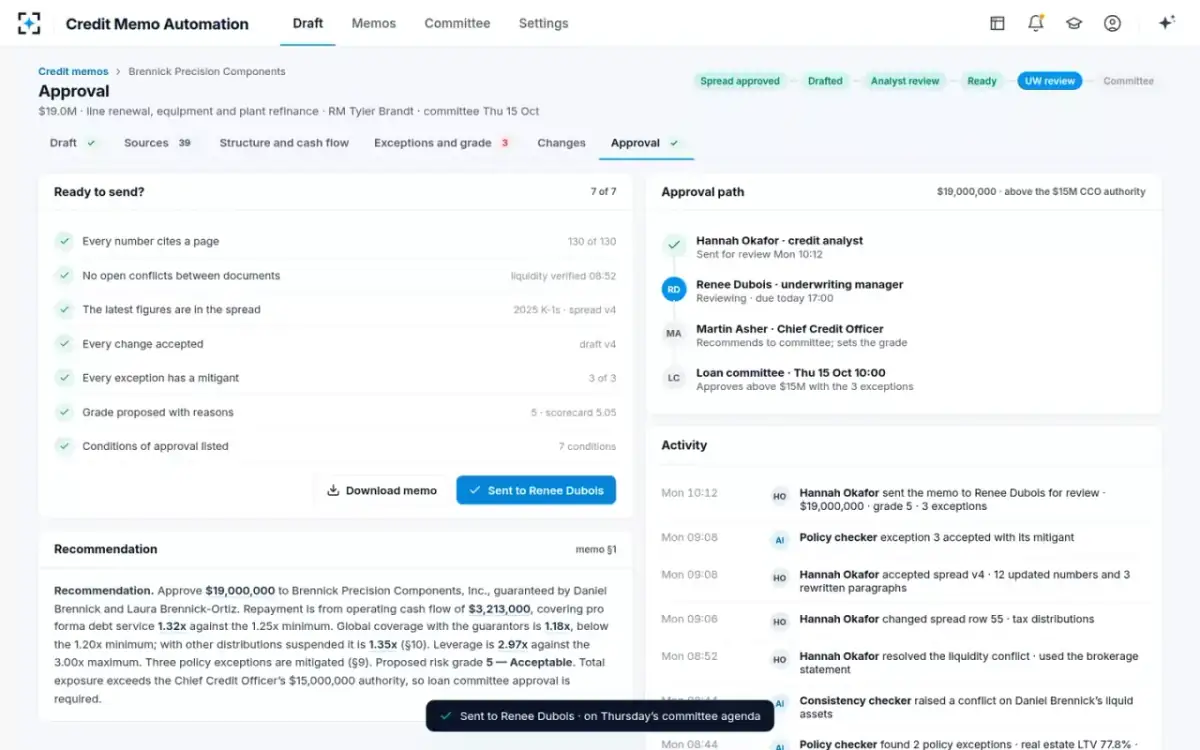
In the sample, the spread was approved on Friday at 16:48. The memo was drafted on Monday morning, rewritten after the CPA's final K-1s arrived at 09:05, accepted by the analyst at 09:08 and sent to the underwriting manager at 10:12. It was on Thursday's agenda with its three policy exceptions mitigated. The borrower's wait ended when the committee met, not when the analyst finished typing.
The same credit from the borrower's chair, with and without Credit Memo Automation
Memo written by hand: The analyst hunts through fourteen pages for every figure the tax distributions fed; the RM tells the borrower Thursday is at risk.
Memo drafted by the agents: 12 numbers and 3 paragraphs rewritten and marked within minutes; accepted at 09:08.
Memo written by hand: Found late, or by the reviewer; the mitigant is negotiated after the memo is sent back.
Memo drafted by the agents: Found when the spread changed, with a drafted mitigant the RM can discuss with the borrower the same morning.
Memo written by hand: Learned at or after committee.
Memo drafted by the agents: Known on Monday: other distributions of $480,000 suspended until global coverage is at least 1.25x for two quarters.
Memo written by hand: Next meeting, if the lock is missed.
Memo drafted by the agents: Thursday's committee.
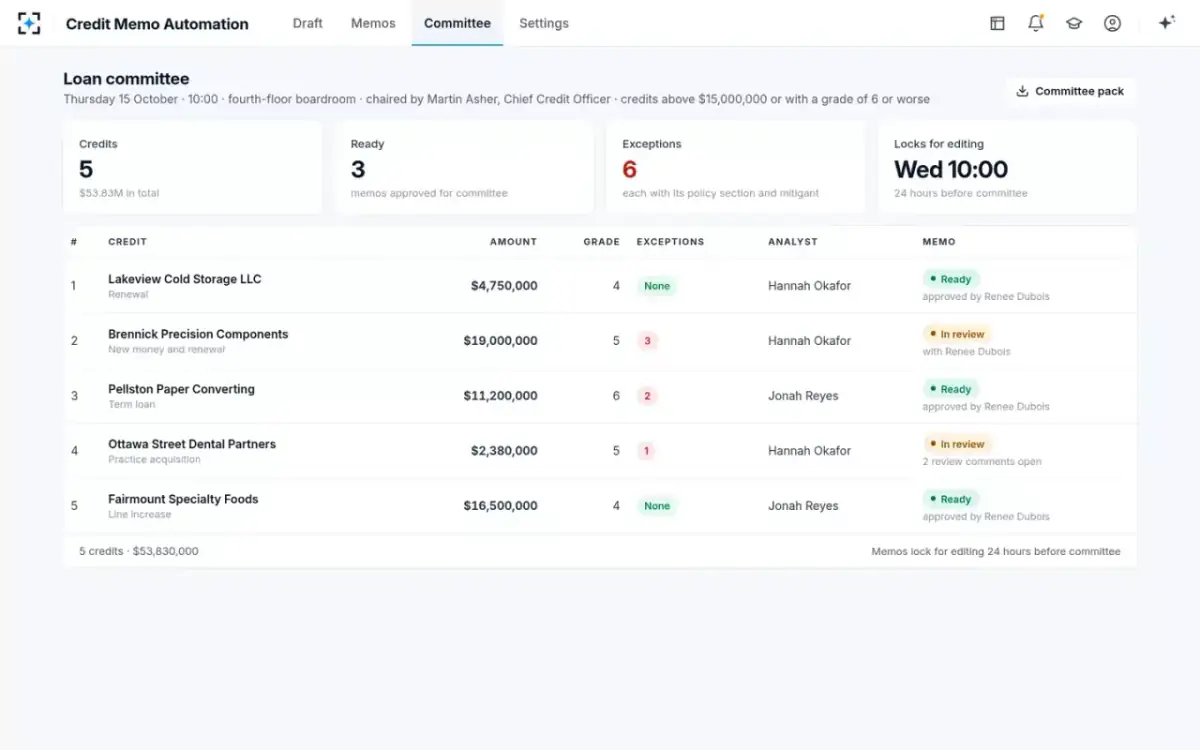
On Thursday's agenda in Credit Memo Automation, with its exceptions
What must a bank tell a business it turns down?
That it has declined, and, on request, why. Regulation B splits business applicants at $1 million of gross revenue in the preceding fiscal year. For the larger business, the bank must "Notify the applicant, within a reasonable time, orally or in writing, of the action taken" and give "a written statement of the reasons for adverse action" if the applicant asks in writing "within 60 days of the creditor's notification" (12 CFR 1002.9(a)(3)). For the smaller business, the consumer-style notice rules apply with some relief: the decision may be given orally or in writing, and the right to a statement of reasons may be disclosed at application.
Either way, the reasons have to be specific, which is easier when the memo already states them against the file. A decline that cites coverage of 0.9x against a 1.25x minimum, from named statements, tells the borrower what would change the answer. Speed matters here too: an early, clear no lets a borrower restructure the request or go elsewhere while the opportunity it was borrowing for is still open.
What a bank can promise a borrower, and what it cannot
A faster memo does not change the credit standard, and a bank should not promise that it does. The analyst still accepts every change, the underwriting manager still reviews every memo, and the approver still decides within authority. What a bank can promise is a predictable path: what it needs, when the credit can reach the committee, and what will happen if a document arrives late.
Commitments that shorten the borrower's wait without loosening the credit
- Name the committee date at the term sheet
And the lock time before it, so the borrower knows when documents must be in.
- List the documents each section needs
Statements, returns and K-1s, appraisal, guarantor statements: the borrower can chase its own CPA.
- Tell the borrower about late-document risk early
If final K-1s will replace interims in committee week, say what could change.
- Share conditions as soon as they are drafted
A distribution suspension or a borrowing-base change is easier to accept on Monday than after a vote.
- Decline quickly and specifically when the answer is no
Reasons tied to the file are clearer, and Regulation B gives a business applicant 60 days to ask for them in writing.
- Measure your own spread-to-memo time
No published benchmark exists; your own files are the only baseline.
The approval path and its timing, in one place
The economics on the bank's side are different and are covered with the agents' work on the Credit Memo Automation page. For the step-by-step path of the late K-1 in this story, see one number's trip from a K-1 to the committee's DSCR.
Questions people ask
How long does a commercial loan take to close after approval?
That depends on conditions, documentation and collateral work after the decision, such as lien filings, title and insurance. No regulator or academic source publishes a typical figure; the FDIC survey covers approval, not closing.
How often do loan committees meet?
As often as the bank's policy sets; no rule fixes a frequency. The Federal Reserve's examination manual notes that in most banks with loan committees, all new loans are reviewed by the committee before or after funding, with the threshold for prior approval set by the size of the loan or of the borrower's total debt (CBEM).
What happens if a document arrives after the credit memo is written?
Every figure it feeds has to be rewritten and reviewed again, and in committee week that can cost the meeting. In the sample credit, the owners' final K-1s arrived at 09:05 on the Monday before committee; with the memo drafted from cited sources, 12 numbers and 3 paragraphs were rewritten and marked, and the analyst accepted them at 09:08. Done by hand, the same change means finding every figure the K-1s touched.
Why was my business loan approved for less than I asked?
Usually because cash flow covers a smaller amount at the bank's minimum coverage, or collateral supports less at its advance rates. It is common: in the Federal Reserve Banks' 2025 survey, 42% of applicants received the full amount they sought, 36% some or most, and 22% none (SBCS, 2026).
Why do banks turn down business loans?
In the borrowers' own words, mostly because requirements were too strict: among small firms not approved for at least some financing, 46% said so, and the next most cited reasons were too much existing debt, a low credit score, insufficient collateral and weak sales (SBCS, 2026). A credit memo states the same reasons from the bank's side, against coverage, leverage and collateral minimums.