First NBC Bank of New Orleans failed on 28 April 2017 because a dominant chief executive with broad lending authority and a passive board kept lending to borrowers who could not pay, renewing their loans and advancing new money so that the loans looked current. The FDIC's Inspector General estimated the loss to the Deposit Insurance Fund at $996.9 million, and the former chief executive is serving 170 months for bank fraud. Two smaller failures reviewed by the Treasury's Inspector General since then, First National Bank of Lindsay in Oklahoma and Santa Anna National Bank in Texas, show the same pattern: the bank's own records described troubled loans as healthier than they were. The credit memo is where a loan's condition is put into words for an approver, so it is where that gap either opens or shows. No drafting software stops a chief executive determined to lie to examiners. Botminds' Credit Memo Automation is built so that every number points to a page and every change is logged, and this guide reads the three reviews for what that kind of memo can and cannot prevent.
Three failures, three Inspector General reviews
$996.9M
estimated loss to the Deposit Insurance Fund, First NBC Bank, New Orleans (2017)
$42.3M
estimated loss, First National Bank of Lindsay, Oklahoma (2024): 54% of assets
$23.5M
estimated loss, Santa Anna National Bank, Texas (2025)
170months
prison sentence for First NBC's former chief executive
What the Inspectors General found at First NBC, Lindsay and Santa Anna
The three reviews differ in scale and in detail, but each names the same failure. The bank's internal picture of its loans did not match reality, and the people meant to rely on that picture were misled: the board, the auditors, the examiners.
Losses to the Deposit Insurance Fund as a share of each bank's assets
Why did First NBC Bank fail?
The FDIC Inspector General's material loss review names the causes plainly: "a dominant official with broad lending authority and limited Board of Directors (Board) oversight, rapid growth funded by high-cost deposits, and large lending relationships and concentrations without adequate risk management controls". At one point four borrowers each had relationships above 25% of Tier 1 capital. The chief executive's personal lending authority "had reached an excessive $13 million" in 2009; the board cut it to $5 million in 2011 and raised it to $7.5 million in 2013 "despite prior supervisory concerns". Losses on large relationships, trade receivables and complex tax credit investments then "depleted capital to a point at which the bank could not recover" (FDIC OIG, 2017).
Inside those causes, the Inspector General found that "Risk management deficiencies related to loan extensions and loan reviews were the most prevalent". From 2008 to 2016, examiners criticised "numerous renewals with little or no repayment of principal, new loans or renewals with additional advances, and questionable collateral protection". Working capital lines for two borrowers turned into "short-term, interest-only working capital loans" and then long-term borrowings with little required principal repayment. Management "extended new loans that were used to make payments on existing loans" (FDIC OIG, 2017).
The criminal case named the purpose. The former chief executive was convicted of bank fraud and false statements in bank records, and sentenced to 170 months. According to the U.S. Attorney, he and others conspired to defraud the bank "by disguising the true financial status of certain borrowers and their troubled loans, and concealing the true financial condition of the Bank from the Bank's Board, external auditors, and federal examiners" (September 2023). He was ordered to pay restitution of over $214 million. The failure, the release adds, cost "approximately $1 billion in loss to the FDIC and the loss of approximately 500 jobs".
The credit lesson is about renewals. A renewal memo that treats each extension as a fresh decision, without the history of what was promised and paid, makes a deferred problem look like a performing loan. The OCC's Rating Credit Risk booklet lists "re-writes or renewals for the purpose of simply deferring a maturity" among the structural weaknesses examiners look for (OCC). How a memo should carry that history is on the loan that has been amended five times.
What is a material loss review?
It is the statutory post-mortem an agency's Inspector General must write when a bank failure costs the Deposit Insurance Fund more than $50 million, the threshold the Federal Deposit Insurance Act has set for losses since 1 January 2014. Below that, the Inspector General writes a shorter limited review and decides whether the failure deserves a full one. First NBC's $996.9 million loss required a full review. Lindsay's $42.3 million and Santa Anna's $23.5 million did not, which is why their reports are memoranda of a few pages. For Lindsay the Treasury Inspector General went further anyway, judging an in-depth review warranted "given that fraud was a significant contributing factor" and the loss rate (OIG-25-024).
Why did First National Bank of Lindsay fail?
Because records were altered to hide bad loans until the losses exceeded the bank's capital. First National Bank of Lindsay was a one-office national bank chartered in 1902, with $108 million of assets, closed by the OCC on 18 October 2024. The Treasury Inspector General found that weak board oversight and internal controls "allowed one or more Bank employees to alter Bank records and hide weaknesses in the Bank's loan portfolio from examiners" (OIG-25-024). The estimated loss was 54% of assets, which the review called "extraordinarily high". In May 2026 the former chief executive pleaded guilty to bank fraud. According to the Justice Department, he "manipulated the bank's records and falsified various bank reports to falsely overstate the performance of the loans, including by using new loans or transfers of the bank's own funds to cover overdrafts of outstanding loans" (May 2026).
What happened at Santa Anna National Bank?
The same thing, at a smaller bank, eight months later. Santa Anna National Bank, a one-office Texas bank chartered in 1933 with $77 million of assets, was closed by the OCC on 27 June 2025, critically undercapitalized. The review found "a critical breakdown in the Bank's internal controls which allowed fraudulent activity to occur that affected a substantial portion of the Bank's credit portfolio". The deficiencies "masked weaknesses in the Bank's loan portfolio, created excessive credit risk, and resulted in inaccurate representations of the Bank's financial condition" (OIG-26-023).
The pattern: the bank's own account said one thing, the facts another
In all three, the failure was not a bad credit decision in the ordinary sense. It was a gap between what the bank's records said about a loan and what the documents and payments showed. That gap is exactly what a credit memo is supposed to close for the approver.
What the bank's account showed, and what the reviews found
What the bank's records said: Loans renewed and performing; borrowers able to pay.
What the reviews and courts found: Renewals "with little or no repayment of principal"; new loans used to make payments on existing ones; borrowers' true status disguised from board, auditors and examiners.
What the bank's records said: Loans performing as reported.
What the reviews and courts found: Records altered to "hide weaknesses in the Bank's loan portfolio from examiners"; overdrafts covered with new loans or the bank's own funds.
What the bank's records said: Financial condition as represented.
What the reviews and courts found: Fraud affecting "a substantial portion" of the credit portfolio; "inaccurate representations of the Bank's financial condition".
The OCC's lending booklet describes the honest version of the same gap. "Unidentified exceptions are often the result of errors, miscalculations, breakdowns in the pre- or post-closing review process, or system failures" (OCC, 2026). Fraud and error leave the same trace: a figure in the bank's account that no document supports. Examiners hunt for both the same way. They "review a sample of loans and compare internal bank ratings with those assigned by OCC staff", and they "should be most concerned when rating inaccuracies understate risk" (Rating Credit Risk).
Controls a credit memo can carry, and how Credit Memo Automation applies them
A memo cannot stop a determined insider, but it can make the gap between account and evidence hard to open and easy to see. Five properties do most of the work. Each number cites the page it came from. Disagreements between documents are raised, not settled quietly. Every edit is logged with who made it and the value before and after. Renewal history and prior performance travel with the credit. The person who drafts is not the person who approves.
Failure pattern, and the memo control that makes it visible
| What went wrong | Memo control | How it appears in Credit Memo Automation |
|---|---|---|
| Borrower's condition described better than the documents show | Every number and claim cites its page | A memo with an uncited number cannot be sent for review; reviewers click any figure for its page. |
| Two sources disagree and the better-looking one is used | Conflicts raised, never settled quietly | The agents use neither figure until the analyst chooses; the choice and reason are logged. |
| Figures changed after the fact | Every edit logged with before and after | Edits by agents and people are on the change log; each version is kept for the credit file. |
| Renewals treated as fresh credits | Prior memo and performance carried forward | The memo writer carries forward text from the last approved memo and says when it has. |
| One official with broad authority and little challenge | Drafting, checking and approving separated | Agents draft and check; the analyst accepts, the underwriting manager reviews, the approver decides within authority. |
Every edit in Credit Memo Automation, by an agent or a person, before and after
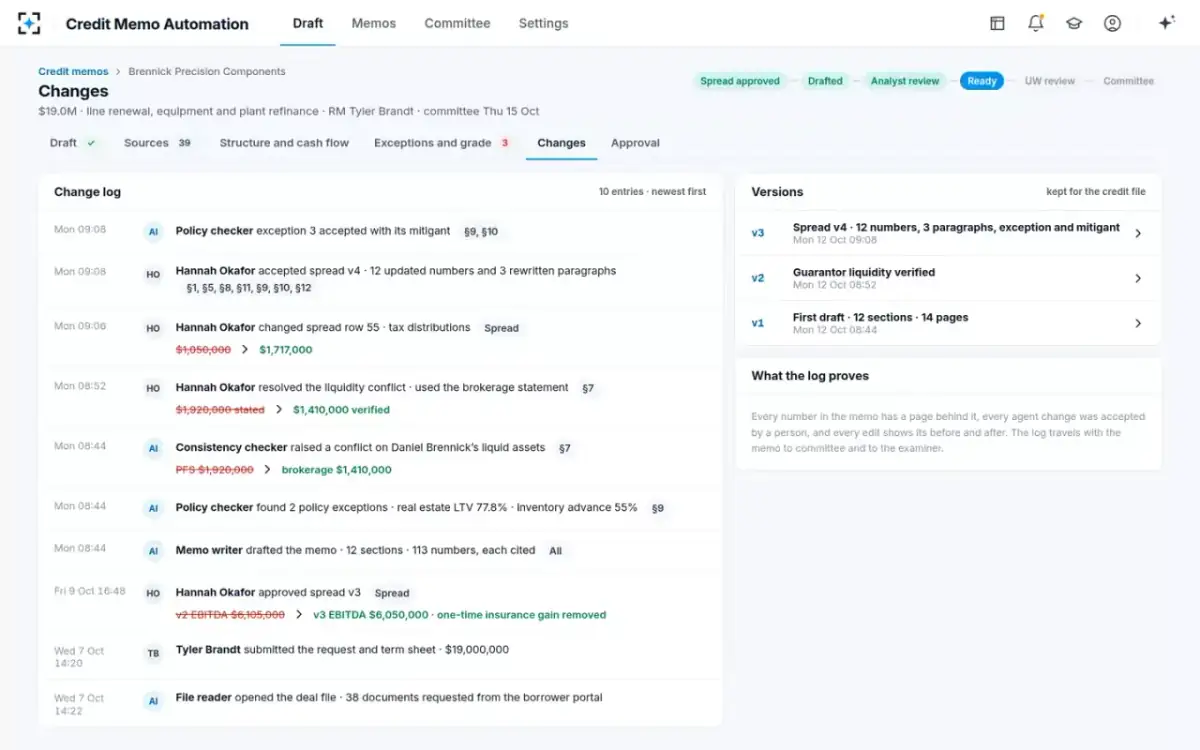
Two limits deserve plain statement. First, a citation proves that a number came from a document, not that the document is genuine. Fabricated statements and leases still need verification at intake: tax transcripts, third-party statements, site visits. Second, a log is a control only if someone reads it. Credit administration, loan review and audit have to look. What the solution changes is the cost of looking: the evidence for each figure is one click away rather than a file search.
What do bank examiners look for in a credit memo today?
Sufficient analysis and an authorised approver. The OCC's June 2026 lending booklet asks examiners to determine "if the documentation and analysis are sufficient to make an informed credit decision, and that the approver had sufficient authority based on the bank's established limits" (OCC, 2026). Its four tests for an approval package, covering repayment sources, prior transactions and performance, risks and mitigants, and support for the rating, are set out with the sections they shape in how to write a commercial credit memo. The second of them, prior transactions and performance, is the one the three failures make most pointed.
Questions an examiner can put to any credit memo
- Can every number be traced to a document?
Pick five figures at random, including one from the recommendation, and find each page.
- Does the memo show the loan's history?
Prior terms, renewals, advances, waivers and how the borrower performed against them.
- Where sources disagreed, is the choice explained?
A signed statement against a later bank statement; an interim against a final return.
- Is every exception identified, with a mitigant?
Unidentified exceptions are themselves a finding.
- Does the grade match the analysis?
A grade that understates the risk the memo describes is what examiners are most concerned about.
- Did the approver have the authority?
Amount, exceptions and grade against the bank's approval limits.
- Can the bank show who changed what, and when?
Versions and edits, especially after the memo was first drafted.
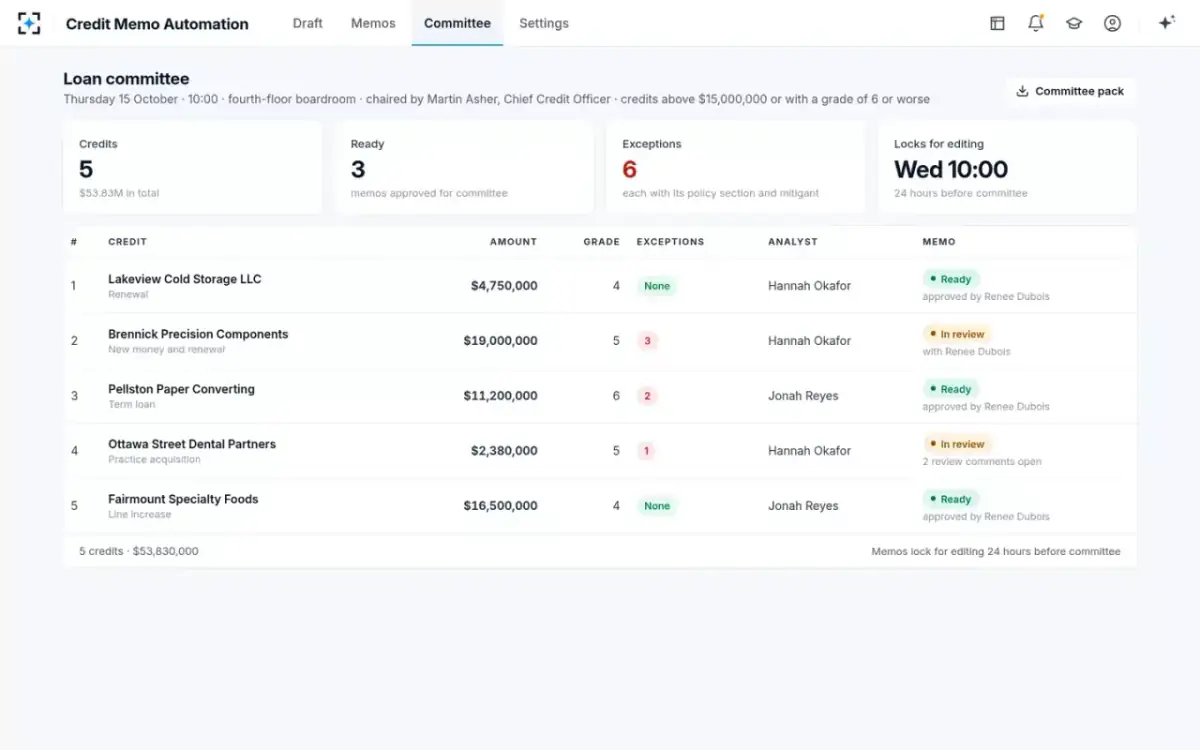
Committee view: every credit with its grade and exceptions
A memo built to these tests also answers the loan reviewer who reads it a year later, and the examiner after that. Separating drafting from checking, the control behind the last row of the table above, is set out in why the AI that drafts the memo should not check it. The sample memo is on the Credit Memo Automation page.
Questions people ask
What happened to Ashton Ryan?
First NBC's former president, chief executive and chairman was convicted by a jury in February 2023 on all 43 counts of bank fraud and false statements in bank records, after a five-week trial. In September 2023 he was sentenced to 170 months in prison and ordered to pay over $214 million in restitution to the FDIC.
Was First NBC's failure fraud or bad lending?
Both, and the two fed each other. The Inspector General's review describes weak governance, concentrations and liberal renewals; the criminal case shows those renewals were used to disguise borrowers who could not pay. Weak controls gave the fraud room, and the fraud made the weak lending invisible.
How can a board spot loans renewed to hide delinquency?
Ask for the renewal history of the largest relationships with principal actually repaid at each renewal. The FDIC's examination manual lists "numerous renewals with little or no principal reduction" and "renewals that include interest" among the trouble indicators (FDIC), and says renewal standards should aim at orderly repayment, "not at maintaining a low ratio of past due paper".
Who investigates a failed bank?
The Inspector General of the bank's primary federal regulator. First NBC was a Louisiana state bank supervised by the FDIC, so the FDIC's Inspector General reviewed it; Lindsay and Santa Anna were national banks supervised by the OCC, so the Treasury's Inspector General did. Criminal cases are brought separately by the Justice Department.
Can software prevent loan fraud by bank insiders?
Not on its own. Citations, conflict checks and an edit log make altered figures visible and slow to hide, but someone independent of the lender still has to read them, and documents still have to be verified at intake. The three reviews all point to board oversight and internal controls as the root failure.