A credit memo for a renewal or modification should say what has changed since the loan was first approved: every amendment, waiver, reset and advance, and how the borrower performed against each version of the terms. Most loans are not the deal that was first approved. Research on bank loans finds the typical one renegotiated five times over its life, and examiners now ask in writing for "information about previous and related transactions and performance". A memo that starts from a blank page each renewal hides that history from the approver. Botminds' Credit Memo Automation drafts the memo in the bank's template from the approved spread, the deal file and the last approved memo for the borrower, and marks every passage it carries forward. This guide sets out what the history section should hold, whoever writes it.
How often a bank loan stops being the deal that was approved
5times
the typical bank loan is renegotiated over its life, in a study of public borrowers
9months
between renegotiations, on average, with pricing, maturity, amount and covenants all modified
75%+
of covenant violations lead to a renegotiation
3in 4
credit lines to firms under $50M in assets mature within a year of origination
Loan renewal vs modification: what is the difference?
A renewal replaces or rolls over a loan that is reaching maturity, usually with a new note and often with new terms; a modification changes the terms of a loan that is still running, such as its rate, payments, covenants, collateral or amount. An extension is the narrowest case, a later maturity with little else changed. The interagency statement on commercial real estate workouts uses the same vocabulary, listing "a renewal or extension of loan terms, extension of additional credit, or a restructuring with or without concessions", and defines a restructuring as "a formal, legally enforceable modification in the loan's terms" (2023 policy statement).
Renewal, extension, modification and restructuring, side by side
| What changes | Typical trigger | What the credit memo has to add | |
|---|---|---|---|
| Renewal | A new maturity, often a new note, rate and covenants | The loan or line reaches maturity | Full re-analysis, plus how the borrower performed under the old terms |
| Extension | Maturity only, sometimes with a fee | Timing: a refinance, sale or renewal not ready | Why more time is needed, and whether the repayment source is still there |
| Modification | Rate, payment, amount, covenants or collateral on a live loan | A borrower request, a new need, or a covenant problem | The change against the original approval, and the current numbers against both |
| Restructuring | A formal, legally enforceable change, with or without concessions | The borrower cannot meet the original terms | Repayment capacity on the new terms, the grade, and the accrual treatment |
The words matter less than the question behind them: is the bank still relying on what it relied on at approval? A renewal that changes nothing but the date can carry more risk than a modification that adds collateral, if the borrower has stopped repaying principal.
How often are commercial loans renegotiated?
Often enough that an unamended loan is the exception. Michael Roberts's study of bank loans in SEC filings found that "the typical bank loan is renegotiated five times, or every nine months", and that "The pricing, maturity, amount, and covenants are all significantly modified during each renegotiation" (NBER, 2014). Most of those changes are not distress. Fewer than 28% of renegotiations in the sample were caused by a covenant violation or the expectation of one. The rest followed changes in the borrower's needs or prospects. Once a violation happens, though, "more than 75% of all covenant violations lead to a renegotiation".
Smaller borrowers renew more often still, because their lines are short. Among firms with less than $50 million in assets, "three-quarters of credit lines have maturity of 1 year or less at origination and more than one-quarter of loans to these firms are demand loans immediately callable by the lender" (Chodorow-Reich et al.). For a community or middle-market bank, the renewal memo is the most common memo it writes.
An illustrative revolving line: a change to the terms every nine months
- Originalmonths 0–9
- Pricing resetmonths 9–18
- Covenant waivedmonths 18–27
- Line increasedmonths 27–36
- Maturity extendedmonths 36–45
What do examiners look for in a loan renewal?
History, principal actually repaid, and any covenant loosened to keep the borrower compliant, because supervisors read a renewal as a continuation of the credit, not a fresh decision. The OCC's 2026 lending booklet asks examiners whether the approval package includes "information about previous and related transactions and performance, if applicable" (OCC, 2026). The same booklet counts "Covenant breaches (even if waived)" during the life of a loan as financial exceptions. A waiver ends the default; it does not erase the exception.
The Rating Credit Risk booklet is more pointed about what to look for. Among the most prevalent structural weaknesses it lists "rewrites or renewals for the purpose of simply deferring a maturity", and it tells examiners to "be alert for covenants that have been waived or renegotiated by the bank to accommodate a borrower's failure to maintain the original standards" (OCC). Its own sample write-up starts the loan's description with its history: "Originated May-89 at 12MM; renewed Feb-92 at 11MM, renewed Dec-95 at 9MM, and renewed Dec-98 at 8MM". The Federal Reserve's write-up standard asks for "Repayment terms and historical performance". It also asks whether guarantors' "financial strength has changed significantly since the initial guarantee" (SR 99-24).
The cost of leaving history out is documented. At First NBC, examiners criticised "numerous renewals with little or no repayment of principal, new loans or renewals with additional advances", and the Inspector General found that the extensions "masked potential delinquencies" (FDIC OIG, 2017). The case is set out in three failed banks, one pattern.
When is a renewal just deferring a maturity?
When the borrower stays current only because the bank keeps renewing it, and nothing in the renewal improves the bank's prospect of being repaid. The interagency statement warns that being contractually current "can be misleading" when "the liberal use of extensions and renewals masks credit weaknesses and obscures a borrower's inability to meet reasonable repayment terms" (2023 policy statement). The FDIC's examination manual lists "numerous renewals with little or no principal reduction" and "renewals that include interest" among its trouble indicators, and says renewal standards should aim at "an orderly liquidation of loans and not at maintaining a low ratio of past due paper through unwarranted extensions or renewals" (FDIC, RMS Manual §3.2).
The statement's own worked example shows how far apart a lender and an examiner can read the same renewal. A shopping-centre loan was renewed for a year on interest-only terms after historical coverage of 0.92x; the guarantor paid down $200,000, leaving $9.8 million against an as-is value of $10 million.
One renewed loan, graded by the lender and by the examiner
The lender's reading: Occupancy improving; coverage adequate on interest-only payments.
The examiner's reading: Cash flow covers only the interest; historical coverage was 0.92x.
The lender's reading: Liquid enough to cover global debt service for twelve months, and paid down $200,000.
The examiner's reading: Able and willing to cover shortfalls; the examiner agreed the loan could stay on accrual.
The lender's reading: Permanent financing once the property stabilises.
The examiner's reading: "considerable uncertainty surrounding the takeout financing".
The lender's reading: Pass, monitored.
The examiner's reading: Special mention.
The lesson for the memo is that a renewal needs a grade argued from current repayment capacity, not from payment status. The statement says renewals to borrowers who can repay on reasonable terms "will not automatically be subject to adverse classification", but they "should be identified in the financial institution's internal credit grading system and may warrant close monitoring".
The amendment table a renewal memo should carry
The simplest fix is a table near the top of the memo: one row per change since the loan was first approved, in date order. Each row gives what changed, why, the covenant status at the time, and how the borrower performed under the terms that followed. It is short and factual, and it lets an approver see at a glance whether the credit has been improving, holding or being accommodated.
An amendment history, laid out for the approver
| Date | What changed | Why | Covenants then | Performance after |
|---|---|---|---|---|
| Origination | $5.0M line, 1 year, DSCR ≥ 1.25x, leverage ≤ 3.00x | Working capital | Set at close | Paid as agreed |
| Month 9 | Pricing reset, +25 bp | Rate environment | In compliance | Paid as agreed |
| Month 18 | Leverage covenant waived for one quarter; test reset to 3.25x | Leverage 3.4x after a lost customer | Breach, waived | Leverage back to 2.9x two quarters later |
| Month 27 | Line increased to $6.5M | New contract | In compliance | Usage averaged 70% |
| Month 36 | Maturity extended one year | Renewal timing | In compliance | Paid as agreed |
The rows that matter most are waivers and resets. A covenant reset from 3.00x to 3.25x is a decision to accept more leverage than the original approver did. The renewal memo should say so in those words, and should test the current numbers against the original covenant as well as the reset one. If the borrower would fail the original test today, the approver deserves to know that the structure has drifted.
Carrying forward the last approved memo, and marking what was reused
Renewal memos are often built by copying last year's memo and editing it. That saves time, and it is how stale text survives. A sentence about the borrower's largest customer, true two years ago, can sit unchanged under this year's numbers. The fix is not to stop reusing text. It is to know which passages are carried forward, from which memo and page, and to check each against this year's file.
A renewal memo written as a new credit, and one that carries the history
Written as if new: Requests renewal of the $8,000,000 line.
Written as a continuation: Requests renewal of the $8,000,000 line, a customer since 2014, last approved in October 2024 at grade 4.
Written as if new: Proposed covenants listed.
Written as a continuation: Proposed covenants listed beside the prior ones, with each waiver or reset since the last approval.
Written as if new: Current ratios against policy.
Written as a continuation: Current ratios against policy and against the last memo: leverage 2.97x pro forma against 1.71x a year ago.
Written as if new: Copied from last year, unmarked.
Written as a continuation: Carried forward from the October 2024 memo, page 6, and marked as carried forward.
Written as if new: Proposed grade.
Written as a continuation: Proposed grade 5 against the prior 4, with the factors that moved.
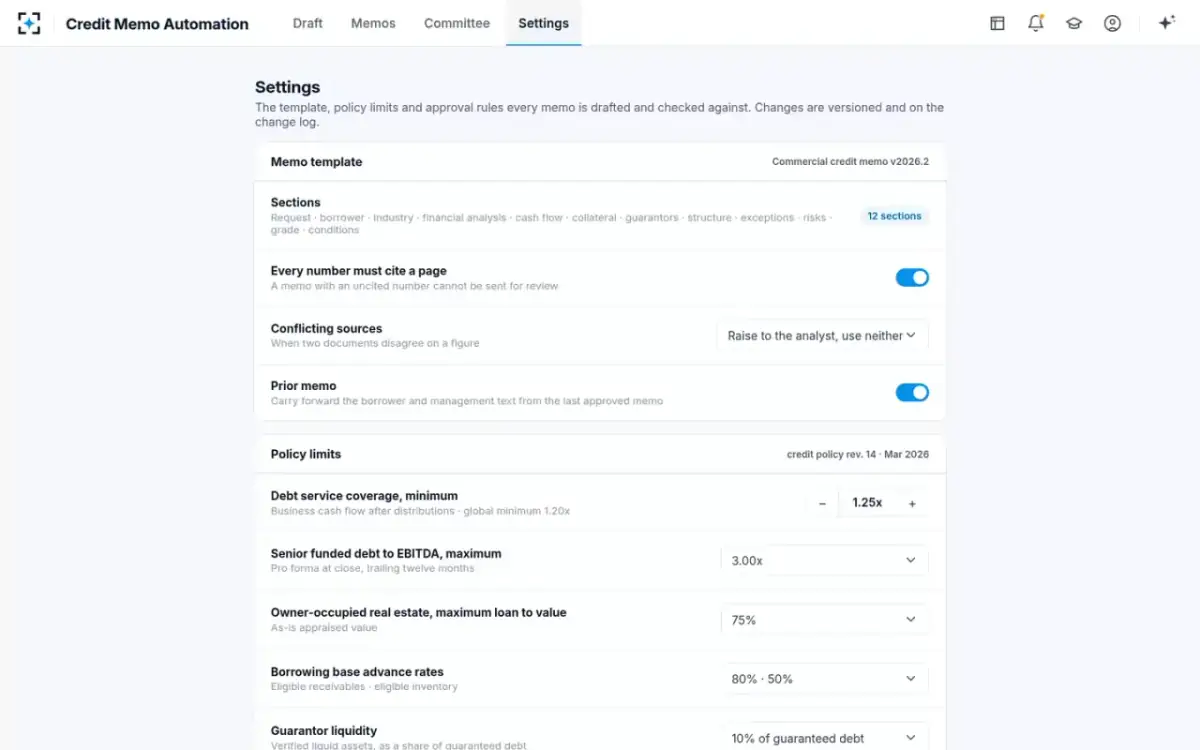
Take the sample credit as it runs through the solution. Brennick Precision Components, a fictional machining shop, has banked with the fictional Halvern Bank & Trust since 2014 and is renewing its $8,000,000 line alongside two new term loans. The memo writer carries forward the borrower and management text from the last approved memo, of October 2024, and the margin cites "Oct 2024 memo, p. 6" beside the carried passages. The bank can switch that carry-forward on or off. The risk grader proposes grade 5 against the prior 4, and the scorecard names why: leverage of 2.97x pro forma against 1.71x a year ago, and coverage of 1.32x once the K-1 tax distributions are in.
Credit Memo Automation proposes the grade beside the last approved one
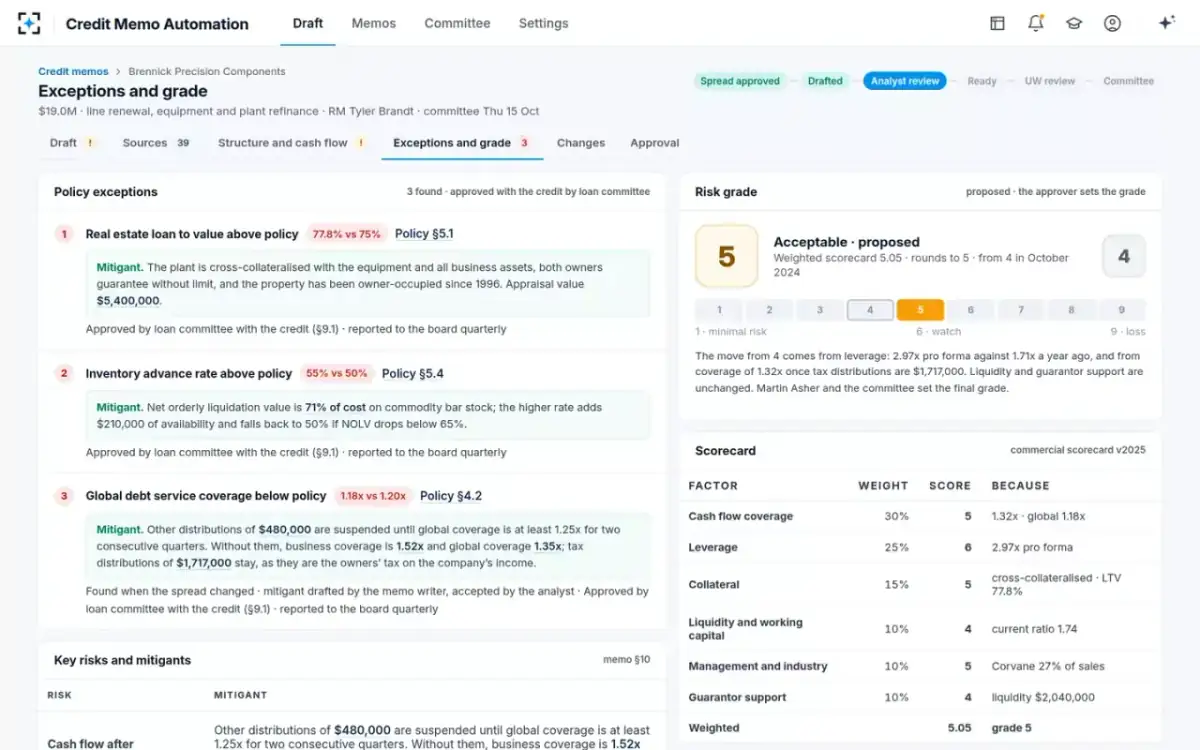
The square on the right is October 2024's grade: the history sits next to the proposal, not in a different file.
Carrying forward the prior memo is a setting in Credit Memo Automation
Does a loan modification need a new credit memo?
Usually yes, sized to the change. A modification that touches amount, pricing, maturity, collateral or covenants normally needs approval under the bank's policy, and the approver needs the analysis behind it; the OCC's rule of thumb is that "The level of analysis should be commensurate with the level of risk" (OCC). A rate reset for a performing borrower can be a page. A covenant waiver, a reset test or new money for a borrower that missed its numbers needs the full history, the current numbers against the original terms, and a grade that reflects both.
Two things should appear in any modification memo, however short. The waiver or change is recorded as what it is: the OCC counts "Covenant breaches (even if waived)" among financial exceptions. And if the borrower is in financial difficulty, the memo says so, because the modification then has its own accounting and reporting treatment and belongs on the bank's list of loans to watch.
What should a renewal credit memo include? Questions to answer every time
A renewal memo answers the original approver's questions again, plus questions only history can answer. Has the borrower done what the last memo said it would? Have the terms been loosened to keep it compliant? Has the guarantor's position changed? Is the bank now relying on something it did not rely on before? The comparison of last year's projections with this year's actuals is the sharpest of these, and it has its own guide: last year's projections against this year's actuals.
A renewal and modification memo checklist
- State the history in one table
Every amendment, waiver, reset, advance and extension since origination, with dates.
- Test today's numbers against the original covenants too
If the borrower would fail the original test, say how far the structure has moved.
- Report waived breaches as exceptions
The OCC counts covenant breaches "even if waived" as financial exceptions.
- Show principal actually repaid
Renewals with little or no repayment are what examiners criticised at First NBC.
- Compare the prior memo's projections with actuals
A borrower that repeatedly misses its projections loses credibility, and the grade should say so.
- Re-test the guarantor
Ask whether financial strength has changed since the guarantee was given, with current statements.
- Mark every carried-forward passage
Name the memo and page it came from, and check it against this year's file.
- Explain any grade change, either way
A grade unchanged through five amendments needs as much explanation as one that moved.
For the full section-by-section skeleton of a memo, see how to write a commercial credit memo. The sample renewal is on the Credit Memo Automation page.
Questions people ask
Is a covenant waiver a policy exception?
The OCC's 2026 lending booklet lists covenant breaches during the life of a loan, "even if waived", among financial exceptions. How a bank tracks them is set by its own policy, but a waiver should appear in the next memo with the reason it was granted.
What is the difference between a loan renewal and a refinance?
A renewal continues the same lending relationship on a new maturity; a refinance pays the old loan off with a new one, often from a different lender or for a different purpose. For the credit memo the difference is the history: a renewal has the bank's own record of how the borrower performed, and a refinance of another lender's debt should explain why the borrower is moving.
Does a loan renewal need a new appraisal?
Not always. The appraisal rules exempt certain renewals, refinancings and other subsequent transactions, and the FDIC's manual says using that exemption "depends on the condition and quality of the loan, the soundness of the underlying collateral and the validity of the existing appraisal or evaluation". New money, a weaker borrower or a changed property usually mean a new valuation.
Does a renewed loan have to be downgraded?
No. Under the 2023 interagency statement, renewals to commercial borrowers who can repay on reasonable terms are not automatically classified adversely. The grade should follow repayment capacity, which is why a renewal memo needs current cash flow, not a payment history.
How many renewals is too many?
There is no number in the rules. The warning sign is renewals without principal reduction, or with interest rolled into the balance, which the FDIC lists as trouble indicators; a line renewed every year that is paid down to zero in its season is a different credit from one that has not amortised since origination.