Commercial underwriting takes as long as its slowest input. No regulator publishes a median for middle-market credits, but the sequence is set by the documents: a few days to collect and spread the statements, then a credit memo that cannot be finished until four inputs owned by other people are final, then an approver or a loan committee that meets on its own calendar. The relationship manager owns the request and the term sheet, and the borrower and its CPA own the financial statements and tax returns. The appraiser and the bank's appraisal reviewer own the collateral value, and the guarantors own their personal statements. When any of them changes after drafting starts, the analyst rewrites every passage that used the old figure. Botminds' Credit Memo Automation is a set of agents that draft the memo from the approved spread and the deal file and redraft what a change touches. This guide is about the waits themselves: which input owns the most days, and which the credit team can stop waiting on.
One sample credit, from request to committee
8days
from the RM's term sheet to Thursday's loan committee
38
documents in the deal file, 412 pages, from four kinds of owner
3days
of writing after the spread, by hand (our estimate)
67min
from the final K-1s arriving to a memo sent for review, with the agents
How long does underwriting take for a commercial loan?
For a small, simple loan, days; for a credit that needs a written memo, an appraisal and a committee, as long as its steps and the committee calendar allow, and longer whenever an input arrives late. The published figures cover only the small end; no regulator or academic study publishes one for middle-market credits. The FDIC found that "Three in four banks approve their typical loan within ten business days" (FDIC Small Business Lending Survey), and the borrower's view of those numbers is on how long a business loan takes to get approved. For larger credits the clock is set by the steps below, and the committee date at the end of them.
The sample credit used on this page shows the steps at their tightest. Its relationship manager submitted the request and term sheet on Wednesday 7 October. The file reader asked the borrower's portal for 38 documents the same afternoon, the spread was approved on Friday at 16:48, and the memo was drafted on Monday morning. It went to the underwriting manager at 10:12 and to the loan committee on Thursday 15 October: eight calendar days from term sheet to decision, with the appraisal already reviewed before the term sheet arrived.
Commercial loan underwriting, step by step: who holds each step, and how it runs late
| Step | Held by | What it produces | How it usually slips |
|---|---|---|---|
| 1 · Request and term sheet | Relationship manager | Amount, structure, pricing, guarantors, collateral | Terms change after the memo is drafted |
| 2 · Document collection | Borrower, its CPA, the guarantors | Three years of statements and returns, an interim, K-1s, personal statements | Final returns and K-1s arrive after the interims are spread |
| 3 · Spreading | Credit analyst | The approved spread: earnings, cash flow, ratios | Re-spread when a later statement arrives |
| 4 · Collateral | Appraiser, then the bank's reviewer | A reviewed value, loan to value, the secondary source | Review finds a problem after the value is cited |
| 5 · Credit memo | Credit analyst | The analysis, exceptions, risks, grade and recommendation | Rewritten for every late input above |
| 6 · Review | Underwriting manager | Questions back, then a memo fit for approval | Returned for a figure that does not tie out |
| 7 · Decision | Approver or loan committee | Approval within authority, with conditions | A missed lock waits for the next meeting |
Approval itself is rarely deep. The FDIC found that "Nearly three in four banks have at most three levels of approval, even for larger and more complex-loans" (FDIC). The days go to the steps before it.
A credit memo is a dependency problem before it is a writing problem
The memo sits at the end of four chains, and its turnaround is set by the slowest of them, not by the analyst's typing. The Federal Reserve's examination manual describes what a credit file must hold before a credit is granted. It must "identify the borrower's business or occupation", "document the borrower's past and current financial condition", "state the purposes of all loans", and "identify the collateral and state its value and the source of the valuation" (Federal Reserve, CBEM §2010.1). Each clause names an input that someone outside the credit department produces.
A loan committee is a fixed date, and a memo that misses its lock waits for the next meeting. That turns a one-day slip in any of the four chains into a week or more for the borrower, if the committee meets weekly.
Four owners, four inputs: what a credit memo waits on
Relationship manager
The request and term sheet
Sets amount, structure and pricing. Every later section depends on it.
Arrives late when An amount or rate changes after drafting.
Borrower and its CPA
Statements, returns, K-1s
The spread is only as current as the latest statement.
Arrives late when Final K-1s replace an interim estimate in committee week.
Appraiser and the appraisal reviewer
Collateral value, reviewed
Loan to value and the secondary source rest on it.
Arrives late when The review finds a problem after the memo cites the value.
Guarantors
Personal statements and proof of liquidity
Global cash flow and guarantor support rest on them.
Arrives late when A later statement contradicts the signed one.
All four feed
The spread, then the memo
Written by the credit analyst · read by the underwriting manager · decided by the CCO or loan committee
What slows down a commercial loan approval: four inputs and their owners
Four inputs slow an approval, each with an owner the credit team cannot direct and a typical way of arriving late. The useful distinction is between an input that is missing, which delays the start, and one that changes, which costs rework. A missing appraisal is visible on a checklist. A changed figure is not, because the memo already reads as finished.
The people whose inputs set a credit memo's date
Today
Submits the request and term sheet, then changes an amount or a rate after the memo is drafted, and asks whether it can still go Thursday.
With agents
Changes the term sheet; every figure that depends on it is recomputed and marked for the analyst.
Still theirs: The structure and the client conversation.
Today
Sends final returns and K-1s after the interims were spread, so the cash flow moves late.
With agents
The new figure goes into one spread cell; the memo follows.
Still theirs: The numbers themselves.
Today
Reviews the appraisal while the memo is being written; a finding changes LTV and the exception list.
With agents
The memo cites the reviewed value at its page; a changed value updates every section that uses it.
Still theirs: The review and its conclusion.
Today
Signs a personal financial statement that a later bank or brokerage statement contradicts.
With agents
Both figures are raised side by side; the analyst chooses, with the reason logged.
Still theirs: The disclosure and its signature.
Can a credit memo be written before the appraisal comes back?
Most of it can, but not the collateral section, the loan to value or any exception that rests on them, because the appraisal is the one input with a formal review step and it often sets the earliest date a memo can be final. The interagency guidelines say that "as part of the credit approval process and prior to a final credit decision, an institution should review appraisals and evaluations" (2010 guidelines). The value only becomes usable once the reviewer signs off. In the sample deal, the appraisal of the plant was effective 21 September at $5,400,000 and the bank's appraisal desk reviewed it on 29 September, a week before the term sheet.
That ordering is what makes the memo possible. The value sets the real estate loan to value at 77.8% against a 75% policy maximum, so it creates a policy exception before any analysis is written. A memo drafted on an unreviewed value would have to be re-checked against the review. In the solution, the appraisal's value is cited at page 2 of 86, and every section that uses it is listed beside it: sections 2, 6 and 9.
What does underwriting need from a guarantor?
A signed personal financial statement, recent returns, and third-party evidence of the liquidity the statement claims; guarantor support is where documents of different dates collide. The interagency workout statement describes what a bank needs to judge a guarantor: information on "global financial condition, income, liquidity, cash flow, contingent liabilities", and whether the guarantor can meet "the total number and amount of guarantees currently extended" (2023 policy statement). That information comes from a personal financial statement the guarantor signed, then brokerage and bank statements that arrive later. Personal guarantees are common: 59% of small firms with debt used one (Small Business Credit Survey, 2026).
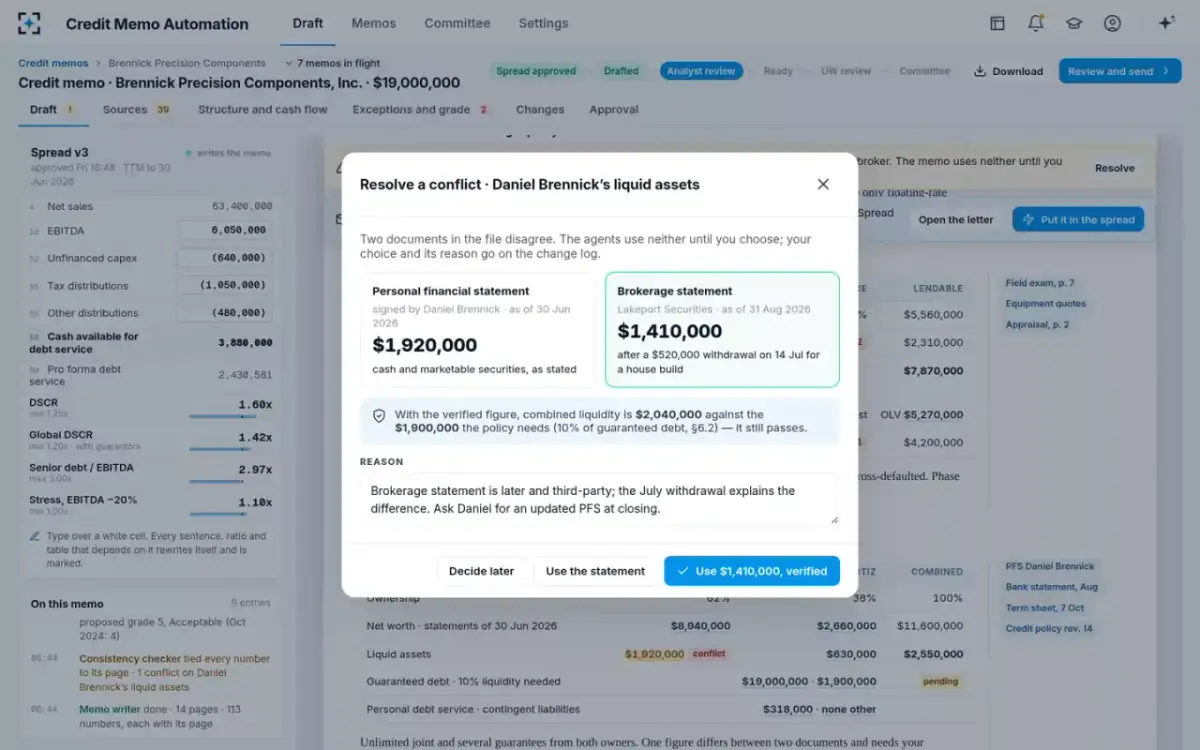
In the sample, Daniel Brennick's statement of 30 June lists $1,920,000 of liquid assets. His brokerage statement of 31 August shows $1,410,000, after a $520,000 withdrawal on 14 July for a house build. By hand, the analyst finds this if she compares them, and the memo may already carry the higher figure in three places. The agents use neither figure until the analyst chooses.
A guarantor conflict, raised before it reaches the memo
Why does loan underwriting take so long when the file looks complete? The late K-1
The most expensive input is the one that arrives after the memo is drafted, because it changes numbers that other numbers depend on. Pass-through borrowers make this routine. Interim statements carry an estimate of the owners' tax distributions, and the final K-1s come from the CPA when they come. The SBA's list of cash-flow adjustments a memo must justify names "Distributions for S-Corp taxes" for that reason (SOP 50 10 8.1).
At 09:05 on the Monday of committee week, the sample borrower's CPA sent the 2025 K-1s: tax distributions of $1,717,000, not the $1,050,000 in the interim estimate. Cash available for debt service fell from $3,880,000 to $3,213,000. Coverage fell from 1.60x to 1.32x, global coverage from 1.42x to 1.18x, below the 1.20x policy minimum, and a new policy exception and a new risk appeared. By hand, that is a search through fourteen pages for every figure the old number fed. The timeline shows why that search decides whether the memo makes Thursday.
Committee week for one credit memo, by hand and with Credit Memo Automation
- Writing after the spread, Mon to Wedabout 3 days
- K-1 rework½ day
- Review¼ day
- Drafted and reviewedMon 08:44 to 17:00
- Time left before the lockTue to Wed 10:00
How long does it take to write a credit memo? Where three days go
About three working days after the spread, by our estimate, and inside the credit team most of them go to moving and re-describing what is already in the file. Our estimate for a typical middle-market memo: three-quarters of a day pasting spread tables into the template, three-quarters describing the borrower, guarantors and collateral, half a day testing the structure against policy, and half a day on risks, mitigants and the grade rationale. Updating numbers after a change and answering the reviewer take about a quarter-day each. None of these is the decision. They are the work around it, and they are why a late input hurts. Each change lands on prose that someone wrote by hand.
The OCC's lending booklet notes that committee approval "can diminish accountability and can slow a bank's responsiveness" (OCC, 2026). It leaves the choice of structure to the bank. A bank that keeps a committee can still shorten the time before it, and the writing is the part it controls.
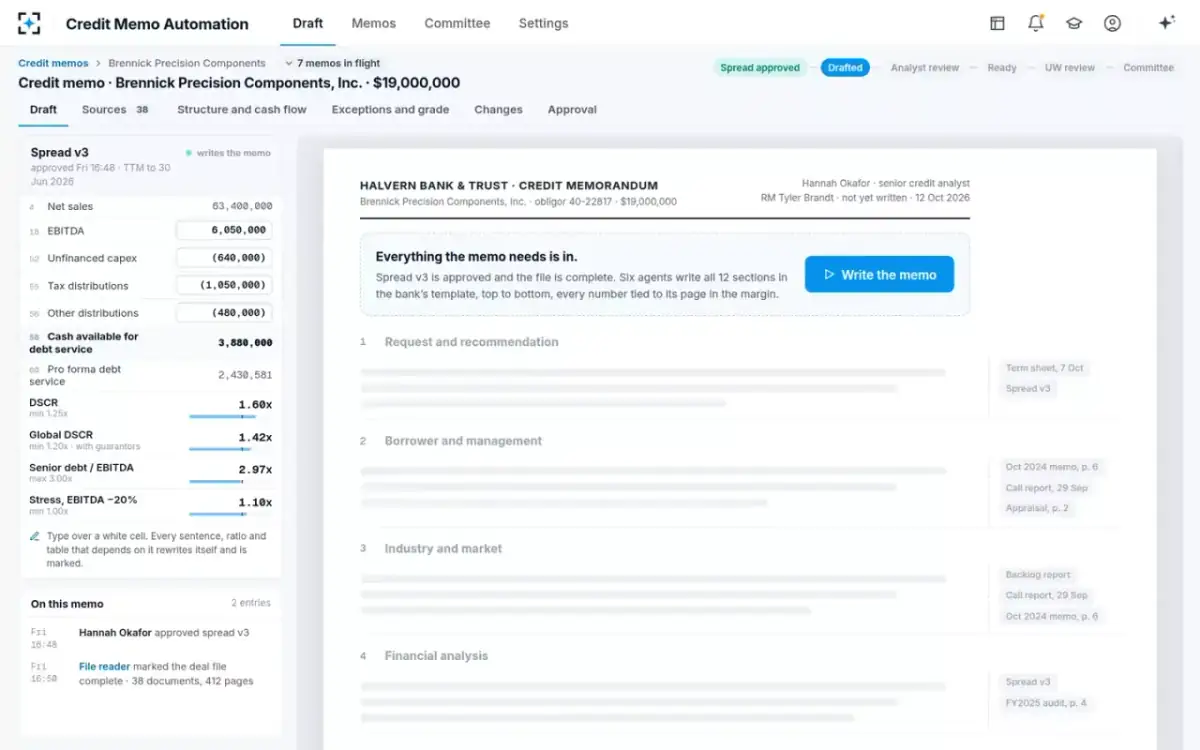
Credit Memo Automation with the spread approved and the file complete
How a bank can speed up commercial underwriting without loosening it
By removing the waits it owns. A credit team cannot make the appraiser or the CPA faster, but it can stop paying for their lateness twice. Three habits do most of the work, by hand or with software: know which inputs each section depends on before writing it, raise disagreements between documents instead of choosing silently, and treat a late figure as a change to propagate rather than a passage to hunt for.
Shortening a credit memo's turnaround without new headcount
- List each section's inputs before drafting
A section whose inputs are not final is drafted last, or marked provisional, so a late document changes one section rather than surprising five.
- Do not cite an appraisal value before the review
The review comes "prior to a final credit decision"; a value that changes after review moves LTV and the exception list.
- Compare every guarantor statement with its later evidence
Signed statements and brokerage or bank statements of different dates often disagree; decide with a reason, once.
- Ask pass-through borrowers for K-1 timing at application
If final K-1s will land in committee week, plan for the tax-distribution figure to move.
- Keep a map of which numbers depend on which
Coverage, global coverage, stress cases, exceptions, risks and the recommendation all hang off cash available for debt service.
- Set the lock time and work back from it
In the sample, memos lock 24 hours before committee; a late input after the lock waits for the next meeting.
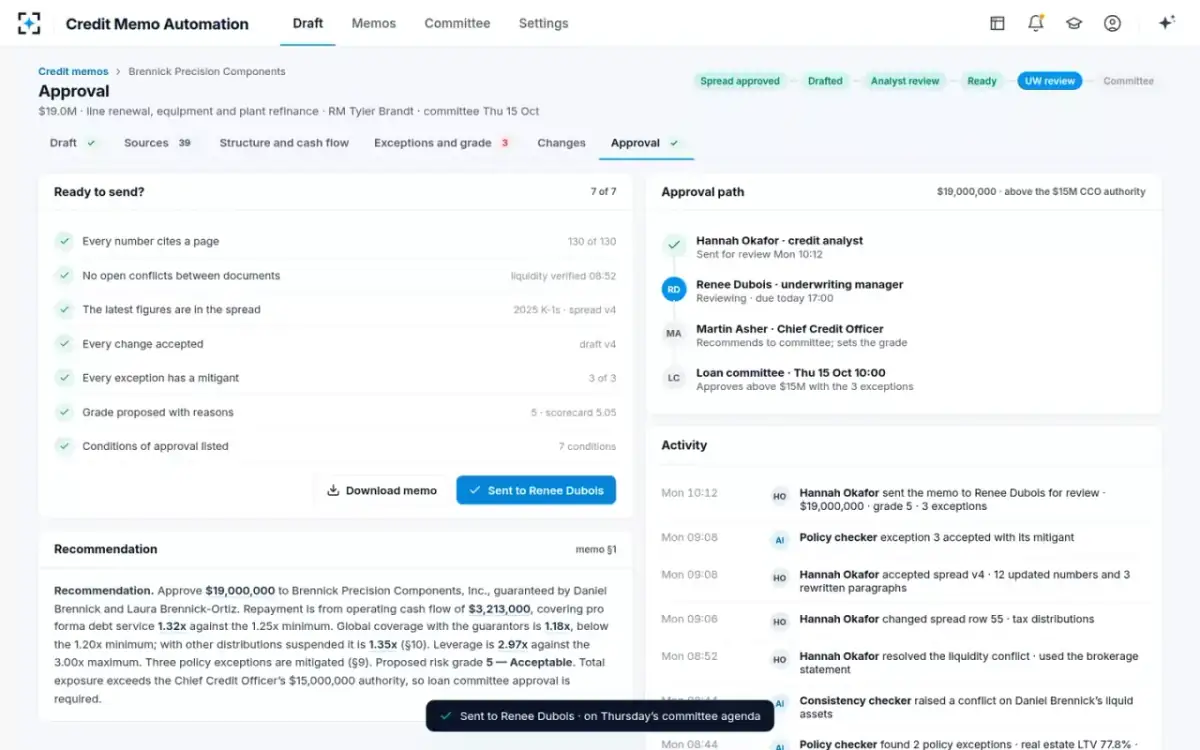
In the solution, the consistency checker keeps that dependency map. When Hannah Okafor, the sample's senior credit analyst, typed the K-1 figure into spread row 55, 12 numbers updated and 3 paragraphs were rewritten in 7 sections. A new exception and its mitigant were added, and nothing was final until she accepted. She accepted at 09:08 and sent the memo to the underwriting manager at 10:12.
Seven checks before the memo goes for review
The number-by-number path of that change is traced in one number's trip from a K-1 to the committee's DSCR. What the shorter wait is worth on the borrower's side of the desk is on what a faster credit decision is worth to the borrower. The full sample memo is on the Credit Memo Automation page.
Questions people ask
Does a bigger loan take longer to underwrite?
Usually, because it climbs the approval ladder. The OCC notes that "Large loans and loans with elevated risk characteristics generally require higher levels of approval, which may come from a committee or individuals" (OCC, 2026), and the board generally reviews any commercial loan large enough to hurt the bank if the borrower defaults. Each level adds a reader and, often, a meeting date.
How long does a loan committee take to approve a loan?
The meeting itself decides in minutes; the wait is the time to the next meeting plus the lock before it. In the sample bank, memos lock 24 hours before a Thursday committee, so a memo finished on Wednesday afternoon waits a week if the committee meets weekly.
Why is my business loan stuck in underwriting?
Most often because one section of the credit memo is waiting on a document: final tax returns or K-1s, the bank's review of the appraisal, or third-party proof of a guarantor's liquidity. Asking the relationship manager which document the memo is waiting on is usually the fastest way to move it.
Who underwrites a commercial loan?
A credit analyst or underwriter spreads the statements and writes the memo, an underwriting manager reviews it, and an approver or committee decides. The Bureau of Labor Statistics counted 64,390 people employed as credit analysts across all industries in May 2025, against 274,330 loan officers (BLS).
Can underwriting start before every document is in?
Yes, and it should: sections whose inputs are final can be drafted while the rest wait, marked as provisional. What cannot be final early is anything that rests on the reviewed appraisal value or on figures the CPA has yet to confirm.