Capital structure analysis is the work of listing every claim on a company, its loans, bonds, leases and equity, in the order those claims would be paid if the company failed, and measuring how much value sits ahead of the instrument you hold. The table looks simple; building it is not, because each cell comes from a different document: amounts from the 10-Q's debt note, liens from the credit agreement and indentures, ranking between lenders from the intercreditor, guarantees from the indentures and a subsidiary's own accounts, maturities from all of them. Botminds' AI Credit Analysis builds the table from those documents, cites every cell, and pins each sentence of an answer to the tranche it concerns, so a bondholder can see what ranks ahead and why.
The worked example is a fictional sponsor-owned issuer, Halvorsen Packaging, and the fictional Quillfield funds that hold $86.4 million of its 2029 notes: sample data on fictional people and companies. The rules on disclosure and priority come from SEC regulations and the Bankruptcy Code, linked where they appear.
A capital structure table with a source for every cell
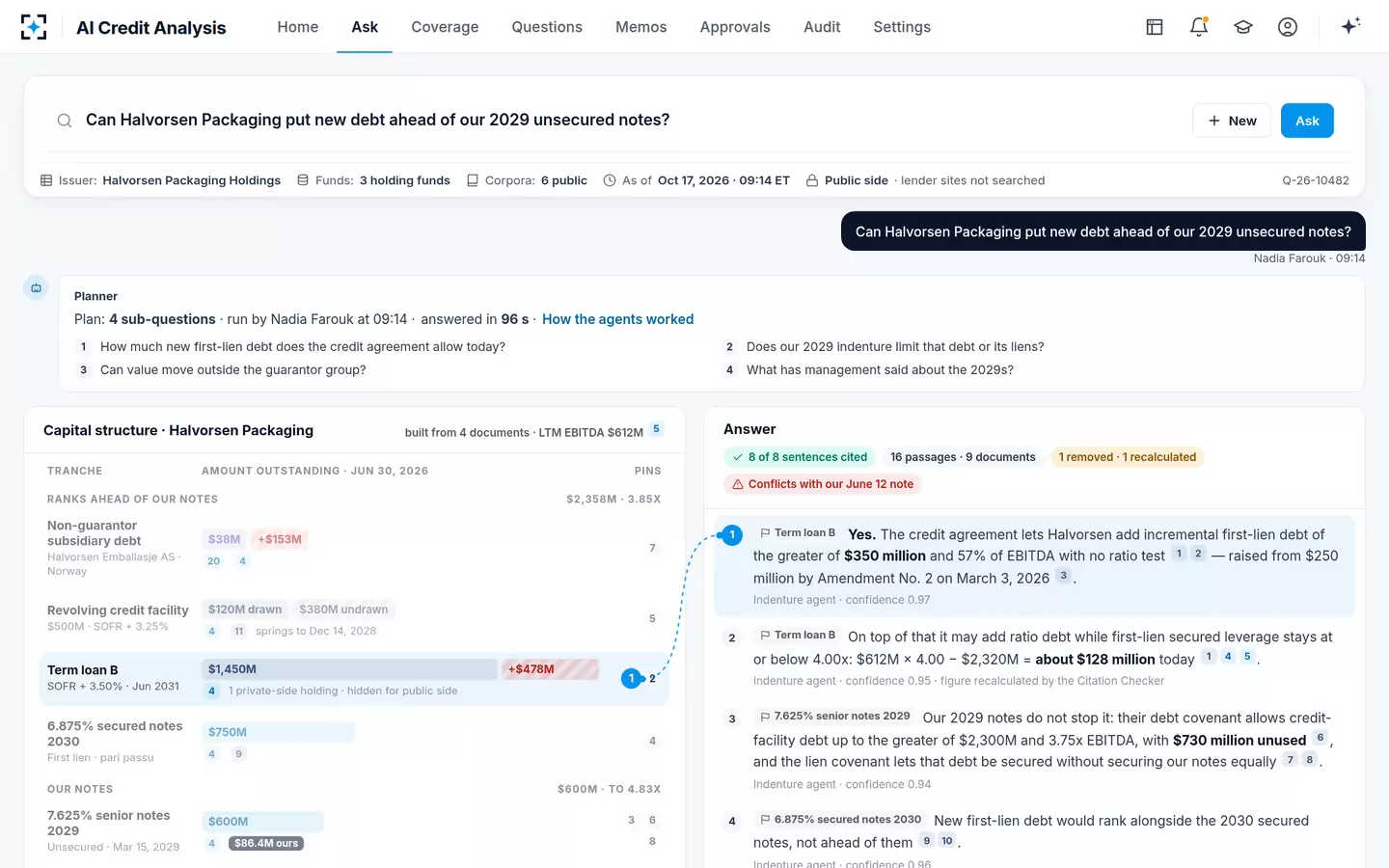
Non-guarantor subsidiary debtHalvorsen Emballasje AS, Norway
Amount$38.1M10-Q debt note, p.31
RankAhead of the notes at the subsidiary’s assets: it guarantees nothingÅrsrapport 2025, p.47 (Norwegian)
MaturityIn the subsidiary’s own accountsÅrsrapport 2025
Revolving credit facility$500M, SOFR + 3.25%
Amount$120M drawn, $380M undrawn10-Q, p.31 and liquidity section
RankFirst lienCredit agreement; intercreditor of July 15, 2023
MaturityJune 2030, springing to December 14, 2028Credit agreement §2.05(c), p.57
Term loan BSOFR + 3.50%
Amount$1,450M10-Q, p.31
RankFirst lienCredit agreement as amended; intercreditor
MaturityJune 2031Credit agreement
6.875% secured notes due 2030Pari passu with the term loan
Amount$750M10-Q, p.31
RankFirst lien, shared equally2030 secured indenture; intercreditor
Maturity20302030 secured indenture (July 15, 2023)
7.625% senior notes due 2029The fund’s notes, $86.4M held
Amount$600M10-Q, p.31
RankSenior unsecured: behind the liens to the value of the collateral, and behind non-guarantor creditors at their subsidiaries2029 notes indenture (March 15, 2021)
MaturityMarch 15, 20292029 notes indenture
EquitySponsor-owned
Amount≈ $1,632M impliedDerived, not filed
RankLast
MaturityNone
What is capital structure analysis?
Capital structure analysis answers three questions for a creditor: who is paid before me, from which assets, and what can be added ahead of me later. The first two describe the company today; the third is in the documents, and it is the one that most often changes the answer. A bond that sits at 4.8 turns of EBITDA today can sit at 5.9 turns tomorrow without a single covenant being broken, if the credit agreement allows enough new senior debt.
For an equity analyst, capital structure analysis is about the cost of capital and the right mix of debt and equity. For a credit analyst it is about rank and recovery. This guide is about the second meaning.
How to build a capital structure table
Build it bottom-up from documents, not top-down from a data feed. Start with the debt note in the latest 10-Q or 10-K for amounts, then read each instrument's governing document for its security, guarantors and maturity, then the intercreditor for how secured lenders rank against each other, then the guarantor disclosures and subsidiaries' accounts for what sits outside the guarantor group.
Each row needs at least five facts with a source: the amount outstanding and committed, the lien (first, second, none), the guarantors, the maturity including any springing maturity, and the rank against the other rows. In the sample, the table was built from four documents in the first pass and the answer drew on 9; one column is easy to get wrong by hand, maturity, because a springing date lives in the credit agreement, not in the debt note's maturity table.
What is priority of claims in a capital structure?
Priority of claims is the order in which creditors and shareholders are paid from a company's value, and in US bankruptcy it rests on two rules. First, agreements between creditors hold: "A subordination agreement is enforceable in a case under this title to the same extent that such agreement is enforceable under applicable nonbankruptcy law" (11 U.S.C. 510(a)). That is why the intercreditor agreement matters as much as the loans.
Second, the absolute priority rule: a plan crammed down over a dissenting class of unsecured creditors is fair and equitable only if that class is paid in full or the holder of any junior claim or interest "will not receive or retain under the plan on account of such junior claim or interest any property" (11 U.S.C. 1129(b)(2)(B)). Rank is not a convention; it is how the court divides value.
Who is paid first in the sample capital structure
A person decides
Creditors of the non-guarantor subsidiaryPaid first from that subsidiary’s own assets, such as the Norwegian company’s barrier-film patents; the parent’s creditors reach only what is left, as equity.
A person decides
First-lien secured creditorsRevolver, term loan B and 2030 secured notes share the collateral equally, as the intercreditor agreement sets; a subordination agreement between creditors is enforced in bankruptcy as it would be outside it.
A person decides
Senior unsecured creditorsThe 2029 notes, with trade and other unsecured claims, share what the collateral did not cover and what non-guarantor equity passes up.
A person decides
EquityUnder the absolute priority rule, retains nothing in a plan crammed down over a dissenting class ahead of it unless that class is paid in full.
Secured vs unsecured debt ranking
Secured debt is paid first from the assets that secure it; unsecured debt shares what is left with other unsecured claims. Among secured lenders, the intercreditor agreement decides whether liens are pari passu, sharing equally as the sample's term loan and 2030 secured notes do, or first and second lien. Among unsecured creditors, contractual subordination and guarantees decide the order.
The ranking that matters for an unsecured bond is not today's but tomorrow's. In the sample, the 2029 indenture's debt covenant allows credit-facility debt up to the greater of $2,300 million and 3.75x EBITDA, with $730 million unused, and its lien covenant lets that debt be secured without securing the notes equally. Read together, the two clauses mean the notes' rank can fall without any amendment the noteholders vote on. How lenders' own protections against that kind of move are graded is the subject of the separate series on uptier and priming transactions.
The capital structure built from the documents, each sentence pinned to its tranche
What is structural subordination?
Structural subordination is the position of a parent company's creditors against the assets of a subsidiary that has not guaranteed their debt: the subsidiary's own creditors are paid from its assets first, and the parent's creditors reach those assets only as equity, after them. It is invisible in a consolidated balance sheet, which adds every subsidiary's assets together, and visible only in the guarantee and subsidiary documents.
The SEC's rules for guaranteed securities require issuers to describe it. For registered guaranteed debt, the parent must disclose "how payments to holders of the guaranteed security may be affected by the composition of and relationships among the issuers, guarantors, and subsidiaries of the parent company that are not issuers or guarantors", and summarized financial information that "shall exclude subsidiaries that are not issuers or guarantors" (Regulation S-X, Rule 13-01, adopted in 2020). The rule reaches registered guaranteed debt; for a bond sold under Rule 144A without registration, the analyst has to find the same facts in the offering memorandum and the subsidiaries' own accounts.
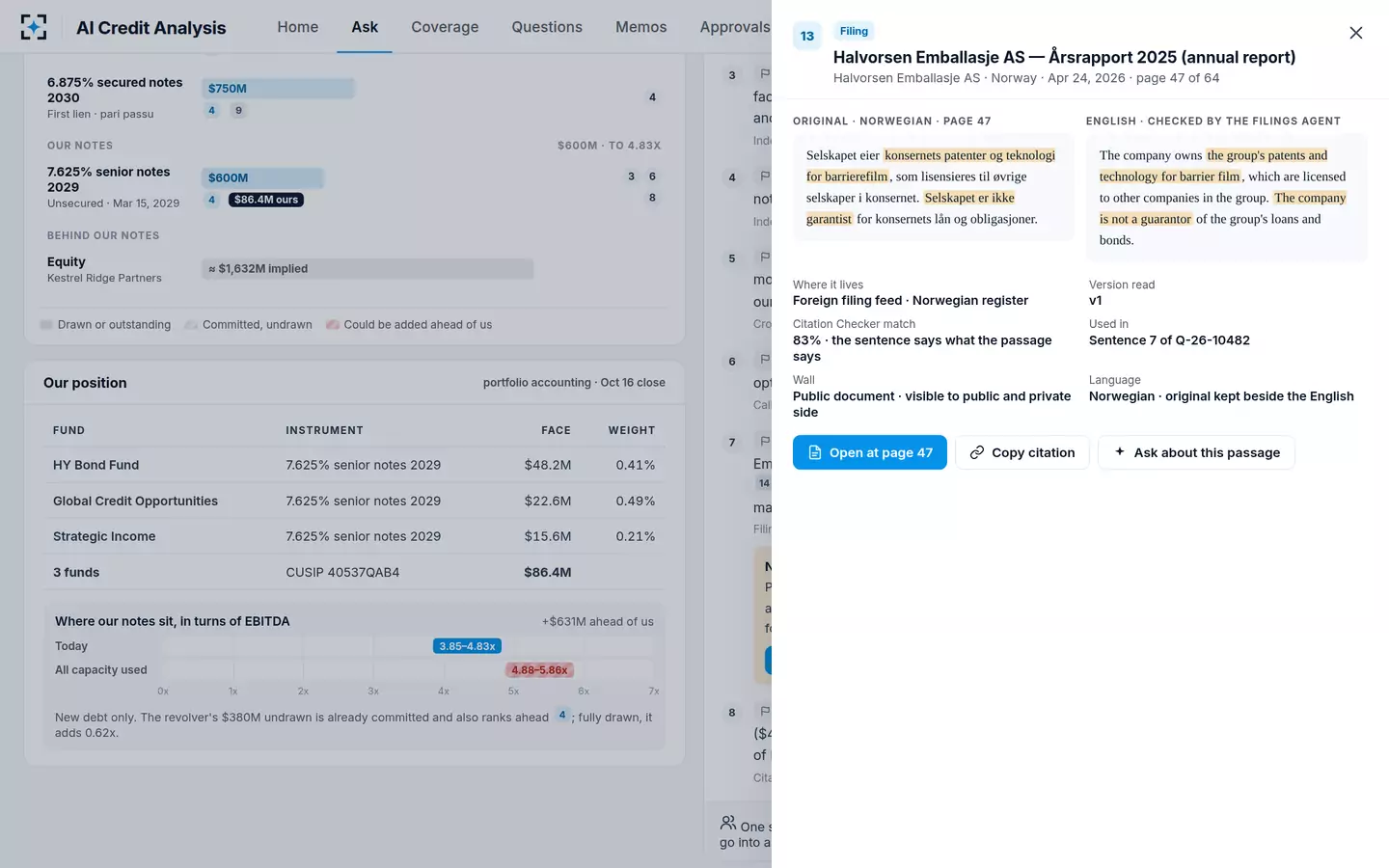
In the sample, that meant a Norwegian annual report. Page 47 of Halvorsen Emballasje AS's 2025 report says, in Norwegian, that the company owns the group's barrier-film patents and is not a guarantor of the group's loans and bonds; the credit agreement's IP blocker reaches only unrestricted subsidiaries, and the Norwegian company may borrow up to $153 million under the non-guarantor basket. Barrier film is 41% of group sales. Whether those patents are "Material Intellectual Property" under the agreement was a judgement, and the analyst made it.
The cited page that decided the subsidiary's rank, original beside the English
Where to find a company's debt maturities
Start with the debt note in the 10-Q or 10-K, then check each instrument's own document for anything that can move the date. SEC rules require the balance sheet or its notes to state, for each issue or type of long-term debt, "the date of maturity, or, if maturing serially, a brief indication of the serial maturities", any contingency on payment, and "a brief indication of priority" (Regulation S-X, Rule 5-02.22(a)). Unused commitments must also be disclosed in the notes "if significant".
What the debt note does not show is a springing maturity. In the sample, the revolver's stated maturity is June 2030, but credit agreement §2.05(c) on page 57 moves it to December 14, 2028, 91 days before the 2029 notes mature, if more than $150 million of those notes remain outstanding; the 10-Q shows all $600 million outstanding. The Cross-reference agent linked the two pages, and a person confirmed the link. A maturity column built only from the 10-Q would show the revolver after the notes. It is in fact before them.
How to read the debt footnotes in a 10-K
Read the debt footnote for amounts, rates, stated maturities, the brief indication of priority and the unused commitments, and treat everything else as a pointer to the governing documents. The footnote tells you a facility exists and is secured; it rarely tells you the baskets, the springing conditions or which subsidiaries guarantee it. Those are in the credit agreement, which a registrant files as an exhibit when it is a material contract (Regulation S-K, Item 601(b)(10)), and in the indentures.
Two checks catch most errors. Reconcile the footnote's total to the sum of the instruments you have documents for; in the sample, $2,958.1 million of total debt splits into five lines, including $38.1 million at a subsidiary that a quick read would miss. And date every document: the footnote is as of the quarter-end, the credit agreement as of its last amendment, and the two must agree.
The debt that is not there yet: capacity
A capital structure table that shows only outstanding debt understates what can rank ahead of a bond, because loan documents leave room for more. Ivashina and Vallée, studying 1,240 credit agreements, found that while 87% restrict additional debt, 92% of those allow some, and that the deductibles on the indebtedness covenant average "more than 2.3x EBITDA multiples" (NBER Working Paper 27316).
How much room loan documents leave for more debt
2.3x
EBITDA: average size of the deductibles on the restriction on additional debt
76%
of firms at 5x EBITDA at origination can later issue debt beyond 6x
>70%
of contracts allow additional senior secured debt taking leverage above 5x
$631M
of new debt that could rank ahead of the sample issuer’s 2029 notes today
In the sample, that room is $631 million: $350 million of free-and-clear first-lien debt, about $128 million of ratio debt at 4.00x secured leverage, and $153 million at the Norwegian subsidiary. The undrawn $380 million of the revolver is shown separately because it is already committed; fully drawn, it would add 0.62x. A capital structure table needs a capacity column, or it is a picture of a structure that can change by Monday.
What is a capital structure waterfall?
A capital structure waterfall stacks the claims in order of payment and shows, at each layer, how much of the company's value or earnings is claimed before the next. Measured in turns of EBITDA, it tells a bondholder where its first and last dollar sit.
The sample waterfall in turns of EBITDA: cumulative leverage at each layer
A recovery view follows from the waterfall: if the enterprise is worth a given multiple of EBITDA in distress, the layers above that multiple are covered and the layers below it are not. The analysis is only as good as the table under it, which is why each line carries its document. The ratios themselves are traced in financial ratios used in credit analysis, and how a note built on an old table goes wrong is in when a house note outlives its source. The full answer is on the AI Credit Analysis page.
Questions people ask
What is the difference between capital structure analysis in credit and in corporate finance?
In corporate finance it is about the mix of debt and equity that minimises the cost of capital; in credit it is about who is paid first and from which assets. A credit analyst's table ranks every claim and shows what can be added ahead of the instrument held.
Does pari passu mean equal in everything?
It means equal in right of payment or in a shared lien, as the documents define. In the sample, the term loan and the 2030 secured notes share the first lien equally under an intercreditor agreement; their maturities, covenants and voting rights still differ.
Why are the guarantors so important?
Because a creditor can claim directly only against the companies that owe or guarantee its debt. Assets in a non-guarantor subsidiary go first to that subsidiary's creditors, which is why SEC rules require registered guaranteed debt to show how non-guarantor subsidiaries affect payment.
Where do I find who guarantees a bond?
In the indenture's guarantee provisions and, for registered debt, the guarantor disclosures under Regulation S-X Rule 13-01 in the notes or MD&A. For a Rule 144A bond, the offering memorandum's description of the notes, and the subsidiaries' own accounts.
How often should a capital structure table be rebuilt?
With every 10-Q and 10-K, and whenever an 8-K reports a new financing, an amendment or a repurchase. A repurchase that left $150 million or less of the sample's 2029 notes outstanding would remove the revolver's springing maturity altogether.