A buy-side credit analyst works for an asset manager, a hedge fund, an insurer or a pension plan and forms the fund's own view of an issuer's ability to pay its debt: which bonds or loans to buy, hold or sell, and how much protection the documents give if things go wrong. Unlike a sell-side analyst, whose research is published to clients, the buy-side analyst writes for one reader, the portfolio manager, and the work is judged by the positions it supports. The hard part is reading: whether new debt can rank ahead of a fund's notes is decided in credit agreements, their amendments, indentures and intercreditors that nobody reads end to end. Botminds' AI Credit Analysis exists for that reading, with agents that read and cite while the analyst and the people around her keep every decision.
The examples come from a fictional fund group, Quillfield, and a fictional issuer, Halvorsen Packaging, as they run through the solution: sample data on fictional people and companies. Pay and employment figures come from the Bureau of Labor Statistics; the rules from FINRA's rulebook and the Investment Advisers Act, linked where they appear.
The job in four numbers
$124,370
median annual wage of financial and investment analysts in securities and investment firms, May 2025
377,200
financial and investment analyst jobs in 2025, a quarter of them at securities and investment firms
$1.77T
high-yield and unrated US corporate bonds outstanding at the end of 2025
15 min
for a dealer to report a corporate bond trade to TRACE after it is executed
What does a buy-side credit analyst do?
A buy-side credit analyst answers one question for the fund, over and over: will this issuer pay, and does this security pay us enough for the chance that it will not? The daily work is narrower than that sounds. It is reading what the issuer filed, what the documents allow, and what management said, and turning that into a recommendation a portfolio manager can size.
The federal occupation codes split the work oddly. The Department of Labor's O*NET defines credit analysts by the risk of extending credit or lending money (O*NET 13-2041), which is the lending desk. Buy-side credit work usually sits under financial and investment analysts, who, in the Bureau of Labor Statistics' words, "rate and recommend investments based on their analysis of businesses and economic or industry trends" (BLS).
In a high-yield book the questions are specific. Can the issuer add secured debt, and how much? Does the revolver mature before our notes? Is the valuable subsidiary inside the guarantor group? What did the chief financial officer say about the 2029s on the call? Each answer lives in a different document, and the analyst is the person who puts them together and signs the conclusion.
Buy-side vs sell-side credit analyst: who the research is for
The sell-side analyst works for a broker-dealer and publishes; the buy-side analyst works for an investor and recommends. That difference decides which rules apply. A sell-side debt research analyst is covered by FINRA Rule 2242, in force since July 16, 2016, whose definition reaches any associated person "primarily responsible for" preparing the substance of a debt research report (FINRA Rule 2242). The rule requires the member's policies to "prohibit prepublication review, clearance or approval of debt research reports" by investment banking, principal trading and sales and trading personnel.
Buy-side vs sell-side credit analyst, row by row
Sell-side debt research analyst: A broker-dealer, a FINRA member.
Buy-side credit analyst: An investment adviser, insurer or pension plan that owns the risk.
Sell-side debt research analyst: Clients; institutional research carries a first-page notice that it is not subject to all of the rule’s standards for retail research.
Buy-side credit analyst: The fund’s own portfolio managers and investment committee.
Sell-side debt research analyst: FINRA Rule 2242: conflicts policies, no prepublication review by trading or banking, information barriers around the analyst.
Buy-side credit analyst: Rule 2242 does not apply. The adviser’s fiduciary duty, its compliance program, and Section 204A on material nonpublic information do.
Sell-side debt research analyst: Client ratings and the quality of published research, under a pay committee that excludes banking and principal trading.
Buy-side credit analyst: The positions the research supported, and whether the record shows why.
Sell-side debt research analyst: The firm’s information barriers insulate the analyst from banking and trading pressure.
Buy-side credit analyst: Arrives through lender groups and creditor committees; the wall runs through the buy-side desk itself.
Rule 2242 also lets a member distribute institutional debt research with lighter requirements if the first page says the document "is intended for institutional investors and is not subject to all of the independence and disclosure standards applicable to debt research reports prepared for retail investors". A buy-side analyst reading that research is reading an input, not a conclusion, and has to form her own.
Five seats around one bond question
A single bond question touches at least five seats before a position moves, and most of the elapsed time sits between them. Take one sample question as it runs through the solution: on a Friday morning, Quillfield's high-yield portfolio manager, Meg Castellano, asks whether Halvorsen Packaging can put new debt ahead of the 7.625% Senior Notes due 2029 that three Quillfield funds hold, $86.4 million in all, before Monday's committee.
One bond question, seat by seat, with the wall checked before anything is read
A person decides
Portfolio manager asksNeeds a view before Monday’s investment committee: can the issuer put new debt ahead of the notes three funds hold? Sizes the position once the answer is approved.
Never: Reads a memo before the checker has signed it.
Agent
Wall check, then a planApplies the control room’s wall list, restricted list and fund entitlements to the analyst’s seat, then splits the question into sub-questions and names the documents for each.
Never: Reads anything before the analyst runs the plan.
Agent
Readers and the citation checkRead the credit agreement as amended, both indentures, the intercreditor, the 10-Q, a foreign subsidiary’s annual report and the call; recompute every figure; remove any sentence without a source.
Never: Search lender sites for a public-side analyst.
A person decides
Credit analyst decidesConfirms or edits the one sentence below the confidence line, writes the recommendation by fund, and submits the memo.
Never: Approves her own memo.
A person decides
Senior analyst checks and signsChecks the flagged sentences against their pages and approves with a reason code. Only then can the portfolio manager read.
A person decides
Trader executesWorks the order the portfolio manager places, against the prices the market has reported that day.
A person decides
Research compliance stands above the wallOwns the wall list and decides every request to cross it; internal audit later tests who asked, saw and signed.
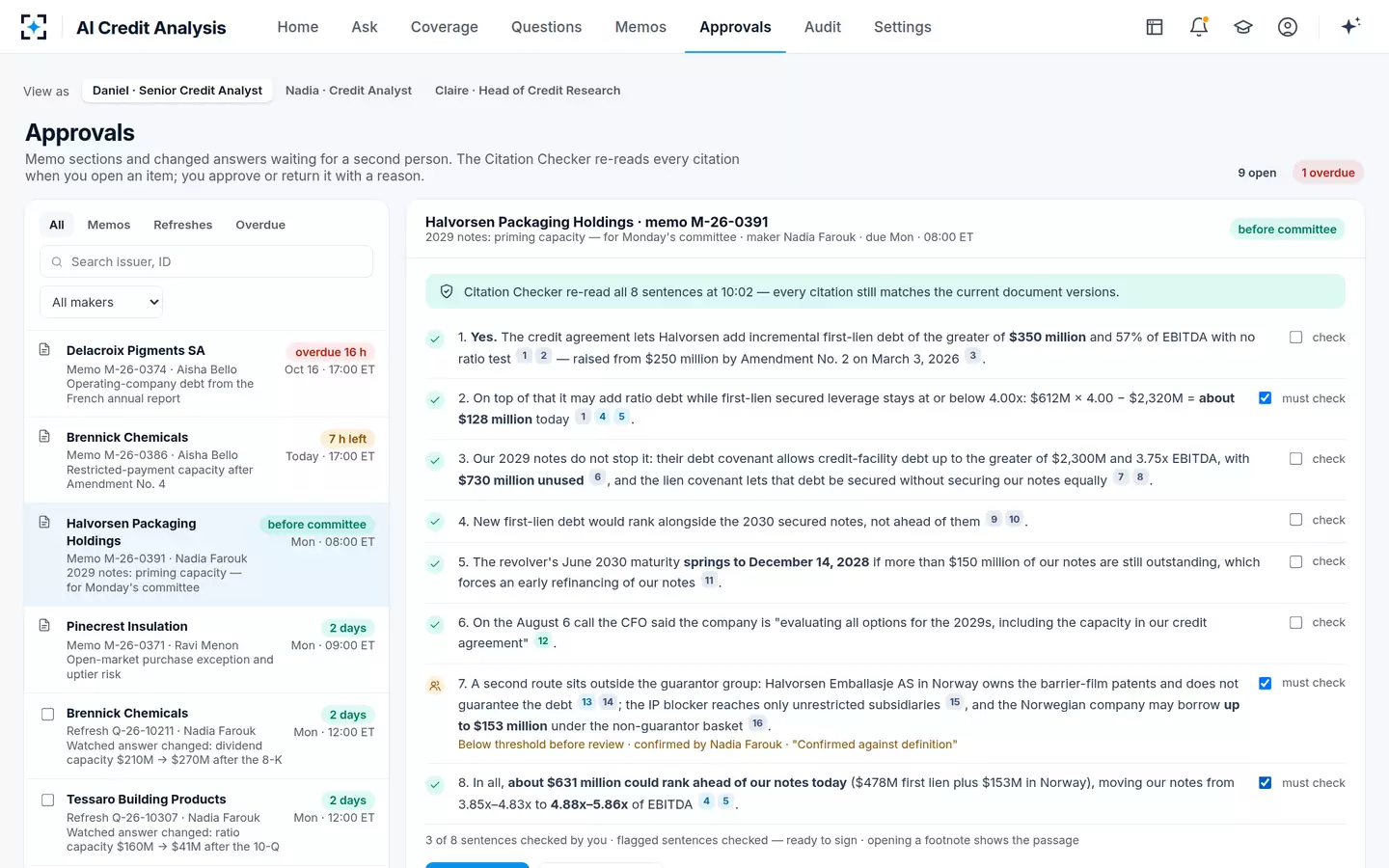
By hand, the analyst's part of that chain is days of reading: finding the credit agreement and every amendment, applying them in order, tracing "Incremental Cap" to "Consolidated EBITDA", working each "greater of" basket at today's EBITDA. In the sample, the agents read 9 documents and return an answer of eight cited sentences in 96 seconds: about $631 million of new debt could rank ahead of the notes, moving them from 3.85x–4.83x to 4.88x–5.86x of EBITDA. The analyst still spends real time, on the one sentence that needs judgement.
What did not change is who decides. The analyst owns the recommendation, the senior analyst owns the signature, the portfolio manager owns the size, and compliance owns the wall. The page on the citation checker that blocks uncited sentences goes inside the agent step.
How many issuers does a credit analyst cover?
There is no official count: no regulator or labour survey publishes issuers per credit analyst, and coverage depends on the sector, how much of the book is high yield, and how deep each name has to go. What a head of research can measure is the ratio that matters: names covered against the deep questions the desk can actually answer each quarter.
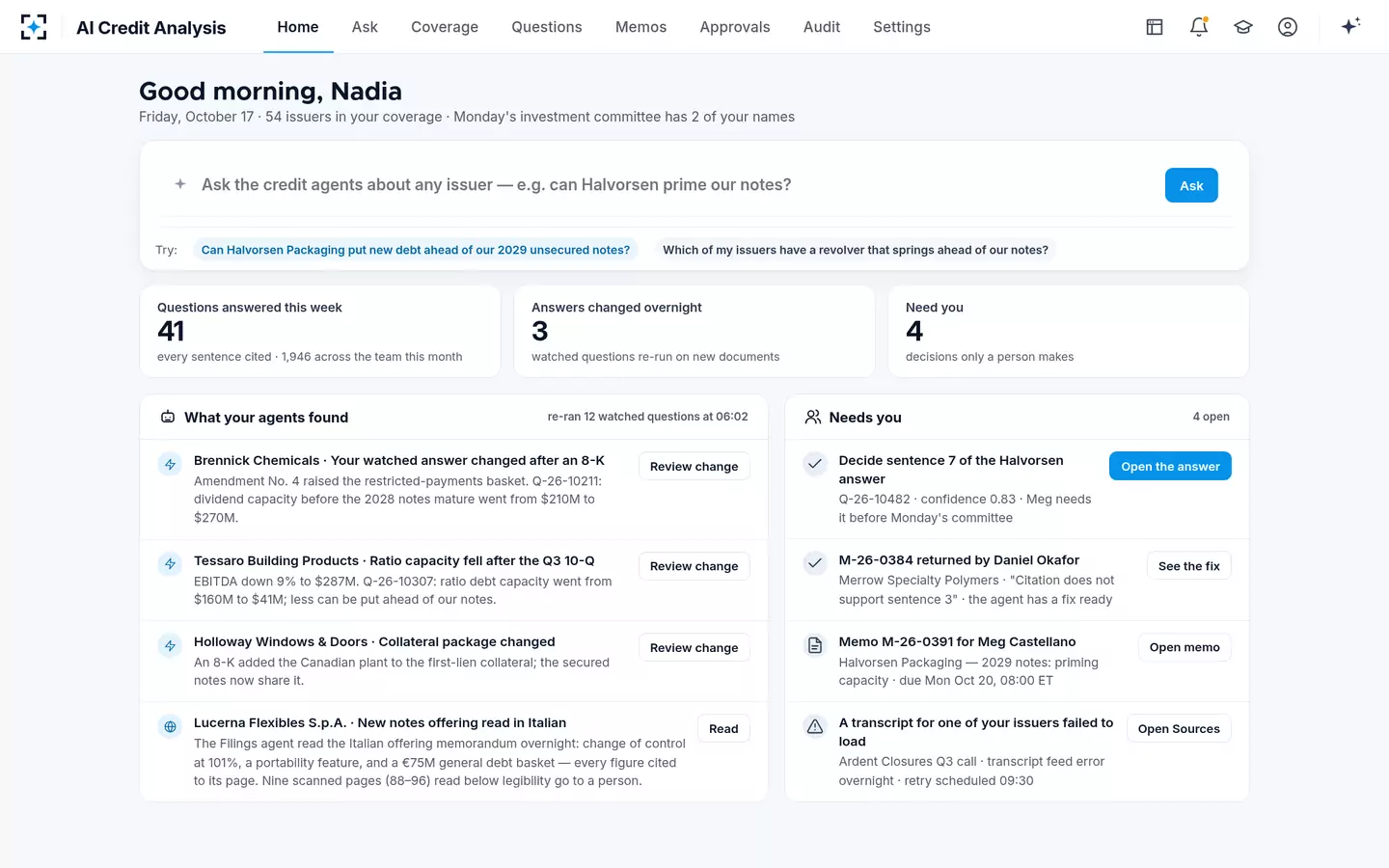
In the sample, Nadia Farouk covers 54 issuers in packaging and paper, chemicals and building products, out of a 412-issuer research universe, and her team lead, Daniel Okafor, reviews the memos of seven analysts. At that size the constraint is not reading speed in general but specific reading at the wrong moment: an amendment filed the week of a committee, a 10-Q that cuts EBITDA and with it every basket sized on EBITDA.
An analyst's Friday: 54 issuers, three answers changed overnight
Who does a credit analyst report to?
On most buy-side desks a credit analyst reports to a senior analyst or sector head, who reports to the head of credit research; the portfolio managers are the analyst's customers, not usually her bosses. The line matters because it decides who signs. A memo a portfolio manager sizes on should carry two names: the analyst who wrote it and a second person who checked it.
That maker-and-checker split is the control most desks already describe in their policies, and the one hardest to prove after the fact. In the solution the author of a memo cannot approve it, the checker's approval opens only after the flagged sentences are checked, and the portfolio manager reads only approved text. Each step is on the audit trail with who, when and why.
The checker's queue: three flagged sentences before Approve opens
What does a credit trader do, and where does the analyst meet the trading desk?
A credit trader executes the portfolio manager's orders and reads the market in real time; the analyst reads the issuer. In corporate bonds the trader works against a market where dealers report their trades within minutes: a FINRA member must report a corporate bond trade "no later than within 15 minutes of the Time of Execution" (FINRA Rule 6730). In September 2026 TRACE recorded 3,019,506 trades in non-convertible corporate bonds, $1.264 trillion of par, an average of 143,786 trades a day, including Rule 144A trades (FINRA TRACE monthly volume, September 2026).
The difference between credit research and credit trading is therefore a difference of clock. The trader sees a price move within minutes; the analyst needs to know whether the move reflects something in the documents. When the two meet, the useful currency is a sentence the trader can trust, with its page, not a model the trader has to re-read.
The wall runs through the buy-side desk
On a credit fund, the information barrier is not between research and banking, as on the sell side; it runs between people sitting a few desks apart. Funds that lend, sit in lender groups or join creditor committees receive material nonpublic information, and Section 204A of the Investment Advisers Act requires every adviser to keep and enforce written policies reasonably designed to prevent its misuse (15 U.S.C. 80b-4a).
In the sample, 60 people sit on the public side and nine on the private side, which also sees 386 lender-site documents such as compliance certificates and lender presentations. A public-side analyst's question never searches those sites, and the answer says so. The mechanics, and the enforcement cases behind them, are in private side vs public side: who may read what in a credit fund.
How much does a buy-side credit analyst make?
The best public figure is the BLS wage for financial and investment analysts at securities and investment firms: a median of $124,370 in May 2025, against $102,740 for the occupation as a whole, whose top 10% earned more than $180,860 (BLS Occupational Outlook Handbook). These are base wages from an employer survey; they do not separate credit from equity analysts or include bonuses.
What BLS publishes about the analyst seat, and what it does not
| Measure | BLS figure | What it covers |
|---|---|---|
| Median wage, financial and investment analysts | $102,740 (May 2025) | All industries; base wages, no bonus |
| Median wage, same occupation, securities and investment firms | $124,370 (May 2025) | The industry where most buy-side analysts work |
| Highest 10% earned more than | $180,860 | All industries |
| Jobs, financial and investment analysts | 377,200 (2025) | 24% in securities, commodity contracts and other financial investments |
| Projected openings, all financial analysts | About 29,500 a year, 2025–35 | Includes financial risk specialists |
| Credit analysts on the buy side | Not published separately | Lending credit analysts have their own code, 13-2041 |
For a head of research, the wage matters less than the hours behind each answer. A desk that spends days on one priming question is paying senior wages for document retrieval. Three ways to cover the same coverage list works the arithmetic.
What is a high yield credit analyst, and why the documents decide
A high yield credit analyst covers issuers rated below investment grade, where the documents matter more than the ratings. The Federal Reserve puts high-yield and unrated corporate bonds at $1,772 billion at the end of 2025 and leveraged loans at $1,549 billion, against $8,284 billion of investment-grade bonds (Financial Stability Report, May 2026). In that market, recovery depends on where a bond ranks, and rank depends on what the credit agreement allows the issuer to add later.
That is why the high-yield analyst's working day is reading covenants, baskets and definitions rather than models. The page on capital structure analysis, line by line shows how each tranche maps to the document that sets its rank.
What changes on the credit desk when agents do the reading
Agents change what each seat reads, not who decides. The analyst reads an answer with its pages instead of the 318 pages behind it; the checker reads the sentences that moved; the portfolio manager reads only signed text; compliance reads a log of what was not searched.
Four seats on the credit desk, before and with AI Credit Analysis
Today
Traces defined terms through a 318-page credit agreement and every amendment by hand, then retypes the basket arithmetic into a memo.
With agents
Asks in plain words, reads a cited answer pinned to the capital structure, and spends the hour on the one sentence that needs judgement.
Still theirs: The recommendation and every sentence below the confidence line.
Today
Approves every memo section seven analysts write and wants the clause behind each sentence he signs.
With agents
Opens a memo whose citations were re-read minutes earlier and checks only the flagged sentences in depth.
Still theirs: The signature; the author can never approve her own memo.
Today
Sizes positions on a house note that may have missed the last amendment.
With agents
Reads only approved memos, with the position by fund and where the notes sit in turns of EBITDA today and with every basket used.
Still theirs: Position size and the vote at committee.
Today
Runs the wall, the restricted list and crossing approvals, and has to prove the public side never saw lender material.
With agents
Sees the wall applied before any document is chosen and a record of what was not searched on every answer.
Still theirs: Every wall-crossing decision.
The design choices follow from the seats. Nothing is read until the analyst runs the plan, so the question stays hers. A sentence below 0.85 confidence goes to her to confirm, edit or remove with a reason code. Thresholds, roles and agent versions change only with a second signature. Every step is kept for the sample house policy's seven years. To see the same Halvorsen answer from each seat, start from AI Credit Analysis.
Questions people ask
What does a buy-side credit analyst do day to day?
Reads filings, credit agreements, indentures and calls for the issuers in coverage, answers the portfolio managers' questions about them, and writes recommendations the fund can size on. Most days are spent on specific questions, such as whether an issuer can add secured debt, rather than on full initiations.
Is a buy-side credit analyst the same as a credit risk analyst?
No. A credit risk analyst usually measures a lender's or a portfolio's exposure; BLS counts financial risk specialists separately, with a May 2025 median wage of $117,330. The buy-side credit analyst judges individual issuers and securities for investment.
Do buy-side credit analysts need a FINRA licence?
Not usually. FINRA licences attach to work at broker-dealers, and BLS notes that most licences need an employer's sponsorship. Sell-side debt research analysts work under FINRA Rule 2242; a buy-side analyst at an investment adviser is covered by the adviser's own compliance program.
What is the difference between credit research and credit trading?
Research forms the view on the issuer; trading executes and reads the market's price of that view. Corporate bond trades are reported to TRACE within 15 minutes of execution, so the trader sees prices move first; the analyst explains whether the documents justify the move.
How do credit analysts handle private information?
Through the firm's wall. Section 204A of the Investment Advisers Act requires written policies reasonably designed to prevent misuse of material nonpublic information, so a fund that sits in lender groups keeps that material on a private side that public-side analysts and traders cannot see.