Reverse stress testing starts from failure and works backwards: instead of choosing a scenario and measuring its damage, it defines the outcome the fund cannot survive and searches for the conditions that would produce it. For an open-ended fund, ESMA defines that outcome as "the point at which the fund would no longer be liquid enough to honour requests to redeem units", and because redemptions arrive day by day, the most useful answer is a date: the day, at a given pace of outflows and cash calls, on which the fund's liquid assets are gone and it must sell at a loss, defer redemptions or suspend. Botminds' Liquidity Stress Testing draws each fund as a tank of liquidity tiers draining under a scenario, marks the day it breaks, and shows which tool or assumption would move that day, before a risk manager decides what to do about it.
The worked example is the solution's fictional sample fund, Quillfield Global Strategic Bond Fund, a $4.8 billion Irish UCITS, under its approved scenario of the three largest holders leaving during a gilt shock.
The same fund breaks on day 4 or day 6, depending on how fast one holder leaves
- Days 1–3: buffer falls from 21.3% to 1.9%D1–3
- Buffer goneD4
- 10% limitD5
- Days 1–5: buffer holds; daily requests peak at 5.8%D1–5
- Buffer goneD6
What is a reverse stress test?
A reverse stress test is a stress test run in the opposite direction. ESMA's definition, written for funds, is "a fund-level stress test which starts from the identification of the pre-defined outcome with regards to fund liquidity (e.g. the point at which the fund would no longer be liquid enough to honour requests to redeem units) and then explores scenarios and circumstances that might cause this to occur" (ESMA34-39-897, definitions). The output is not a pass or a fail but a boundary: everything inside it the fund survives, everything beyond it breaks the fund.
ESMA asks managers to use reverse stress tests "where appropriate" and is most insistent for funds whose strategies expose them "to low-probability risks with a potentially high impact" (paragraphs 31 and 34). It is also specific about how: reverse tests "should simulate assets being liquidated in a way that reflects how the manager would liquidate assets during a period of exceptional market stress", taking into account "the treatment of remaining, as well as redeeming, unitholders as well as the role of transaction costs and whether or not fire sale prices would be accepted" (paragraph 33).
Reverse stress testing vs stress testing
A forward test answers "what happens if"; a reverse test answers "what would have to happen". Both use the same model of the fund, but they produce different kinds of evidence and they fail in different ways.
Forward and reverse liquidity stress tests on the same fund
Forward stress test: A scenario: an outflow pattern, a market shock, a cash call.
Reverse stress test: An outcome: the fund can no longer meet redemptions from liquid assets.
Forward stress test: A result per scenario: pass, watch or breach, and by how much.
Reverse stress test: A boundary: the outflow pace, concentration or shock at which the fund breaks, and the day it happens.
Forward stress test: Only as severe as the scenarios someone chose.
Reverse stress test: Can find breaking points too implausible to act on.
Forward stress test: Whether the fund survives the events the risk team imagined.
Reverse stress test: How far the fund is from breaking, and which lever moves that distance most.
Forward stress test: Always: hypothetical and historical scenarios.
Reverse stress test: "Where appropriate", especially for low-probability, high-impact strategies.
The two belong together. Research on swing pricing by Capponi, Glasserman and Weber shows why a boundary exists at all: when redemptions push down the prices of what a fund must sell, the first-mover advantage "introduces a nonlinear dependence between a market shock and the aggregate impact of redemptions on the fund's NAV", so that "there is a critical magnitude of the shock", beyond which redemptions alone bring the fund down (Management Science, 2020). A forward test with a scenario below that magnitude passes; one just above it fails badly. The reverse test is how a manager finds where the cliff is.
For a fund, the breaking point is a date
Because a fund pays redemptions daily, the breaking point is best read as the day the fund can no longer pay from cash and highly liquid assets. On the sample fund, the buffer at the start of the scenario is 21.3% of net assets: 4.1% in cash and 17.2% in highly liquid holdings, after a 14.2% block of long gilts drops out of the highly liquid tier because their bid-ask spreads widen fourfold in the shock. Redemption requests then run at 3.2%, 4.1%, 5.6%, 6.9% and 10.4% of net assets on days 1 to 5, and variation margin on the fund's rate hedges takes 2.9%, 2.4% and 1.2% on days 1 to 3.
Highly liquid assets left at each day's close: below the 5% floor on day 3, gone on day 4
Three things happen on the way down, and a reverse test reports each. The fund crosses its own 5% liquidity floor on day 3, which is the trigger in its policy for escalation. It exhausts highly liquid assets on day 4, when $241 million, 5.0% of net assets, must be sold from investment-grade credit at a stressed cost. And on day 5, requests of 10.4% exceed the 10% one-day redemption limit in the prospectus, so the limit applies and $19 million is deferred to day 6. The breaking day is day 4: the first day the fund cannot pay from what it could sell without loss.
The drain-down in Liquidity Stress Testing, with the breaking day circled
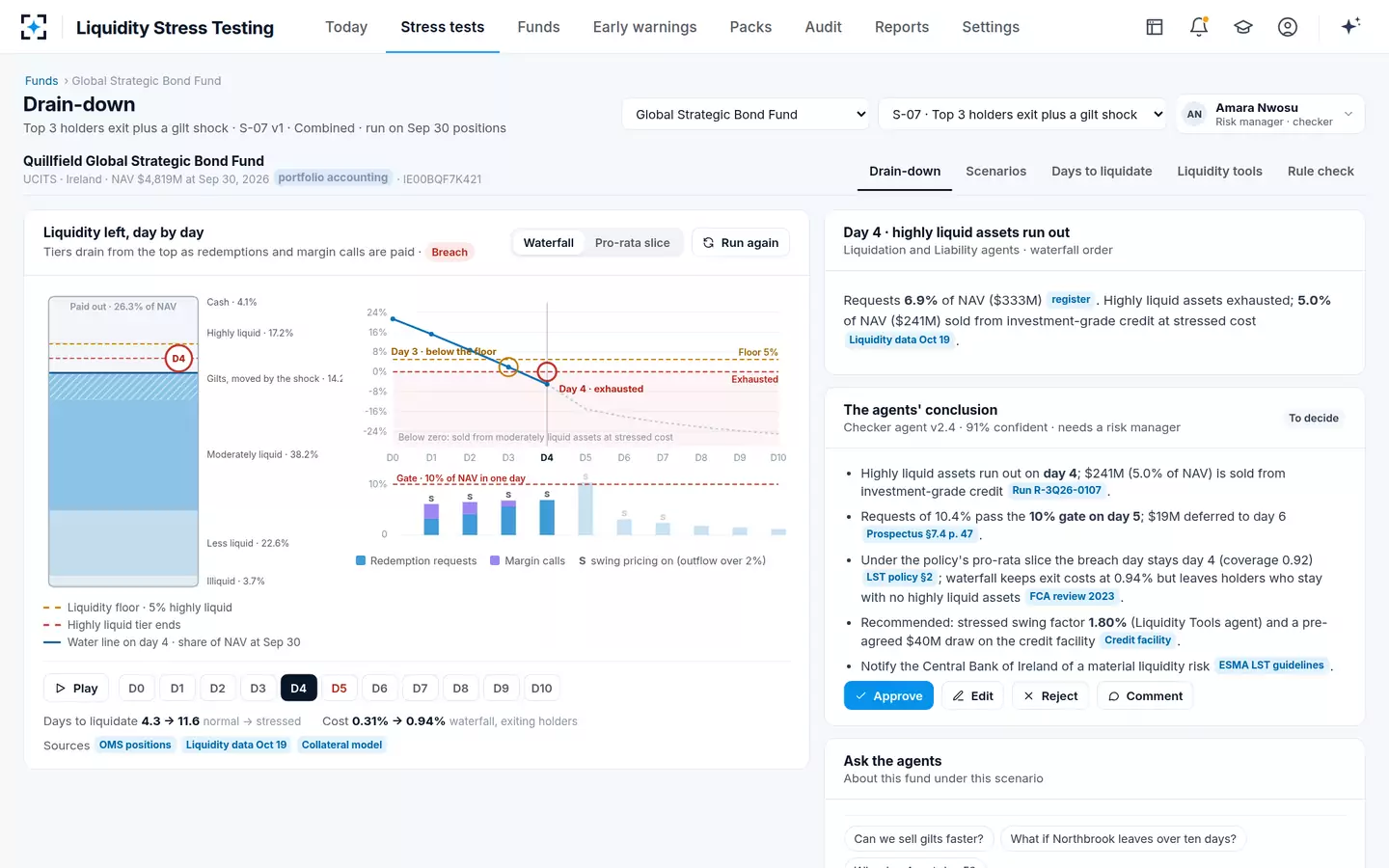
How many days of outflows can the fund survive?
Three full days at the scenario's pace, with the fourth partly paid from sales at a loss. The more useful question is what moves that number. A reverse test answers it by varying one input at a time and noting the new breaking day, which turns a single result into a map of the fund's sensitivities.
What moves the sample fund's breaking day, one input at a time
| Change to the scenario or the model | Breaking day | Why |
|---|---|---|
| First pass: long gilts kept in the highly liquid tier | Day 5 | A 14.2% block counted as sellable in three days, though its spreads widened fourfold in 2022. |
| Gilts moved to moderately liquid by the checking agent | Day 4 | The buffer falls from 35.5% to 21.3% of net assets. |
| Largest holder spreads its exit over ten days | Day 6 | Daily requests peak at 5.8% instead of 10.4%, and the 10% limit never applies. |
| Gilts sold in one day at 40% of daily volume | Day 5 | Faster sales buy one day; at 20% of volume they cost about 1.9% on those lines. |
| Pro rata sale order instead of most liquid first | Day 4 | Same day; the difference is who bears the cost, not when the fund breaks. |
| Pre-agreed $40 million draw on the shared credit line | Day 4 | Adds 0.8% of net assets, less than one day's requests. |
Read down the middle column and the fund's real exposures appear. It is far more sensitive to how fast one pension scheme leaves than to the order in which it sells, and the classification of one block of gilts is worth a full day. Those are the things a board can act on: a conversation with the largest holder about notice, a limit on how much of the fund any one holder may own, or a decision to hold more of the buffer outside gilts.
Which tool moves the breaking day?
Mostly the ones that slow outflows, not the ones that price them. A redemption limit, a longer notice period or a redemption in kind changes how much cash leaves on a given day, and so moves the date. Swing pricing, dual pricing or a levy changes who pays the cost of leaving, and so protects the investors who stay, but does not by itself change the date unless it changes behaviour. The research is mixed on whether it does in a stress: UK evidence finds swing pricing reduces outflows in market stress, while a Bank for International Settlements study of Luxembourg funds found a limited effect; what swing pricing does and does not do sets out both.
The sample shows the timing problem precisely. The fund's 10% one-day limit is crossed on day 5, a day after the breaking day. As written in the prospectus, it protects the fund once the damage has started, not before. A reverse test makes that visible and lets the risk team ask whether a lower threshold, a redemption in kind for the largest professional holder, or an extension of notice would move the date; whether those are permitted is a matter for the fund documents and the EU's new rules on liquidity management tools.
Reverse stress testing examples beyond redemptions
The breaking point can come from the liability side without a single redemption. ESMA says a liquidity stress test should sometimes "determine the circumstances in which liquidity risk cannot be mitigated, for example a level of margin calls the fund would not be able to fund" (paragraph 58). That is a reverse test on derivatives: solve for the rate or currency move whose margin calls exhaust the buffer.
Three breaking points regulators and researchers have measured
≤40%
of 297 high-yield bond UCITS could face a liquidity shortfall under ESMA's severe but plausible shocks
£25.3bn
of gilts sold by LDI funds in five weeks of 2022, 30% of it in five days
~10%
price discounts on gilts from those forced sales, about half the fall in gilt prices
Each is a reverse-test result in all but name. ESMA's simulation asked which funds' "holdings of liquid assets alone would not cover the redemptions assumed in the shock scenario", and found up to 40% of high-yield bond funds in that position (ESMA34-43-880). The 2022 gilt episode showed what happens past the boundary: liability-driven investment funds, which are not ordinary open-ended funds, met collateral calls by selling roughly £25.3 billion of gilts over five weeks, 30% of it in the five days before the Bank's intervention, and those forced sales "led to price discounts on the order of 10%" (Bank of England Staff Working Paper No. 1,089). The lesson for an ordinary bond fund is the asset-side one: the price at which it can sell on its breaking day is not the price on its screen the day before.
Private markets show the other branch of a reverse test, the point at which a fund uses its contractual tools. In May 2026 the Federal Reserve reported that redemption requests rose at some types of private credit vehicles, and that most of them responded by using their right to limit the size of redemptions (Federal Reserve, Financial Stability Report, May 2026). ESMA's guidelines anticipate exactly this use: an AIF "may also use RST to simulate the level of assets that may be liquidated before implementing 'special arrangements' allowed by its redemption policy" (paragraph 36).
Reverse stress testing process, step by step
The process runs in five stages, and the people in it decide two things: whether the scenario that breaks the fund is plausible, and what to do about the date. The flow below is how Botminds' Liquidity Stress Testing divides the work between its agents and the risk team.
Reverse stress testing in Liquidity Stress Testing: agents search, people decide
Agent
Liquidation and liability agentsCompute days to liquidate and cost by position in the policy's sale order, and add margin calls, collateral, the fund's share of the credit line and settlement gaps, day by day.
Never: Overwrite a person's override, or assume the shared credit line beyond the fund's allocation.
Agent
Scenario agentSearches outflow paces and concentrations for the one that exhausts liquid assets, starting from the register and flow history.
Never: Activates a scenario.
Agent
Checker agentRecomputes the result and challenges the classifications behind it, such as gilts counted as highly liquid in a gilt shock.
Never: Settles a disagreement itself.
Agent
Liquidity tools agentTests which selected tool moves the breaking day, and by how much.
Never: Activates a tool or changes a factor.
A person decides
Risk manager, then Chief Risk OfficerThe risk manager judges whether the breaking scenario is plausible and approves or rejects it with a required reason; the Chief Risk Officer signs the committee papers and any regulator notice.
Two details in the flow matter more than they look. The checking agent's challenge on the sample fund moved the breaking day from 5 to 4, which is the difference between a breach a forward test reports and one it misses. And the boundary only becomes useful once a person accepts that the scenario producing it could happen; a reverse test that breaks every fund at a 60% outflow in one day tells a board nothing it can use.
Bank reverse stress tests answer a different question
ESMA's definition is built on the banking one, and the difference between them is the point. The European Banking Authority's guidelines on institutions' stress testing define a reverse stress test as one "that starts from the identification of the pre-defined outcome (e.g. points at which an institution business model becomes unviable, or at which the institution can be considered as failing or likely to fail ...)" (EBA/GL/2018/04). The bank's outcome is the failure of the firm. The fund's outcome, in ESMA's text, is one fund's inability "to honour requests to redeem units", which is narrower, more frequent and measurable in days.
A fund manager that borrows a bank's framework therefore gets outputs that are too coarse for the decisions a fund board actually faces, such as whether to lower a redemption threshold or ask its largest holder for notice. The fund version needs daily granularity, the fund's own dealing terms and the register, none of which a firm-wide test models.
ESMA draws the fund-specific consequence itself: a reverse test "can be used to establish whether action needs to be taken to ensure the fund is adequately liquid or whether such a circumstance would be exceptional enough to enable suspension to be imposed in compliance with applicable rules" (paragraph 35). Put plainly, the breaking day is where the fund's options change, from managing liquidity to rationing it.
From breaking day to decision
A breaking day becomes a decision when someone with authority reads it beside the alternatives. At the sample manager, the risk manager opens each fund at its breaking day, with the agents' day-by-day account beside the tank, and approves, edits or rejects their conclusion with a reason. The questions she can ask the agents in plain words, such as what happens if the largest holder takes ten days, return a saved variant for an analyst to check, not an answer that changes the result on its own.
A portfolio manager's challenge answered beside the drain-down in Liquidity Stress Testing
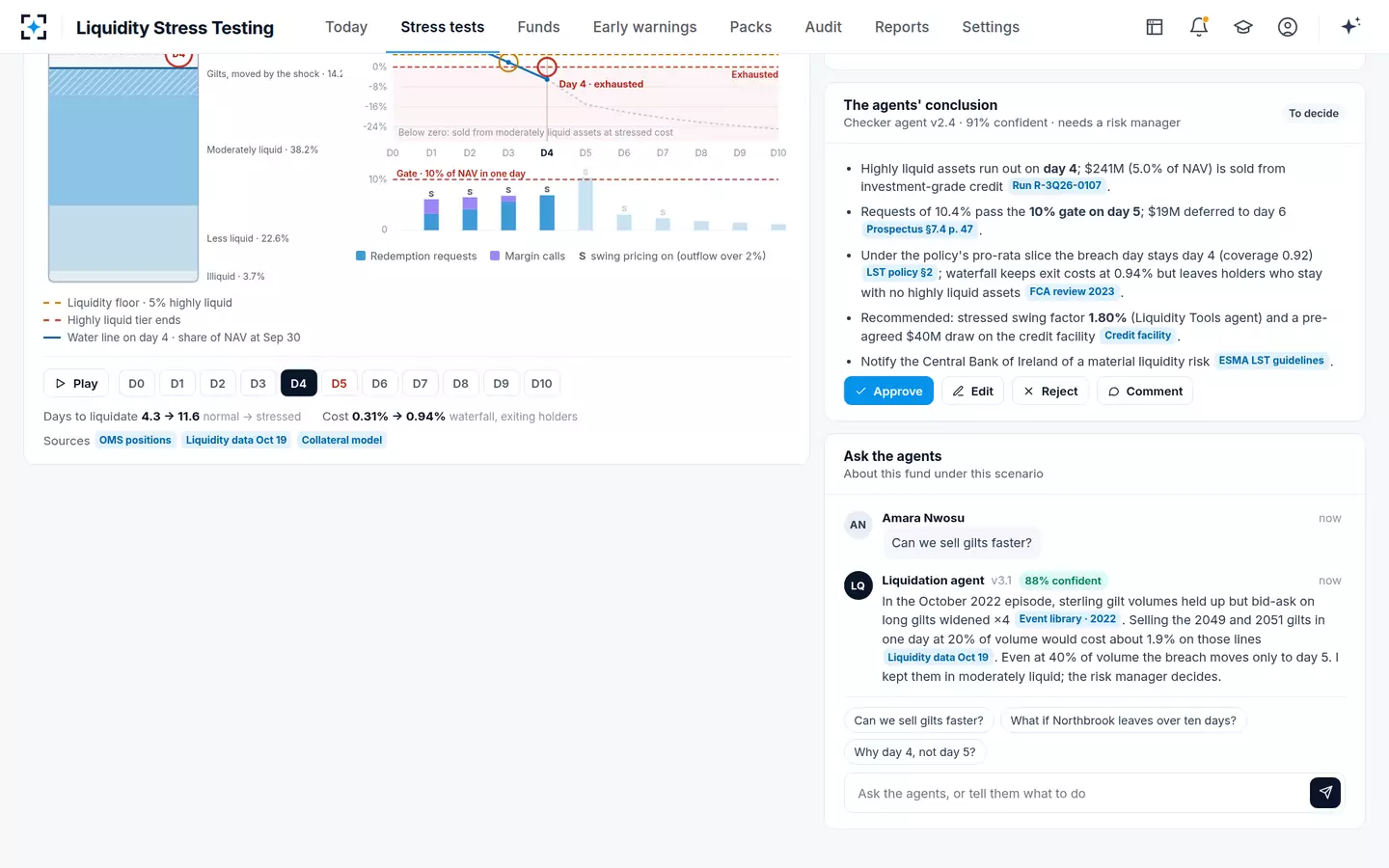
The answer to "can we sell gilts faster?" is a small reverse test of its own: at what speed would the breaking day move, and at what cost? Selling the 2049 and 2051 gilts in one day at 20% of volume would cost about 1.9% on those lines, and at 40% of volume the breaking day moves only to day 5. The risk manager keeps the gilts in the moderately liquid tier. To see the breaking day for each of your own funds, start from Liquidity Stress Testing.
Questions people ask
What does reverse stress testing mean for a fund?
It means defining the outcome the fund cannot survive, usually being unable to meet redemptions from liquid assets, and searching for the scenarios that would cause it. ESMA's definition for UCITS and AIFs uses exactly that outcome, "the point at which the fund would no longer be liquid enough to honour requests to redeem units".
Is reverse stress testing required for UCITS?
ESMA's guidelines, which apply to every UCITS, ask for reverse stress testing "where appropriate", alongside the historical and hypothetical scenarios every fund must run. Funds exposed to low-probability, high-impact risks "should pay particular regard" to it, and ESMA calls it "a particularly valuable tool" for funds in less liquid assets.
How is a reverse liquidity stress test different from a solvency one?
A liquidity reverse test asks when a fund runs out of assets it can sell without loss to pay what is due; a solvency reverse test asks when losses wipe out capital. Open-ended funds have no capital in the bank sense, so for them the liquidity question is the one that applies.
How severe should the breaking scenario be before anyone acts on it?
Severe enough to be informative and plausible enough to be believed, which is a judgement, not a formula. ESMA asks for scenarios "sufficiently severe but plausible"; a useful test is whether the risk manager can point to holders, history or a market event that make the breaking scenario possible, as the sample's register and the 2022 gilt shock do.
Does the order in which assets are sold change the breaking day?
Sometimes, but it changes the cost for the investors who stay far more often. On the sample fund, selling a pro rata slice of every holding and selling the most liquid assets first both break on day 4; the difference is that the most-liquid-first order leaves remaining holders with no highly liquid assets at all.