Liquidity stress testing in asset management is risk-function work, usually carried by an analyst, a liquidity risk manager and a head of liquidity risk reporting to the Chief Risk Officer, who design the scenarios, run every fund through them, challenge the results with portfolio managers and present them to a risk committee and the fund boards. The work has to sit outside portfolio management: ESMA's guidelines ask risk staff to act "independently from other functions such as portfolio management", and in the US the person administering a fund's liquidity program may not be solely its portfolio managers. What makes the job hard is not the arithmetic but the assembly: every quarter, positions, the transfer agent's register, market liquidity data, collateral and the prospectus terms of every fund must be stitched together before anyone can judge anything. Botminds' Liquidity Stress Testing gives that assembly to agents and leaves the analyst the parts that need a person: challenging, preparing and explaining.
The quarter described here is the solution's fictional sample: Quillfield Capital, 90 open-ended funds and about $412 billion, with a liquidity risk analyst in New York, a head of liquidity risk in London and a Chief Risk Officer who signs.
One quarter of liquidity stress testing at a 90-fund manager
20days
business days after quarter end: the sample manager's deadline for approved results
1,452runs
in the sample quarter: 78 funds pass, 9 on watch, 3 breach under stress
6.0days
Botminds' estimate of the assembly and checking work in one cycle by hand
1.0day
Botminds' estimate of the same work with the agents
What does a liquidity risk analyst do in asset management?
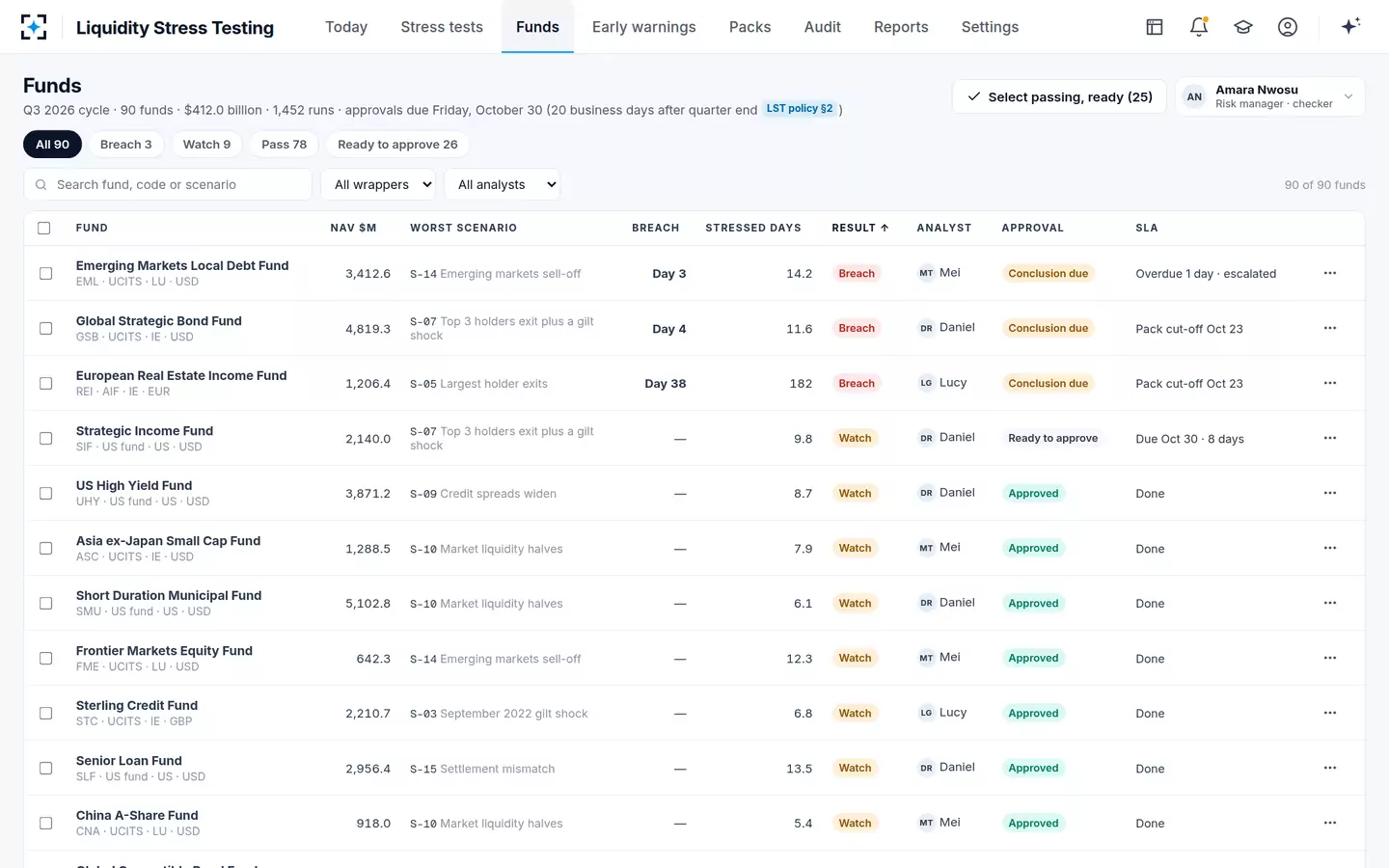
The analyst runs the quarterly cycle and prepares everything others decide on. In practice that means loading and checking the inputs, running every fund through every scenario, computing days to liquidate and the liability side, comparing results against each fund's limits and rulebook, recalibrating liquidity tools such as swing factors, and drafting the committee papers. Between quarters, the analyst watches for the triggers that call for an ad hoc test, such as a holder passing a concentration threshold or three days of heavy outflows.
The job sits in a governance structure that the regulators describe precisely. ESMA's guidelines ask for an LST policy that sets out "its internal ownership and which management function(s) is/are responsible for its performance", "a requirement for regular internal reporting of LST results specifying the frequency and recipients of the report", and the circumstances that must be escalated, a breached liquidity limit or threshold among them (ESMA34-39-897, paragraph 24). The analyst is the person who makes that policy happen every quarter.
A liquidity risk analyst's quarter, week by week
A quarterly cycle is roughly four weeks from quarter end to signed results, and the first of them goes almost entirely on data. The table describes a typical by-hand cycle at a multi-fund manager; the timeline after it shows Botminds' estimate of how much of that work is assembly and checking that agents can take.
A quarterly liquidity stress testing cycle, week by week
| Week | By hand | With the agents |
|---|---|---|
| Week 1 | Pull positions from the order management system, the register from the transfer agent, two market liquidity feeds, official NAVs and margin data; reconcile them fund by fund; chase late or stale feeds. | Inputs arrive overnight with their timestamps; stale data is flagged and a proxy is proposed for a person to approve. |
| Week 2 | Build redemption scenarios fund by fund; compute days to liquidate, margin calls and the credit line; run every fund through every scenario. | All funds run overnight; the analyst works a queue ordered by breaking day and deadline. |
| Week 3 | Check results against UCITS, AIFMD, Rule 22e-4 and each prospectus; recalibrate swing factors and other tools; argue sale order and classifications with portfolio managers. | A checking agent recomputes and cites the rule for each result; challenges are answered from the data beside the result. |
| Week 4 | Copy results into committee papers and board summaries; collect review and sign-off by email; draft any regulator notice. | Papers are drafted with every figure linked to its run; prepare, review and sign happen in sequence on one screen. |
Where six days of a quarter's assembly and checking go, by hand and with the agents
- Gathering data1.5 d
- Scenarios1 d
- Liquidity and margin1 d
- Rule checks0.75 d
- Tools0.5 d
- Papers, sign-off1.25 d
- All six1 d
The estimate puts the largest saving where the job is least skilled: pulling inputs together and building scenarios fund by fund. The smallest saving is in checking results against the rules and recalibrating tools, because both end in a person's judgement. That is the right shape for the role: an analyst whose first week is copying numbers is an analyst who has no time to challenge them. The sample analyst's own line about his old quarters was "I spend the first week of every quarter copying numbers."
The five numbers an analyst defends at committee
Whatever the model, a liquidity stress testing analyst ends the quarter defending a small set of numbers per fund, and each invites a different challenge. The sample bond fund's numbers show what a committee actually discusses.
Five numbers from one fund, and the question each one draws
| Number | The sample fund | The question it draws at committee |
|---|---|---|
| Breaking day | Day 4 under the approved scenario | Why not day 5? (Because the gilts move tier in a gilt shock.) |
| Coverage on the breaking day | 0.92 on the pro rata sale order | Is the shortfall large, or one day's timing? |
| Days to liquidate the whole fund | 4.3 normal, 11.6 stressed | Which holdings drive the difference? |
| Cost of liquidating | 0.31% normal, 1.74% stressed (pro rata) | Who pays it: leavers through the swing factor, or stayers? |
| Tool calibration | Swing factor 1.80% against a 2.00% maximum | Does it cover the stressed cost, and who approved it? |
The skill is in having the second answer ready. A portfolio manager who disputes the breaking day wants to know which assumption produced it; a Chief Risk Officer who signs wants to know that someone other than the analyst checked it. Both are easier when the numbers trace back to their runs and the runs to their inputs, which is most of what the agents' assembly buys the analyst.
Who approves liquidity stress test scenarios?
A risk manager senior to the analyst and independent of portfolio management, usually the head of liquidity risk. ESMA asks managers to control the conflict of "allowing other parties, such as portfolio management staff ... to exercise undue influence over the execution of LST, including reliance on judgements relating to asset liquidity" (paragraph 23), and to define "the role of senior management in the process, including the governing body (e.g. Board of Directors or Trustees)" in the LST policy (paragraph 24(a)).
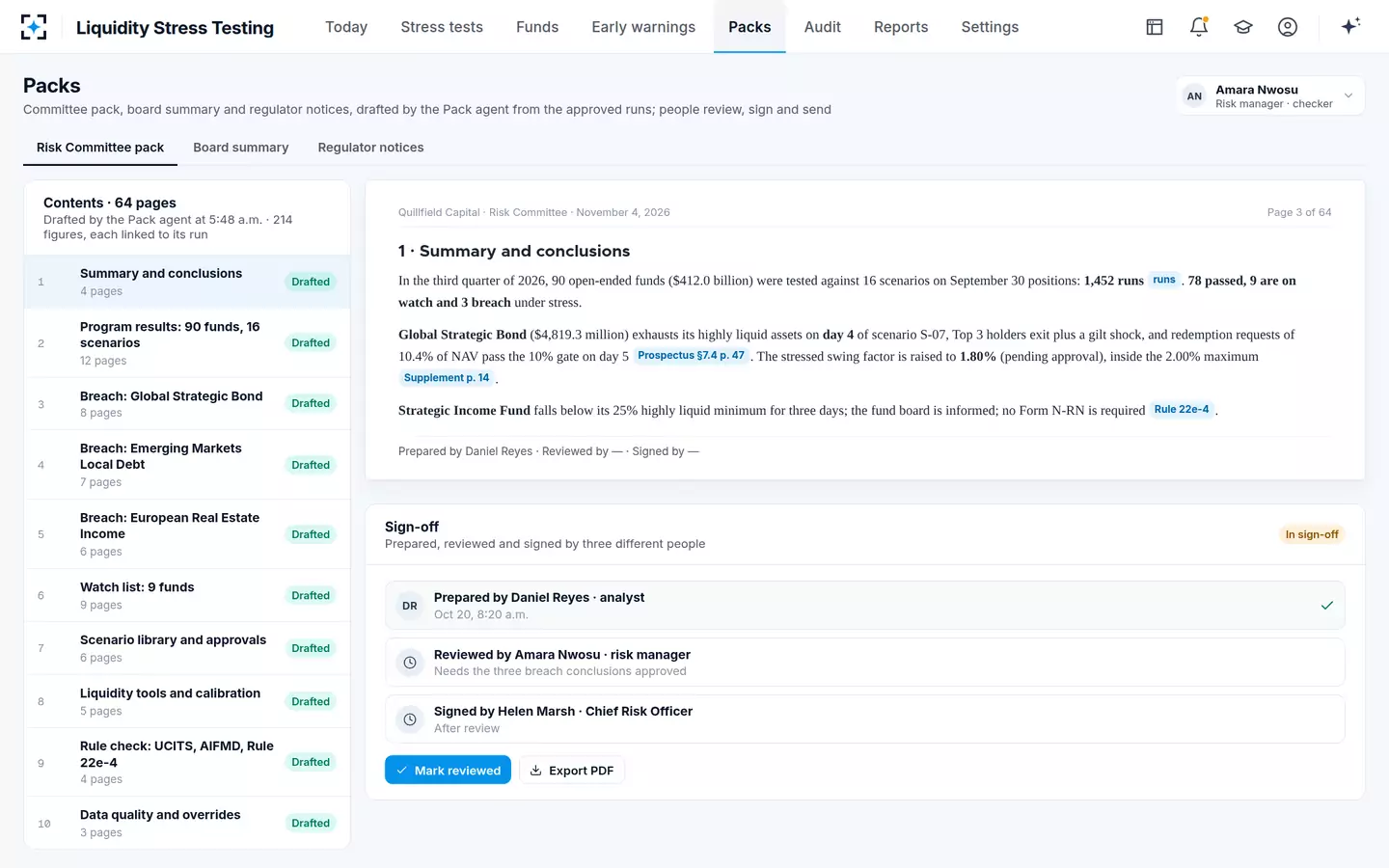
In the sample cycle, the head of liquidity risk approves every new or changed scenario, every breach conclusion, every override of an asset's liquidity and every change to a tool's threshold, each with a required reason. The analyst prepares; the system refuses to let anyone approve work they prepared themselves. How the scenarios she approves are built explains what she is judging.
Who signs off a fund liquidity stress test?
The Chief Risk Officer or the equivalent senior officer, then the board or the risk committee that the policy names. ESMA leaves the exact chain to each manager's LST policy but expects results to reach senior management and, where they reveal material risks, the regulator: managers tell their national regulator about material risks and what they are doing about them (paragraph 80; set beside the SEC's rule in liquidity stress testing requirements). For US funds, the board must review "no less frequently than annually, a written report prepared by the person(s) designated to administer the program" on its adequacy and effectiveness (17 CFR 270.22e-4(b)(2)(iii)).
Prepared, reviewed and signed: three people in Liquidity Stress Testing
What data does a liquidity stress test need?
Six kinds, from at least five systems, each with its own timetable and failure modes. The test is only as current as the stalest of them, which is why most of the analyst's first week goes on reconciliation.
The inputs to a fund liquidity stress test, and what goes wrong with each
| Input | Where it comes from | What goes wrong |
|---|---|---|
| Positions | Order management system | Trades booked late; positions in transit between custodians. |
| Holders and flows | Transfer agent register and flow history | Omnibus and nominee accounts hide the holders behind them; histories too short to include a stress. |
| Market liquidity | Market data vendors: volumes, bid-ask spreads, dealer quotes | Feeds late or missing for thinly traded bonds; one vendor relied on without a cross-check. |
| Net assets and share classes | Portfolio accounting and the fund administrator | Official NAV a day behind the positions file. |
| Margin, collateral and credit lines | Collateral system, custodian, fund administrator | Eligible collateral counted twice; a shared credit line assumed in full by every fund. |
| Terms and rules | Prospectuses, supplements, LST and liquidity tool policies | A threshold changed in a supplement but not in the spreadsheet. |
Regulators have found the weak point. In its 2020 review of UCITS liquidity management, ESMA reported that "in some cases, NCAs observed a widespread lack of data quality checks in a context of overreliance on very few data providers", and that managers had not built "robust and documented control processes, based on cross-checks and back-tests" (ESMA34-43-880, March 2021). In the sample quarter, one vendor's feed for 214 emerging-market local bonds arrived without prices; the agents applied a dealer-quote proxy covering 92% of them, and results on six funds stayed provisional until a person approved the proxy.
What skills does a liquidity stress testing analyst need?
Market microstructure, fund law and the nerve to disagree with a portfolio manager in writing. The checklist below is ours, built from what the regulators say good practice looks like.
Seven skills a liquidity stress testing analyst uses every quarter
- Reading market liquidity
Bid-ask spreads, volumes and participation rates, and why a portfolio cannot be assumed to sell at an asset's whole daily volume without evidence (ESMA, paragraph 39).
- Reading the register
Holder types, concentration and how each type has behaved in past stresses.
- Reading fund documents
Dealing terms, notice periods, redemption limits and swing factor maximums, page by page.
- Knowing three rulebooks
ESMA's guidelines and AIFMD for EU funds; Rule 22e-4 for US funds; the FCA's expectations in the UK.
- Modelling both sides
Redemptions and margin calls, collateral and credit lines, in the same daily model.
- Challenging, with evidence
The FCA lists "the willingness to challenge investment managers about their funds' liquidity" as good practice.
- Writing for a committee
Turning a breaking day into a decision a board can take, with every figure traceable.
Can a portfolio manager run the liquidity stress test?
Not as the person responsible for it. ESMA wants stress tests "performed under similar conditions to other risk management operations that are subject to regulatory requirements on independence, including the requirement for risk management staff to act independently from other functions such as portfolio management" (paragraph 21). Rule 22e-4 makes the program administrator the fund's adviser or officers, and the role may not be held by portfolio managers alone (17 CFR 270.22e-4(a); who signs a liquidity program).
Portfolio managers still have a role: they know their markets and should challenge the results. In the sample cycle, the bond fund's portfolio manager argued he could sell gilts in a day, even in 2022, and put the question to the agents beside the result; the answer, with 2022 market data, was that faster sales would move the breaking day by one day at most. He can read and comment on his own funds; he cannot approve them.
What regulators found about the work
Mostly that it varies widely in depth. The FCA's 2023 review of 14 firms found that "firms' approaches to stress testing methodologies varied from highly sophisticated in-depth models to basic tick-box exercises" (FCA, July 2023). It also found weak follow-through: "Where the funds repeatedly trigger in stress tests, we did not see sufficient follow-up actions within firms' governance."
Those findings describe the staffing a firm needs as much as the practice. A firm whose test is a tick-box exercise needs someone to fill in the boxes; a firm whose test is a model that changes decisions needs someone who can build, defend and challenge it. The difference between a model that passes and one that is right is where that second kind of analyst earns their place.
How the job changes when agents do the assembly
The roles stay, and the weeks change shape. Each person below does the same job as before; what moves is how much of their quarter goes on finding numbers rather than judging them.
Four people in a quarter of Liquidity Stress Testing, before and after
Today
Spends the first week of every quarter copying numbers between systems and spreadsheets.
With agents
Starts the cycle for all funds in one action, works the queue by breaking day and deadline, and prepares tool changes and committee papers.
Still theirs: Preparing every change; never approving it.
Today
Owns the quarterly cycle for 90 funds and argues with portfolio managers about sale order.
With agents
Opens each fund at its breaking day with the agents' account of every day and their sources.
Still theirs: Approving scenarios, conclusions, overrides and thresholds, each with a reason.
Today
"If it goes to the board, every number has to trace back."
With agents
Signs papers that a different person prepared and another reviewed, with every figure linked to its run.
Still theirs: Signing, and approving each regulator notice.
Today
"I can sell gilts in a day — even in 2022."
With agents
Reads his own funds' results and challenges them in plain words, with the evidence returned.
Still theirs: Comment, never approval.
The analyst's fund queue in Liquidity Stress Testing
How a fund's liquidity stress test differs from a bank's
A bank's liquidity risk team does a different job. Banks stress test their own funding, deposits and collateral under banking rules; fund managers stress test each fund's ability to pay its investors. The skills overlap, but the inputs, the rules and the people the results go to do not. To see how the fund version runs on your own range, start from Liquidity Stress Testing.
Questions people ask
How long does a quarterly liquidity stress testing cycle take?
No rule sets it. ESMA asks only that tests run at least annually and recommends quarterly; the deadline for results is each manager's choice. The fictional sample manager's policy gives 20 business days after quarter end, and Botminds estimates that about six working days of a by-hand cycle go on assembly and checking alone.
Which systems does a liquidity stress testing analyst work in?
Typically the order management system for positions, the transfer agent's register, one or two market liquidity data services, portfolio accounting for net assets, the collateral system, and the fund documents, plus whatever spreadsheet or model joins them. ESMA's 2020 review found too many managers relying on very few data providers without cross-checks.
Who checks the analyst's work?
A reviewer who did not prepare it, usually the head of liquidity risk, before the Chief Risk Officer signs. In the sample cycle a checking agent also recomputes every result, but it never settles a disagreement itself: below the solution's 85% confidence setting, a person decides.
Does the job differ between UCITS and US funds?
The method is similar; the rulebook is not. A UCITS analyst works to ESMA's guidelines and reports material risks to the regulator; a US analyst supports a Rule 22e-4 program built around monthly liquidity classification, a highly liquid minimum and the 15% illiquid limit, where stress testing is a tool rather than a requirement.
What does a head of liquidity risk own?
The quarterly cycle and its conclusions: approving scenarios, breach conclusions, overrides and tool thresholds, and arguing sale order and classifications with portfolio managers. The sample head of liquidity risk's own summary of the job is "Tell me the day it breaks, and show me why."