Swing pricing is a way of pricing an open-ended fund so that investors who buy or sell on a day of large net flows pay the cost of the trading their orders cause. On a day of net redemptions the fund's net asset value per share is adjusted down by a "swing factor" that reflects the cost of selling assets; on a day of net subscriptions it is adjusted up. Without it, a redeeming investor receives the unadjusted price and the fund pays the spreads, market impact and fees of raising the cash, a cost that lands on the investors who stay. Swing pricing is one of the anti-dilution tools EU funds must now consider, and it has been allowed for US mutual funds since 2018, though the SEC reported in 2022 that no US fund had implemented it. Botminds' Liquidity Stress Testing calibrates a stressed swing factor for each fund from the same liquidity data its stress test uses, and sends any change through two people before it reaches the fund administrator.
The figures in the worked example come from the solution's fictional sample fund, Quillfield Global Strategic Bond Fund, a $4.8 billion Irish UCITS that pays out $1,436 million over the five days of its approved stress scenario.
Who bears the $25.8 million cost of meeting $1,436 million of stressed redemptions
No anti-dilution tool
- Investors who stay · 100%
Today's 0.45% swing factor
- Investors who leave ($6.5M) · 25%
- Investors who stay ($19.4M) · 75%
Stressed 1.80% swing factor
- Investors who leave · 100%
How does swing pricing work?
The fund compares each dealing day's redemptions with its subscriptions and, if the difference is large enough, moves the price for everyone dealing that day. The EU's 2026 regulation on liquidity management tools describes the two variants: a fund may swing "where there is a difference between the redemption orders and the subscription orders ('full swing') or where the difference exceeds a predefined activation threshold ('partial swing')". On net redemptions, "the swing factor shall be deducted from the net asset value"; on net subscriptions, it is added (Delegated Regulation (EU) 2026/466, Art. 5).
The US version, available since 19 November 2018, reads the same way in different words: a fund "may use swing pricing to adjust its current net asset value per share to mitigate dilution of the value of its outstanding redeemable securities as a result of shareholder purchase or redemption activity", with a factor applied "once the level of net purchases into or net redemptions from such fund has exceeded the applicable swing threshold" (17 CFR 270.22c-1(a)(3)). Money market funds and exchange-traded funds are excluded.
The sample bond fund uses partial swing pricing with a threshold of net flows above 2.0% of net assets. On an ordinary day the factor is 0.45%. In the stress scenario, net outflows pass the threshold on each of days 1 to 5, so the factor applies every day, and the question becomes whether 0.45% still covers what the fund pays to sell.
Who pays when a fund has no anti-dilution tool?
The investors who stay. When a fund meets redemptions at an unadjusted price, it sells assets at a cost, the bid-ask spread, the price impact of its own selling, broker fees and taxes, and that cost reduces the value of every remaining share. The Financial Stability Board's 2023 recommendations put the principle bluntly: anti-dilution tools "should impose on redeeming investors the explicit and implicit costs of redemptions, including any significant market impact of asset sales to meet those redemptions" (FSB, Recommendation 5).
The sample fund makes the sum concrete. Over the five stressed days it pays out $1,436 million. At the stressed cost of 1.80%, meeting those redemptions costs about $25.8 million. With no swing, all of it falls on the investors who stay. At today's 0.45% factor, leavers pay about $6.5 million and remaining investors about $19.4 million. Only at a stressed factor of 1.80% do the investors who leave pay for their own exit.
There is a second cost, which the research calls first-mover advantage. If leavers get a better price than stayers, the incentive in a stress is to leave first, and that adds to the outflows a stress test must survive. Capponi, Glasserman and Weber show that "properly designed swing pricing transfers liquidation costs from the fund to redeeming investors and, by removing the nonlinearity stemming from the first-mover advantage, it reduces these costs and prevents fund failure", but that "Achieving these objectives requires a larger swing factor at larger levels of outflows" (Management Science, 2020). A factor set once for ordinary days is the wrong factor for the days that matter.
How is a swing factor calibrated?
From the estimated cost of trading to meet the day's net flow: the explicit costs, such as brokerage, taxes and settlement fees, plus, where appropriate to the strategy, the implicit costs of the bid-ask spread and market impact. The EU regulation requires the factor to "include the estimated explicit transaction costs" and, where appropriate, "the implicit transaction costs ... including any significant market impact of asset purchases or sales", estimated "on a best effort basis" (Art. 5(1)). ESMA's guidelines add the basis: the estimate should start from "costs associated with transacting a pro-rata slice of all assets in the portfolio (i.e. 'pro-rata approach')", and managers "may consider using the pro-rata cost in stressed times, when it is most relevant for mitigating the potential dilution impact on the remaining investors" (ESMA34-671404336-1364, paragraph 37).
The sample fund's stressed swing factor, term by term
| Term | Value | Where it comes from |
|---|---|---|
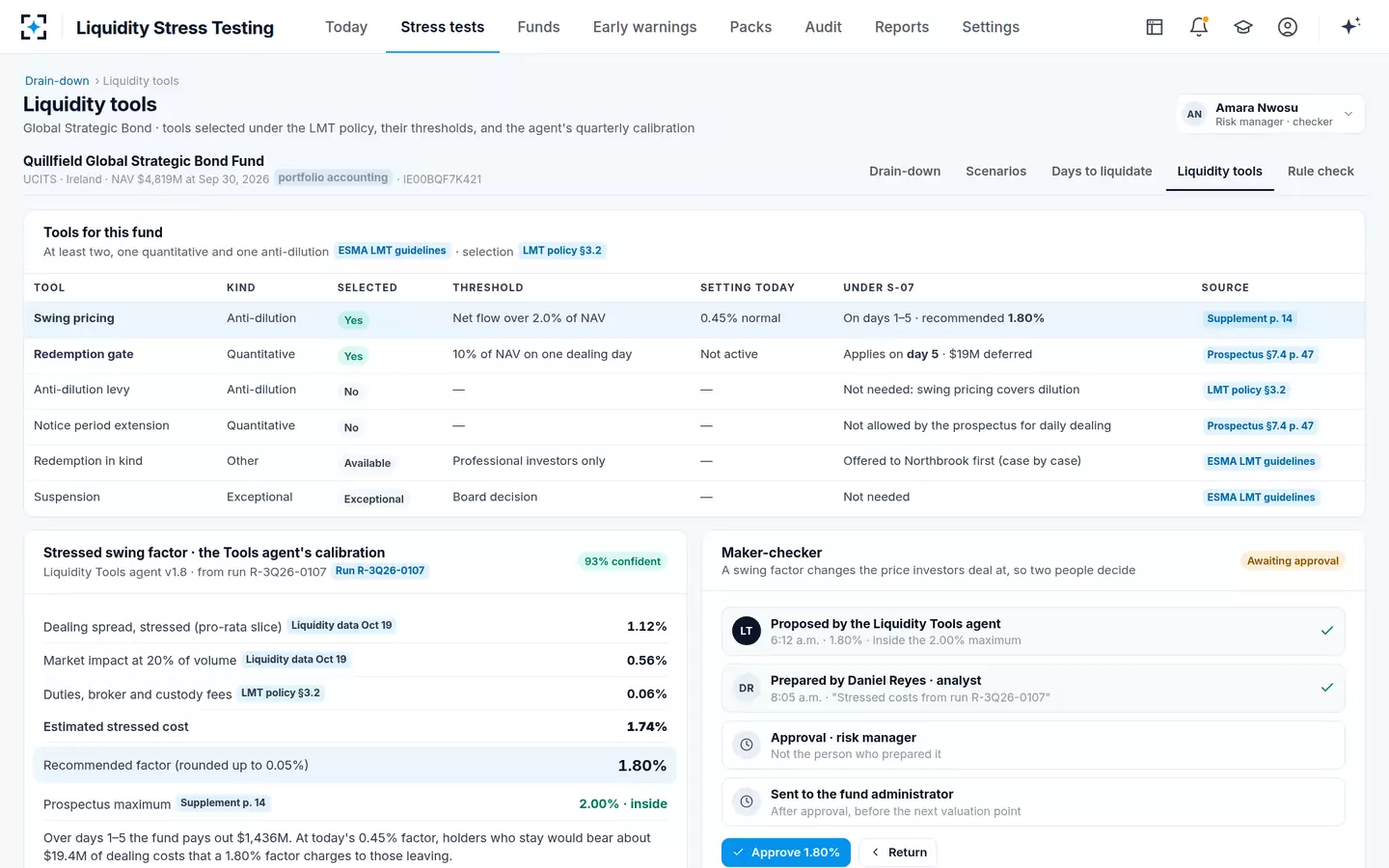
| Dealing spread, stressed | 1.12% | Stressed bid-ask on a pro rata slice of the portfolio, from the market liquidity feed of 19 October. |
| Market impact | 0.56% | The price impact of selling at 20% of daily volume, the policy's participation rate. |
| Duties, broker and custody fees | 0.06% | From the fund's liquidity tool policy. |
| Estimated stressed cost | 1.74% | The sum of the three, computed by the liquidity tools agent. |
| Recommended factor | 1.80% | Rounded up to the next 0.10%, inside the supplement's 2.00% maximum; an analyst prepares it and a risk manager approves it. |
ESMA also asks managers to calibrate "based on market conditions" and to "ensure that the estimated cost of liquidity, in light of the market conditions ... is incorporated in the swing factor, including, where appropriate, any significant market impact of the trades" (paragraphs 43–44). That is where the stress test and the swing factor meet: the spreads, volumes and participation rate that decide a fund's breaking day are the same inputs that decide what leavers should pay. Calibrating the two from different data invites a fund that looks liquid in one report and cheap to leave in another. The participation and spread assumptions do double duty.
Anti-dilution levy vs swing pricing
Both make leavers pay, but a levy charges the investors who trade, while swing pricing moves the price everyone dealing that day receives. The EU now recognises four anti-dilution tools, and ESMA's guidelines say which kind of fund each suits.
Swing pricing, dual pricing, the anti-dilution levy and the redemption fee compared
| Tool | How it works | Who pays | ESMA says it suits |
|---|---|---|---|
| Swing pricing | The NAV per share moves by a swing factor on days of net flows (always, or above a threshold). | Everyone dealing on the side of the net flow that day. | Funds whose assets are "actively traded and information on trading costs (bid/ask) is available and frequently updated". |
| Dual pricing | Separate prices for buying and selling, or one NAV with an adjustable spread around it. | Every buyer and seller, every day. | Funds whose liquidity costs "are reflected primarily by a bid-ask spread". |
| Anti-dilution levy | A fee charged to the dealing investor on net redemptions or net subscriptions, paid into the fund. | Investors trading on the side of the net flow. | Funds "with a high investor concentration", heavy dealing, or less liquid holdings such as high yield bonds and small caps. |
| Redemption fee | A fee within a predetermined range paid to the fund by redeeming investors. | Redeeming investors. | Assets with "fixed, transparent and/or foreseeable transaction costs", or where swing pricing is hard to apply. |
The practical difference is fairness and timing. Swing pricing makes the price itself reflect the day's net flow, so an investor who buys on a heavy redemption day buys cheap; a levy leaves the price alone and charges only the investors on the side that causes the cost. ESMA says managers "should calibrate ADL based on the same factors used to calibrate swing factors", so the evidence a fund needs is the same either way: an estimate of what it costs to trade, by day and by stress (paragraph 52). The EU's two-tool rule means most funds will pair one of these with a tool that limits how much can leave.
Does swing pricing work? What the research found
In normal markets, the evidence says yes; in stress, it depends on whether the factor is large enough. The strongest evidence comes from UK corporate bond funds, where Jin, Kacperczyk, Kahraman and Suntheim used investor-level transactions and found that swing pricing "eliminates the first-mover advantage arising from the traditional pricing rule and significantly reduces outflows during market stress" (Review of Financial Studies, 2022).
"Swing pricing also reduces concavity in the flow-performance relationship and dilution in fund performance."
Jin, Kacperczyk, Kahraman and Suntheim, 'Swing Pricing and Fragility in Open-End Mutual Funds', Review of Financial Studies (2022)
A Bank for International Settlements study of Luxembourg and US bond funds was more cautious. Lewrick and Schanz found that "swing pricing dampens outflows in reaction to weak fund performance, but has a limited effect during stress episodes", and that it "may lead to lower cash buffers"; in the 2013 taper tantrum they found no dampening effect, and suggested that "funds do not use the tool enough to discourage withdrawals during times of stress" (BIS Working Paper No. 664, 2017). Read together with Capponi, Glasserman and Weber's result, the studies point the same way: swing pricing protects investors when the factor reflects the stressed cost of trading, and much less when it does not.
Can US mutual funds use swing pricing?
Yes, since 19 November 2018, but in practice none had by 2022. Rule 22c-1 permits it for registered open-end funds other than money market funds and ETFs, with an upper limit on the factor that "may not exceed two percent of net asset value per share" (17 CFR 270.22c-1(a)(3); adopting release, effective 19 November 2018). In its 2022 proposal, the SEC wrote: "In the time since the adoption of the rule, no U.S. funds have implemented swing pricing", while "swing pricing has been a commonly employed anti-dilution tool in Europe, including among U.S.-based fund managers that also operate funds in Europe" (87 FR 77172, proposed November 2022). One reason it gave: funds "lack timely flow information to operationalize this anti-dilution tool". As the proposal explains, many orders reach a US fund through intermediaries, netted, and some only after the intermediary has received the fund's final price.
Swing pricing in the US: allowed, proposed as mandatory, not adopted
Nov 2018
19 November 2018: optional swing pricing becomes available to US open-end funds under Rule 22c-1
2%
of NAV per share: the US upper limit on a swing factor
Nov 2022
the SEC proposes mandatory swing pricing and a hard close for most open-end funds
Aug 2024
the SEC adopts reporting changes but not the underlying swing pricing rule
The 2022 proposal would have required swing pricing for most open-end funds and a "hard close", so that orders reach the fund before the pricing time. In August 2024 the SEC adopted other parts of the package, published that September, and said: "We also are not adopting proposed reporting amendments relating to funds' use of swing pricing or to liquidity classifications in this release, as we are not adopting amendments to the underlying rules at this time" (89 FR 73764). The proposal was not among those the SEC formally withdrew in June 2025, and the SEC's own rulemaking page for the file lists no later action on it (SEC, file S7-26-22). For a US fund today, swing pricing is permitted, optional and rare.
The maximum swing factor, and what happens above it
Most funds publish a maximum, and a stressed cost can exceed it. ESMA's guidelines allow this: "Fund managers may set a maximum swing factor. In case the swing factor adjustment goes beyond the maximum swing factor, the fund manager should be able to justify, if required by the competent authority, on an ex-post basis the swing factor applied", and any decision "to recalibrate the maximum swing factor" must be "justified and made in the best interest of the investors" (paragraphs 45–46). In the US the 2% cap is in the rule itself.
The sample fund's stressed factor of 1.80% sits inside its supplement's 2.00% maximum, so the question does not arise this quarter. If it had, the solution's liquidity tools agent would not recommend beyond the prospectus maximum: it flags the gap, and the decision, whether to go above it with an ex post justification where the rules allow, to change the documents, or to rely on another tool, stays with people. That gap is also a stress test finding, because it means part of the cost of a run would fall on the investors who stay.
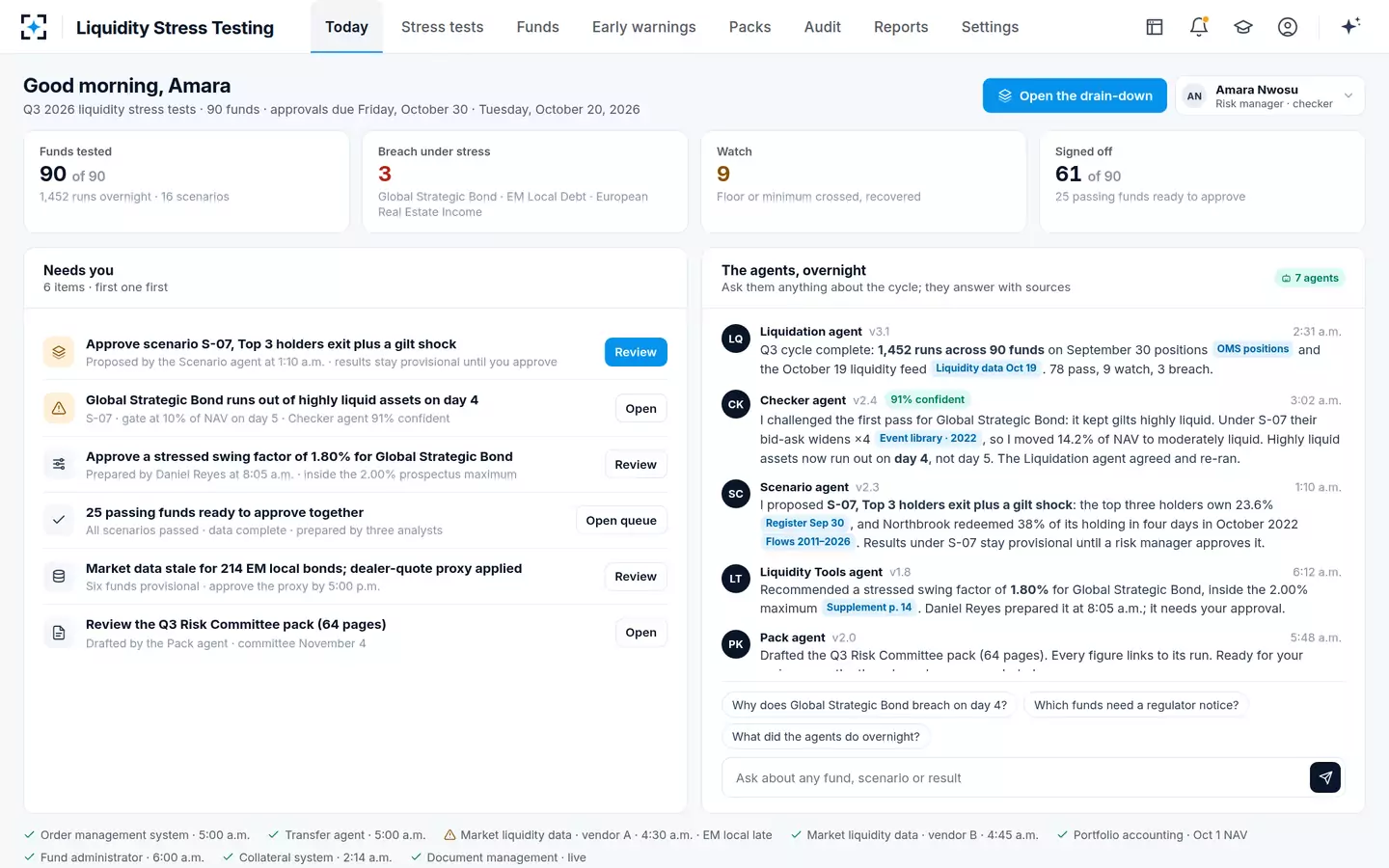
A stressed swing factor waiting for the risk manager on the Today screen of Liquidity Stress Testing
What the FCA found in swing pricing practice
That many factors were set once and left alone. The FCA's 2023 review found that "Thresholds for volumes of redemption orders to trigger the use of swing pricing in fund ranges were often the same across all funds, notwithstanding their different underlying asset classes", that thresholds and pricing "in other firms were never changed", and "a potential over-reliance on the third-party administrators for swing price calculations, and an absence of any back testing with respect to the firm's own executed prices" (FCA, July 2023).
Its good practice is a calibration method in four lines: thresholds and adjustments set "on a fund-by-fund basis, rather than via a one-size-fits-all approach"; "Market impact cost is incorporated into the methodology for calculating the swing factor"; "Back testing is performed using the firm's own executed prices"; and swing pricing changes reported to the board. Each of those is cheaper to do when the stress test already holds the spreads, volumes and executed prices the calibration needs.
Recalibrating the swing factor each quarter, with two people
A swing factor changes the price every dealing investor receives, so changing it should take two people. In Botminds' Liquidity Stress Testing, the liquidity tools agent proposes a stressed factor with its arithmetic and sources each quarter; an analyst prepares the change; a different person, the risk manager, approves it; and only then does it go to the fund administrator, before the next valuation point. The agent never changes a factor or activates a tool itself.
The swing factor calibration and its maker-checker chain in Liquidity Stress Testing
The same evidence answers the FCA's back-testing point. Because the stress test and the calibration share their inputs, the factor applied on any day can be compared afterwards with what the desk actually paid to sell, and the next quarter's factor adjusted. To recalibrate your own funds' factors from their stressed costs, start from Liquidity Stress Testing; the breaking-day analysis shows what the factor does and does not change in a run.
Questions people ask
What is the definition of swing pricing?
In EU law, swing pricing is "a pre-determined mechanism by which the net asset value of the units or shares of an investment fund is adjusted by the application of a factor ("swing factor") that reflects the cost of liquidity". In the US, Rule 22c-1 lets a fund adjust its NAV per share to mitigate dilution from shareholder purchases or redemptions, within a 2% cap.
What is an anti-dilution levy?
It is a fee paid into the fund by an investor who subscribes or redeems on a day of net flows in the same direction, to cover the cost of liquidity their dealing causes. Under the EU regulation it is deducted from the amount paid to redeeming investors on net redemption days and charged to subscribers on net subscription days.
What is the difference between swing pricing and dual pricing?
Swing pricing moves a single NAV up or down depending on the day's net flow; dual pricing quotes different prices for buyers and sellers, either as two NAVs built from ask and bid prices or as a spread around one NAV. ESMA suggests dual pricing for funds whose liquidity costs are mainly the bid-ask spread.
What is a swing threshold?
It is the level of net flows, usually a percentage of net assets, above which a partial swing applies. The sample fund's threshold is net flows above 2.0% of net assets; ESMA asks managers to set thresholds in advance and review them, taking account of investor profile, liquidity profile and historical fund flows.
Does swing pricing affect a fund's reported performance?
It can, in both directions. Swinging the NAV adds volatility to daily prices, which the BIS study noted as "raising accounting volatility", while protecting long-term returns from dilution, which Jin and co-authors found reduced "dilution in fund performance" in UK bond funds.