To automate stress testing for a range of open-ended funds, move the liquidity stress test from the calendar to events. A quarterly run answers last quarter's question; the risks that break funds arrive between quarters, as a large holder's stake grows, as small redemptions add up over a few days, or as a market's volumes dry up. ESMA's guidelines already expect an ad hoc test "as soon as practicable" when a material liquidity risk appears, and the FCA's good practice is a written playbook of actions "to be followed when liquidity stress testing triggers are activated". What automation adds is the watching: checking every fund's register, flows, data and credit line every morning, and starting a test the moment a trigger fires. What it must not take away is the judgement. Botminds' Liquidity Stress Testing runs the quarter overnight, watches for triggers between quarters and starts ad hoc tests on its own, while scenario approval, tool changes, regulator notices and signatures stay with named people.
This guide is about liquidity: redemptions, holders and the tools that answer them. Running market-risk scenarios across portfolios is a different purchase, covered in portfolio stress testing software.
One month between quarter ends at a 90-fund manager
11
early warnings raised by the agents in the month
4
ad hoc stress tests run on a trigger, outside the quarterly cycle
4
warnings still open for a person to act on
1
escalated to the Chief Risk Officer
How often should a fund run a liquidity stress test?
Quarterly as a default under ESMA's guidelines, more often for funds whose liabilities or assets make them fragile, and immediately when a material risk appears. ESMA recommends quarterly testing unless a fund's characteristics justify otherwise, lists a concentrated investor base, a less liquid asset base and a forthcoming event among the factors that increase frequency, and adds a separate line for tests outside the calendar: "Ad-hoc LST should be undertaken as soon as practicable if a material risk to fund liquidity is identified by the manager and requires being addressed in a timely manner" (ESMA34-39-897, paragraph 27).
For funds in less liquid assets ESMA is more specific still: a manager could "prioritise undertaking ad-hoc LST on funds investing in less liquid assets where a forthcoming event has been identified which could negatively impact fund liquidity" (paragraph 65). The guidelines therefore already describe a trigger-driven practice; the calendar is the floor, not the method. The requirements by jurisdiction set out the floors.
Quarterly calendar vs trigger-driven runs over one stressed month
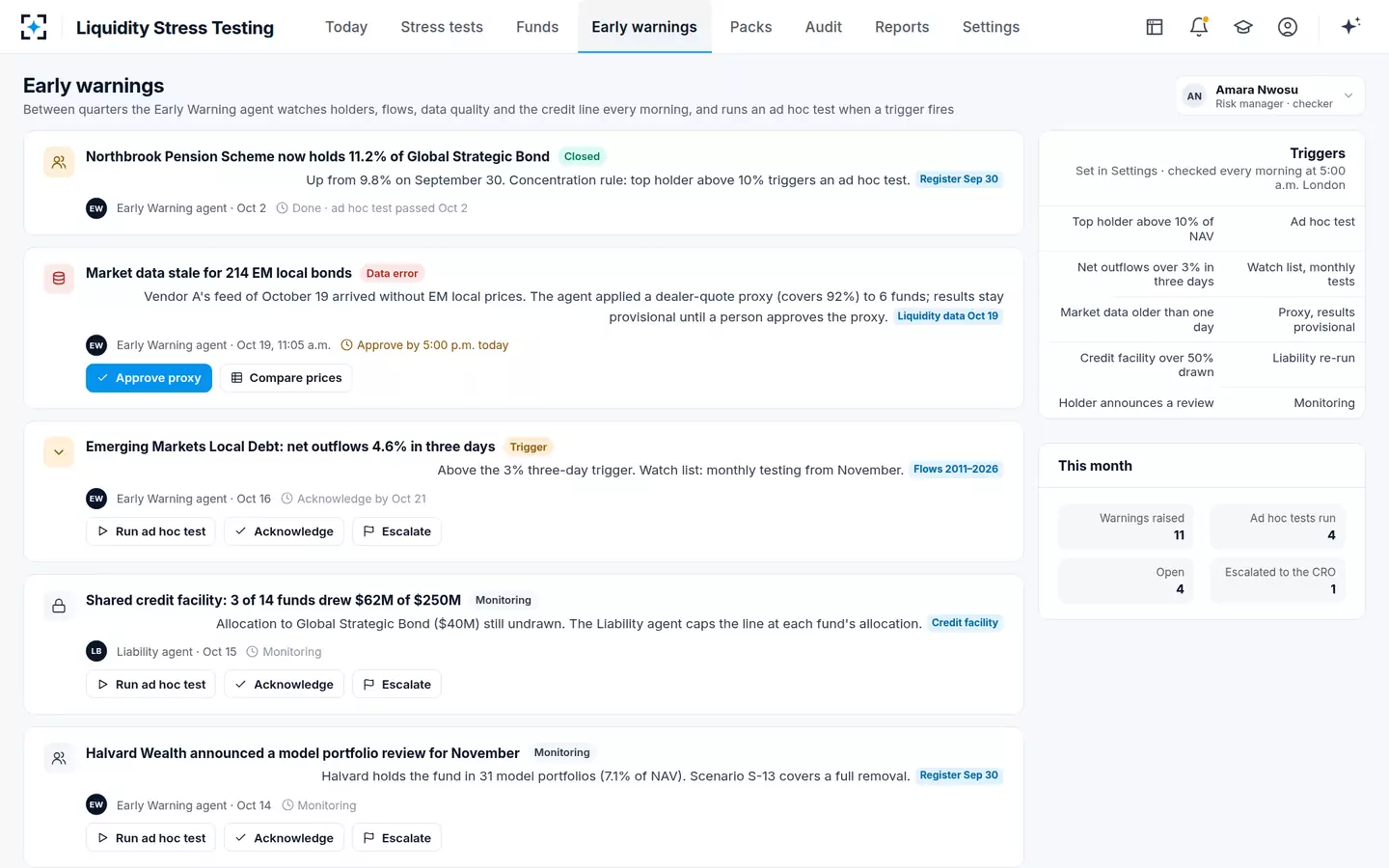
The difference shows best in one month. The sample manager's October 2026 brought a concentration change, an outflow build-up, a data failure and a strategic review by a large holder, all between quarter ends.
October at the sample manager: what a quarterly calendar sees, and what triggers see
Quarterly calendar only: Noticed at the next quarterly run, if the register extract is current.
Trigger-driven, in Liquidity Stress Testing: The 10% concentration trigger starts an ad hoc test the same day; the fund passes.
Quarterly calendar only: Not in any model.
Trigger-driven, in Liquidity Stress Testing: Logged and monitored; a scenario covering a full removal already sits in the library.
Quarterly calendar only: Seen in flow reports; the next test is at quarter end.
Trigger-driven, in Liquidity Stress Testing: The 3% three-day trigger puts the fund on the watch list, with monthly testing from November and an ad hoc test offered to the analyst.
Quarterly calendar only: Prices rolled forward by hand, often silently.
Trigger-driven, in Liquidity Stress Testing: A dealer-quote proxy is proposed; six funds' results stay provisional until a person approves it.
None of the four events is dramatic on its own, which is why calendars miss them. Together they are the build-up that a quarter-end test would meet only as a result. The FCA saw the same gap in practice: "Many firms only had a trigger for enhanced governance at a large redemption threshold. Few firms presented any system or tools to observe and monitor cumulative trends of small redemptions, and their effect on portfolio composition and thus liquidity" (FCA, July 2023).
What triggers an off-cycle liquidity stress test?
Anything that changes either side of the fund's balance sheet faster than the calendar can follow: concentration, cumulative outflows, data quality, funding and known future events. ESMA points to the mechanism in its section on combined testing: "In cases where fund scores/metrics change materially in a given timeframe, combined asset and liability LST can assist in the set-up of an alert system to assess whether action on a fund's liquidity is required" (paragraph 71).
The sample manager's triggers, and what each one starts
| Trigger | Checked | What it starts |
|---|---|---|
| A single holder above 10% of a fund | Every morning, from the register | An ad hoc stress test of that fund |
| Net outflows above 3% of net assets in three days | Every morning, from daily flows | Watch list and monthly testing; an ad hoc test offered |
| Market data older than one day | Every morning, per feed and asset class | A proxy proposed; affected results provisional until a person approves |
| A shared credit facility more than 50% drawn | Every morning, from the administrator | A re-run of the liability side for every fund sharing it |
| A large holder announces a review | When known | Monitoring, with the matching scenario checked |
Early warnings between quarters in Liquidity Stress Testing
What is a liquidity playbook?
It is the written answer to "what happens when a trigger fires": who is told, who decides, which governance steps speed up and which tools may be considered. The FCA listed it among the good practices of its 2023 review.
"Creation of a liquidity 'playbook' outlining governance actions and escalations to be followed when liquidity stress testing triggers are activated, and in preparation for various market scenarios."
FCA, Liquidity Management multi-firm review, good practice on governance
The same review found the opposite in many firms: "In many cases, liquidity risks were flagged only on an exceptions basis", and "Some firms did not have processes in place to accelerate governance in times of stress." It counted as good practice "Established and documented protocols for escalating issues and increasing governance frequency during volatile market conditions". ESMA frames the purpose the same way: stress testing "should assist a manager in preparing a fund for a crisis, and in its broader contingency planning" (paragraph 29). Automation makes a playbook executable: each trigger is a setting, each action is a step with a named owner, and every firing leaves a trace.
Can liquidity stress testing run daily?
The watching can; the full test usually should not. Checking concentration, flows, data freshness and credit line use every morning is cheap and catches the events that matter. Running every fund through every scenario every day would mostly re-confirm yesterday's results while flooding reviewers with provisional numbers. The sample manager runs the full library quarterly, monthly for any fund on the watch list, and an ad hoc test whenever a trigger fires, which in October meant four tests on top of the calendar.
Daily data also raises the stakes on data quality. A feed that fails on a Monday morning should not produce a confident Monday result. In the solution, results on stale market data stay provisional until a person approves the proxy, however confident the agent is, so a faster test never quietly becomes a less reliable one. The assumptions that should always stop an automated run are set out in full.
The US parallel: reviews triggered by market changes
US rules reach a similar place by a different road. Rule 22e-4 does not require a liquidity stress test, but it does require a fund to review its liquidity classifications "at least monthly in connection with reporting the liquidity classification for each portfolio investment on Form N-PORT", "and more frequently if changes in relevant market, trading, and investment-specific considerations are reasonably expected to materially affect one or more of its investments' classifications" (17 CFR 270.22e-4(b)(1)(ii)). That second clause is a trigger rule: a market event, not the calendar, decides when the review happens.
A fund group running both regimes can use one set of triggers for both. The same morning check that starts an ad hoc stress test for a UCITS when gilt spreads widen can flag a US fund's gilt holdings for an intra-month classification review, and the same audit trail shows when each was done and by whom. Liquidity Risk Management Program covers the classification side of that work in full; the mutual fund liquidity rule in 2026 sets out when an intra-month review is due.
What must a person still approve?
Everything that changes what investors receive or what a regulator is told: scenarios before their results count, breach conclusions, overrides of an asset's liquidity, any change to a liquidity tool's threshold or swing factor, regulator notices and the committee papers. Regulators have been explicit that tools do not move responsibility. ESMA's 2024 statement on AI in investment services keeps the responsibility for every decision with the firm's management body, whether a person or an AI tool takes it (ESMA, 30 May 2024). The SEC's examination priorities for fiscal 2027 describe registrants bringing what the SEC calls "super intelligence (SI)" into their businesses, compliance monitoring included (SEC Division of Examinations, October 2026).
An ad hoc test in Liquidity Stress Testing, from trigger to signature
Agent
Early warning agentChecks register concentration, flows, data quality and credit line use every morning; when a trigger fires, prepares an ad hoc test.
Never: Starts an ad hoc test without telling the analyst.
Agent
Scenario, liquidation and liability agentsRun the affected fund, or every fund sharing a credit line, through the approved scenarios and any proposed variant.
Never: Activate a new scenario: proposals stay provisional.
Agent
Checker agentRecomputes the result and checks it against the fund's rulebook and documents.
Never: Settles a disagreement itself; below 85% confidence a person decides.
A person decides
AnalystReviews the result, prepares any tool change or notice, and escalates under the playbook.
A person decides
Head of liquidity risk, then Chief Risk OfficerThe head of liquidity risk approves new scenarios, breach conclusions, overrides and tool thresholds, each with a reason; the Chief Risk Officer signs the committee papers and approves any notice to a regulator.
Aggregating across funds: one market, many sellers
Automated triggers work fund by fund, but the worst liquidity events hit many funds at once. ESMA asks managers to aggregate stress tests across funds "where it assesses such an activity to be appropriate", noting it "may be useful when considering the ability of a less liquid market to absorb asset sales were they to occur concurrently in funds operated by the manager" (paragraphs 72–73). The FSB went further and asked authorities to consider system-wide testing of "collective selling by funds and other investors" (FSB, Recommendation 9).
The Bank of England's 2024 exercise showed why. It found that the sterling corporate bond market "could face a 'jump to illiquidity' in stress, whereby the speed of selling pressures significantly exceeds purchasing capacity and prices need to fall rapidly for the market to clear" (Bank of England, November 2024). For a manager, the internal version is a shared credit line or a market in which several of its own funds hold the same bonds. The sample manager's trigger on its $250 million facility, shared by 14 funds, re-runs the liability side of every fund on the line when it passes 50% drawn, because the line one fund relies on is the line its siblings will draw on the same day.
What automation does not fix
Three things, and a buyer should hear them before signing. First, data: automation runs on the register, the flows and the market data you have, and makes their gaps visible faster but does not fill them. ESMA's 2020 review of UCITS managers found data quality checks missing in some cases, and no amount of scheduling cures that. Second, policy: triggers and thresholds are judgements about the firm's risk appetite, and a badly set trigger fires too often to be read or too late to help. Third, follow-through: the FCA found too little follow-up in firms' governance when funds triggered in stress tests again and again. A trigger that fires into an inbox nobody owns is an alert, not a control.
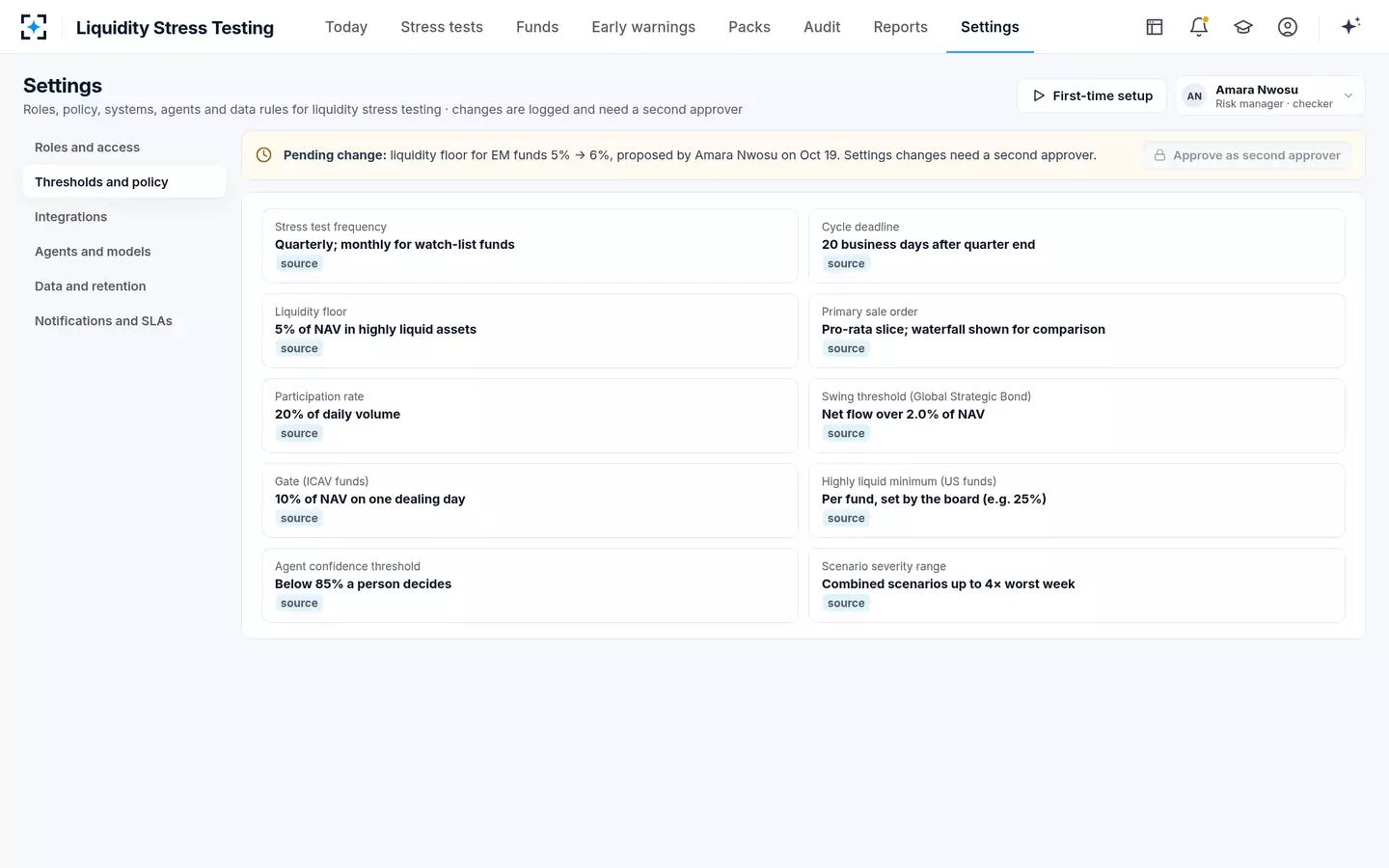
Triggers, thresholds and second approvers as settings in Liquidity Stress Testing
Buying automated liquidity stress testing: what to ask
Ask how the system watches, what it is allowed to start on its own, and how a person stops or overrides it. The checklist is ours; it applies to any product, including ours.
Nine questions to ask before you automate a fund liquidity stress test
- Which triggers can it watch, and how often?
Concentration, cumulative flows, data freshness, credit line use and known events, at least daily.
- Who sets the triggers, and how are changes approved?
Thresholds should be settings with a second approver and a change history.
- What does it do when a trigger fires?
An ad hoc test, a watch-list change, a notification: and does it tell the analyst first?
- What can it never do?
Activate a scenario, a liquidity tool or a swing factor change; send a notice; sign.
- How does it treat stale or missing data?
Results should stay provisional until a person approves a proxy.
- Does it aggregate across funds?
Shared credit lines and common holdings should trigger re-runs of every fund affected.
- Can every automated result be traced?
To its trigger, inputs, agent versions and the people who approved what followed.
- How does it fit your calendar?
The quarterly cycle, watch-list frequency and committee dates should be settings, not code.
- What does go-live need from you?
Your LST and liquidity tool policies, prospectuses, and a past quarter of positions and register data.
Botminds' Liquidity Stress Testing answers each of those in the same way: seven agents run the quarter overnight, watch for triggers every morning and start ad hoc tests, while the analyst prepares, the risk manager approves with a reason and the Chief Risk Officer signs. It does not replace your data vendors or your policy, and it does not act on a fund's behalf. To see it on your own funds, start from Liquidity Stress Testing; a pilot that replays last quarter is the usual first step.
Questions people ask
Is this the same as automated stress testing of software?
No. In software engineering, automated stress testing means loading an application until it fails. In fund management, a liquidity stress test checks whether a fund can meet redemptions and other cash calls under severe but plausible conditions; automating it means running those checks on a schedule and on triggers, with people approving the results.
Can a liquidity stress test run automatically on outflow triggers?
Yes, and ESMA's guidelines anticipate it: an ad hoc test "as soon as practicable" when a material risk appears, and alert systems based on metrics that "change materially in a given timeframe". At the sample manager, net outflows above 3% of net assets in three days put a fund on the watch list and offer the analyst an ad hoc test.
What is ad hoc liquidity stress testing?
It is a test run outside the regular calendar because something has changed, such as a concentration jump, a run of outflows or a market event. ESMA asks for it whenever a material risk to fund liquidity is identified, and suggests prioritising it for funds in less liquid assets facing a known forthcoming event.
Do regulators accept stress test results produced with AI agents?
Regulators judge the result and the governance around it, not the tool. ESMA's 2024 statement says decisions remain the responsibility of management bodies whether made by people or AI-based tools, which is why the agents in Liquidity Stress Testing propose and explain while named people approve and sign.
How many triggers should a fund range have?
Few enough that each firing gets read. The sample manager uses five, covering concentration, cumulative outflows, data freshness, a shared credit line and announced holder reviews, which produced 11 warnings and four ad hoc tests across 90 funds in one month.