Liquidity stress testing requirements differ more between the US and Europe than most global fund groups expect. Every UCITS and AIF falls under ESMA's guidelines on liquidity stress testing, in force since 30 September 2020: a test at least once a year, quarterly recommended, on both the assets and the liabilities of each fund. In the US, Rule 22e-4 makes a fund consider its liquidity and its cash-flow projections "during both normal and reasonably foreseeable stressed conditions", but no SEC rule tells an open-end fund to run a liquidity stress test or how to build one; only money market funds must stress test, under Rule 2a-7. Botminds' Liquidity Stress Testing is an agentic solution that runs one test per fund and scenario and checks each result against UCITS, AIFMD, Rule 22e-4 and the fund's own prospectus, so a group with funds on both sides of the Atlantic works to the strictest rulebook once.
The examples come from the solution's fictional sample manager, Quillfield Capital, which tests 90 open-ended funds every quarter.
Four rulebooks, four different answers to the same question
2020
since 30 September, ESMA's liquidity stress testing guidelines apply to every UCITS and AIF
Quarterly
what ESMA recommends; its floor is once a year
Yearly
the minimum for an AIF under Article 48 of the AIFMD Level 2 Regulation
None
US rules that prescribe how an open-end fund stress tests its liquidity
Does the SEC require liquidity stress testing for mutual funds?
No. The SEC considered a stress testing requirement for open-end funds in 2016 and chose a minimum of highly liquid assets instead. Rule 22e-4 requires each fund to "assess, manage, and periodically review" its liquidity risk at least once a year, considering, among other factors, its "Short-term and long-term cash flow projections during both normal and reasonably foreseeable stressed conditions" (17 CFR 270.22e-4(b)(1)(i)). That is a duty to think about stress. It is not a duty to run a test with a defined frequency, scenario set or output.
The adopting release says why. The Commission looked at letting funds run "stress tests of their own design" in place of a highly liquid investment minimum, and rejected it: "we do not believe that a general stress testing requirement would be an adequate substitute for the highly liquid investment minimum requirement" (Release IC-32315, October 2016). The same release encouraged the practice without mandating it: "if a fund elects to conduct stress testing to determine whether it has sufficient liquid investments to cover different levels of redemptions, a fund may wish to incorporate the results of this stress testing into its liquidity risk assessment and management."
Money market funds are the exception. Their written procedures must provide for "periodic stress testing, at such intervals as the board of directors determines appropriate and reasonable in light of current market conditions", of the fund's ability to keep its required liquidity (17 CFR 270.2a-7(g)(8)). For every other US open-end fund, the program rests on monthly liquidity classification, the highly liquid investment minimum and the 15% illiquid limit, which Liquidity Risk Management Program covers in full (the mutual fund liquidity rule, read for 2026). Most US fund groups that stress test their liquidity do so because the program needs the evidence, not because a rule names the test.
What ESMA's liquidity stress testing guidelines require of UCITS and AIFs
ESMA's guidelines turn a general duty in the UCITS and AIFMD texts into a defined practice. They apply to managers, depositaries and national competent authorities, and to UCITS and AIFs including ETFs and leveraged closed-ended AIFs; for money market funds only the governance, policy and depositary sections apply, beside the money market fund regulation's own stress test (ESMA34-39-897, paragraphs 1–6).
The substance sits in five places. The model must name its risk factors, its scenarios and their severity, its outputs, how results are reported and how risk, portfolio and senior management use them (paragraph 16). The test must cover both sides of the balance sheet: "LST should incorporate scenarios relating to the liabilities of the fund, including both redemptions and other potential sources of risk to liquidity emanating from the liability side of the fund balance sheet" (paragraph 49), and the type and concentration of the fund's investors (paragraph 50). It must use "hypothetical and historical scenarios and, where appropriate, RST", reverse stress testing (paragraph 31). It must be written into an LST policy (paragraph 24). And managers "should notify NCAs of material risks and actions taken to address them" (paragraph 80).
"LST should be carried out at least annually and, where appropriate, employed at all stages in a fund's lifecycle. It is recommended to employ quarterly or more frequent LST."
ESMA, Guidelines on liquidity stress testing in UCITS and AIFs, paragraph 25
The guidelines also say what they are not. They "should be adapted to the nature, scale and complexity of the fund" (paragraph 7), and they do not prescribe a model, a vendor or a spreadsheet. A national regulator may ask to see a manager's tests "to help demonstrate that a fund will be likely to comply with applicable rules, including regarding the ability of the fund to meet redemption requests in normal and stressed conditions" (paragraph 79). In practice, that request is the moment a test written to the letter of the guidelines and a test that actually describes the fund part company.
How often must a UCITS run liquidity stress tests?
At least once a year, and quarterly unless the fund's characteristics justify a different frequency, with the reasons written into the LST policy. ESMA's table lists what pushes the frequency up and what lets it come down, and adds a separate expectation for tests outside the calendar.
What moves a fund's liquidity stress testing frequency, in ESMA's own terms
| ESMA factor | What the guidelines say | What it means for the calendar |
|---|---|---|
| Recommended frequency | "Quarterly, unless a higher or lower frequency is justified by the characteristics of the fund." | Quarterly is the default a supervisor will compare against; a different choice needs a written reason. |
| Factors that increase it | Higher dealing frequency; "a concentrated investor base"; a complex strategy; a less liquid asset base; a forthcoming event that could hurt liquidity. | A daily-dealing bond fund with three large holders should be tested more than quarterly. |
| Factors that decrease it | "A highly liquid asset base"; less frequent dealing. | A large-cap equity fund dealing weekly can justify the quarterly default, or less. |
| Ad hoc tests | An ad hoc test as soon as practicable whenever the manager identifies a material risk to fund liquidity. | A trigger, not a date: an outflow spike, a concentration change, a market event. |
The table reads as permission to test less, but supervisors read it the other way. A fund group that runs every fund quarterly regardless of dealing terms and investor concentration has not adapted the frequency "to the fund rather than a 'one-size-fits-all' approach being taken to all funds operated by the manager" (paragraph 26). At the sample manager, the policy is quarterly for every fund and monthly for any fund on the watch list, which a fund joins when an early-warning trigger fires; moving the test from the calendar to triggers is the logical end of that idea.
What must an AIF stress test cover under AIFMD?
Article 48 of the AIFMD Level 2 Regulation is binding law, not guidance, and it is more specific about the liability side than anything in US rules. "AIFMs shall regularly conduct stress tests, under normal and exceptional liquidity conditions, which enable them to assess the liquidity risk of each AIF under their management" (Regulation (EU) No 231/2013, Art. 48(2)). The article then lists what those tests must do.
What Article 48(2) requires of every AIF liquidity stress test
- Reliable, current inputs
"be conducted on the basis of reliable and up-to-date information in quantitative terms or, where this is not appropriate, in qualitative terms".
- Both shocks at once
"where appropriate, simulate a shortage of liquidity of the assets in the AIF and atypical redemption requests".
- The cash calls of a market move
"cover market risks and any resulting impact, including on margin calls, collateral requirements or credit lines".
- Valuation under stress
"account for valuation sensitivities under stressed conditions".
- A frequency fitted to the fund
Set by "the investment strategy, liquidity profile, type of investor and redemption policy of the AIF, and at least once a year".
Point (c) is the one most often missing from a spreadsheet test. An AIF that hedges with futures or swaps meets margin calls in exactly the market move that makes its assets harder to sell, and a credit line it expects to draw may be shared with other funds. In the sample manager's Luxembourg AIF, 30 days' notice makes the redemption side manageable; the same scenario, run on the Irish UCITS with the same strategy and daily dealing, is the one that breaks.
Do UK funds still follow ESMA's liquidity stress testing guidelines?
Yes, in the FCA's own words. After its 2023 review of liquidity management at 14 firms, the FCA wrote: "We have said publicly that we expect firms to continue to apply these ESMA guidelines (which includes the stress testing guidelines) to the extent they are relevant, and we will also continue to apply the guidelines in respect of our functions" (FCA, Liquidity Management multi-firm review, July 2023). The review assessed stress testing against the FCA's own rule on the measurement and management of risk for authorised funds, COLL 6.12.11.
It also found that the guidelines were not fully applied: "Many firms had not followed all of the guidelines referenced in the ESMA stress testing guidelines in UCITS and AIFs." The good practice it listed starts with "Full application of the ESMA guidelines through the firm's LST policies, processes, and procedures." For a UK manager, then, ESMA's text is the working standard even though it is no longer EU law in the UK.
The requirements side by side: frequency, liabilities, reverse stress tests and the board
Set next to each other, the four regimes agree on almost nothing except that stress matters. The matrix below is the comparison a global risk team needs when it writes one policy for funds in several wrappers.
Liquidity stress testing requirements for US funds, UCITS, AIFs and UK funds
| Requirement | US open-end fund (Rule 22e-4) | UCITS (ESMA guidelines) | EU AIF (AIFMD + ESMA) | UK authorised fund (FCA) |
|---|---|---|---|---|
| Is a liquidity stress test required? | No; stressed cash-flow projections are a factor in the annual risk assessment. Money market funds must stress test (Rule 2a-7). | Yes, for every UCITS. | Yes, by regulation (Art. 48) and guidelines. | Expected: the FCA applies the ESMA guidelines. |
| Frequency | Not set. | At least annually; quarterly recommended; ad hoc when a material risk appears. | At least once a year (Art. 48); quarterly recommended. | As ESMA. |
| Liability side | Redemptions through cash-flow projections; no list. | Redemptions, investor type and concentration, and other liabilities such as margin calls. | Explicitly margin calls, collateral requirements and credit lines. | As ESMA; the FCA singles out investor-type concentration. |
| Reverse stress testing | Not mentioned. | "Where appropriate". | "Where appropriate". | As ESMA. |
| Who sees results | The board, in the program administrator's annual report. | Senior management under the LST policy; the regulator on material risks. | As UCITS. | Boards and committees; the FCA found reporting often only "on an exceptions basis". |
The practical conclusion is that a group with funds in more than one wrapper should design to the European standard and treat the US program as the narrower case. A test that covers holders, margin calls and credit lines quarterly will satisfy Rule 22e-4's stressed projections; the reverse is not true. Europe's money market funds sit under their own regulation, which requires "sound stress testing processes" and that the manager "regularly conduct stress testing for different possible scenarios" (Regulation (EU) 2017/1131, Art. 28).
One strategy, three rulebooks: where the regimes meet in one quarter
The differences stop being academic when the same scenario runs on three funds that share a strategy. At the sample manager, one global bond strategy is offered as an Irish UCITS, a US mutual fund and a Luxembourg AIF, and the same redemption-plus-gilt-shock scenario lands on each in a different way.
Liquidity Stress Testing's rule check: one scenario, three rulebooks
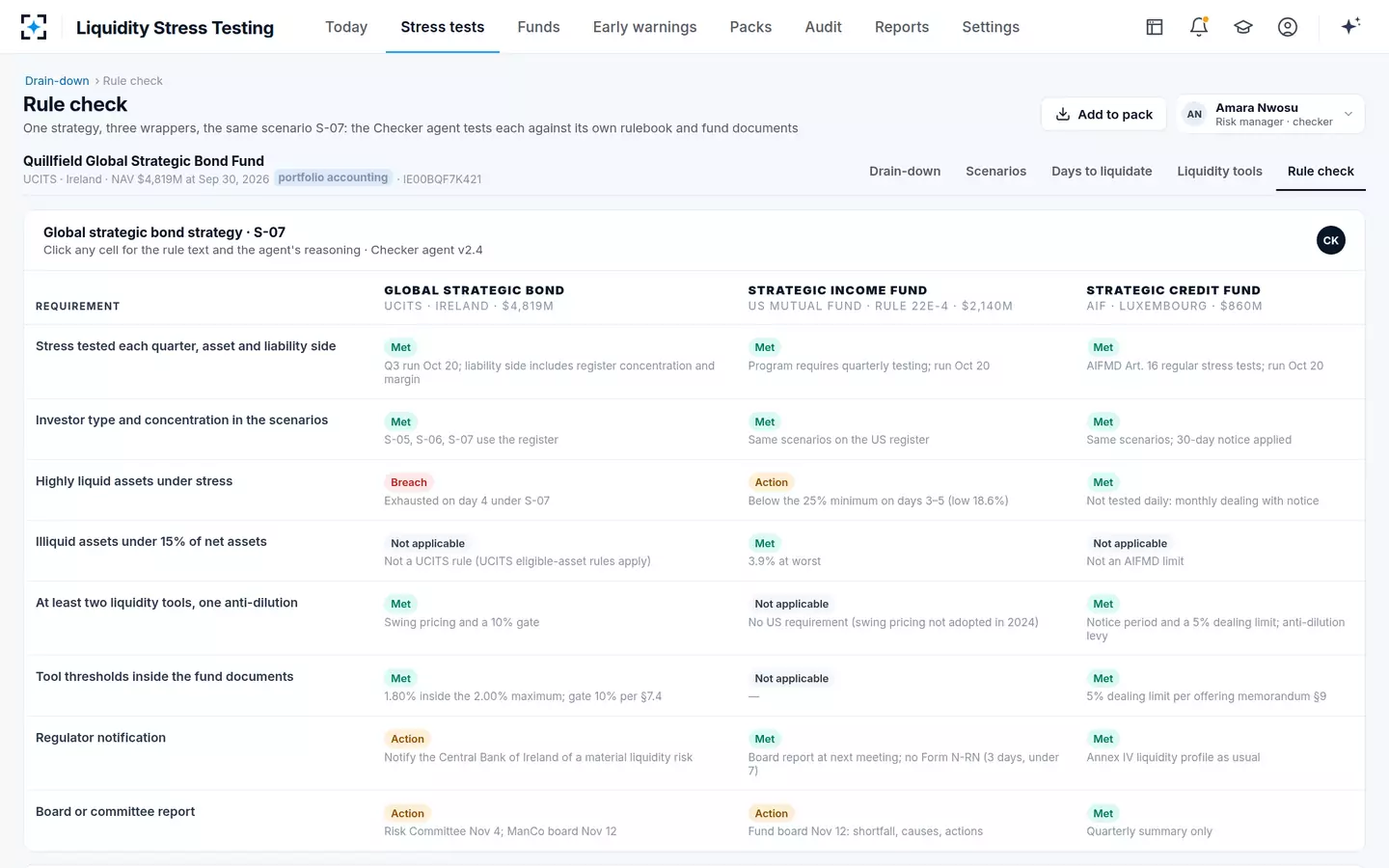
The UCITS runs out of highly liquid assets on day 4 of the scenario, so the Central Bank of Ireland must be told of a material liquidity risk, in line with ESMA's paragraph 80. The US fund falls below its board-set highly liquid investment minimum, a shortfall that Rule 22e-4 sends to the board "no later than its next regularly scheduled meeting", and to the board within one business day, with a Form N-RN filing, only if it lasts more than seven consecutive calendar days. The AIF passes. Each cell in the solution's rule check cites the rule paragraph and the fund document page it relied on, which is what a reviewer needs when the three answers differ.
Two cells are worth a second look. The 15% illiquid limit is marked not applicable for the UCITS and the AIF, because it is a US rule; and the requirement for at least two liquidity management tools is marked not applicable for the US fund, because nothing in US law requires one. The EU's new two-tool rule applies to the other two from April 2026.
What international standard setters ask for next
The direction of travel favours the European model. In December 2023 the Financial Stability Board revised its recommendations on open-ended funds, starting from the view that "A key structural vulnerability from asset management activities is the potential mismatch between the liquidity of fund investments and daily redemption of fund units in open-ended funds." Recommendation 6 asks that "Authorities should require and/or provide guidance on stress testing at the level of individual open-ended funds", and Recommendation 9 asks authorities to consider system-wide stress tests of many funds and other investors selling at once (FSB, 20 December 2023).
European supervisors have also said the practice is not yet where the guidelines put it. In March 2022 ESMA reported on a supervisory engagement with corporate debt and real estate funds: compliance was "satisfactory", but the exercise "highlights some room for improvement and continued monitoring, especially on the liquidity stress testing and valuation of less liquid assets" (ESMA, 30 March 2022). Liquidity stress tests also appear in other industries, from broker-dealers to insurers, under different regulators and different definitions; this guide covers open-ended funds only.
Does the depositary check liquidity stress tests?
It checks that they exist, not whether they are right. Under ESMA's guidelines a depositary "should set up appropriate verification procedures to check that the manager of a fund has in place documented procedures for its LST programme", but "The verification does not require the depositary to assess the adequacy of the LST" and the depositary "does not need to replicate or challenge the LST undertaken by a manager" (paragraphs 74, 75 and 78). If it is not satisfied that a test is in place, it treats that like any other suspected breach of the rules.
The quality of the test therefore rests with the manager, its risk function and, in the US, the program administrator and the board. That is why governance matters as much as arithmetic: ESMA asks for an LST policy that names "the circumstances requiring escalation, including when liquidity limits/thresholds are breached" (paragraph 24(f)), and for the risk staff who run the tests to be independent of portfolio management (paragraph 21).
Meeting the strictest rulebook once, for every fund
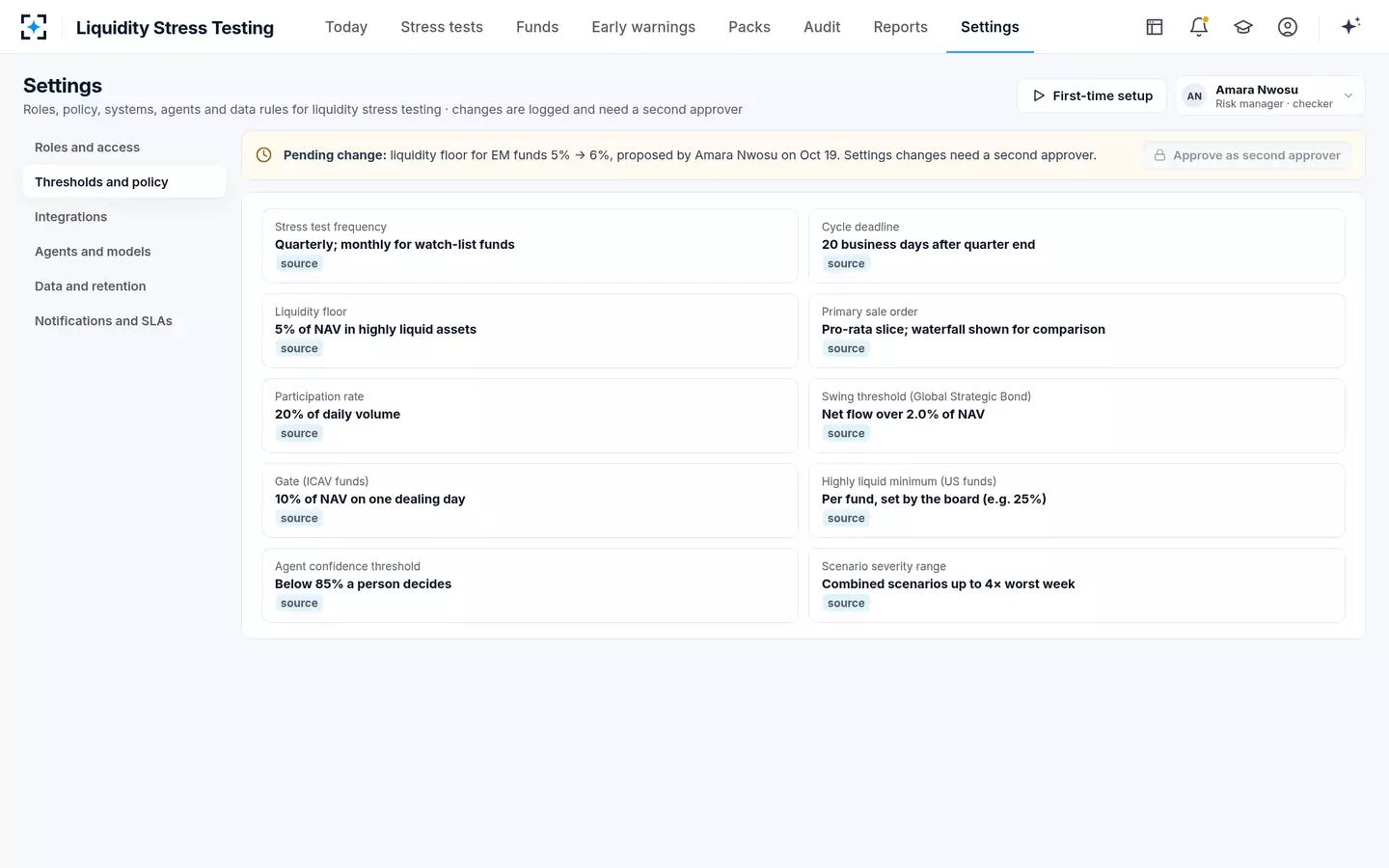
A fund group can meet all four regimes with one liquidity stress testing policy if the policy is written as settings rather than prose. In Botminds' Liquidity Stress Testing, the frequency, the liquidity floor, the sale order, the participation rate, each fund's tool thresholds and each US fund's highly liquid minimum are settings taken from the firm's LST and liquidity management tool policies and the fund documents. A change is proposed, needs a second approver and is kept on the audit trail.
The liquidity stress testing policy, held as settings in Liquidity Stress Testing
One policy for every wrapper, compared with a policy per regime
A policy per regulator: Annual for some funds, quarterly for others, depending on the wrapper.
One policy at the strictest standard: Quarterly for every fund, monthly on the watch list, ad hoc on triggers.
A policy per regulator: Redemptions only where the rulebook names nothing else.
One policy at the strictest standard: Redemptions by holder, margin calls, collateral, credit lines and settlement mismatches for all funds.
A policy per regulator: Separate spreadsheets per regime.
One policy at the strictest standard: One run per fund and scenario, checked against each fund's own rulebook and documents.
A policy per regulator: Email chains that differ by team.
One policy at the strictest standard: The same approve-with-a-reason step for every scenario and conclusion.
The agents then do the mechanical part across the whole range: one agent designs scenarios from each fund's holders, another computes days to liquidate, a third adds margin calls and the credit line, and a checker recomputes their work and tests each result against the rule that applies. A risk manager approves every scenario before its results count, and the Chief Risk Officer signs. How those scenarios are built from the register is where the European liability-side requirement becomes concrete. To see the rule check on your own fund range, start from Liquidity Stress Testing.
Questions people ask
When did ESMA's liquidity stress testing guidelines start to apply?
On 30 September 2020. They were published as ESMA34-39-897 and apply to UCITS and AIF managers, depositaries and national regulators, with only the governance, policy and depositary sections applying to money market funds, which have their own stress testing regime.
Is reverse stress testing required for funds?
ESMA asks managers to use reverse stress testing "where appropriate", and says funds whose strategies expose them to low-probability, high-impact risks "should pay particular regard" to it. No US rule mentions it for open-end funds. Reverse stress testing a fund shows how to turn the definition into a breaking day.
Are money market funds stress tested differently?
Yes, on both sides of the Atlantic. In the US, Rule 2a-7 requires periodic stress testing at intervals the board sets, including rate rises combined with redemptions. In the EU, the money market fund regulation's Article 28 requires regular stress tests of severe plausible scenarios, and ESMA's general guidelines apply to money market funds only in part.
Does an EU fund have to tell its regulator about a stress test result?
Only when the result shows a material risk: ESMA's paragraph 80 says managers "should notify NCAs of material risks and actions taken to address them". Regulators may also ask, at their discretion, for a manager's tests, models and results, which ESMA says may be particularly likely "during a period of large redemptions across the market".
Can a US fund group simply adopt the ESMA standard for its US funds?
It can, and many global groups do, because nothing in Rule 22e-4 prevents a more demanding test. The US program still needs its own elements on top: monthly classification into four liquidity buckets, the highly liquid investment minimum and its shortfall reporting, the 15% illiquid limit and the annual report to the board.