A liquidity stress testing methodology is the set of choices that turns a fund's positions and holders into a breaking day: how fast each holding can be sold and at what cost, in what order the fund sells, what else needs cash besides redemptions, and which data is trusted when markets thin out. ESMA's guidelines leave the model to the manager but name the traps, from "avoiding optimistic assumptions" to warning that a portfolio should not be assumed to sell at an asset's full daily volume, and the FCA found that many firms still assumed the most liquid assets would be sold first. The assumptions that flatter a result are exactly the places an automated test should stop and ask. Botminds' Liquidity Stress Testing is built that way: its agents compute everything, but on sale order, stale data, overrides and any conclusion they are less than 85% sure of, a person decides.
The examples come from the solution's fictional sample fund, Quillfield Global Strategic Bond Fund, a $4.8 billion Irish UCITS holding 412 positions, in the third quarter of 2026.
One run of Liquidity Stress Testing, and the three places the agents stop and ask
Agent
Liquidation and liability agentsCompute days to liquidate and cost for each position at the policy's participation rate from two market liquidity feeds, then add margin, collateral, the credit line and settlement gaps, day by day.
Never: Overwrite a person's override, or assume a shared credit line beyond the fund's allocation.
A person decides
Ask 1 · stale or missing dataWhen a feed is late or empty, the agents propose a proxy; a person approves it, and results stay provisional until then.
Agent
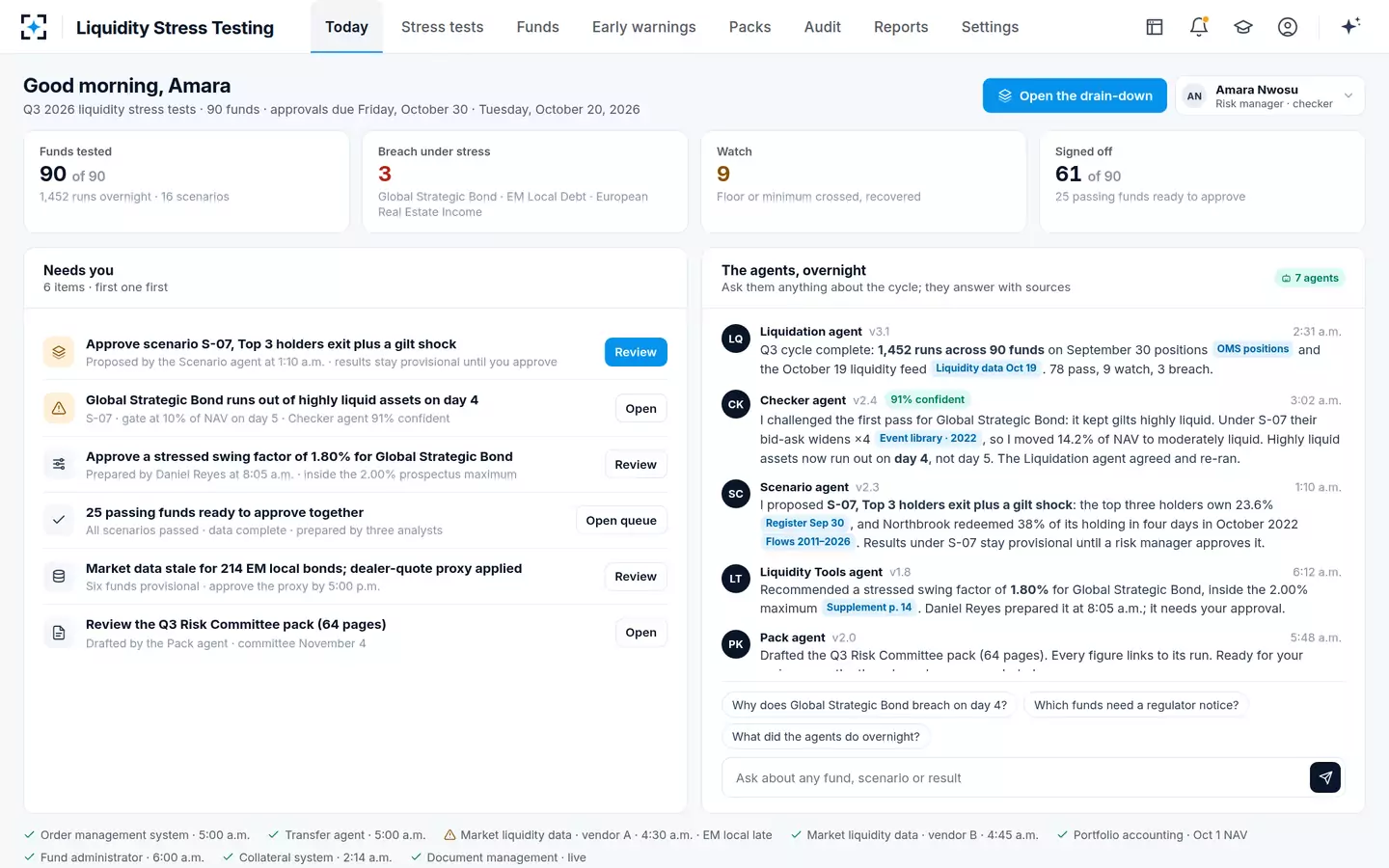
Checker agentRuns both sale orders, recomputes the result and challenges classifications that the scenario itself should change.
Never: Settles a disagreement itself.
A person decides
Ask 2 · sale order and classificationThe risk manager decides between orders and classifications the agents dispute, with a reason.
A person decides
Ask 3 · overrides and low confidenceAny change to a stressed spread or liquidation time, and any conclusion below 85% confidence, goes to a person with its evidence.
What goes into a liquidity stress testing methodology?
Two halves and a join. On the asset side, ESMA says "Liquidation cost and time to liquidity are the two principal approaches typically employed by managers to simulate asset liquidity under normal and stressed conditions", and that liquidation cost "depends on asset type, liquidation horizon and the size of the trade/order" (ESMA34-39-897, paragraphs 43–44). On the liability side, the test must cover redemptions and "All relevant items on the liability side of the fund's balance sheet, including items other than redemptions" (paragraph 57). The join is the daily model in which both run at once, which ESMA asks managers to build "After separately stress testing the assets and the liabilities".
Each half rests on assumptions that no data set settles. How much of a day's volume can the fund trade without moving the price? Does it sell its most liquid holdings first, or a slice of everything? Is the swap margin it will owe in a rates shock in the model at all? When a vendor's prices are a day old, does the model use them anyway? ESMA's answer is a principle rather than a number: a manager should overcome data limits by "avoiding optimistic assumptions", "justifying reliance on third parties' LST models" and "exercising expert qualitative judgement" (paragraph 37). The rest of this guide takes each assumption in turn.
What sale order should a liquidity stress test assume?
Run both, and make the pro rata slice the primary answer. A waterfall order sells the most liquid assets first; a pro rata order sells a proportional slice of every holding. The waterfall is not unrealistic: Ma, Xiao and Zeng found that in March 2020, "In meeting redemptions, funds followed a pecking order by first selling their liquid assets, including Treasuries and high-quality corporate bonds, which generated the most concentrated selling pressure in these markets" (Review of Financial Studies, 2022). It is realistic and dangerous at once, because it pays leavers from the assets the remaining investors will need next.
The FCA lists as good practice "Use of a 'pro-rata' methodology and not 'most liquid first' in calculating both liquidity bucketing and stress testing, in which volume and participation rates have real stresses applied" (FCA, July 2023). ESMA asks that the liquidation method "reflect how a manager would liquidate assets during normal and stressed conditions in accordance with applicable rules" (paragraph 47). The sample manager's policy reconciles the two: both orders are computed on every run, the pro rata slice is primary, and the waterfall is shown beside it so nobody can present the flattering one alone. What the two orders do to the same fund is worked through in full elsewhere.
What participation rate should a liquidity stress test use?
One the fund could actually trade at in a stress, which is lower than in normal markets and lower still for its least liquid lines. ESMA's guidelines say so directly, and add that simulated liquidity should fall even when history offers no example as bad as the scenario.
"It should not be assumed that the portfolio can be liquidated at the full average daily traded volume of an asset unless such an assumption can be justified based on empirical evidence."
ESMA, Guidelines on liquidity stress testing in UCITS and AIFs, paragraph 39
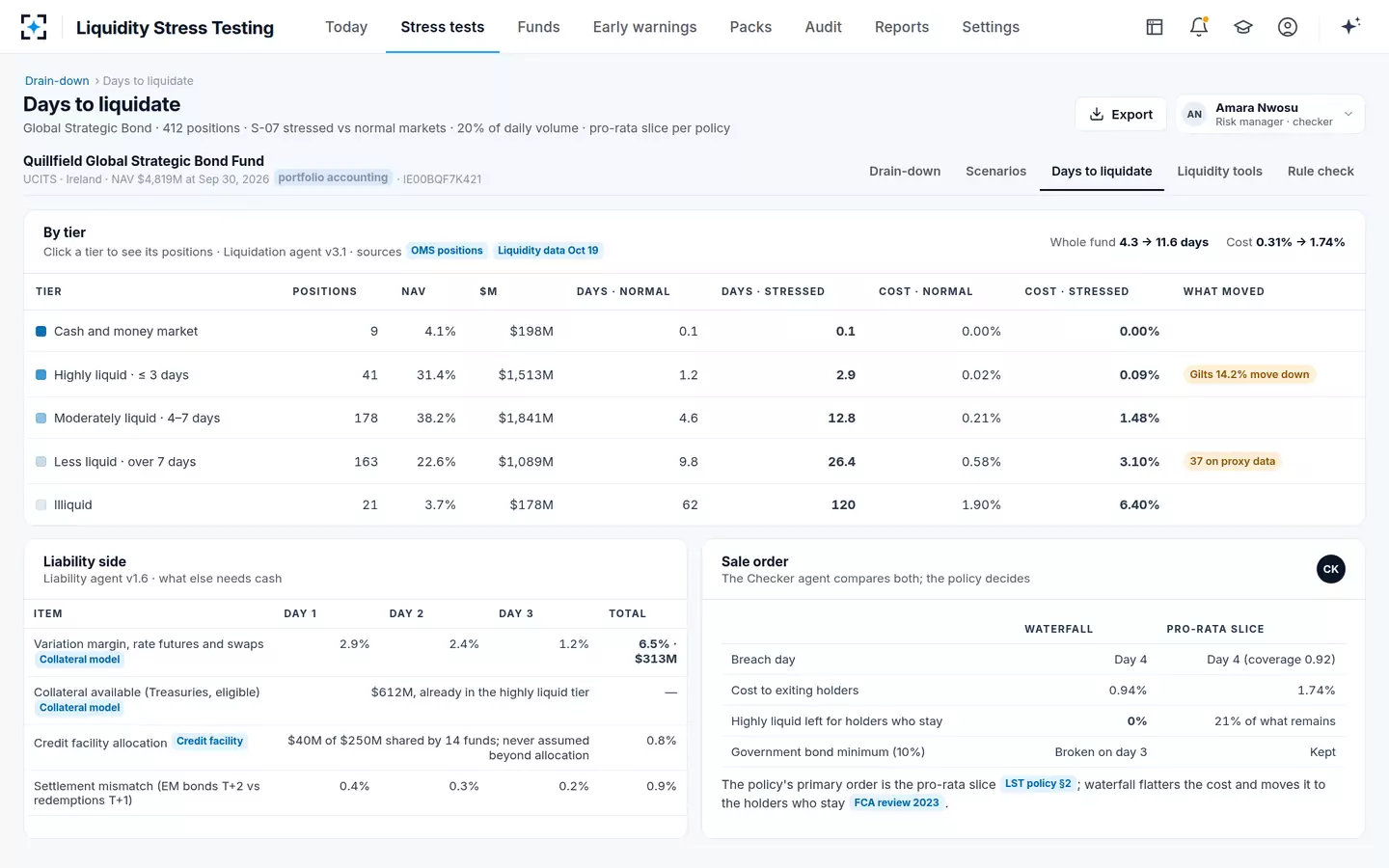
The sample manager sets 20% of daily volume as its participation rate, and the stress lowers the volume itself: in the approved scenario, sterling investment-grade volume falls 60%. The result is a fund that takes 4.3 days to liquidate in normal markets and 11.6 days in the stressed one. When the bond fund's portfolio manager asked whether gilts could simply be sold faster, the agents answered that at 20% of volume, selling the 2049 and 2051 gilts in one day would cost about 1.9% on those lines, and even at 40% of volume the fund would break only one day later.
Days to liquidate the sample fund by tier, normal and stressed
| Liquidity tier | Share of net assets | Days to liquidate: normal | Days to liquidate: stressed | Cost: stressed |
|---|---|---|---|---|
| Cash and money market | 4.1% | 0.1 | 0.1 | 0.00% |
| Highly liquid (three days or less) | 31.4% | 1.2 | 2.9 | 0.09% |
| Moderately liquid (four to seven days) | 38.2% | 4.6 | 12.8 | 1.48% |
| Less liquid (over seven days) | 22.6% | 9.8 | 26.4 | 3.10% |
| Illiquid | 3.7% | 62 | 120 | 6.40% |
Stressed spreads and market impact: where the cost numbers come from
From the same three drivers ESMA names for every asset: what it is, how fast it must be sold and how big the order is. Liquidation cost "depends on asset type, liquidation horizon and the size of the trade/order", and stressed conditions "are typically characterised by higher volatility, lower liquidity (e.g. higher bid-ask spread) and longer time to liquidate", which managers should estimate from "a significant number and variety of market stresses", not only from history (paragraphs 44–45).
In practice that means a stressed spread and an impact curve per asset class. The sample fund's scenario widens gilt bid-ask spreads fourfold, as in October 2022, and cuts sterling investment-grade volume by 60%; across the portfolio, the cost of liquidating rises from 0.31% in normal markets to 1.74% under stress on a pro rata basis, and from 0.02% to 0.09% even in the highly liquid tier. The jump is steepest where the fund can least afford it: 1.48% for moderately liquid holdings, 3.10% for less liquid ones and 6.40% for the illiquid tail. Those are the numbers that decide both the breaking day and, as the swing factor calibration shows, what investors who leave should pay.
Should margin calls be in a fund liquidity stress test?
Yes, for any fund with derivatives, and AIFMD makes it law for alternative funds: their stress tests must cover market risks and what follows from them, margin calls, collateral and credit lines included (Regulation (EU) No 231/2013, Art. 48(2)(c)). For UCITS, ESMA lists derivatives among the liabilities to simulate, with the example of "a change in the value of the underlying of the derivative leading to a larger than anticipated margin call" (paragraph 59).
In the Bank of England's 2024 market-shock exercise, margin, not redemptions, drove the cash calls
~85%
of non-banks' reported liquidity needs came from variation margin calls
~8%
came from initial margin calls
~7%
came from redemptions by UK investors
The Bank of England's exercise is the clearest recent evidence that the liability side is not only redemptions. Across the non-banks it modelled, "approximately 85% of NBFIs' reported liquidity needs arise from variation margin (VM) calls, around 8% from initial margin (IM) calls and around 7% from redemptions from UK investors" (Bank of England, November 2024). For a bond fund that hedges interest rate risk with futures and swaps, the rates shock in its own stress scenario is also a margin call. In the sample scenario, variation margin on rate futures and swaps takes 2.9%, 2.4% and 1.2% of net assets on days 1 to 3, $313 million in all, in the same three days as the largest redemptions.
How should collateral calls and credit lines be modelled?
Day by day, with each source of cash counted once and capped at what the fund can actually use. The table shows the sample fund's liability side under the approved scenario, as the solution's liability agent builds it.
The sample fund's liability side, beyond redemptions
| Item | Day 1 | Day 2 | Day 3 | Total and rule |
|---|---|---|---|---|
| Variation margin on rate futures and swaps | 2.9% | 2.4% | 1.2% | 6.5% of net assets ($313 million), from the collateral model |
| Eligible collateral available (Treasuries) | — | — | — | $612 million, already counted in the highly liquid tier, so not counted again |
| Credit facility | — | — | — | $40 million allocation of a $250 million line shared by 14 funds (0.8%); never assumed beyond the allocation |
| Settlement mismatch: bonds settle T+2, redemptions pay T+1 | 0.4% | 0.3% | 0.2% | 0.9% of net assets of timing gap to fund |
Two modelling errors are common and both flatter the result. The first is double counting collateral: government bonds held to meet margin calls are usually already in the highly liquid tier, so counting them again as a separate source of cash covers the same call twice. The second is the shared credit line. A $250 million facility shared by 14 funds is not $250 million for each fund; in a market-wide stress several will draw at once, and the lender may tighten terms. The Bank of England saw the second effect in repo: in its exercise, "many banks reduce tenors and increase haircuts for maturing repo financing, with repo haircuts often doubling over a few days" (SWES final report).
Days to liquidate, the liability side and both sale orders in Liquidity Stress Testing
When should a person override a stressed spread?
When there is evidence the model cannot see, and only with that evidence attached. A dealer's firm bid for a bond the vendor prices on proxy data is the classic case. ESMA expects managers to supplement models by "exercising expert qualitative judgement" and to review assumptions "adequately" where data is limited (paragraphs 37–38); the FCA adds "increased scrutiny of liquidity assumptions of least liquid buckets" to its list of good practice.
In the sample quarter, an analyst requested an override on one bond, Pampas Agro 2031, cutting its stressed days to liquidate from 31 to 24 after receiving a dealer bid. The override does not take effect when requested. It goes to the risk manager with the dealer bid attached, the liquidation agent never overwrites it once approved, and the audit trail keeps who asked, who approved, why and on what evidence. The asymmetry matters: overrides almost always make a fund look more liquid, so they deserve more scrutiny than the model's own numbers, not less.
What confidence should an agent need before using proxy data?
High enough that a person would have made the same call, and never so high that a person stops looking. Proxy data is unavoidable for thinly traded bonds, and ESMA expects it to be handled openly: a test should "demonstrate a manager is able to overcome limitations related to the availability of data" (paragraph 37). What it should not do is turn a stale price into a confident result.
Stale data, a proposed proxy and results kept provisional in Liquidity Stress Testing
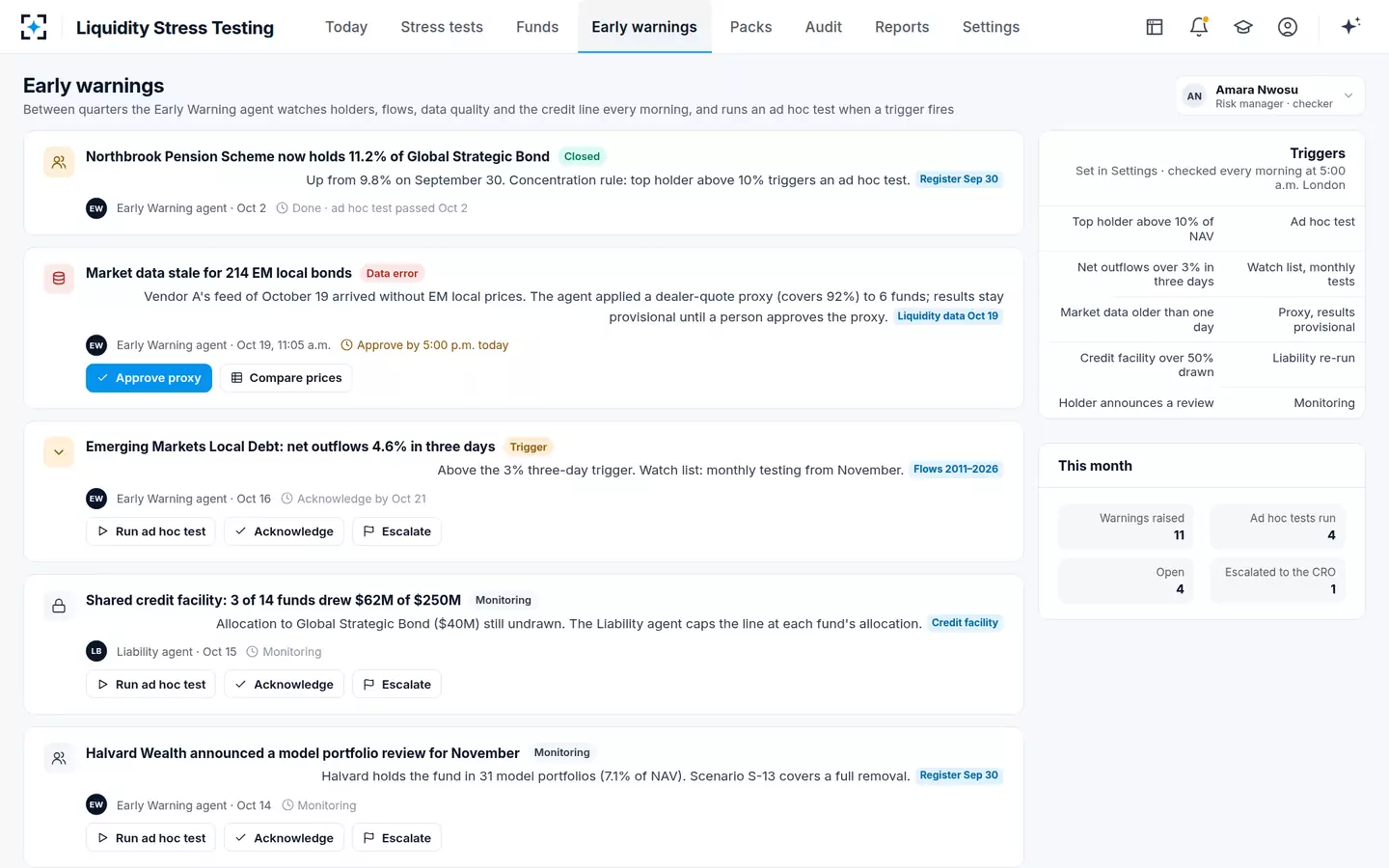
The sample manager sets two rules. Results on stale market data stay provisional until a person approves the proxy, whatever the agent's confidence. And any agent conclusion below 85% confidence goes to a person; the sample's Chief Risk Officer raised that threshold from 80% to 85% in October 2026, as a logged settings change with a second approver. Both rules can be argued with. The point is that they are written down, versioned and visible, rather than living in the analyst's head.
Write the assumptions down: what the LST policy must say
Every assumption in this guide belongs in the policy, with its reason. ESMA's list of what an LST policy must contain includes "the assumptions used relating to data availability for the scenarios, their rationale and how frequently they are revisited" and "the methods for liquidating assets, including the limitations and assumptions used" (paragraph 24(j) and (l)). The checklist turns that into the questions a reviewer will ask.
Eight assumptions a liquidity stress testing methodology should state, with its reasons
- Sale order
Pro rata, waterfall or a policy hybrid; which one is primary and whether the other is shown beside it.
- Participation rate
The share of daily volume in normal and stressed markets, by asset class, and the evidence for it.
- Stressed spreads and market impact
How bid-ask spreads widen and how impact grows with order size, and from which history.
- Classification under stress
Which holdings move tier when the scenario hits their market, rather than keeping normal-market buckets.
- Liabilities beyond redemptions
Margin, collateral, credit lines, settlement gaps and, for real assets, committed capital.
- Data and proxies
Which feeds, how stale is too stale, which proxy is used and who approves it.
- Overrides
Who may request one, who approves, what evidence is required and how long it lasts.
- Review cycle
How often each assumption is revisited and what event forces an early review.
Writing the assumptions down is also what makes them testable. A policy that says "pro rata, 20% of volume, gilts move tier when spreads widen fourfold" can be checked against every run; a policy that says "a prudent approach" cannot. In Botminds' Liquidity Stress Testing, each of these assumptions is a setting with its source, a change needs a second approver, and the audit trail keeps every agent step with the agent's version. To see your own methodology as settings, start from Liquidity Stress Testing; the scenarios those assumptions run under are the other half of the method.
The checking agent's overnight challenge on the Today screen of Liquidity Stress Testing
Questions people ask
What is the waterfall approach in liquidity stress testing?
It is a sale order that meets redemptions by selling the most liquid assets first and moving down the liquidity tiers. It shows the lowest cost to investors who leave but leaves the remaining investors with a less liquid fund; the FCA found many firms used it and called it the less conservative approach, preferring a pro rata slice.
Is time to liquidity or liquidation cost the better approach?
Neither on its own. ESMA names both as the two principal approaches and asks managers to "apply the appropriate method for the individual fund"; in practice a daily model needs both, how much can be sold each day and at what cost, because the breaking day depends on the first and fairness between investors on the second.
How often should liquidity stress testing assumptions be revisited?
As often as the policy says, and the policy must say. ESMA requires the LST policy to state the data assumptions, "their rationale and how frequently they are revisited", and a market event that changes spreads or volumes in an asset class is a reason to revisit early.
Should settlement timing be part of the methodology?
Yes, where assets settle more slowly than redemptions are paid. A fund that pays redeeming investors one day after dealing but receives the proceeds of its bond sales two days after trading must fund the gap; in the sample fund that gap adds 0.9% of net assets over three days.
Do the assumptions differ for funds with notice periods?
The method is the same but the clock is longer. A fund with 30 days' notice knows its redemptions a month ahead, so its test is mostly about whether assets can be sold within the notice period at acceptable cost. The sample manager's Luxembourg AIF with 30 days' notice passes the same scenario that breaks its daily-dealing UCITS sibling.