Liquidity stress testing scenarios are the assumed redemptions, market moves and other cash calls a fund is put through, day by day, to see whether it can pay what it owes without harming the investors who stay. The weakest scenarios are generic: a flat 10% or 20% outflow applied to every fund. The useful ones start from who actually holds the fund, how each kind of holder has behaved in past stresses and how concentrated the register is, because ESMA's guidelines expect "risk factors related to investor type and concentration" in every liquidity stress test and the Bank of England's 2024 system-wide exercise found that fund redemptions in a stress are "highly dependent on their investor base". Botminds' Liquidity Stress Testing reads the transfer agent's register and the fund's flow history, proposes scenarios with its reasons, and keeps every result provisional until a risk manager approves the scenario.
The worked example is the solution's fictional sample: Quillfield Global Strategic Bond Fund, a $4.8 billion Irish UCITS bond fund at the fictional Quillfield Capital, tested at the end of September 2026.
One fund's register: five holders own almost a third of it
Register, 30 September
- Three largest: pension scheme, wealth platform, insurer · 23.6%
- Next two: public pension, private bank · 6.3%
- All other holders · 70.1%
Scenario S-07, five dealing days
- Requested · 30.2%
- Stays · 69.8%
What is liquidity stress testing?
Liquidity stress testing is a simulation of whether a fund can meet its obligations, mostly redemptions, under conditions worse than normal but still plausible. ESMA defines it as "a risk management tool within the overall liquidity risk management framework of a manager which simulates a range of conditions, including: normal and stressed (i.e. extreme, unlikely or unfavourable) plausible conditions, to assess their potential impact on the funding (liability), assets, overall liquidity of a fund and, the necessary follow-up action" (ESMA34-39-897, definitions).
A liquidity stress test has two halves. The asset side asks how quickly, and at what cost, the fund's holdings can be turned into cash. The liability side asks how much cash will be demanded, and when. ESMA's guidelines say plainly which half carries the most weight: "Redemption requests are the most common and typically most important source of liquidity risk for investment funds" (paragraph 51). That makes the redemption scenario the single most consequential choice in the test, and the one most often left generic. The requirements on each side of the Atlantic differ, but none rewards a scenario that ignores who the holders are.
Why a generic 10% outflow tells a board little
Because outflows in a real stress are spread very unevenly across funds. In March 2020, the SEC's later analysis found, open-end funds as a whole lost $329.4 billion, or 1.7% of assets, in the month; taxable bond funds lost $241.7 billion, or 5.2%; and bank loan funds "experienced outflows of approximately 13% of assets, more than any other type of fund" (SEC proposing release, Release 33-11130, December 2022). A single percentage applied to every fund would have overstated the stress for most and understated it for the funds that mattered.
March 2020: the same month, very different outflows
0.2%
a month: the average net inflow into US open-end funds through 2019
1.7%
of assets: all US open-end funds' outflows in March 2020
5.2%
taxable bond funds' outflows that month
~13%
bank loan funds' outflows, "more than any other type of fund"
Research on the same episode points at the reason. Falato, Goldstein and Hortaçsu studied daily flows in corporate bond funds and found that "Large outflows were sustained over weeks and most severe for funds with illiquid assets, vulnerable to fire sales, and exposed to sectors hurt by the crisis" (NBER working paper 27559; later Journal of Monetary Economics, 2021). Outflows depend on the fund: its assets, its holders and its recent returns. A scenario that does not start from those is a sensitivity test, not a liquidity stress test.
Which investor types redeem first in stress?
The ones with their own cash needs and the least discretion over meeting them. ESMA's guidelines give examples: the likelihood of redeeming in stress "could be categorised according to whether investors are wealth managers, pension schemes, direct retail investors, or other UCITS or AIFs", and a model "may simulate, for example, funds of funds posing more redemption risk than other types of investors" (paragraph 56). They also name investors with "formulaic or pre-defined strategies", such as funds targeting a level of volatility, which "often seek to de-risk during volatile periods".
The Bank of England's system-wide exploratory scenario, published in November 2024, saw the same pattern from the investor's side. "The scale of redemptions OEFs experienced in the SWES depended heavily on their investor base and the investors' levels of resilience. For example, smaller pension schemes often had less scope for discretionary decision-making and may therefore redeem from OEFs regardless of price changes" (Bank of England, SWES final report). Its next step for fund managers was to "consider whether they have the ability to prepare for stressed redemptions, taking into account the likely behaviour of their investor base".
"We observed that investor type concentration analysis was not fully considered in redemption stresses, where redemptions could be highly correlated to such concentration, as was seen in the LDI crisis."
FCA, Liquidity Management multi-firm review, July 2023
The FCA's point is that concentration by type can matter as much as concentration by name. Ten unrelated pension schemes that each hold 2% of a fund look diversified on the register; in a gilt shock that sends all of them to their liquidity waterfalls on the same morning, they behave like one 20% holder. The Bank of England observed exactly this in pension schemes, many of which "have similar waterfalls determining which assets to sell", so that "sales will be correlated".
How do you size a redemption shock?
From four sources at once, and then by combining them: the fund's own history, its holders, comparable funds and the market event the scenario describes. ESMA lists the ingredients for stressed conditions as "historical trends, historical events, contemporary trends in peer funds, hypothetical/event-driven scenarios and reverse stress testing" (paragraph 53), and asks that the time series for normal conditions be "long enough to fairly reflect 'normal' conditions" (paragraph 52).
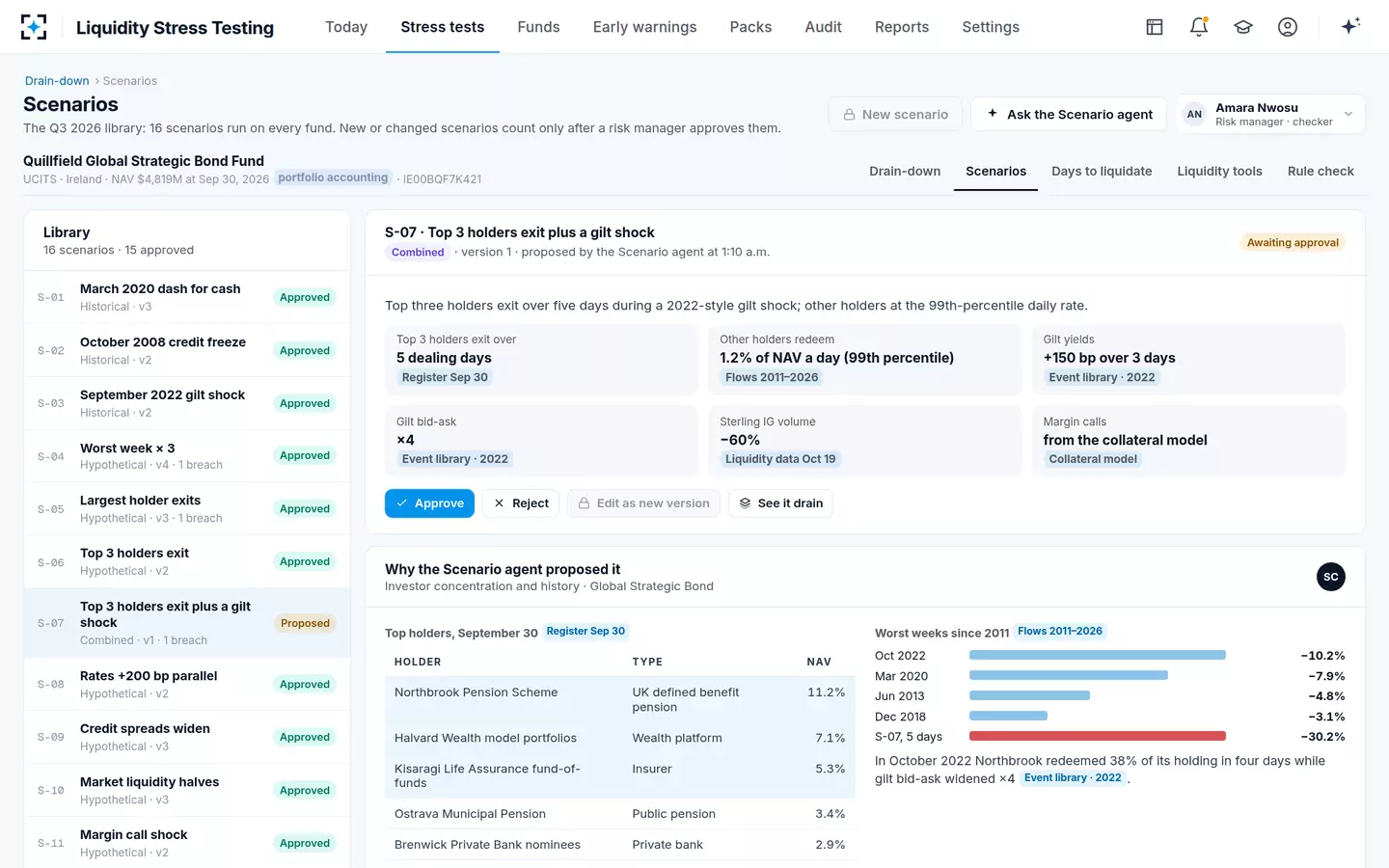
The sample fund's approved scenario, S-07, was proposed by the solution's scenario agent from all four. From the register: the three largest holders own 23.6%. From the holders' own history: the largest, a UK defined benefit pension scheme, redeemed 38% of its holding in four days in October 2022. From weekly flows since 2011: other holders redeem 1.2% of net assets a day at the 99th percentile. From the market event: gilt yields rise 150 basis points over three days and gilt bid-ask spreads widen four times, as in 2022. The three leave over five dealing days while everyone else redeems at the 99th-percentile rate.
The scenario is three times the fund's worst week since 2011
Is 30.2% in five days plausible? That is the question the risk manager must answer before the results count, and the evidence is on the screen: the holders exist, the largest one has done something similar before, and the market event happened. A scenario three times the worst week the fund has seen is severe. ESMA asks for scenarios that are "sufficiently severe but plausible" (paragraph 30), and warns that a test "should not overly rely on historical data, particularly as future stresses may differ from previous ones" (paragraph 31). Research on choosing plausible scenarios, such as Glasserman, Kang and Kang's work on stress scenario selection by empirical likelihood (Quantitative Finance, 2015), formalises the same trade-off between severity and likelihood.
What historical outflows should a bond fund test?
Its own worst periods first, then the market events that hurt its asset class most, then the combinations its holders make possible. ESMA's examples of historical scenarios are "the global financial crisis 2008-2010 or the European debt crisis 2010-2012", and of hypothetical ones "rising interest rates, credit spread widening, or political events" (paragraph 32). For a sterling or euro bond fund today, March 2020 and the September 2022 gilt shock belong on the list as well.
A scenario library for one bond fund: what each family captures
| Family | What it captures | In the sample library |
|---|---|---|
| Historical | A real episode replayed on today's portfolio and holders: flows, spreads and volumes as they were. | March 2020 dash for cash; October 2008 credit freeze; September 2022 gilt shock. |
| Hypothetical, liability side | Holders leaving at rates history has not shown: multiples of the worst week, the largest holder alone, the top three together. | Worst week × 3; largest holder exits; top three holders exit. |
| Hypothetical, market side | A shock to the assets without an unusual run: rates, spreads, market liquidity, margin. | Rates +200bp parallel; credit spreads widen; market liquidity halves; margin call shock. |
| Combined | Holders and markets moving together, which is how real stresses arrive. | Top three holders exit plus a gilt shock. |
| Reverse | Start from the failure and solve for the outflow pace that causes it. | Run on every fund to find its breaking point. |
The library is shared across funds, but the numbers inside each scenario are not. "Largest holder exits" means 11.2% of net assets for the sample bond fund and something quite different for a fund whose largest holder owns 2%. A scenario defined by a rule, the largest holder, the 99th percentile, the worst week times three, travels across a fund range and stays specific to each fund. Reverse stress testing completes the library by asking how bad the outflow would have to be.
Concentration: model the largest holders leaving together
ESMA's table of investor-behaviour factors is specific: "The manager may model one or a number of the largest investors redeeming simultaneously from the fund over a given period of time." It adds a sensible caveat, that this "may have limited utility where the fund has only one institutional investor that cooperates with the manager concerning intentions to subscribe and redeem units" (paragraph 56 and note 11). For most daily-dealing funds, the largest holders do not cooperate in that way, and their exit is the scenario that matters most.
Concentration also changes between quarterly tests. At the sample manager, a trigger set in the solution starts an ad hoc test whenever a single holder passes 10% of a fund; the pension scheme crossed it on 2 October, moving from 9.8% to 11.2%, and the ad hoc test passed the same day. A wealth platform that holds the fund in 31 model portfolios announced a review in mid-October, which the early-warning agent now watches, because a model change moves all 31 portfolios at once.
Why the scenario agent proposed this scenario, in Liquidity Stress Testing
What is the redemption coverage ratio?
It is the stress test's summary number: liquid assets available against the cash the scenario demands. ESMA defines it as "a measurement of the ability of a fund's assets to meet funding obligations arising from the liabilities side of the balance sheet, such as a redemption shock", and suggests it as a basis for a comparable metric or score across funds (paragraph 70). A common way to compute it is the assets that can be sold within the scenario's horizon, at the stressed cost and participation rate the policy allows, divided by the outflows and other cash calls over the same horizon. Below 1, the fund cannot pay from liquid assets alone.
The ratio is only as good as the scenario in its denominator. On the sample bond fund under S-07, the coverage ratio on day 4 is 0.92 under the policy's pro rata sale order, because the three largest holders and a margin call arrive in the same week. A generic 10% outflow over the same five days, even with the scenario's 6.5% of margin calls added, would be met from the fund's 21.3% of cash and highly liquid assets with room to spare. Both answers are arithmetically correct; only one describes the fund.
Who approves a liquidity stress testing scenario before it counts?
A risk manager, independent of the portfolio managers whose funds are being tested. ESMA asks managers to stop portfolio managers and others from steering how a stress test is run, including through their own judgements of how liquid an asset is (paragraph 23; the analyst who runs it), and to write into the LST policy "the types and severity of stress test scenarios used and the reasons for selecting those scenarios" (paragraph 24(i)).
Approving a scenario with a reason in Liquidity Stress Testing
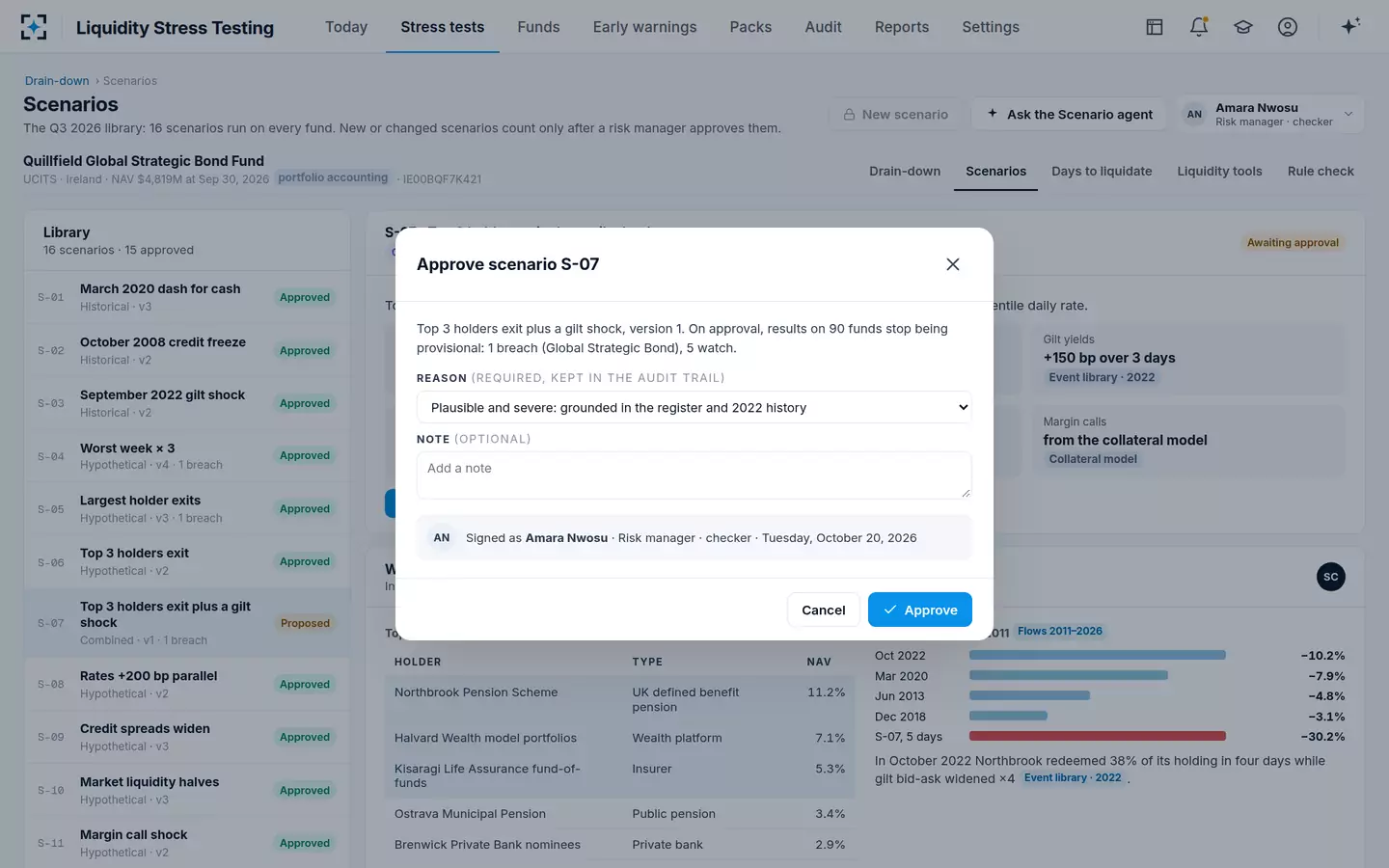
In the solution, the scenario agent never activates its own proposal. The sample's head of liquidity risk approves S-07 with the reason "Plausible and severe: grounded in the register and 2022 history", and only then do the results on all 90 funds become final: one breach and five funds on watch under that scenario. An analyst signed in to the same screen finds the approve button locked. The audit trail keeps the approval, its reason and the evidence beside every result it produced.
Questions people ask
What is a liquidity stress test for a fund?
It is a test of whether a fund can meet redemptions and other cash calls under severe but plausible conditions without harming the investors who stay. ESMA's guidelines require one at least once a year for every UCITS and AIF and recommend quarterly testing, on both the assets and the liabilities of the fund.
How do you calculate the redemption coverage ratio?
Divide the assets the fund can sell within the scenario's horizon, at stressed costs and the policy's participation rate, by the redemptions and other cash calls over the same horizon. ESMA defines the ratio but not a formula, so the policy must say which assets count, over what horizon and in what sale order. A ratio below 1 means the fund cannot meet the scenario from liquid assets alone.
How many liquidity stress test scenarios should a fund run?
Enough to cover its distinct risks, without diluting the key ones. ESMA asks for tests that are "adequately focused, specific to the fund" and that use "a wide enough range of scenarios to adequately represent the diversity of the fund's risks" (paragraph 19). The sample manager runs 16 scenarios on every fund: historical, hypothetical, combined and reverse.
Can a scenario use peer funds' outflows?
Yes. ESMA lists "average redemptions of peer funds" for normal conditions and "contemporary trends in peer funds" for stressed ones. Peer data is most useful for a young fund with little history of its own, or for an investor type the fund has not yet held through a stress.
How far back should the flow history go?
Far enough to include at least one real stress for the fund's asset class. ESMA asks that the series be "long enough to fairly reflect 'normal' conditions", and for a bond fund that usually means reaching back before 2013's taper episode and 2020. The sample fund uses weekly flows since 2011.