Liquidity management tools under AIFMD II are the redemption limits, notice periods, fees, pricing adjustments and in-kind transfers an open-ended fund may use when redemptions outrun the liquidity of its assets. Directive (EU) 2024/927, which amended both the AIFMD and the UCITS Directive, applies from 16 April 2026 and requires every open-ended AIF and every UCITS to select at least two of them from a harmonised list, put them in the fund rules and adopt detailed policies for switching them on and off. Two Commission regulations define each tool from the same date, with funds that existed before it deemed compliant until 16 April 2027, and ESMA's guidelines on choosing and calibrating the tools follow the same two dates. Botminds' Liquidity Stress Testing runs each fund's selected tools inside its liquidity stress test, so a manager can show not just that two tools are in the prospectus, but when each would activate and what it would change.
The tools rule in four numbers
2tools
the minimum each open-ended AIF and UCITS must select from points 2 to 8 of the annex
1tool
the minimum for a money market fund
Apr 2026
16 April 2026: the directive and the Commission's tool regulations apply
Apr 2027
16 April 2027: funds constituted before 16 April 2026 stop being deemed compliant with those regulations
What are liquidity management tools?
They are the nine tools listed in Annex V of the AIFMD and Annex IIA of the UCITS Directive, defined in the same words in both. Suspension (point 1) and side pockets (point 9) are for exceptional circumstances; the seven in between are the ones a fund chooses from, and the directive adds one constraint: "It shall not be possible for that selection to include only the tools referred to in Annex V, points 5 and 6", that is, swing pricing and dual pricing alone (Directive (EU) 2024/927, new AIFMD Art. 16(2b)).
The nine liquidity management tools, as the directive defines them
| Annex point and tool | The directive's definition (quoted) | ESMA's grouping | Counts toward the two? |
|---|---|---|---|
| 1. Suspension | "temporarily disallowing the subscription, repurchase and redemption of the fund's units or shares" | Exceptional circumstances | No |
| 2. Redemption limit (gating) | "a temporary and partial restriction of the right of unit-holders or shareholders to redeem their units or shares, so that investors can only redeem a certain portion" | Quantitative | Yes |
| 3. Extension of notice periods | "extending the period of notice that unit-holders or shareholders must give to fund managers, beyond a minimum period which is appropriate to the fund" | Quantitative | Yes |
| 4. Redemption fee | "a fee, within a predetermined range that takes account of the cost of liquidity, that is paid to the fund" | Anti-dilution | Yes |
| 5. Swing pricing | The net asset value is moved by a "swing factor" that reflects the cost of liquidity | Anti-dilution | Yes, but not with dual pricing alone |
| 6. Dual pricing | "subscription, repurchase and redemption prices ... are set by adjusting the net asset value per unit or share by a factor that reflects the cost of liquidity" | Anti-dilution | Yes, but not with swing pricing alone |
| 7. Anti-dilution levy | "a fee that is paid to the fund by a unit-holder or shareholder at the time of a subscription, repurchase or redemption ... that compensates the fund for the cost of liquidity" | Anti-dilution | Yes |
| 8. Redemption in kind | "transferring assets held by the fund, instead of cash, to meet redemption requests" | Other | Yes; professional investors only |
| 9. Side pockets | "separating certain assets, whose economic or legal features have changed significantly or become uncertain due to exceptional circumstances" | Exceptional circumstances | No |
The reason for the list is first-mover advantage. Investors who redeem early in a stress get cash at a price that does not yet reflect the cost of selling assets in a falling market; those who stay pay for it later. The Financial Stability Board's 2023 recommendations asked authorities to ensure that "anti-dilution liquidity management tools are available to managers of open-ended funds" and that managers "consider and use such tools" (FSB, Recommendation 5). The EU went further and made two tools a condition of running the fund.
Which dates apply: 16 April 2026, 16 April 2027 and the tool regulations
Three texts carry the rule, and each has its own date. The directive tells member states to apply their transposing laws "from 16 April 2026". The Commission's delegated regulations, which set what each tool must look like, were adopted on 17 November 2025, published in the Official Journal on 27 February 2026 and "shall apply from 16 April 2026" (Delegated Regulation (EU) 2026/466 for UCITS; 2026/465 for AIFs). ESMA's guidelines on selecting and calibrating the tools are tied to the regulations: they apply "on the date of application of the RTS", and for a fund existing before that date "these guidelines apply twelve months from that date" (ESMA34-671404336-1364, paragraphs 3–4).
The tools rule from directive to guidelines, date by date
| Date | What happened or applies | Text |
|---|---|---|
| 13 March 2024 | Directive (EU) 2024/927 adopted, amending the AIFMD and the UCITS Directive. | Directive (EU) 2024/927 |
| 15 April 2025 | ESMA publishes its final reports on the draft technical standards and the guidelines. | ESMA34-671404336-1363 |
| 17 November 2025 | The Commission adopts the technical standards, with amendments on redemption limits and transaction costs. | Delegated Regulations 2026/465 and 2026/466 |
| 27 February 2026 | The two regulations are published in the Official Journal. | OJ L 2026/465, 2026/466 |
| 16 April 2026 | Member states apply the directive; the regulations and ESMA's guidelines apply to funds constituted from this date. | Directive Art. 4; regulations; guidelines para. 3 |
| 16 April 2027 | Funds constituted before 16 April 2026 are no longer deemed compliant with the regulations; ESMA's guidelines apply to them. | Regulations, transition article; guidelines para. 4 |
When must existing funds comply with the liquidity management tools rules?
By 16 April 2027 at the latest. Both regulations say: "Until 16 April 2027, UCITS that were constituted before 16 April 2026 shall be deemed to comply with this Regulation", and the same of AIFs, with an option to opt in early by notifying the home regulator (Regulation (EU) 2026/466, Art. 10). The Commission's recital explains why: compliance "would also require changes to the fund documentation and an update of the existing processes and technical infrastructure".
Read the derogation narrowly. It covers the regulations' detail on how each tool works and, through ESMA, the guidelines on choosing and calibrating them. It is the reason most existing funds are revising prospectuses, activation policies and dealing systems during the twelve months to April 2027. A fund launched after 16 April 2026 has no such window.
Which two LMTs should a fund choose?
Usually one tool that limits how much leaves and one that makes leavers pay the cost of leaving. ESMA's guidelines ask managers to consider "the merit of selecting at least one quantitative-based LMT", meaning a redemption limit or an extension of notice periods, "and at least one ADT (i.e.: redemption fees, swing pricing, dual pricing, ADL)", and allow "one LMT to use under normal market conditions and one LMT to be used under stressed market conditions" (paragraph 15). The choice must follow an assessment against at least eight factors, among them "the characteristics of the fund's investor base" and "the results of liquidity stress testing" (paragraph 13).
Quantitative tools and anti-dilution tools solve different problems
Quantitative tools (redemption limits, notice periods): How much leaves, and how fast.
Anti-dilution tools (swing pricing, dual pricing, levies, fees): Who pays the cost of what leaves.
Quantitative tools (redemption limits, notice periods): Redemption limits for funds with "a concentrated investor base" or assets that "might become illiquid during stressed market conditions"; notice periods especially for real estate and private equity AIFs.
Anti-dilution tools (swing pricing, dual pricing, levies, fees): For "all types of funds to mitigate material investor dilution and potential first mover advantage"; swing pricing where trading costs are "available and frequently updated".
Quantitative tools (redemption limits, notice periods): Mainly stressed; ESMA says managers should consider extending notice periods "both under normal and stressed market conditions".
Anti-dilution tools (swing pricing, dual pricing, levies, fees): Both: ESMA says managers "should activate ADTs both under normal and stressed market conditions".
Quantitative tools (redemption limits, notice periods): The day the activation threshold is reached, and how much is deferred.
Anti-dilution tools (swing pricing, dual pricing, levies, fees): The stressed cost of liquidity, and whether the factor or fee covers it.
ESMA's tool-by-tool guidance narrows the choice further. It asks managers to consider a redemption limit for every fund, because "all assets could potentially suffer from liquidity issues during stressed market conditions" (paragraph 23), and that an anti-dilution levy is "especially appropriate" for funds "with a high investor concentration" or that "invest in less liquid assets (e.g.: high yield bonds, small cap equities)" (paragraph 49). For AIFs with no retail investors and few professional investors, the amended guidelines add investor-level redemption limits "to mitigate first mover advantage" (paragraph 27.a). Redemption in kind may only be used for professional investors and, in most UCITS, only as a pro rata share of the portfolio.
What the Commission's regulations fix about each tool
The regulations turn the definitions into mechanics a fund's dealing process must follow. For UCITS, Delegated Regulation (EU) 2026/466 sets them out tool by tool; the AIF regulation is close, with additions such as investor-level limits.
Six mechanics the UCITS tool regulation makes binding
- Suspension is all or nothing
"A UCITS shall not suspend redemptions without simultaneously suspending subscriptions and repurchases." (Art. 1)
- A redemption limit needs a threshold, set in advance
The limit cannot be activated below an activation threshold, which is "set at the level of the UCITS", applies "equally to all investors" and is expressed "as a proportion to the net asset value". (Art. 2)
- Limited redemptions are paid pro rata
Orders are executed "on a pro rata basis ... for an amount that corresponds to at least the level of the activation threshold". (Art. 2(4))
- A longer notice period does not change dealing frequency
"The extension of the notice period shall not have any impact on the redemption frequency of the UCITS." (Art. 3)
- Swing factors include explicit costs, and implicit costs where appropriate
Implicit costs, "including any significant market impact", are "estimated on a best effort basis". (Art. 5)
- A levy is charged to the side that causes the cost
Deducted "from the amount paid to redeeming investors" on net redemptions; charged to subscribers on net subscriptions. (Art. 7)
Two of these change how a liquidity stress test has to be written. A limit with a threshold set in advance can be simulated exactly: the test must find the day net requests cross it and carry the deferred amount forward. And a swing factor whose components are named in law, spread, market impact and explicit costs, can be calibrated from the same liquidity data the stress test already uses. How a stressed swing factor is calibrated works through one.
Liquidity management tools under UCITS: the same list and the same dates
UCITS follow the same rule through a new Article 18a of the UCITS Directive: "A UCITS shall select at least two appropriate liquidity management tools from those referred to in Annex IIA, points 2 to 8, after assessing the suitability of those tools in relation to its pursued investment strategy, its liquidity profile and its redemption policy" (Directive (EU) 2024/927, Art. 2). The selection and the activation policies "shall be communicated to the competent authorities of the UCITS home Member State".
One UCITS provision arrives a year later. The directive's new Article 20a, which member states apply from 16 April 2027, makes a management company report to its regulator "the current selection of liquidity management tools, and any activation or deactivation thereof" and "the results of the stress tests" it performs. A tool selection that has never been run through the stress test will be hard to defend once both pieces of information sit side by side on a supervisor's desk.
"Fund managers should be able to demonstrate, at the request of the competent authority, that the activation and calibration(s) of the selected LMTs are in the best interest of all investors and are appropriate and effective in light of market conditions and the relevant characteristics of the fund."
ESMA, Guidelines on liquidity management tools, paragraph 17
Why the selection has to be tested in the liquidity stress test
Because the guidelines make the test an input to the choice, and the choice an input to the test. ESMA lists "the results of liquidity stress testing" among the factors for selecting tools, asks managers to calibrate a redemption limit's threshold with regard to "the liquidity of the underlying assets", "the current market conditions" and "the expected cash flows", and to set anti-dilution thresholds with regard to "historical fund flows" (paragraphs 13, 26 and 34). The original stress testing guidelines already expected a fund's liquidity tools, including redemption limits and side pockets, to shape how often it is tested; the tools rule simply makes the tools mandatory.
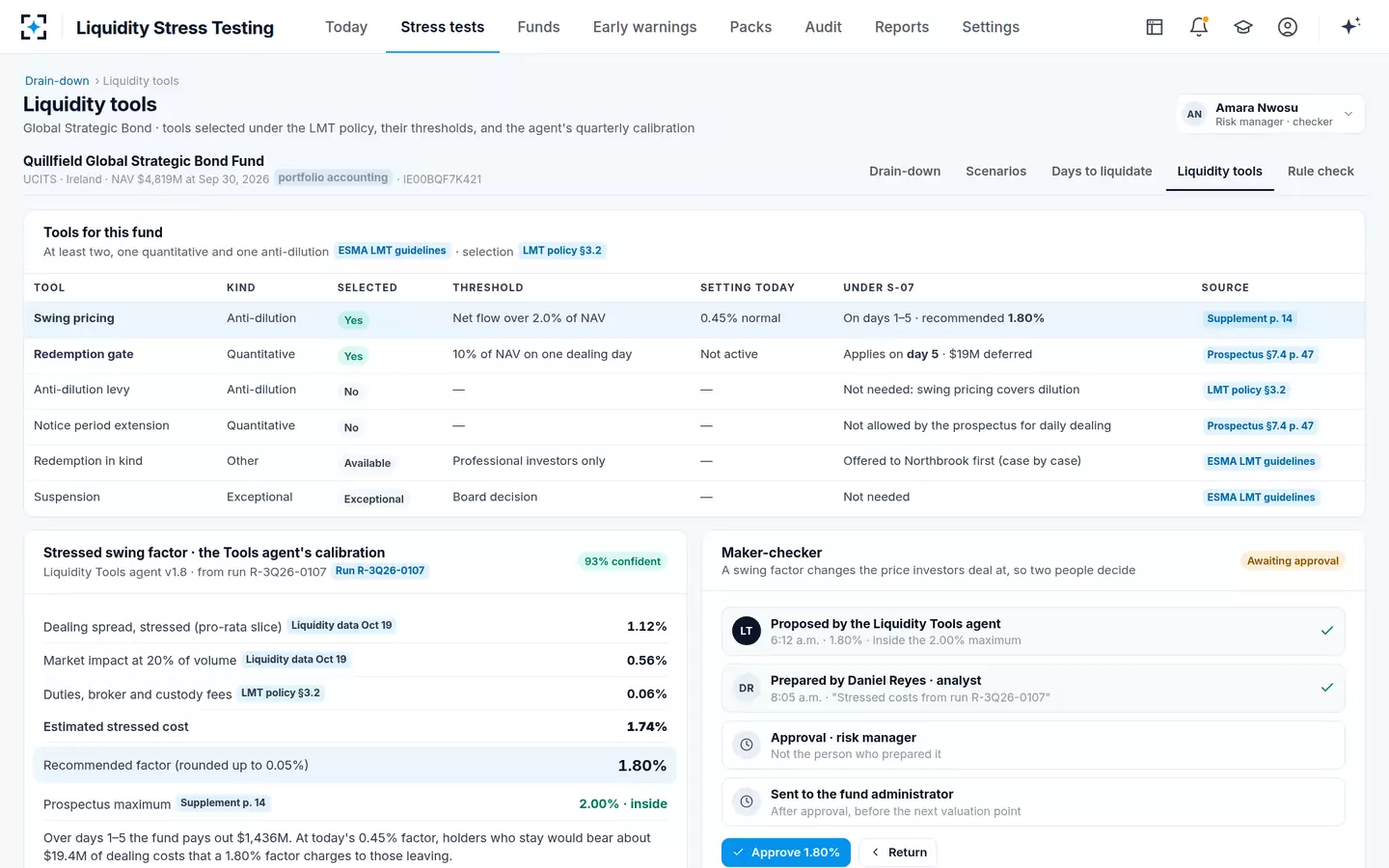
The sample manager's Irish bond fund shows what that looks like in one quarter. The fund selected swing pricing as its anti-dilution tool and a 10% limit on redemptions on any one dealing day as its quantitative tool. Under the approved stress scenario, requests reach 10.4% of net assets on day 5, the limit applies and $19 million is deferred to day 6, a day after the fund has already run out of highly liquid assets. Extending notice periods is not available because the prospectus offers daily dealing, and redemption in kind is offered to the largest professional holder first, case by case.
Each selected tool and its threshold in Liquidity Stress Testing
How a redemption limit and a swing factor work together on a stressed day
On the days that matter, both selected tools act at once, and the stress test has to model them together. The swing factor changes the price every redeeming investor receives; the redemption limit changes how much of each order is paid. Under the Commission's regulation, once the limit applies the fund pays every investor's order "on a pro rata basis", so a holder asking for $100 million on a day when requests are 4% above the threshold receives about $96 million and carries the rest to the next dealing day, at that day's price and, if the swing still applies, that day's factor.
The drain-down in Liquidity Stress Testing, with both tools drawn as lines
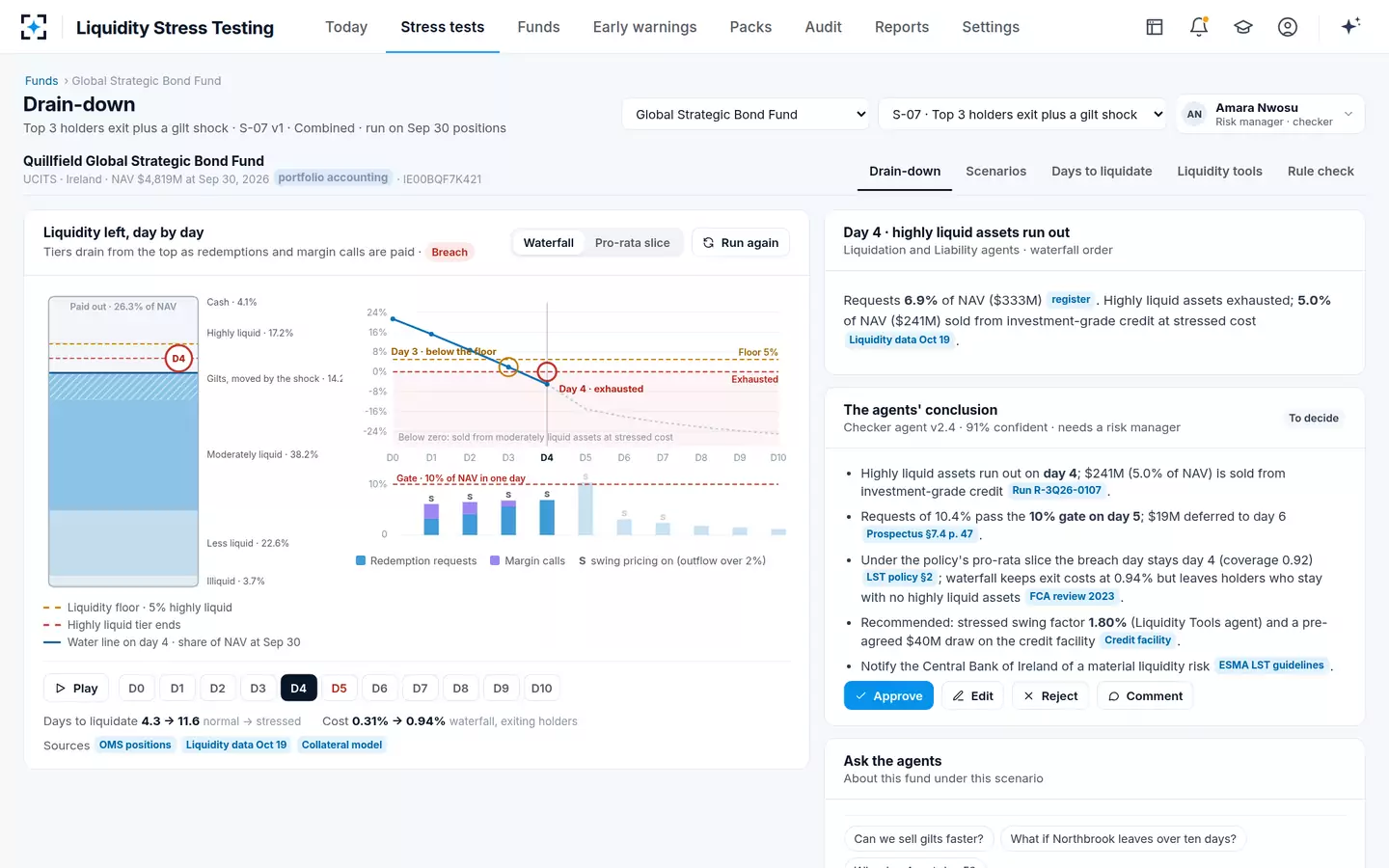
Two design choices follow from this. The test must carry deferred amounts forward rather than drop them, or day 6 looks calmer than it will be. And the activation policy must say how investors are told, because ESMA asks managers to treat orders "in a manner which avoids that some investors benefit from information on the probability that LMTs may be activated" (paragraph 18): a fund that publishes how close it is to its threshold invites the run the tool exists to prevent.
The test also shows what the tools do not do. The redemption limit acts a day after the highly liquid assets run out, so it protects the fund from day 5 onwards but not on day 4. Whether that is acceptable is a judgement for the risk manager and, ultimately, the board; finding the day a fund breaks is how the question gets asked precisely.
What national regulators will ask to see
Expect three requests. First, the selection itself and the "detailed policies and procedures for the activation and deactivation of any selected liquidity management tool", which the directive says must be communicated to the home regulator. Second, notice of activations outside the ordinary course: for AIFs, the directive requires the manager to notify its regulator "without delay" when it activates or deactivates suspension, or any of the tools in points 2 to 8 "in a manner that is not in the ordinary course of business as envisaged in the AIF rules". Third, the evidence ESMA's paragraph 17 describes, that the calibration is "appropriate and effective".
National regulators had two months from publication of the translated guidelines to tell ESMA whether they comply, and "In the absence of a response by this deadline, competent authorities will be considered as non-compliant" (paragraph 10). A regulator that complies may still add detail of its own, so managers should read their home regulator's text beside ESMA's. The guidelines themselves are direct about responsibility: "The primary responsibility for liquidity risk management, as well as for the selection, calibration, activation and deactivation of LMTs, remains with the fund manager" (paragraph 12).
A readiness checklist for existing funds before April 2027
For a fund that existed before 16 April 2026, the twelve months to April 2027 are for evidence as much as documents. The checklist below is ordered so that each step feeds the next.
Before 16 April 2027: ten steps for an existing fund range
- Map each fund to its dealing terms and investor base
Frequency, notice, settlement, and the share held by the largest holders and by each investor type.
- Shortlist tools per fund from points 2 to 8
One quantitative and one anti-dilution tool as a default; never swing and dual pricing alone.
- Run the shortlist through the liquidity stress test
Find the day each threshold is reached and what each tool changes. ESMA lists stress test results as a selection factor.
- Calibrate thresholds from flows and stressed costs
Historical flows for thresholds; spread, impact and explicit costs for swing factors and levies.
- Write activation and deactivation policies
Who decides, on what evidence, and how investors are told; avoid leaking how close a threshold is.
- Amend the prospectus or fund rules
The tools must be in the fund rules or instruments of incorporation to be usable.
- Prepare dealing and administration
Pro rata execution of limited orders, carry-forward of deferred amounts, and swing factor delivery to the administrator.
- Communicate the selection to the home regulator
With the policies and procedures, as the directive requires.
- Set the review cycle
ESMA expects calibrations to be reviewed regularly and adjusted when needed.
- Keep the evidence
Each calibration, approval and activation decision with its reason, ready for a supervisor's request.
Botminds' Liquidity Stress Testing carries steps three and four for the whole range and keeps the seventh honest: a liquidity tools agent calibrates swing factors, redemption limits, levies and notice periods from stressed costs and tests when each would activate, but it never activates a tool or changes a factor, and never recommends beyond a prospectus maximum. A change goes to the fund administrator only after an analyst prepares it and a risk manager approves it. To test your own funds' selections, start from Liquidity Stress Testing.
Questions people ask
What are the RTS on liquidity management tools?
They are Commission Delegated Regulations (EU) 2026/465 for AIFs and 2026/466 for UCITS, adopted on 17 November 2025 from ESMA's draft regulatory technical standards. They define the characteristics of each of the nine tools, apply from 16 April 2026, and deem funds constituted before that date compliant until 16 April 2027.
Can a fund choose swing pricing and dual pricing as its two tools?
No. Both the AIFMD and the UCITS Directive now say the selection may not include only points 5 and 6 of the annex, swing pricing and dual pricing. A fund may select either of them alongside another tool, and ESMA suggests pairing an anti-dilution tool with a quantitative one.
Do money market funds need two liquidity management tools?
No. A fund authorised as a money market fund may select only one tool from points 2 to 8 of the annex. Money market funds remain subject to their own regulation's liquidity and stress testing rules as well.
Are suspension and side pockets among the tools a fund selects?
No. Member states must make all nine tools available, but suspension (point 1) and side pockets (point 9) sit outside the points 2 to 8 from which the two are chosen. ESMA's guidelines treat both as tools for exceptional circumstances, with suspension to be "temporary" and side pockets for assets whose valuation or legal status has become uncertain.
What is an investor-level redemption limit?
It is a limit applied to each investor's own redemption order rather than to the fund's total requests. The Commission added it for AIFs in its regulation, and ESMA's amended guidelines say managers of AIFs with no retail investors and a limited number of professional investors should consider investor-level limits, alone or with fund-level ones, "to mitigate first mover advantage".