Liquidity stress testing models fail in a particular way: they produce a result in the right format, with the right scenarios and the right sections, and the result is wrong because of an assumption nobody priced. Supervisors have found the same handful of them in review after review: selling the most liquid assets first, which the FCA said creates "a false sense of security"; margin calls left out of the model; listed securities presumed liquid without volume data; and liquidity forecasts that ESMA found could be "unrealistically stable or even improving" in a crisis. A model that passes every compliance checklist can still tell a board its fund survives a week it would not survive. Botminds' Liquidity Stress Testing is built to test the answer, not the format: it runs both sale orders on every fund, adds the liability side, flags every position priced on proxy data, and has a separate agent recompute and challenge each result before a person approves it.
The comparisons use the solution's fictional sample fund, Quillfield Global Strategic Bond Fund, a $4.8 billion Irish UCITS, under its approved scenario of the three largest holders leaving during a gilt shock.
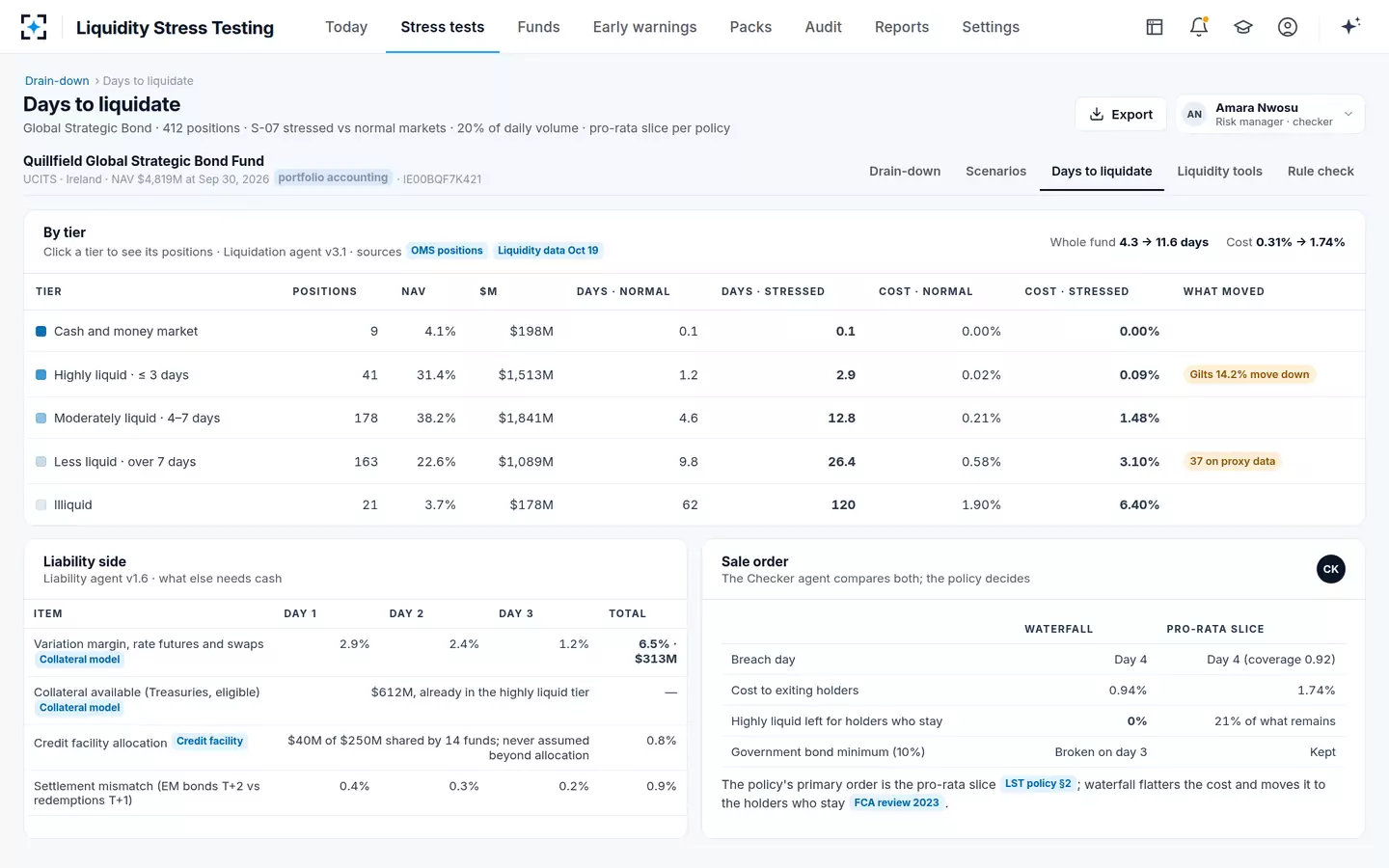
Two compliant answers for the same fund: most liquid first, and a pro rata slice
Most liquid first (waterfall): Day 4.
Pro rata slice of every holding: Day 4, with a redemption coverage ratio of 0.92.
Most liquid first (waterfall): 0.94% of what they redeem.
Pro rata slice of every holding: 1.74% of what they redeem.
Most liquid first (waterfall): None.
Pro rata slice of every holding: 21% of what remains.
Most liquid first (waterfall): Broken on day 3.
Pro rata slice of every holding: Kept.
Most liquid first (waterfall): A breach on day 4 at an exit cost under 1%.
Pro rata slice of every holding: A breach on day 4 at an exit cost of 1.74%, with a fund still able to meet the next week.
What does a liquidity stress test miss?
Usually not a section but an effect. ESMA's 2020 review of UCITS liquidity risk management, run with all 30 national regulators, listed what it found in the weaker cases: methodologies "not always appropriate, not forward-looking and, more frequently, not justified and back-tested"; monitoring with an "absence of analyses involving all liabilities, lack of investors behaviour modelling and forward-looking estimates"; and, "In some particularly worrisome cases, margin calls were not considered at all" (ESMA34-43-880, 24 March 2021). It also found "Overreliance on liquidity presumption with regard to listed securities", where a listing was taken as proof of liquidity without data on volumes.
"In some cases, LRM mechanisms and methodology were too static ... This may result in unrealistically stable or even improving liquidity forecasts in crisis time."
ESMA, public statement on the 2020 common supervisory action on UCITS liquidity risk management
Each of those is a model that would pass a format check. It has scenarios, it reports a coverage ratio, it is documented. What it lacks is a way for its answer to change when the world does: a classification that moves when spreads widen, a liability that appears when rates move, a volume assumption that falls in a stress. The COVID-19 period, ESMA added, "revealed cases of lack of reactivity or adaptation", including weak "understanding of the limits of the models employed to the changed market conditions".
Waterfall vs pro rata sale order: two compliant answers
Both orders are allowed, and they give different answers to different questions. The FCA's 2023 review put the regulators' preference plainly: "Many firms in their models used the less conservative approach of assuming the most liquid assets would be sold first, creating a false sense of security, and affecting portfolio composition if executed. This approach provides a distorted view of real portfolio liquidity and makes stress tests less effective in comparison to a more conservative pro-rata approach to modelling, where a proportionate 'slice' of every asset comprising the portfolio is contemplated to accommodate the redemption" (FCA, Liquidity Management multi-firm review, July 2023).
The sample fund shows why the choice can hide inside a passing result. Both orders break on day 4, so a model that reports only the breaking day looks the same either way. The difference is in who pays: the waterfall gives leavers an exit cost of 0.94% and leaves the remaining investors with no highly liquid assets and a government bond minimum already broken, while the pro rata slice charges leavers 1.74% and keeps a fifth of what remains in highly liquid assets. ESMA's guidelines say the liquidation method must "reflect the fund being managed in the interests of all investors, both those redeeming and remaining" (ESMA34-39-897, paragraph 47). A model that only computes the waterfall cannot show that it does.
The classification that moved the breaking day
The most consequential error on the sample fund was not in the sale order but in a label. The first overnight pass kept 14.2% of net assets in long gilts in the highly liquid tier, because in normal markets they sell in under three days. The scenario, though, is a gilt shock in which gilt bid-ask spreads widen fourfold, as they did in 2022. The checking agent challenged the classification at 3:02 a.m., moved the gilts to the moderately liquid tier, and the breaking day moved from day 5 to day 4.
One fund, four sets of assumptions, three different breaking days
A model with static liquidity buckets would have reported day 5 and passed every structural test. This is the "too static" failure in ESMA's review, and the fix is not a better report but a model whose classifications respond to the scenario it is running. The assumptions behind the methodology decide whether a model can make that move at all.
Two halves that pass separately and fail together
A model can test the asset side and the liability side correctly and still miss the breach, if it never runs them on the same days. ESMA asks managers, after testing each side, to "combine the results of the LST appropriately to determine the overall effect on fund liquidity" (paragraph 67), because the dangerous days are the ones on which both sides move at once.
The sample fund shows how. Taken alone, its 6.5% of variation margin over three days is well inside a 21.3% buffer, and so are the first three days of redemptions. Taken together, they draw 6.1%, 6.5% and 6.8% of net assets on days 1 to 3, leaving 1.9% at the close of day 3, below the fund's own 5% floor, and nothing on day 4. A model that reports a margin stress and a redemption stress as two passing results has told the committee two true things and missed the only one that matters.
How do you validate a liquidity stress testing model?
Test what it says against what happened, against itself and against an independent recomputation. ESMA asks for "initial validation of the LST models and assumptions underpinning them, which should be performed independently from portfolio management, though not necessarily by an entity/person external to the manager" (paragraph 24(h)), and its review criticised methodologies that were "not justified and back-tested". The FCA's good practice is "regular challenge, review and updating of the firm's models (whether internal or external), supported by qualitative and quantitative assessments of liquidity conditions, and analysis of their drawbacks and weaknesses".
Five tests a liquidity stress testing model should pass beyond its format
| Test | How to run it | What failure looks like |
|---|---|---|
| Replay a real stress | Run the model on the fund's holdings and holders before March 2020 or September 2022, and compare its daily path with actual flows, prices and sales. | The model says the fund had days to spare when it was selling at a discount. |
| Back-test costs | Compare the model's stressed costs with the fund's own executed prices in volatile weeks. | Modelled costs a fraction of what the desk paid. |
| Flip one assumption at a time | Change sale order, participation, classification and holder pace one by one, and note the breaking day. | The result never moves, or moves only one way. |
| Recompute independently | Have a second model or person rebuild the result from the same inputs. | Differences nobody can explain. |
| Read the distribution | Look at how many funds pass, watch and breach across the range, quarter after quarter. | Nothing ever breaches. |
Results that never fail are a finding too
A model that passes every fund every quarter is more likely to be lenient than the funds are to be safe. The FCA was explicit: "Where the results suggest that no or few funds ever fail tests, it should be considered whether thresholds and triggers set by the firm are not challenging enough to reflect volatile and stressed market conditions." The Bank of England's 2024 system-wide exercise made the same point from the market side: "In the SWES firms are often not able to anticipate how their counterparties, investors, or markets they operate in behave in the stress, which could leave them underprepared in a real stress" (Bank of England, November 2024).
The sample manager's third-quarter results across 90 funds were 78 passing, 9 on watch and 3 breaching under stress. That spread is not a target, but it is the kind of distribution that shows a test with teeth: the breaches were in a bond fund with concentrated holders, an emerging-market local debt fund and a real estate income fund, each for reasons a committee can read.
Days to liquidate and both sale orders, side by side, in Liquidity Stress Testing
Which liquidity stress testing model should a fund buy?
The one whose answers you can reproduce, challenge and explain to a regulator, whoever built it. Vendors do not publish comparable accuracy figures for these models, and no regulator or independent study ranks them, so the evaluation has to be done on your own funds. The checklist below is the set of questions we would put to any model, including ours.
Ten questions to ask any liquidity stress testing model before you rely on it
- Does it compute both sale orders on every run?
And show who bears the cost under each, not just the breaking day.
- Do classifications respond to the scenario?
A gilt shock should be able to move gilts out of the highly liquid tier.
- Does it model the liability side beyond redemptions?
Margin, collateral, the fund's share of a credit line and settlement gaps, day by day.
- Does it read the register?
Holder types and concentration, not a percentage outflow applied to every fund.
- Are participation rates stressed?
And can you see the volume assumption behind every position's days to liquidate?
- Does it flag proxy and stale data?
With results marked provisional until someone approves the proxy.
- Can someone recompute any result independently?
From the same inputs, with every figure traced to its source.
- How are overrides handled?
Who can request one, who approves it, and is the evidence kept with it?
- Does it check results against each fund's own rulebook?
UCITS, AIFMD, Rule 22e-4 and the prospectus, cited cell by cell.
- Can you export the evidence for an auditor or regulator?
Including model and agent versions, approvals and reasons.
Where Botminds' Liquidity Stress Testing fits, and where it does not, is easy to state. It does not replace your market liquidity data: it reads two vendors' feeds and flags data that arrives late, stale or empty. It does not write your policy: frequency, floors, sale order, participation and thresholds are settings taken from your own LST and liquidity tool policies. It needs the transfer agent's register and flow history to build scenarios from holders, and where a register hides holders behind nominee accounts, its concentration analysis is only as good as what the register shows. What it adds is the run of every fund through every scenario, both sale orders, the liability side, a checking agent that recomputes and challenges, and an approval chain in which no agent activates a scenario, a tool or a notice.
Outsourced models and the understanding gap
Buying a model does not transfer responsibility for it. ESMA asks managers to justify "reliance on third parties' LST models, including where the model is developed by a third party portfolio manager" (paragraph 37), and where portfolio management is delegated, to pay "particular attention ... to the independence requirement, in order to avoid reliance on or influence by the third party's own LST" (paragraph 22). The FCA found the gap these rules aim at: "Some firms had a limited understanding of the models and methodologies used, particularly when their construction is outsourced and there is insufficient internal evaluation of the stress tests results."
The practical test for any bought model, then, is whether your own risk team can explain any one result from its inputs without calling the vendor. In Liquidity Stress Testing, every value names its source, whether an order management position, a register date, a liquidity feed and its date, a prospectus page or a rule paragraph, and the agents explain each day of a fund's drain-down in their own words, with those sources, to anyone who asks.
What a second model catches: the checker pattern
A second, independent computation catches errors the first model cannot see in itself, which is why the solution separates the agents that compute from the one that checks. The checking agent recomputes the liquidation and liability agents' work, compares both sale orders, tests each result against the applicable rules and the prospectus, and challenges assumptions such as a classification the scenario should have changed. It never resolves a disagreement itself; when it and another agent disagree, or its confidence is below the 85% the sample manager has set, a person decides.
Every step on the audit trail of Liquidity Stress Testing, with version and evidence
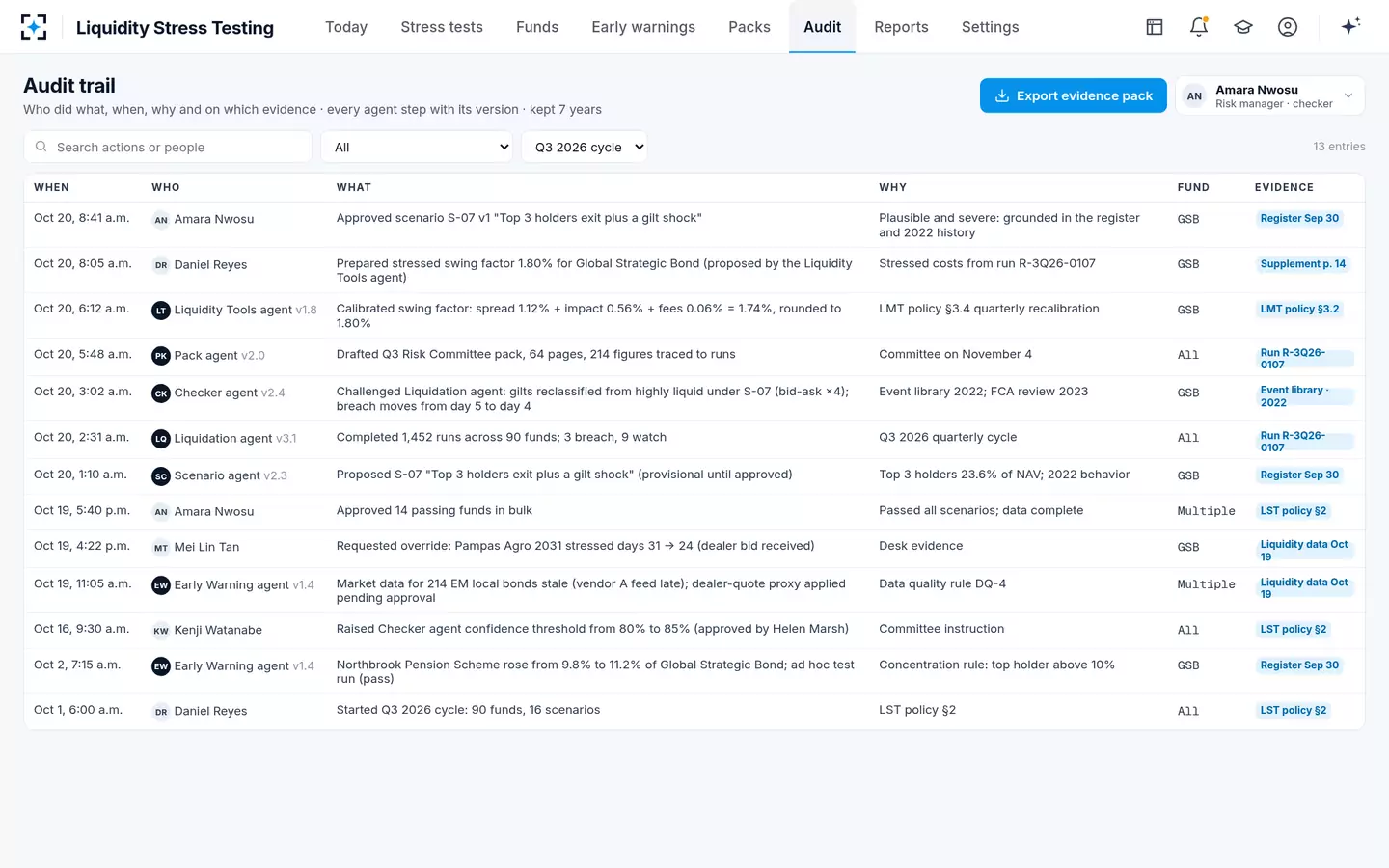
That pattern answers the validation question in a way a single model cannot. When a regulator asks why a fund broke on day 4 and not day 5, the answer is on the trail: which agent challenged which classification, on what evidence, and which person approved the result with what reason. To run the same comparison on your own funds and your current model, start from Liquidity Stress Testing, or see how a pilot replays last quarter side by side with it.
Questions people ask
What is a pro rata liquidation approach?
It is a sale order in which the fund meets redemptions by selling a proportional slice of every holding, so the portfolio left behind has the same liquidity profile as before. The FCA prefers it to selling the most liquid assets first, which it found creates "a false sense of security", and ESMA's anti-dilution guidance uses the same pro rata basis as the starting point for estimating the cost of liquidity.
What is a combined liquidity stress testing model?
It is one that runs the asset and liability sides together, day by day, rather than reporting them separately. Beyond catching days on which both sides move at once, ESMA says a combined test can show "which funds present the largest liquidity risk at a given moment", which makes it the basis for comparing funds across a range.
Can a fund rely on a vendor's liquidity stress testing model?
Yes, but the manager stays responsible for it. ESMA requires managers to justify their reliance on third-party models and to validate models and their assumptions independently of portfolio management, and the FCA criticised firms with "a limited understanding" of outsourced models.
How often should a liquidity stress testing model be revalidated?
At least whenever the LST policy's periodic review comes round, and sooner after a market event the model failed to anticipate. ESMA requires the policy to provide for "periodic review, documentation of the results and a procedure for amending the policy where required by the review".
Does a model need the investor register?
To meet ESMA's guidelines, it needs what the register knows. The guidelines expect every fund's test to reflect who its investors are and how concentrated they are, and a model that only applies a percentage outflow cannot show either. Where the register is held by a transfer agent, the model needs that feed, including the holders behind nominee accounts where they can be identified.