A liquidity risk management program is the written program every US open-end fund other than a money market fund must adopt under SEC Rule 22e-4 "that is reasonably designed to assess and manage its liquidity risk" (Rule 22e-4(b)). It must classify every investment into four buckets, keep illiquid holdings at or below 15% of net assets, set a highly liquid investment minimum where needed, and report to the board, and the rule names who answers for it: an administrator designated by the board, which may be the adviser or the fund's officers but "may not be solely portfolio managers", and a board that approves the program, approves the administrator and reads an annual report on whether it works. The hard part is the chain in between, where an analyst, a vendor feed, a portfolio manager and a compliance officer each touch a bucket. Botminds' Liquidity Risk Management Program is an agentic solution that does the proposing and checking with agents and leaves every approval with a named person, so the chain can be read back.
The figure below walks one decision, a bucket that moves, from the first proposal to the board, with the line no one in the chain may cross. The rest of the page sets out what the rule requires of each person and what the SEC's examiners have found missing.
One bucket change in a liquidity risk management program, from proposal to board
Agent
Classification agentProposes a bucket from days to US dollars at the program’s trade size and value impact, with its sources.
Never: Finalises a bucket below its confidence threshold, and never relabels a holding to stay under a limit.
Agent
Checker agentRe-tests the proposal: the same security in every fund, back-tests of real sales, stale data.
Never: Closes its own challenge.
A person decides
Liquidity analystReviews the proposal, answers challenges, proposes overrides with a reason code.
Never: Approves a proposal of her own.
A person decides
Portfolio managerAdds market colour: dealers, likely bids, planned trades.
Never: Approves a bucket in his own funds; the rule bars a program run solely by portfolio managers.
A person decides
Program administratorApproves buckets, overrides and escalations; reports breaches and shortfalls to the board.
Never: The same person as the proposer.
A person decides
Chief compliance officerCo-signs any Form N-RN before it is filed.
Never: Files on an untraced figure.
A person decides
BoardApproves the program and the administrator; reads the annual report; reassesses any above-15% plan every 30 days.
Never: Left to learn of a breach at the next quarterly meeting.
What is a liquidity risk management program under Rule 22e-4?
It is a set of written policies and procedures with five required parts: assessing, managing and at least annually reviewing liquidity risk; classifying each investment; a highly liquid investment minimum for funds that need one; the 15% limit on illiquid investments; and, for funds that redeem in kind, procedures for how and when they do it (Rule 22e-4(b)(1)). The liquidity risk assessment must consider the strategy and portfolio liquidity "during both normal and reasonably foreseeable stressed conditions", short- and long-term cash flow projections, and holdings of cash, cash equivalents and borrowing arrangements.
People search for a "liquidity risk management policy" or "framework"; the rule's word is program, and its distinctive feature is that every part has an owner. A policy that describes the buckets but not who approves an override, who reports a breach and who reads the report is not yet a program. Stress scenarios that feed the "reasonably foreseeable stressed conditions" are a discipline of their own; Botminds covers them in Liquidity Stress Testing, and liquidity stress testing requirements, SEC vs ESMA sets the rulebooks side by side.
The program's accountability, in the rule's numbers
1
administrator, or group of officers, designated with the board’s approval
3
board approvals: the program, the administrator, and any change to a minimum during a shortfall
30
days between board reassessments while a fund stays above 15% illiquid
5years
to keep the program and board materials, the first two easily accessible
Who can be the liquidity program administrator?
The fund's investment adviser, or an officer or officers of the fund, "which may not be solely portfolio managers of the fund" (Rule 22e-4(a)(13)). A committee is allowed; a committee made up only of the fund's portfolio managers is not. The board approves the designation, including a majority of independent directors.
The administrator can sit outside the main adviser. The SEC staff say a fund's sub-adviser may be named program administrator (the staff's FAQ, explained), or be given specific tasks such as classification under supervision, while "the fund at all times retains ultimate responsibility for complying with the rule" (SEC staff FAQ, Q1). In a manager-of-managers structure the staff do not require differences between sub-advisers' classifications to be resolved for compliance, but the fund must reconcile them for N-PORT reporting (Q7). Whoever administers the program owns that reconciliation.
Portfolio managers are not shut out: they know where the bids are, and a program that ignores them classifies blind. The rule's line is about who decides, not who speaks. The cleanest way to hold it is the one in Botminds' Liquidity Risk Management Program, where the portfolio manager adds market colour to an escalation in his own name but the approval control is locked for his funds.
The classification chain: proposer, checker, approver
The rule does not prescribe maker and checker, but it makes them necessary. Classification must use "information obtained after reasonable inquiry and taking into account relevant market, trading, and investment-specific considerations" (Rule 22e-4(b)(1)(ii)); someone has to show that the inquiry happened. The SEC's 2021 risk alert put the vendor in the chain too, listing the oversight of vendors that supply liquidity classifications as an exam focus (vendor buckets, models or agents; SEC risk alert, 26 October 2021), and since 17 November 2025 Form N-CEN names each liquidity service provider and the asset classes it classified (89 FR 73764).
The dismissed Pinnacle case shows the chain failing at its first link. In the settled order against one trustee, which he neither admitted nor denied, the SEC found that a restricted private placement was classified "less liquid" on a portfolio manager's belief that he could sell it in seven days, against the advice of fund counsel and the auditors (Release IA-6303). The case against the other defendants was dismissed with prejudice in July 2025; SEC v. Pinnacle Advisors, read for boards separates the allegations from the findings.
Five people in the chain, and what each keeps
Today
Approves overrides from a spreadsheet comment and an email thread; reconstructs the reason at exam time.
With agents
Approves each bucket change with the reason, the source and the checker’s verdict on one screen.
Still theirs: Every approval, every board report, the minimum.
Today
Rekeys vendor buckets and writes override reasons by hand for hundreds of holdings.
With agents
Reviews the agents’ proposals, answers challenges and proposes the judgement calls.
Still theirs: Answers to challenges; never approves her own proposals.
Today
Hears about the 15% limit when it stops a trade.
With agents
Sees his funds’ projections days ahead and adds market colour to escalations.
Still theirs: Market colour; no approval on his own funds.
Today
Co-signs a Form N-RN under a one-business-day clock on figures she cannot trace.
With agents
Co-signs a draft kept current daily, each figure linked to its source.
Still theirs: The second signature on every filing.
Today
Reads an annual report that lists events but not evidence.
With agents
Reads a cited report and asks it questions in plain words.
Still theirs: Program approval, administrator designation, the 30-day reassessment.
What does the board approve in a liquidity risk management program?
Three things, and each needs a majority of directors who are not interested persons: the program itself, initially; the designation of the administrator; and any change to a highly liquid investment minimum while the fund is below it (Rule 22e-4(b)(1)(iii)(A)(1), (b)(2)). The board also reviews a written report from the administrator at least annually, and while a fund stays above 15% illiquid it must assess, 30 days after the breach and every 30 days after that, whether the plan "continues to be in the best interest of the fund".
The adopting release describes this as "one of general oversight", in which directors "exercise their reasonable business judgment in overseeing the program" (Rule 22e-4 adopting release, 2016, as quoted in Release IA-6303). General is not passive. The SEC's November 2024 risk alert reported boards that "did not adopt certain written policies and procedures tailored to the funds' operations (e.g., liquidity risk management program" and minutes that did not "memorialize the approval of funds' liquidity risk management programs" (SEC Division of Examinations, 4 November 2024).
Fund board minutes did not fully document board actions, (e.g., memorialize the approval of funds' liquidity risk management programs ...).
SEC Division of Examinations, risk alert, 4 November 2024
What goes in the annual board report on liquidity?
The rule sets the floor: a written report prepared by the administrator "that addresses the operation of the program and assesses its adequacy and effectiveness of implementation, including, if applicable, the operation of the highly liquid investment minimum, and any material changes to the program" (Rule 22e-4(b)(2)(iii)). Operation is what happened; adequacy and effectiveness are a judgement about whether it worked, and a report that only lists events has not made the judgement.
The annual liquidity report: what a trustee should find in it
- How classification ran
Holdings classified each month, overrides by reason, intra-month reviews and what triggered them.
- The 15% limit
Peak illiquid share by fund, early warnings, any breach with its board report, Form N-RN Parts B and C, and 30-day reassessments.
- Every highly liquid minimum
Level, annual review, any shortfall, the seven-day clock, any Form N-RN Part D.
- Evidence the classifications held
Back-tests of real sales against the bucket each carried; cross-fund differences and how they were resolved.
- Vendors and sub-advisers
Who supplied buckets for which asset classes, how they were overseen, any change of provider.
- Material changes
To trade sizes, value-impact thresholds, triggers or the minimum, with the reason for each.
- An assessment, signed
Whether the program was adequate and effectively implemented, and what will change.
The report also has to reflect what the SEC now examines. The fiscal 2027 priorities single out funds that hold complex products and less liquid or illiquid investments, private credit among them, with the valuation, redemption and disclosure questions they raise (SEC, FY2027 examination priorities). A fund with private credit in a daily-dealing portfolio should expect a trustee to ask how those holdings were classified and by whom.
How long must liquidity program records be kept?
Five years, with the first two in an easily accessible place, for three sets of records. The rule specifies each period separately, and they do not start on the same day.
Liquidity risk management program records: what to keep, and for how long
| Record | How long | From when |
|---|---|---|
| The written program and its policies and procedures | Any version in effect within the past five years, kept easily accessible | Each version, while in effect and five years after |
| Board materials for the program’s approval and the annual reports | At least five years, the first two easily accessible | The end of the fiscal year in which they were provided |
| How each highly liquid minimum and adjustment was determined, with shortfall reports to the board | Not less than five years, the first two easily accessible | Each determination of, and change to, the minimum |
Breaches: who reports, to whom, and how fast
The administrator reports, and the clocks are short. Above 15% illiquid, the administrator reports to the board "within one business day of the occurrence" with the extent, the causes and a plan (Rule 22e-4(b)(1)(iv)(A)); the fund files Form N-RN Part B within one business day, and Part C when it is back at or below 15% (Form N-RN). Below the minimum, the report goes to the next regularly scheduled board meeting, or within one business day once the shortfall has lasted more than seven consecutive calendar days, with Form N-RN Part D. The SEC staff tie the reporting obligation to the fund verifying the breach, which they expect within three business days, while the breach period runs from the trade date (SEC staff FAQ, Q32–Q33).
The rule does not say who signs Form N-RN for the fund. In Botminds' Liquidity Risk Management Program the Program Administrator signs a draft as ready and the chief compliance officer co-signs it; a person then files it through the fund's filing agent. The agents keep the draft current every day and never file.
Liquidity Risk Management Program: the plan to approve, with the maker-checker chain
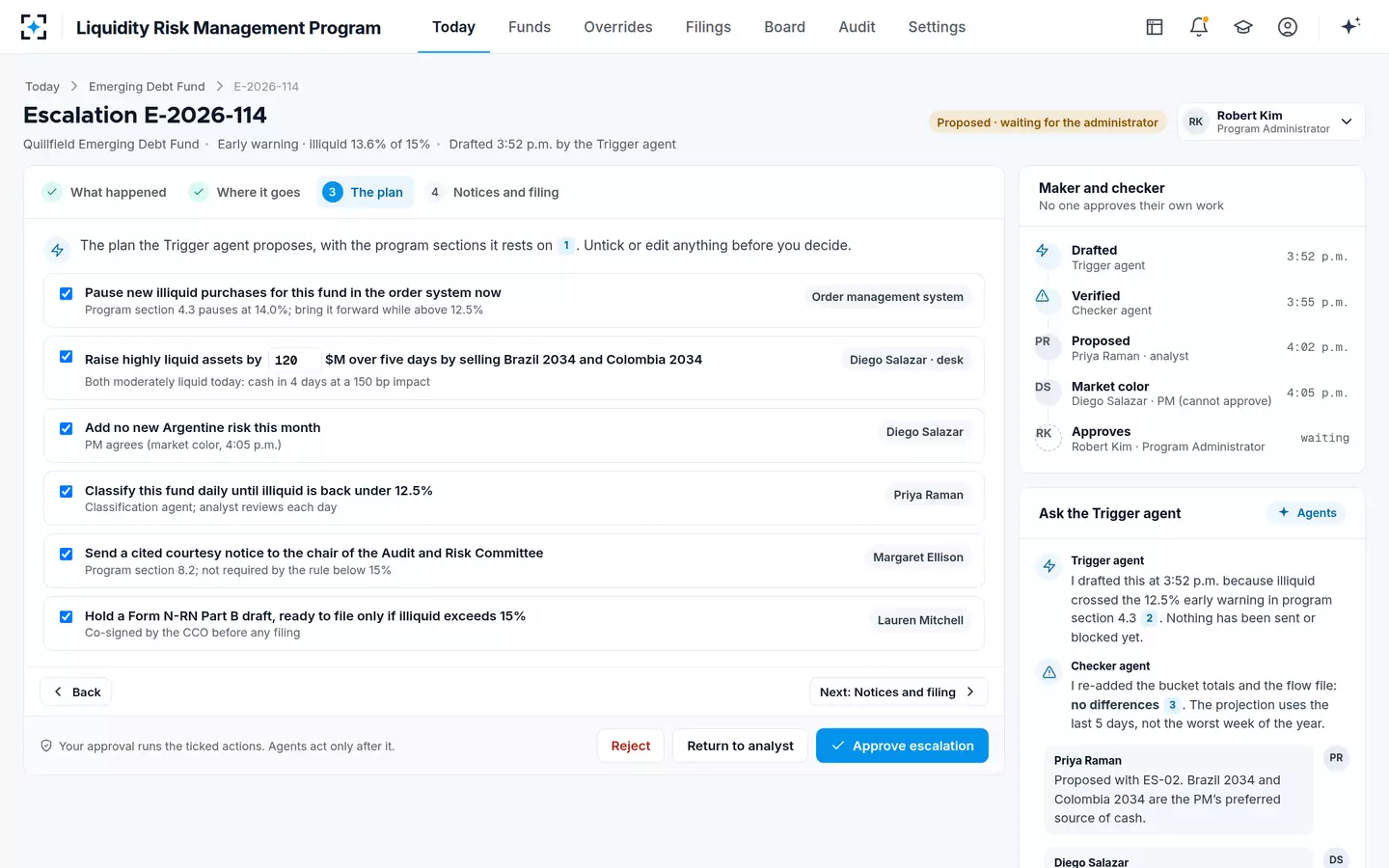
The portfolio manager's market colour is recorded in the chain, but his approval control is locked: the rule bars a program run solely by portfolio managers, and the solution goes further on his own funds.
Where examiners have found the chain broken
The SEC's published exam findings point at governance more than at models. The 2024 risk alert grouped liquidity risk management programs with policies that "did not appear to be reasonably designed" or "did not appear to be effectively implemented", and found boards that had not adopted tailored programs or had not minuted approving them (SEC risk alert, 4 November 2024). The 2021 alert asked how each fund administered its program and oversaw the vendors that supply buckets (SEC risk alert, 2021). The 2024 guidance added a third: funds "not prepared to review classifications intra-month" when markets moved (89 FR 73764).
Each finding is a missing signature. An unminuted approval is a board signature that cannot be shown. Unsupervised vendor buckets are approvals nobody gave. An intra-month review that never happened is a trigger nobody owned. The remedy is the same in each case: a chain in which every step leaves a dated, attributed record with its evidence. Which of those steps agents can take over, and which must stay with the people above, is worked through in AI tools for mutual funds' liquidity programs.
The administrator's day in Liquidity Risk Management Program: what needs a signature
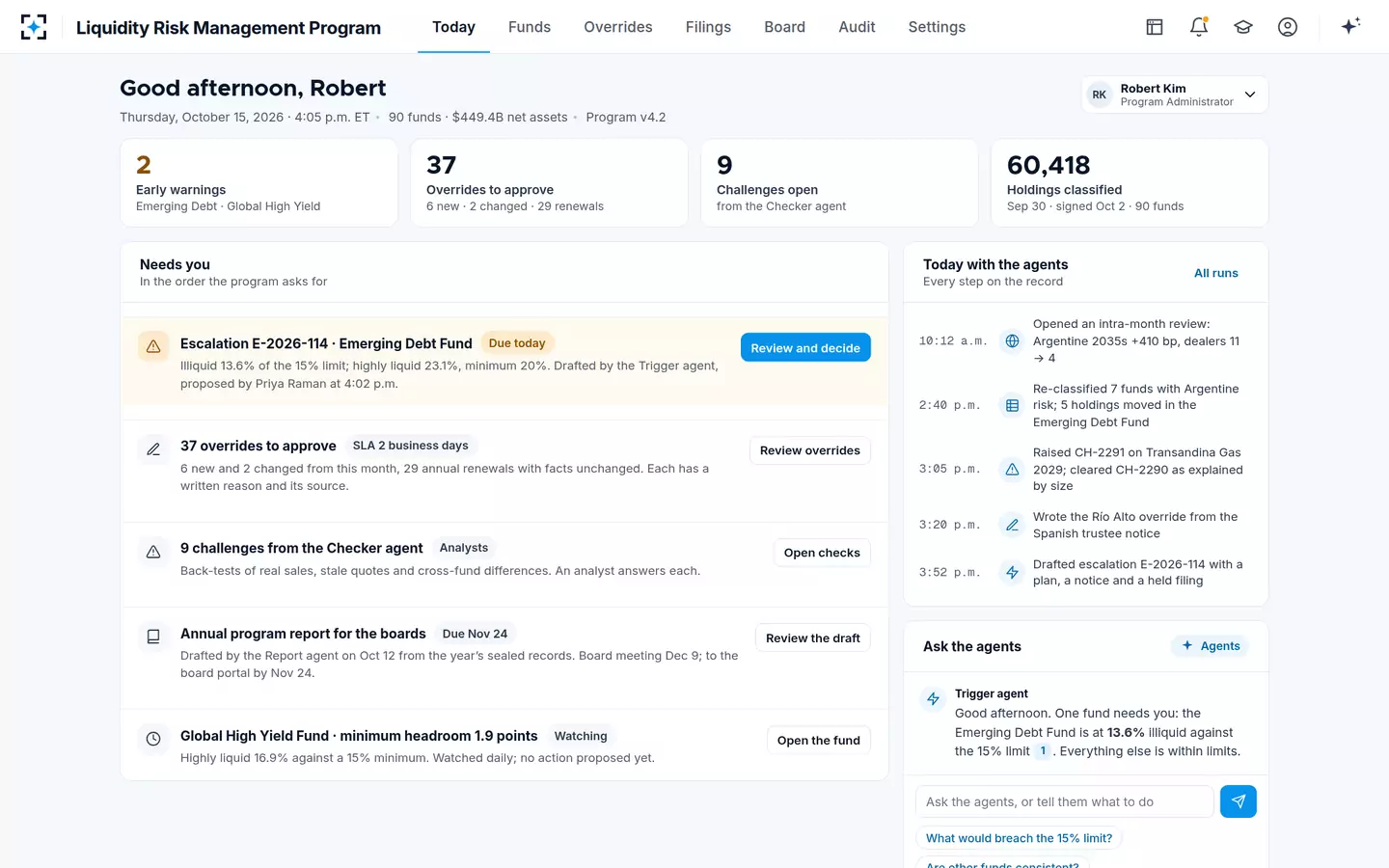
Questions people ask
Is a liquidity risk management program required for every mutual fund?
Every registered open-end fund except a money market fund must adopt one under Rule 22e-4, and so must In-Kind ETFs, though they do not classify holdings or set a minimum. Unit investment trusts have a single duty at the time of deposit instead of a program.
Can the chief compliance officer be the liquidity program administrator?
The rule allows the adviser or an officer or officers of the fund, so a fund officer such as the chief compliance officer is not excluded; the only stated limit is that the administrator may not be solely portfolio managers. A fund that wants its compliance officer to test the program independently can keep the two roles apart; the rule permits either.
Does the board approve each liquidity classification?
No. The board approves the program and the administrator, reads the annual report and reassesses any above-15% plan every 30 days; classifications are the administrator's responsibility under the program. The board does have to approve any change to a highly liquid investment minimum made while the fund is below it.
Must a liquidity risk management program be reviewed every year?
Yes, in two ways. The fund must review its liquidity risk at least annually, and the board must review the administrator's written report on the program's operation, adequacy and effectiveness at least annually. Highly liquid minimums must also be reviewed at least annually.
Can one adviser run different liquidity programs for different funds?
Yes. The SEC staff say an adviser may administer several funds' programs that differ from one another and need not reconcile their methods or outputs; each fund's board-approved program governs how the adviser works for that fund.