A highly liquid investment minimum, or HLIM, is the percentage of its net assets that a US open-end fund commits to hold in highly liquid investments: cash in US dollars and investments it reasonably expects to convert into dollars within three business days without significantly changing their value. SEC Rule 22e-4 requires one from every fund that does not primarily hold highly liquid assets, has the fund review it at least annually, forbids lowering it during a shortfall without the board, and starts two reporting clocks when the fund falls below it (Rule 22e-4(b)(1)(iii)). It is hard to run well because the number moves with every redemption and every reclassification, and because collateral posted for derivatives can count as highly liquid while being unavailable to pay anyone. Botminds' Liquidity Risk Management Program is an agentic solution that checks every fund's minimum each business day and projects when it would be reached; named people decide what to do.
The worked example below follows one fictional fund through a month end and a run of redemptions. The fund and its numbers are invented for the example.
Highly liquid investment minimum, worked on one fund: $120M of headroom, $60M of it usable
1. Net assets
From the day’s NAV
$1,500.0M
2. Highly liquid investments that are assets
US dollars $45M + Treasuries $225M + sovereign bonds settling offshore in dollars $150M
$420.0M · 28.0%
3. Primarily highly liquid?
($420M − $60M pledged) ÷ $1,500M = 24.0%, well under the 50% the SEC called unlikely to qualify
No: a minimum is required
4. The minimum
Set by the program, approved by the board, reviewed at least annually
20.0% · $300.0M
5. Headroom
$420M − $300M
$120.0M · 8.0 pts
6. Pledged against non-highly-liquid derivatives
Treasuries posted as margin: $35M for swaps classed moderately liquid, $25M for forwards classed less liquid. Highly liquid collateral is applied first.
$60.0M · 14.3% of highly liquid
7. Unencumbered headroom
($420M − $60M) − $300M: the cash the fund can actually use
$60.0M · 4.0 pts
8. Days of runway at $25M a day of redemptions
Paid from highly liquid assets while net assets shrink by the same amount
6 days reported · 3 unencumbered
What is a highly liquid investment minimum?
It is a floor the fund sets for itself, not a number the SEC prescribes. The rule defines it as "the percentage of the fund's net assets that the fund invests in highly liquid investments that are assets", and a highly liquid investment as "any cash held by a fund and any investment that the fund reasonably expects to be convertible into cash in current market conditions in three business days or less" without significantly changing its market value (Rule 22e-4(a)(6)–(7)). Since 2024 "cash" has a precise meaning: the Commission restated that it "means U.S. dollars and does not include foreign currencies or cash equivalents" (89 FR 73764). A euro deposit is an investment to classify, not cash.
The words "that are assets" matter. Derivatives with a negative value are classified like any other investment, but they are liabilities, so they never add to the numerator. The minimum is a share of net assets, so when redemptions shrink the fund, a constant dollar amount of highly liquid holdings becomes a larger share, and a fund that pays redemptions from its highly liquid bucket loses ground slower than the dollar outflow suggests.
The 2024 guidance closed off a common misreading. The minimum "does not mean that a fund must continuously maintain a specific level of highly liquid assets and cannot use those assets to meet redemptions" (89 FR 73764). Spending the buffer in a bad week is what it is for; the rule only asks that the board hear about it.
Which funds need a highly liquid investment minimum?
Every fund covered by Rule 22e-4 that "does not primarily hold assets that are highly liquid investments" needs one. Money market funds are outside the rule and In-Kind ETFs are outside this requirement. The rule does not define "primarily", but the adopting release gives the line in practice: "if a fund held less than 50% of its assets in highly liquid investments it would be unlikely to qualify as “primarily” holding" them (81 FR 82142, 2016). A large-cap equity index fund usually qualifies; a bond, bank loan, emerging-market or small-cap fund usually does not.
The test has one mechanical trap. In deciding whether it is primarily highly liquid, a fund "must exclude" the highly liquid investments it has pledged as margin or collateral for derivatives it classified as moderately liquid, less liquid or illiquid (Rule 22e-4(b)(1)(iii)(B)). A fund at 55% highly liquid with eight points pledged against illiquid swaps is at 47% for this test, and needs a minimum.
How funds set the minimum, and the floor the SEC did not adopt
<10%
the minimum most funds with one had set, as of March 2020
SEC, 2022 proposal
~8%
of those funds had set a minimum above 50% of net assets
SEC, 2022 proposal
10%
the floor the SEC proposed for every minimum in 2022, not adopted
1year
the longest a minimum may go without review
How to calculate highly liquid investment minimum headroom, step by step
Headroom is the fund's highly liquid share minus its minimum, in points and in dollars. In the worked fund, $420M of a $1,500M portfolio is highly liquid, 28.0% against a 20% minimum: eight points, or $120M, of headroom. That is the number most dashboards print, and on its own it is the number that misleads.
Three choices sit inside step 2, and each should be written into the program. First, the trade size: the fund must ask whether selling the sizes it "would reasonably anticipate trading" changes an investment's liquidity (Rule 22e-4(b)(1)(ii)(B)), and the SEC staff rule out assuming a trade size at or near zero (SEC staff FAQ, updated 9 March 2026). Second, the value impact that counts as significant, which the staff allow to differ by fund, asset class or investment. Third, the currency leg: the $150M of sovereign bonds count only because they settle offshore in dollars within three business days. If the same bonds traded only locally and the proceeds needed a four-day conversion, they would move to moderately liquid and the fund would be at 18.0%, already short.
Do pledged assets count toward the highly liquid investment minimum?
They count in the reported percentage, but they should not count in the fund's planning, and the rule makes the fund measure them. For derivatives it classified as moderately liquid, less liquid or illiquid, a fund must "identify the percentage of the fund's highly liquid investments that it has pledged as margin or collateral" in each category (Rule 22e-4(b)(1)(ii)(C)), and the rule's note says that where a fund has pledged both kinds of assets it "first should apply pledged assets that are highly liquid investments", unless it has specifically earmarked other collateral. The minimum itself goes to the SEC on Form N-PORT, in Item B.7, which the Commission does not make public; the 2016 release wanted the pledged percentages reported so that the staff can see "what percentage of a fund's highly liquid investment minimum is composed of encumbered assets".
The adopting release says what to do with the number. A fund with significant pledged highly liquid assets "should take into account the fact that such segregated or pledged highly liquid investments may not be available to meet redemptions" when it sets its minimum (81 FR 82142). In the worked fund that means $60M of Treasuries posted as margin: the reported headroom is $120M, the usable headroom $60M.
The worked fund reports eight points of headroom. Four of them are collateral it cannot sell. At $25M a day of redemptions, that is the difference between six days of runway and three.
The runway arithmetic is short. Paying $25M a day from highly liquid assets while net assets fall by the same $25M, the fund reaches its 20% minimum when ($420M − 25d) ÷ ($1,500M − 25d) = 20%, which is after six days. Using only unencumbered assets the same equation, starting from $360M, gives three. A program that projects only the first figure will tell the board it has a week when it has half of one.
What happens after 7 days below the minimum? The two shortfall clocks
A shortfall starts two clocks, and which one runs depends on how long it lasts. The program must require the administrator to report to the board "no later than its next regularly scheduled meeting" with "a brief explanation of the causes of the shortfall, the extent of the shortfall, and any actions taken in response". If the shortfall "lasts more than 7 consecutive calendar days", the administrator must report to the board "within one business day thereafter with an explanation of how the fund plans to restore its minimum within a reasonable period of time" (Rule 22e-4(b)(1)(iii)(A)(3)). The same event requires Form N-RN Part D, filed within one business day (Form N-RN).
Two shortfall clocks: a four-day dip waits for the board meeting, an eight-day one does not
- Short4 d
- Back above; causes, extent and actions noteduntil the meeting
- Boardreport
- Short, 7 days7 d
- Report, Part D1 bd
- Restore within a reasonable periodplan runs
- Boardreport
Two details from the SEC staff decide when day one is. A breach period starts on the trade date of the event that put the fund out of compliance, so the days spent confirming a provisional classification count; and the staff expect that confirmation within three business days (SEC staff FAQ; the staff's answers, explained). A fund that takes a week to verify a shortfall has used up its seven days before it knows it had any.
The 2024 guidance put the consequence in proportion: "The only consequence under the liquidity rule of a fund dropping below its highly liquid investment minimum is the triggering of the fund's shortfall policies and procedures" (89 FR 73764). A shortfall is not a violation. Missing the board report or the Form N-RN Part D filing is.
Can a fund change its highly liquid investment minimum during a shortfall?
Only with the board. The minimum "may not be changed during any period of time that a fund's assets that are highly liquid investments are below the determined minimum without approval from the fund's board of directors", and the approval must include a majority of the independent directors (Rule 22e-4(b)(1)(iii)(A)(1)). Outside a shortfall the program can change it under its own procedures, and must keep a written record of how the minimum and each adjustment were determined for at least five years, the first two in an easily accessible place.
The design is deliberate: a minimum that can be lowered on the day it is breached is not a minimum. It also means the annual review is where the number is really set. The rule has the fund weigh its factors in normal conditions, and in stressed conditions only to the extent they are "reasonably foreseeable during the period until the next review"; the 2024 guidance singled out bank loan funds and funds with volatile flows as needing a higher minimum.
Setting the number: what the SEC expects a minimum to reflect
The rule lists the factors and the guidance adds weight to three. The factors are the strategy and the liquidity of holdings, short- and long-term cash flow projections, holdings of cash and cash equivalents with borrowing arrangements, and, for ETFs, the trading of their shares and their baskets (Rule 22e-4(b)(1)(i)). The guidance says a less liquid strategy and more volatile flows each call for a higher number, and that a credit line can be considered but "liquidity risk management is better conducted primarily through construction of a fund's portfolio" (89 FR 73764).
Few funds can defend their minimum with arithmetic, and a defensible method is short. Take the worst redemption window the fund has seen and the worst it can reasonably foresee, express each as a share of net assets over the days a manager would need to raise cash from the moderately liquid bucket, add the pledged collateral back in, and compare the result with the minimum. The stress scenarios behind "reasonably foreseeable" are their own discipline; Botminds covers them in liquidity stress testing scenarios built from a fund's holders.
Sample minimums against today's highly liquid share: the gap is the headroom
How Liquidity Risk Management Program watches every minimum
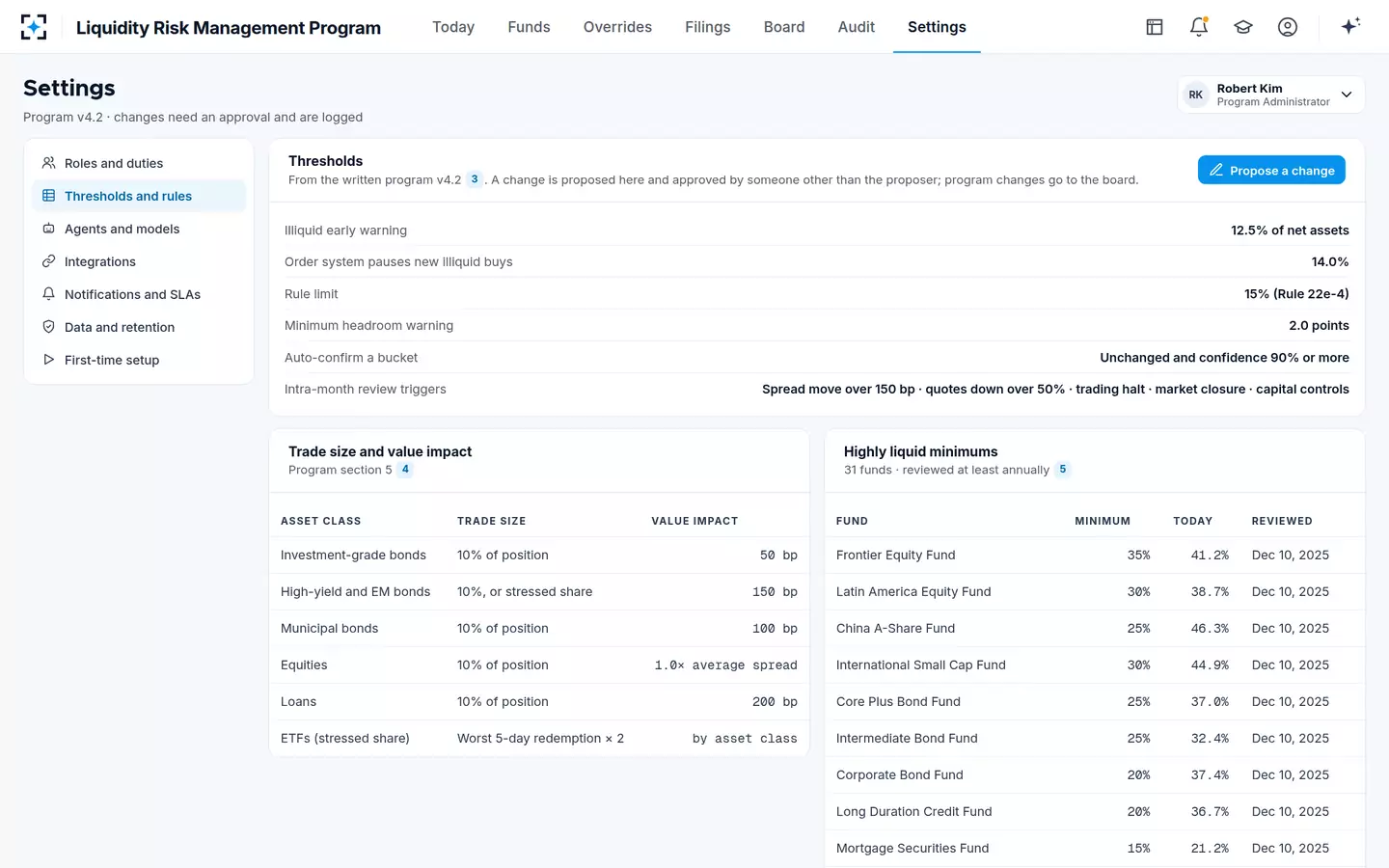
In Botminds' Liquidity Risk Management Program, a Trigger agent checks the 15% limit and every fund's minimum each business day, projects the date the minimum would be reached at the current redemption pace, and drafts the escalation, the board notice and any Form N-RN for people to approve. The minimum itself is a setting: proposed and approved by two different people, reviewed at least annually, and locked during a shortfall unless the board approves a change.
In the solution's sample data, a fictional emerging debt fund with $4.82B of net assets and a 20% minimum stood at 23.1% highly liquid on 15 October 2026, $149.4M above its minimum. Net redemptions had run at $37.2M a day for five days, paid from highly liquid holdings, so the agent projected the fund would reach 20% in five business days, on 22 October, while its illiquid share drifted from 13.6% to 14.1% as the fund shrank.
Liquidity Risk Management Program's projection: when the minimum is reached at today's pace
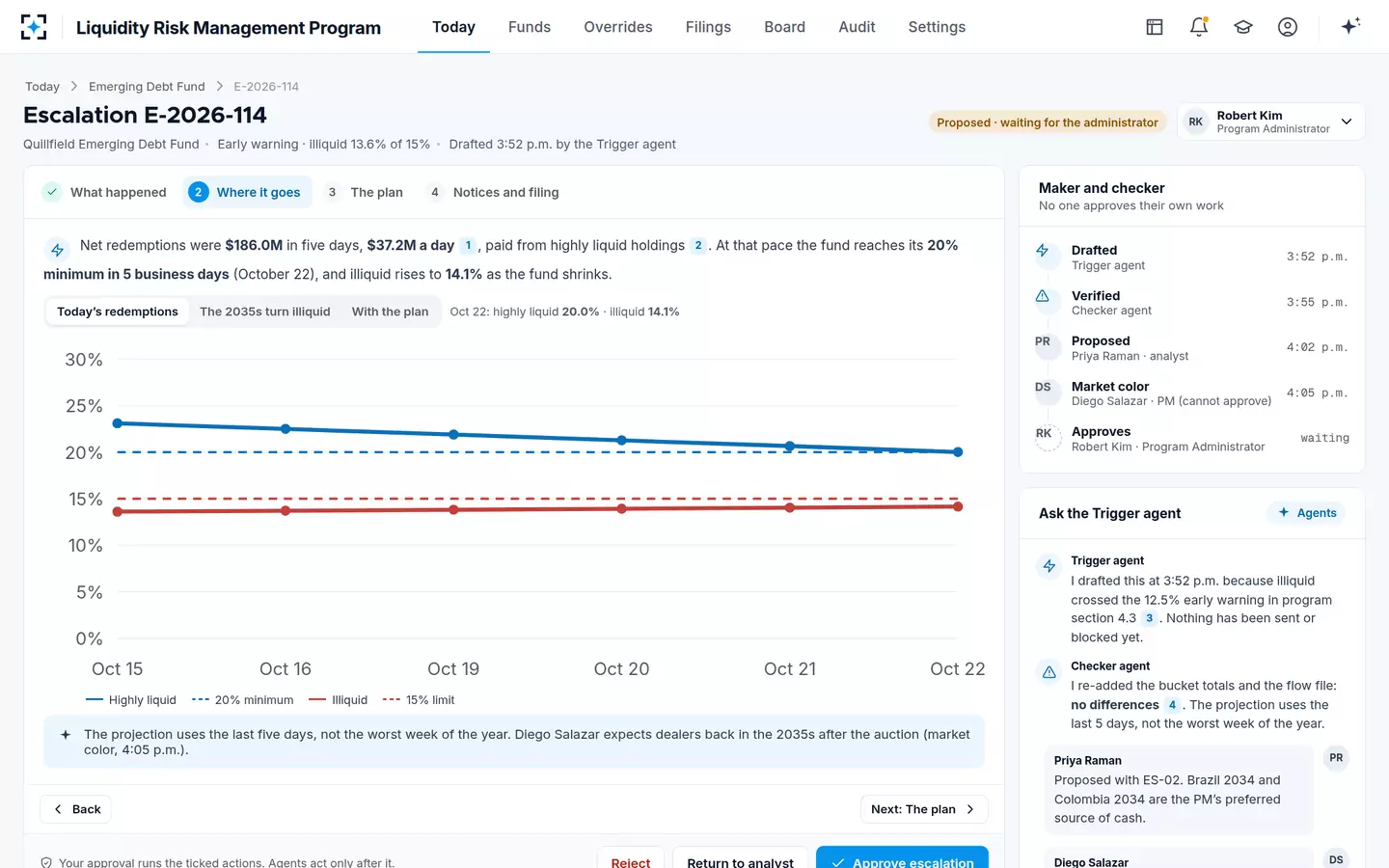
The projection uses the last five days, not the worst week of the year; which window to use is a program choice the board should know about.
Every minimum on one screen, with the date of its latest review
Highly liquid investment minimum: eight checks before the annual review
- Re-test "primarily highly liquid" without pledged collateral
Exclude highly liquid assets pledged against non-highly-liquid derivatives, as Rule 22e-4(b)(1)(iii)(B) requires.
- Count days to US dollars
Foreign holdings and currencies count as highly liquid only if dollars arrive within three business days.
- Show reported and unencumbered headroom side by side
The 2016 release asks funds to weigh pledged assets when setting the minimum.
- Project the runway at a stated redemption rate
Say which window the projection uses and why.
- Start the clock on the trade date
Verification of a provisional classification within three business days; those days count.
- Pre-draft the day-8 board report and Form N-RN Part D
The restoration plan is due within one business day after seven consecutive calendar days.
- Lock the minimum during a shortfall
Any change needs the board, including a majority of independent directors.
- Keep the file five years
How the minimum and every adjustment were determined, and the shortfall reports to the board.
Who approves the minimum, who reports a shortfall and what the board must read each year are set out in who classifies and who signs; how the minimum fits the rest of the rule in 2026 is in the mutual fund liquidity rule now.
Questions people ask
What does "highly liquid investments" mean?
Under Rule 22e-4, highly liquid investments are cash in US dollars and any investment a fund reasonably expects to convert into dollars, sold and settled, within three business days without significantly changing its market value. The fund judges this at the trade size it would reasonably anticipate, not at one round lot. Foreign currencies and cash equivalents are investments to classify, not cash.
Is there a minimum HLIM percentage set by the SEC?
No. Each fund sets its own minimum and reviews it at least annually. The SEC proposed a 10% floor for every minimum in December 2022, noting that most funds with a minimum had set it below 10% as of March 2020, but did not adopt the proposal.
Is falling below the highly liquid investment minimum a violation?
No. The 2024 guidance says the only consequence under the rule is that the fund's shortfall procedures are triggered. The violations come from what follows: failing to report to the board at its next meeting, or within one business day once the shortfall has lasted more than seven consecutive calendar days, or failing to file Form N-RN Part D.
Does a fund that primarily holds highly liquid assets need a minimum?
No, but it has to show that it primarily holds them after excluding highly liquid assets pledged against derivatives classified below highly liquid. The 2016 adopting release said a fund holding less than 50% of its assets in highly liquid investments would be unlikely to qualify. A fund that relies on the exemption should re-test it whenever its holdings or derivatives change materially.
Is the highly liquid investment minimum public?
No. Funds report the minimum on Form N-PORT Item B.7, which the Commission does not make public, and a shortfall of more than seven days on Form N-RN, whose fund-identifiable information the Commission does not intend to make public either.
How often should a fund check compliance with its minimum?
Regularly, and in practice daily. The SEC staff say monitoring should reflect changes in value, acquisitions and reclassifications, and that existing investments can be valued in conjunction with the daily computation of net asset value using the classifications the fund last verified; daily reclassification is not required.