AI tools for mutual funds are most useful, and least risky, where the work is gathering, comparing and drafting, and a fund's liquidity risk management program is mostly that. Under SEC Rule 22e-4 a fund classifies every holding into one of four liquidity buckets at least monthly, watches a 15% limit on illiquid investments and its highly liquid minimum, writes the reason for every override, and reports to its board and the SEC on short clocks (17 CFR 270.22e-4). Agents can do or draft thirteen of the program's fourteen recurring tasks, but every approval, the minimum itself and every signature stay with the administrator, the compliance officer and the board, because the rule puts them there. Botminds' Liquidity Risk Management Program is an agentic solution built on that split, with seven agents doing the work and named people deciding every step.
The grid below is the whole argument. Each row is a task the program repeats every month or every day; each column says who does what. The rest of the page explains why each line sits where it does, what the SEC has said about firms using these tools, and what to ask a vendor, including where this kind of tool does not fit.
AI tools for mutual funds' liquidity programs: 14 tasks, and who does each
Gather positions, flows and market liquidity data
Agents: Does
Analyst: —
Administrator: —
CCO / board: —
Propose a bucket for every holding
Agents: Proposes
Analyst: Reviews
Administrator: Approves changes
CCO / board: —
Write override reasons from source documents
Agents: Drafts, cited
Analyst: Proposes
Administrator: Approves
CCO / board: —
Compare the same security across funds
Agents: Challenges
Analyst: Answers
Administrator: —
CCO / board: —
Back-test buckets against real sales
Agents: Runs
Analyst: Answers misses
Administrator: Reviews
CCO / board: Annual report
Watch triggers and open intra-month reviews
Agents: Opens
Analyst: Reviews changes
Administrator: Approves changes
CCO / board: —
Check the 15% limit and every minimum daily
Agents: Checks
Analyst: —
Administrator: Notified
CCO / board: —
Project when a limit would break
Agents: Projects
Analyst: Checks inputs
Administrator: Decides
CCO / board: —
Decide the plan for a warning or breach
Agents: Drafts options
Analyst: Proposes
Administrator: Approves
CCO / board: Reassesses at 30 days
Report a breach or shortfall to the board
Agents: Drafts, cited
Analyst: —
Administrator: Signs, sends
CCO / board: Receives
Sign and file Form N-RN
Agents: Drafts, never files
Analyst: —
Administrator: Signs
CCO / board: CCO co-signs
Prepare N-PORT liquidity fields
Agents: Prepares
Analyst: Reviews
Administrator: Approves
CCO / board: —
Set the minimum, trade sizes and thresholds
Agents: —
Analyst: Proposes
Administrator: Approves
CCO / board: Board in a shortfall
Write the annual adequacy report
Agents: Drafts from records
Analyst: Reviews
Administrator: Signs
CCO / board: Board reviews
What AI tools for mutual funds can do in a liquidity program
They can do the parts of the rule that are reading and arithmetic. Classification has to rest on reasonable inquiry and on the market, trading and investment-specific factors the rule lists (Rule 22e-4(b)(1)(ii)), which in practice means pulling positions, dealer quotes, volumes, settlement cycles and corporate notices for thousands of holdings, applying the program's trade size and value impact, and counting days to US dollars. An agent does that the same way every time and shows its sources.
The reading is where language models change the economics. A restricted holding's bucket depends on a lock-up agreement, an offering memorandum, an exchange suspension notice or a trustee's notice, often not in English. Today a person reads those and writes a one-line spreadsheet comment. An agent can read the document, write the reason with a citation to the page and line, and hand it to the analyst. The SEC's own burden figure, 16 hours a fund a year for Rule 22e-4's paperwork (Federal Register, 10 April 2026), counts none of that reading.
What Liquidity Risk Management Program's agents did in one sample cycle
60,418
holdings classified across 90 funds for one month end
Sample data
37
overrides waiting for approval, each with a written, cited reason
Sample data
46
challenges the Checker agent raised that cycle: cross-fund, back-test, stale data, low confidence
Sample data
1day
to sign off the monthly classification, against about five today
Design target
Which liquidity tasks must stay with people?
Four, because the rule or the form assigns them. Approving classifications and overrides belongs to the program's administrator, the adviser or fund officers the board designated, who "may not be solely portfolio managers" (Rule 22e-4(a)(13)). Changing a highly liquid investment minimum during a shortfall needs the board, including a majority of independent directors. Deciding whether an above-15% plan still serves the fund is the board's, every 30 days. And reports to the board and Form N-RN are the fund's statements to its directors and the SEC, due within one business day (Form N-RN).
A fifth stays with people by design rather than by rule: choosing the program's assumptions. Trade sizes, value impact thresholds, intra-month triggers and the minimum itself shape every bucket the agents propose. The SEC staff allow these to vary by fund, asset class or investment and warn that assuming a trade size of zero, or close to it, is not reasonable (SEC staff FAQ, Q21–Q22). An agent can show what a change would do; a person should decide it, and a second person approve it.
Can AI classify liquidity buckets?
It can propose them, and a well-built agent proposes them better than a spreadsheet because it applies the whole test every time. The 2024 guidance shows where hand processes slip: staff found funds "not prepared to review classifications intra-month", international funds counting time to currencies other than the US dollar, and funds treating any currency as highly liquid (89 FR 73764, September 2024). An agent that counts every foreign holding's days to dollars and re-tests affected holdings when a trigger fires closes those gaps mechanically.
What it should not do is finalise its own proposal when it is unsure, or move a holding to suit a limit. In the sample settings of Botminds' Liquidity Risk Management Program, a bucket is auto-confirmed only if it is unchanged from last month and the agent's confidence is 90% or more, and nothing is auto-confirmed on a stale price; every change goes to a person. The Classification agent's limits are written into the solution: it never finalises a bucket below that threshold and never relabels a holding to stay under a limit. Whether those promises hold is something to test, not take on trust; the planted-error test is one way.
Can an agent write the override reason for a restricted security?
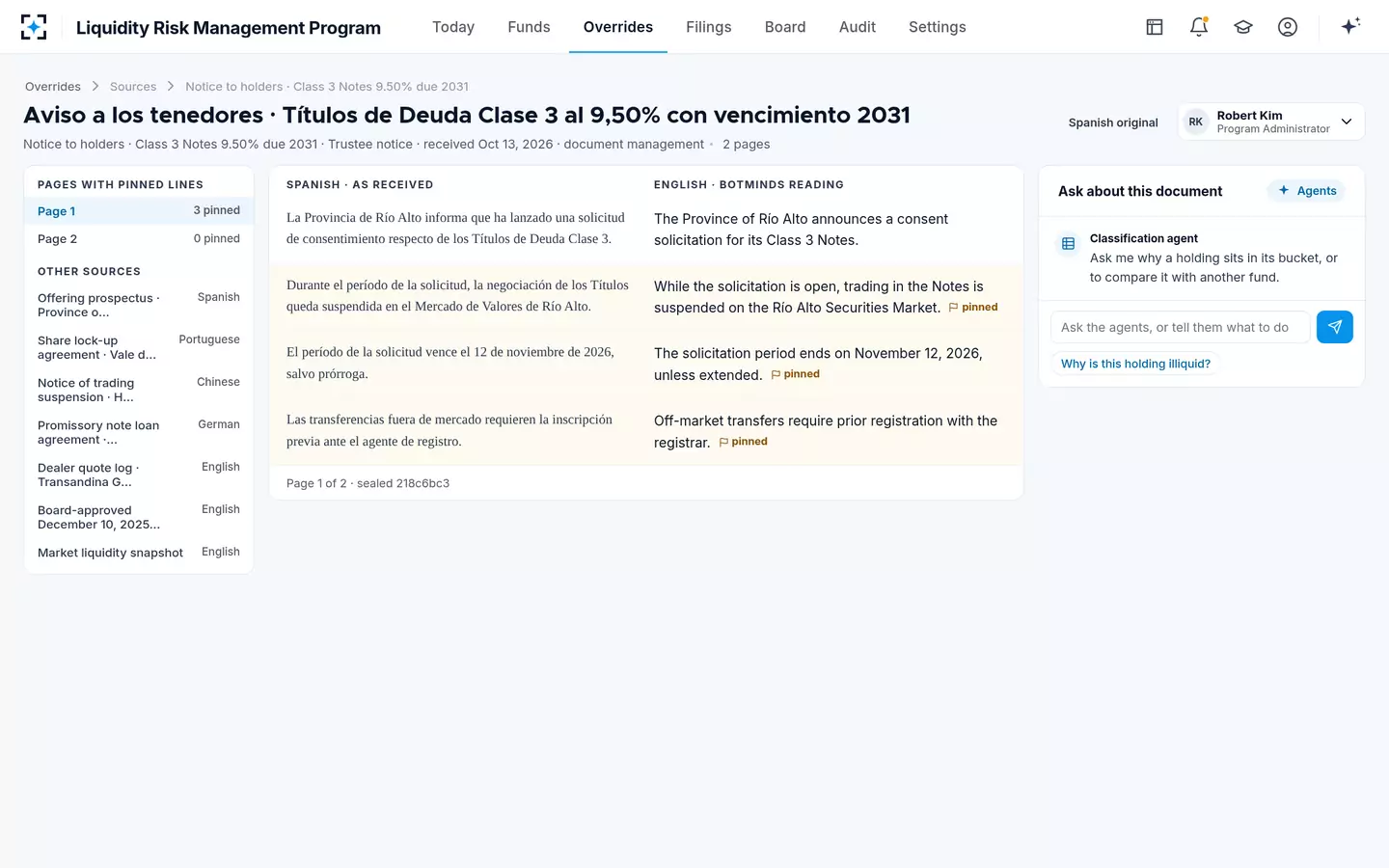
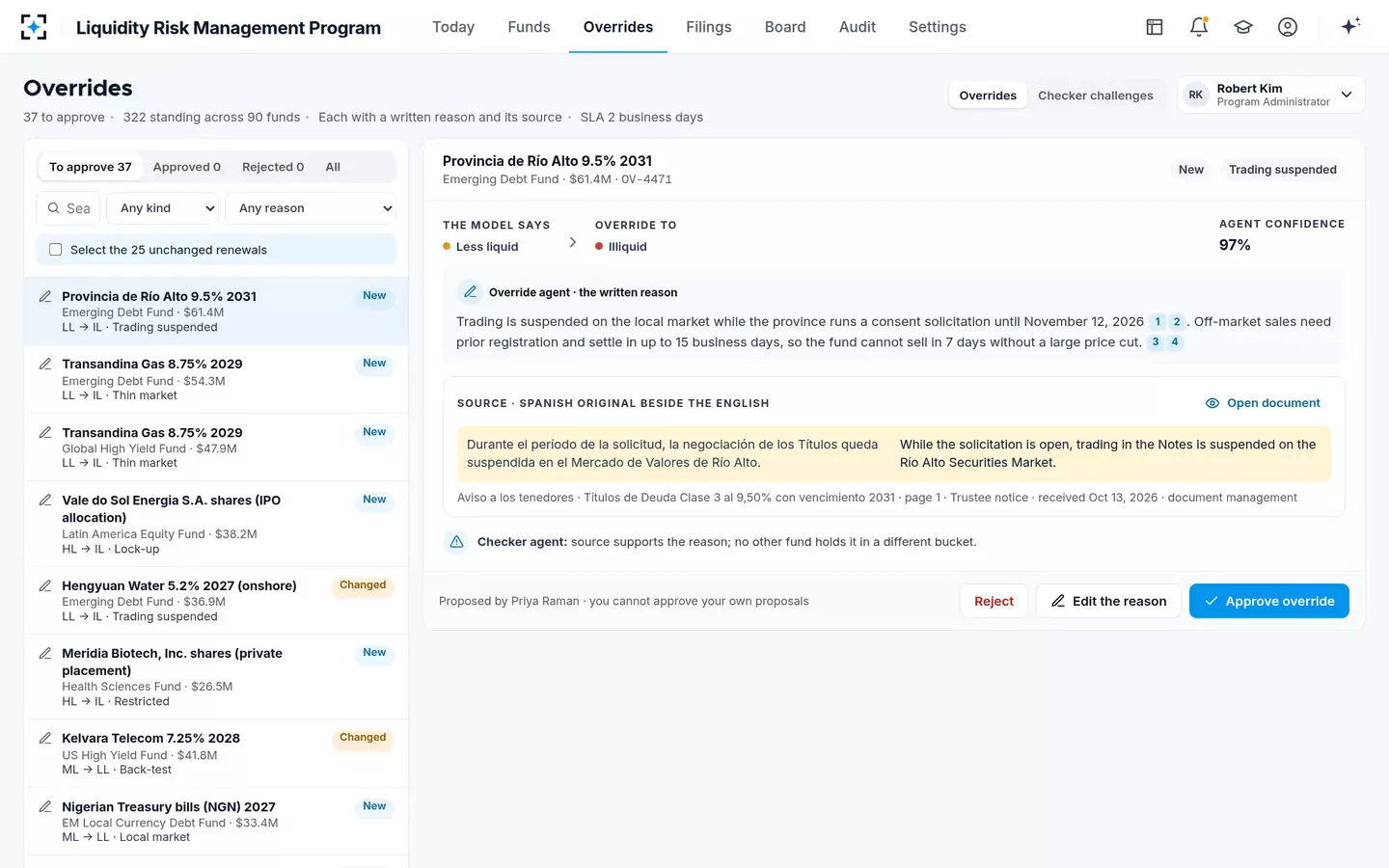
Yes, and this is the task where the gain is largest. An override reason is a short legal reading: what the document restricts, until when, and why that moves the holding out of the bucket the market data suggests. Written by hand it is often a one-line comment that an examiner cannot trace. Written by an agent it can quote the clause, cite the page and show the original language beside the translation, and still go to a person for approval.
The reason, written from the source: a Spanish trustee notice beside its English reading
What does the SEC say about firms using super intelligence?
The SEC's examiners use their own term, and it is worth using exactly. The Division of Examinations' fiscal 2027 priorities, published on 23 October 2026, describe registrants bringing "super intelligence (SI)" into research, drafting, client communications, portfolio management and compliance monitoring, and say examiners will study how these tools change outcomes and whether firms still meet obligations that are "technology-neutral" (SEC, FY2027 examination priorities). The Commission drew the same line about vendors when it adopted the rule.
…third-party products can serve as a useful input to the classification process, it is the fund's responsibility to determine the liquidity of each investment.
SEC, Investment Company Liquidity Risk Management Programs, 81 FR 82142 (18 November 2016)
"Technology-neutral" is the operative word for a liquidity program. Rule 22e-4 does not care whether a bucket was proposed by an analyst, a vendor's model or an agent; it cares whether the classification reflected reasonable inquiry and whether the named administrator, the board and the filings did what the rule requires. An examiner looking at SI in a liquidity program will ask the questions already asked of vendors in 2021, when the SEC made the oversight of liquidity classification vendors an exam focus (SEC risk alert, 2021): what did the tool do, who checked it, and where is the evidence.
Who is accountable when an agent proposes a bucket?
The fund and the program administrator, exactly as before. Nothing in the rule moves responsibility to a tool's supplier, any more than it moved to a vendor of liquidity classifications; the SEC staff say the fund keeps ultimate responsibility even when a sub-adviser takes on tasks such as classification (Q1). What changes is the record. When an agent proposes and a person approves, the approval can carry the proposal, its sources, the checker's verdict and the approver's reason code, which is more than most hand processes leave.
The accountability chain, step by step, is set out in who classifies and who signs. Its short form is the maker-checker rule the solution enforces: the analyst who proposes never approves, the portfolio manager adds market colour but cannot approve on his own funds, and the chief compliance officer co-signs every Form N-RN.
A monthly liquidity cycle in days: by hand and with agents
Most of a monthly cycle is preparation, not judgement. The solution's estimate for one monthly classification cycle at a group of about 90 funds puts six working days into it by hand and about one with agents, with the largest saving in writing and documenting overrides.
One monthly classification cycle: six days by hand, about one with agents
- Pulling positions and vendor data1.5 d
- Buckets at trade size and value impact1 d
- Writing and documenting overrides2 d
- Cross-fund checks, limit tests0.5 d
- Committee review and sign-off1 d
- Data, buckets, overrides, checks and sign-off1 d
What to ask a vendor of AI tools for mutual funds
Ask to see each answer on your own holdings, not on a demonstration fund. The questions follow the rule, the 2024 guidance and the staff FAQ, so a tool that fails one is failing something an examiner will also ask.
Ten questions for AI tools for mutual funds' liquidity work
- Does every bucket show its sources?
Quotes, volumes, settlement route and documents, linked from the bucket itself.
- Does it count days to US dollars?
Including currency conversion and capital controls, as the 2024 guidance requires.
- Which trade size and value impact does it use?
Yours, from the written program, by asset class; never a hidden default.
- Can it read the documents behind overrides?
Lock-ups, notices, offering documents, in their original language, with page citations.
- Can it approve, file or trade on its own?
The right answer is no: proposals and drafts only, every action after a named approval.
- Who checks the agent?
A separate check of every proposal: cross-fund, back-test, stale data, low confidence.
- What happens when it is unsure?
A stated confidence threshold below which a person must decide.
- Does it keep the record an examiner will ask for?
Who proposed, who approved, when, why, and the evidence, kept at least five years.
- How is it validated and versioned?
A model risk review before go-live and after changes, with a test you can rerun.
- What does it not do?
Market data, stress testing and trading stay in their own systems; ask what it connects to.
Be honest about fit. A fund group whose funds all primarily hold highly liquid assets, with no minimum to keep and few overrides, has little reading to automate, and a vendor bucket feed with a simple monthly review may be enough. The case for agents grows with the number of holdings that need judgement: emerging-market debt, loans, private placements, local-market closures and documents in other languages. And agents do not replace the market data that feeds them; they use it. A comparison of the approaches on one fund is in fund liquidity solutions compared.
Overrides in Liquidity Risk Management Program: reason, source and the checker's verdict
Questions people ask
What AI tools for mutual funds exist for liquidity risk?
Three kinds: vendor classification services that supply a bucket per security from their own models, analytics tools that compute days to liquidate from market data, and agent-based tools that also read documents, draft overrides and reports and watch limits. Since November 2025 funds name their liquidity service providers on Form N-CEN.
Does using AI change who is responsible under Rule 22e-4?
No. The fund and its program administrator remain responsible for classifications, the limits and reports, whoever or whatever proposed them. The SEC's fiscal 2027 priorities describe the firms' obligations as existing and technology-neutral.
Can an AI agent file Form N-RN?
It should not. Form N-RN is the fund's report to the SEC, due within one business day of a breach, and a filing needs a person who can attest to it. In Liquidity Risk Management Program the Trigger agent keeps a draft current daily; the administrator signs it as ready, the chief compliance officer co-signs, and a person files it.
Will AI tools replace liquidity risk analysts?
They change the analyst's work from preparing to deciding. In the solution's design the analyst reviews proposals, answers the checker's challenges and proposes the judgement calls, the holdings that need a reason, instead of rekeying vendor buckets and writing comments by hand.
What is the biggest risk of using AI in a liquidity program?
A confident wrong bucket that nobody checks, especially one that keeps a fund under 15%. The controls are a separate checker, a confidence threshold below which a person decides, a ban on any agent moving a holding to suit a limit, and a test with planted errors before relying on the tool.