Redemption processing is the transfer agency work of taking a fund redemption or switch request from receipt to a released, paid and confirmed trade: logging the request with its time of receipt, checking it is in good order and properly signed, applying the fund's notice period, lock-up, fees and redemption gate, verifying the payee, pricing it at the right net asset value, releasing it under maker-checker control, posting it to the shareholder register, paying and confirming. It is done by a fund's transfer agent or administrator, often under deadline pressure, and every check can fail in two directions: a request paid that should have been held, or a request held that should have been paid. No regulator publishes how often either happens, so the only reliable error rate is a desk's own, and the safest way to get it is to replay a closed quarter. Botminds' Redemption Processing is an agentic solution whose agents read and check every request; before it goes live it replays the previous week's requests, and every change to its thresholds is replayed the same way before it applies.
Figures on this page come from sample data on a fictional manager, Quillfield Capital; rules and findings come from the SEC and the US Treasury, linked where they appear.
Where 2,146 requests stood at 11:42 on a notice-deadline day: the outcomes a replay sorts into
What is redemption processing, and who does it?
It is the part of fund operations that turns an investor's request to sell into cash in the right account at the right price. For mutual funds it is done by the fund's registered transfer agent; for private funds, usually by a fund administrator. The US Treasury describes fund administrators as providing services that "include calculating fees, maintaining books and records, and handling subscriptions and redemptions", many of them also conducting due diligence on investors (Treasury, 2024 Investment Adviser Risk Assessment). The SEC notes that mutual fund transfer agents work out the prices investors buy and sell at, and that the gross purchases and redemptions of some of the largest have run between $3.5 trillion and almost $10 trillion a year for one firm (SEC, 91 FR 56946; what a transfer agent does, seat by seat).
At that scale, a small error rate is a large number of wrong payments. A desk that gets 99.9% right still mishandles one request in a thousand, and on a notice-deadline day of 2,146 requests that is two. Whether a desk is at 99.9% or 99% is the number this page is about.
What checks does a redemption request go through?
Ten groups of checks in five stages; each is a place where a replay can find a miss or a false hold. The table lists them with the rule or document behind each, and what a replay compares.
The checks in redemption processing, and what a replay compares for each
| Stage | Check | Rule or source | What the replay compares |
|---|---|---|---|
| Intake | Time of receipt; channel; duplicates across fax, email, portal and order network | Rule 22c-1 forward pricing; the fund's cut-off | Logged time vs the system's receipt time; duplicates paid twice |
| Intake | Every field read: fund, class, account, units or amount, dealing date, payee | The request itself | Fields as read vs the final corrected values |
| Good order | Signatures and seals vs specimens; signers vs the authorised list and signing rule; any guarantee | Fund documents; Rule 17Ad-15 for guarantees | Pass or fail vs the eventual finding |
| Good order | Amount within the holding; minimum holding after redemption | Register; fund documents | Requests for more than the holding that were not caught |
| Fund terms | Notice period, lock-up, early-redemption fee, side letters | Offering memorandum, prospectus, side letters | Clause applied vs clause that should have applied |
| Fund terms | Redemption gate for the dealing date; pro rata factor; carried balances | Fund documents; in the EU, Delegated Regulation 2026/465 | Factor and amounts paid vs recalculated from the final requests |
| Payee | Account on file or new; call-back to the number on file; second approver | Fund procedures; Regulation S-ID | New payees paid without a call-back or second approval |
| Payee | Sender, domain, sanctions screening | Fund procedures; sanctions programmes | Alerts raised vs fraud later confirmed |
| Release | Maker-checker; approval limits; release before the cut-off | Fund procedures; SEC exam focus on processing | Releases by their own preparer; releases above a limit without approval |
| After release | Price at the right NAV; posting; payment within the fund's period; confirmation | Rule 22c-1; section 22(e); Rule 17Ad-10 | NAV date used vs NAV date owed; posting and payment dates |
Why replay a closed quarter?
Because a closed quarter has answers. Every request in it has been paid, held, returned or rejected; corrections have been made; complaints and NAV corrections have surfaced; fraud cases are closed. That gives a ground truth for each request that a live desk never has on the day. Running a new process, or a new set of thresholds, over those requests shows what it would have done differently, without touching a payment.
It is also the only way to get the number at all. No regulator or independent study publishes the share of redemption requests received in good order, the rate of processing errors at transfer agents, or the cost of a redemption, and vendors' figures are not independent. A replay produces all three from the desk's own files, in its own funds and channels, which is the comparison that matters to its board.
The replay should include the quarter's notice-deadline day. That is when volume doubles, when shortcuts are taken and when fraudsters time their requests, so a replay of quiet days alone flatters any process. A replay that leaves out the deadline day measures the process on the days it is least likely to fail.
How do you measure redemption processing accuracy?
By counting two kinds of error separately, at each check, against the corrected outcome. A miss is a request that went through a check it should have failed: a signer without authority, a notice period not met, a new payee paid without a call-back, a duplicate paid twice. A false hold is a request stopped that should have passed: a genuine signature scored too low, a side letter not applied, a known payee treated as new. Misses cost money and findings; false holds cost investors' trust and staff time. A process tuned to eliminate one will produce more of the other, so both must be reported.
Four measures make a replay comparable quarter to quarter. Field accuracy: of all values read from requests, the share equal to the final corrected value. Check accuracy: for each check, misses and false holds per thousand requests. Timeliness: the share of requests accepted or returned before the cut-off, and the time from receipt to return for those not in good order. Control coverage: the share of new payees called back on the number on file and approved by a second person, which should be all of them. The dollar value of the misses belongs beside the counts, because one missed payee change can outweigh a hundred late returns.
Which redemption processing errors are most common?
No published source ranks them, which is the reason to run the replay. What the rules and the SEC's findings do show is where errors carry consequences, and those are the families a replay should report first.
Wrong price date. Rule 22c-1 requires the NAV next computed after receipt (17 CFR 270.22c-1); a request logged late or returned late gets the wrong day's price, and a NAV correction follows. Terms not applied. A lock-up missed, a fee not charged, a side letter ignored, or a late notice accepted on a day a redemption gate binds. Good order missed. A signer not on the authorised list, more units than the holding, an unreadable fax page. Duplicates. The same request by fax and email; in the sample, one would have paid $5.1 million twice. Altered instructions. A faxed amount changed from $250,000 to $2,500,000, caught only because the call-back reached the trustee. Payee changes. The highest-cost family, covered in the change of bank details on a fund redemption.
SEC exam staff found some of the control gaps behind these at transfer agents acting as paying agents: written policies silent on periodic redemption requests from limited partnerships, and no rule that a second person confirm before issuer money moved (SEC OCIE Risk Alert, 2019; the control itself is set out in the change of bank details on a fund redemption).
How to run a replay in four weeks
A replay needs the quarter's requests as received, the fund documents in force at the time, the specimen signatures and contact records as they stood, and the final outcome of each request. The steps below are our suggested plan; the time each takes depends mostly on how scattered those records are.
A replay of one closed quarter, week by week
- Requests3 days
- Outcomes2 days
- Wait for the files
- Terms verified5 days
- Wait for terms
- Run3 days
- Wait for the run
- Rulings7 days
- Report3 days
Adjudication is the step that makes the result credible. A difference between the replay and history is not automatically an error in history: the replay may be wrong, or the desk may have had information the files do not show. Each difference gets a ruling from the dealing supervisor or the fraud analyst, and only ruled errors are counted.
What the replay report should tell the board
One page, five lines, each with a count, a rate and a dollar value, and each compared with the previous quarter once there is one. The first line is control coverage: of the quarter's new or changed payees, how many were called back on the number on file and approved by a second person. The board should expect every one, and any exception should be named.
The second and third lines are misses and false holds per thousand requests, split by stage, so the board can see whether errors cluster in intake, good order, fund terms or payee checks. A desk whose misses sit in fund terms has a documents problem; one whose misses sit in intake has a channel problem, usually fax or free-text email.
The fourth line is timeliness: the share of requests accepted or returned before the cut-off on the notice-deadline day, against the quarter's ordinary days. A gap between the two is the measure of how much the deadline costs in control.
The fifth line is the cost of the misses: NAV corrections, fees not charged, redemption gate allocations recalculated, payments recovered or written off. Set against the cost of running the checks, it is the beginning of a business case, and the measures that carry it forward are in the KPIs that make the business case for transfer agency software.
How do you test a new redemption process without risk?
In three stages, each closer to live: replay a closed quarter, then run in shadow beside the live desk on current requests without releasing anything, then go live with people releasing every payment. The replay measures accuracy on known outcomes; the shadow run measures it on today's mix and timing; neither moves money. What to measure in the shadow stage, and who signs off, is in redemption processing software, proved in a shadow run.
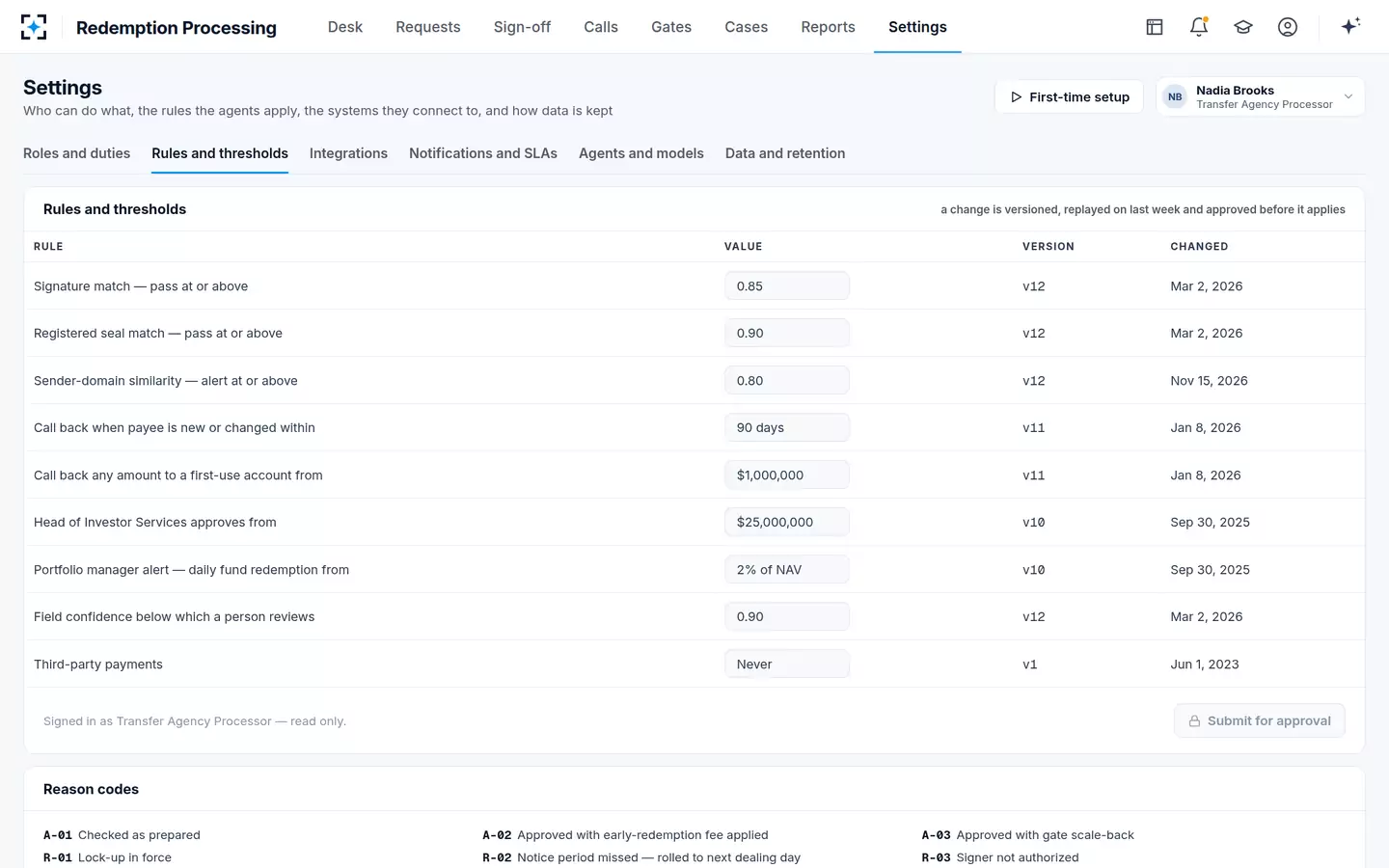
The replay is also how thresholds should change after go-live. A lower signature threshold or a wider call-back window changes misses and false holds in opposite directions; replaying last week's requests under the new value shows by how much before anyone approves it.
What would examiners sample in redemption processing?
The SEC's Division of Examinations says it will examine transfer agents' "perennial risk areas, including processing of items", along with recordkeeping, safeguarding of funds and securities, and compliance with the amended Regulation S-P (SEC, FY2027 examination priorities). The SEC's September 2026 proposal would add specific yardsticks: written notice of every rejected item within one business day, notification to the SEC when more than 3% of items miss their time frame, and it asks whether transfer agents should keep data on every rejected item, its reasons and how long the presentor waited to hear (91 FR 56946; see the SEC transfer agent proposal). It is a proposal, but those are the samples an examiner could pull, and a replay produces them.
Two details matter under any regime. Under the current definitions, a transfer in connection with a redemption is not a routine item (17 CFR 240.17Ad-1(i)(5)), so the evidence for redemptions is the "diligent and continuous attention" the rules expect for non-routine items, shown request by request. And the evidence has to be the desk's own record of what was checked, not a reconstruction after the fact.
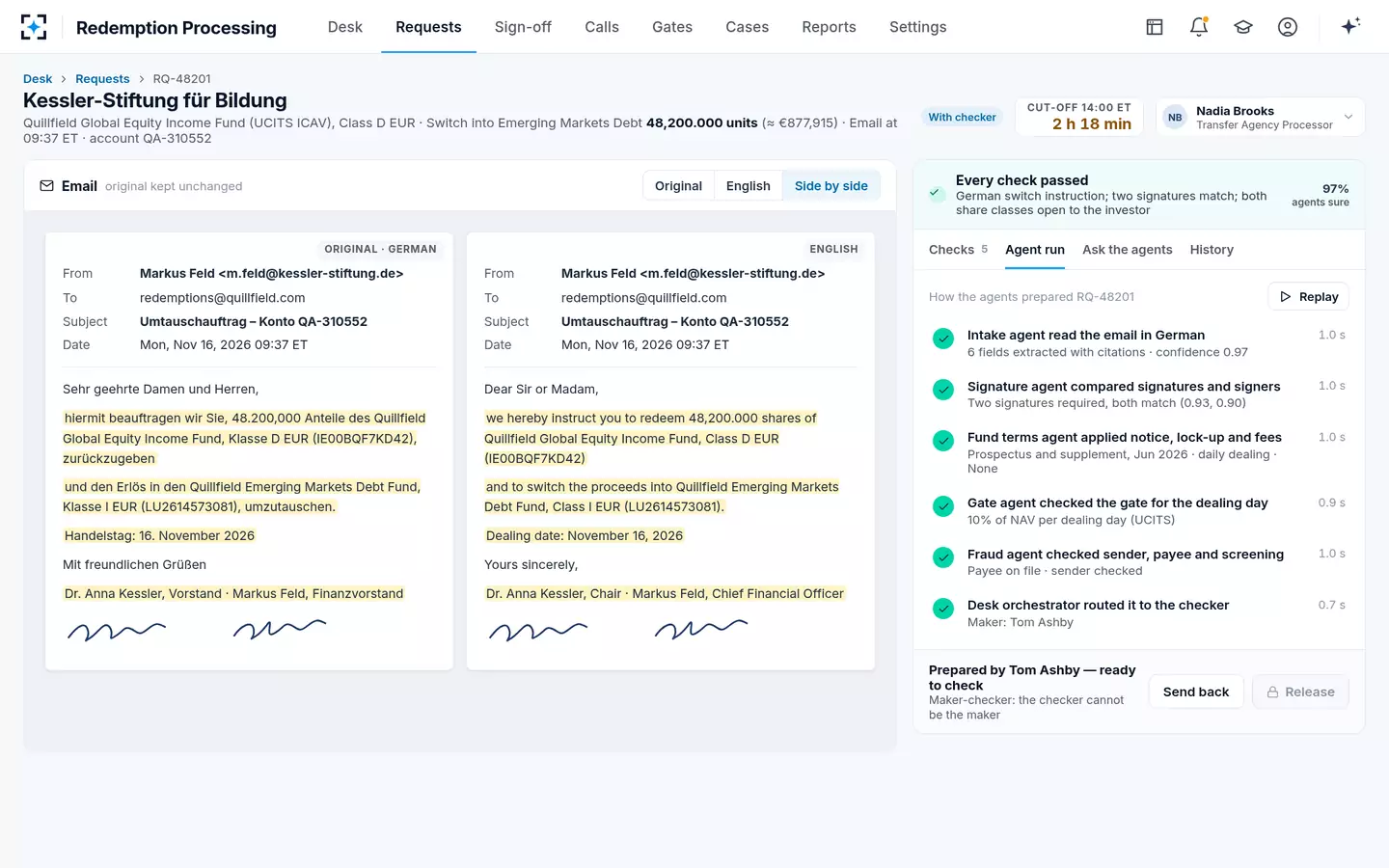
Every check the agents ran on one request, with a replay button
How Redemption Processing replays before it goes live
First-time setup extracts each fund's terms from its documents for people to verify, then replays the previous week's requests before go-live, so the desk sees on its own requests where the agents would have held, returned or released differently from what it did. After go-live, the thresholds the agents apply, signature and seal scores, domain similarity, call-back triggers and approval limits, are versioned settings; a change is replayed on the previous week's requests and approved before it applies.
On the sample desk that produces the outcomes in the first chart: most requests prepared and released through maker-checker, 39 returned not in good order the same morning, 145 exceptions for a person, 3 fraud holds and none paid. The way the agents and people divide the work is described in transfer agency services with agents, and the full desk on the Redemption Processing page.
Thresholds a replay tests before anyone changes them
Questions people ask
How long does redemption processing take?
A request received before the cut-off is priced that day; payment follows within the fund's stated period. A US mutual fund may take no more than seven days under section 22(e); a UK authorised fund must pay by the fourth business day after the valuation point or the receipt of complete paperwork; private funds set their own terms, 30 to 60 days after the dealing date in the sample funds.
What is a NIGO redemption request?
NIGO means not in good order: a request the fund cannot process as received, because a signature, a signer, an amount, an account or a required document is missing or wrong. It is returned to the investor with the reason, and it is priced only when a corrected request is received, so returning it early in the day matters.
What is on a redemption request form?
The fund and share class, the account, the number of units or the amount, the dealing date, the payee account, and the signatures of the registered holder or its authorised signatories, sometimes with a signature guarantee. Fund documents say which fields are required and which channels are accepted, and the transfer agent checks each one before acceptance.
How many requests does a replay need?
A whole quarter, including its busiest day, so that every fund, channel and request type appears. There is no published statistical minimum; the practical test is whether each check met enough cases, including rare ones such as payee changes and late notices, for a miss to show.
Who should adjudicate replay differences?
The people who own the decisions: the dealing supervisor for good order, terms and release, the fraud analyst for payee and sender findings, and payments control for account changes. Their rulings, not the replay engine, decide what counts as an error.
Is a replay enough to go live?
No. It proves accuracy on known outcomes, but not on today's timing and volume. A shadow run beside the live desk is the next step, and go-live should keep people releasing every payment.