In transfer agency operations, a transfer agent keeps the official register of who owns an issuer's securities and changes it when securities are issued, transferred, exchanged or redeemed. US law defines the job in five functions: countersigning securities on issuance, monitoring issuance to stop unauthorised shares, registering transfers, exchanging or converting securities, and moving record ownership by book entry (Exchange Act §3(a)(25)). In practice the desk does a dozen jobs around that core: for mutual funds it calculates the price investors buy and redeem at, it pays dividends and distributions, it searches for holders whose mail comes back, it hands abandoned property to the states, and it answers the letters, emails and calls investors send about their accounts. The work is hard because every one of those jobs runs on the same register and most of them end in a question from an investor. Botminds' Investor Relations AI exists for that last seat: it answers investor and fund shareholder questions from the investor's own register entry, account and fund documents, every figure cited, for a person to approve.
The screens on this page come from the solution's sample data: a fictional manager, Quillfield Capital, on Monday 19 October 2026. The industry figures come from the SEC's own data, linked where they appear.
A small and shrinking industry, with thousands of funds among its clients
327
registered transfer agents on 30 June 2026, the SEC regulating 272 of them
287 → 253
transfer agents filing the annual Form TA-2, 2016 to 2025
57%
of 2025 filers received fewer than 1,000 items for transfer in the year
14,130
registered investment funds, excluding BDCs, among the issuers transfer agents serve (December 2025)
What does a transfer agent do? Five functions in the statute, a dozen on the desk
A transfer agent is the issuer's record keeper for ownership. The statute's five functions are all about the register: who holds what, and how a holding legally changes hands. The SEC's 2026 rule proposal describes how far the job has spread beyond that. Many transfer agents act as administrators and service providers for mutual funds and investment plans, "calculating purchase or sale prices for investors in mutual funds", handling enrolment and account servicing, and running paying-agent work for funds and plans (91 FR 56946). Modern transfer agents may also offer meeting and proxy services, corporate action support and class action administration, the same release notes.
The table below maps the desk's jobs to the rule each answers to. Read it as the reason a transfer agent's errors are so expensive: the SEC lists what an inaccurate register leads to, from wrong vote counts and missed or incorrect payments to improper escheatment, and any of them can end as a question from an investor.
The transfer agent's jobs, and the rule behind each
| Job | What it means on the desk | Rule (US) |
|---|---|---|
| Keep the master securityholder file | The register of record: names, addresses, tax IDs and holdings, kept by the recordkeeping transfer agent for the issue. | Exchange Act §3(a)(25); Rules 17Ad-6, 17Ad-7 (records) |
| Issue, transfer, cancel | Register each change of ownership, check the paperwork and the signature guarantee, and post it within the turnaround time. | Rules 17Ad-2 (turnaround), 17Ad-15 (guarantees) |
| Purchases and redemptions (funds) | Post orders at the next computed price; pay redemptions within the fund's time limit. | Investment Company Act §22(e); Rule 22c-1 |
| Pay dividends and distributions | Calculate, pay and reconcile; chase uncashed checks. | Rules 17Ad-12 (safeguarding), 17Ad-17(c) (unresponsive payees) |
| Find lost holders | Two database searches after mail comes back undeliverable. | Rule 17Ad-17(a) |
| Escheat abandoned property | Report and remit to the state after the dormancy period. | State unclaimed property law |
| Answer investors | Written inquiries about items, payments and account transcripts, within set business days. | Rule 17Ad-5 |
| Protect investor data | Safeguards, incident response, notice to affected individuals. | Regulation S-P, 17 CFR 248.30 |
Transfer agent roles and responsibilities, seat by seat
The jobs above are done by a handful of seats, and the seats are where the questions land. Transfer processing posts the items; dealing works the fund's daily cycle; the paying agent team moves the money; a records team looks after lost holders and escheatment; and a shareholder services team, sometimes a contact centre, answers whoever writes or calls. Above them sit a supervisor who owns register changes and a compliance officer who owns the complaints and the regulator.
Five seats on a fund's shareholder desk, and what changes when agents take the questions
Today
Opens the register, the capital account and the fund documents for every question, retypes the figures and often translates the reply.
With agents
Opens a draft that already shows who may see the account, which figures were read and where each came from, and prepares it for approval.
Still theirs: Judging whether the draft answers what was asked
Today
Bank-detail and address changes arrive in the same mailbox as routine questions; whether a fake one is caught depends on who reads it.
With agents
Every change of payment or contact instruction is held before any account is read, with the call-back steps attached.
Still theirs: The call-back, and the second person who releases it
Today
The standard answers sit in a Word file that is copied and edited reply by reply, so approved wording drifts.
With agents
Co-approves each template with every language back-translated, and one in twenty automatic answers comes back to be re-read.
Still theirs: The second approval on every template and every change to what the agents may do
Today
Relies on whoever reads a message to spot that it is a complaint, in whatever language it came in.
With agents
Gets each complaint the moment it is found, with the words that made it one and the clock already running.
Still theirs: Every complaint reply and every decision that something is not a complaint
Today
Approves the same kind of answer again and again without seeing where each figure came from.
With agents
Approves an answer once as a template, then reviews only what the template does not cover.
Still theirs: Every reply that is not an approved template
The associate's seat is where most hours go. The solution's own estimate, for one translated, two-part reply that no approved wording covers, is about eight hours by hand, of which an hour and a half is looking things up and three hours is writing and translating. That is an estimate on sample work, not a measured result, but the shape is familiar to anyone who has sat the desk: the answer is short, the lookups are long.
Who must register as a transfer agent?
Any person performing transfer agent functions for a security registered under Section 12 of the Exchange Act must register, and so must one acting for a registered investment company's shares, which are exempt from Section 12 registration but caught by name (15 U.S.C. 78q-1(c)(1); 78l(g)(2)(B)). That is why every mutual fund has a registered transfer agent, in-house or outsourced, and why a listed company's register sits with one.
A private fund is different. Its limited partnership interests are not registered securities, so the fund administrator who keeps the register of partners usually does so under the partnership agreement and an administration contract, not as a registered transfer agent. Some third-party administrators register voluntarily, a practice the SEC's 2026 proposal mentions. For the reader that changes which rules apply: a registered transfer agent owes the inquiry, lost-holder and safeguarding rules on this page; a private fund's answers to its partners rest on the agreement, the side letters and the general anti-fraud rule for pooled vehicles.
How many transfer agents are there, and whom do they serve?
There were an estimated 327 registered transfer agents on 30 June 2026, and the industry is contracting: the number filing Form TA-2 fell from 287 in 2016 to 253 in 2025 (91 FR 56946). Most are small. In 2025, 143 of them received fewer than 1,000 items for transfer in the year. A few are very large: for some mutual fund transfer agents, the SEC staff understand that gross purchases and redemptions ran from $3.5 trillion to nearly $10 trillion for one firm in one year.
The split by client is just as sharp. In the SEC's data on the issuers each transfer agent serves, more than half serve no fund at all, and a quarter serve nothing but funds.
Transfer agents split cleanly between companies and funds
Account counts tell the same story from the investor's side. When the SEC amended Regulation S-P in 2024, it found from Form TA-2 data as of September 2023 that transfer agents reported around one million individual accounts each on average, the largest 61 million, while about a third reported none and 58% fewer than ten thousand (89 FR 47688). A desk with ten thousand accounts can answer questions from memory. One with ten million cannot, and an average that high next to a median that low means most investors' accounts sit with the few large firms.
Transfer agent vs custodian vs fund administrator
The custodian holds the fund's assets; the transfer agent holds the register of who owns the fund; the fund administrator keeps the books that turn both into a net asset value. An investor's question usually needs two of the three: the register says how many shares or units the investor holds, the administrator's books say what they were worth and what was paid. How the custodian, the transfer agent and the administrator divide the records, and how a manager checks that they agree, is worked through in its own guide.
For a private fund the roles often collapse into one firm: the administrator keeps the partners' register, calculates each capital account and sends the notices. That is convenient for the manager and awkward for the person answering an LP, because the register, the capital account and the cash receipt may still live in three different systems inside the same administrator.
Who answers shareholder questions, and how fast must they?
For a registered transfer agent, federal rules set the clock on the letters investors write. Rule 17Ad-5 gives five business days to answer a written inquiry about an item presented for transfer, ten business days for a current claim about a missing or wrong dividend or interest payment, twenty for an aged claim more than six months old, and twenty to supply a transcript of an investor's account (17 CFR 240.17Ad-5). A telephone answer counts only if it resolves the inquiry and the investor does not ask for a written one.
The rule binds fund transfer agents today. The 1977 exemption for fund shares and limited partnership interests covers the turnaround and processing rules, not the inquiry rule (17 CFR 240.17Ad-4(a)). Most questions to a fund are not 17Ad-5 inquiries at all, of course: what was my distribution, when will my tax documents come, what is my balance. Those are governed by the firm's own service levels and, in the UK, by the complaint rules the moment the question carries dissatisfaction. How agents handle investor queries, and what they may never send, takes the inquiry seat apart.
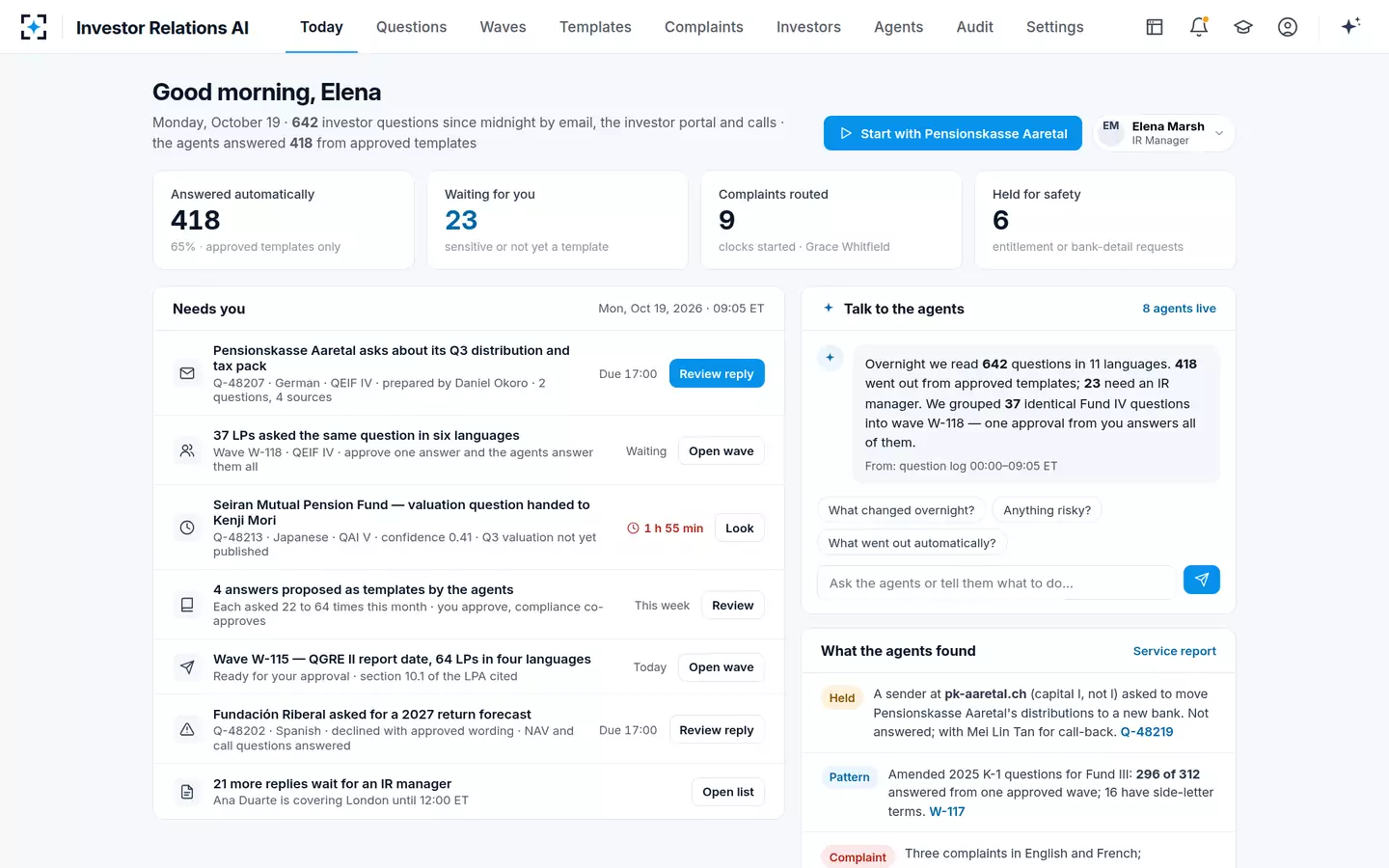
The shareholder desk's morning: what came in overnight, and what needs a person
Who handles lost shareholders and escheatment?
The recordkeeping transfer agent does, because it holds the address that failed. When mail to a holder comes back undeliverable and no new address arrives, Rule 17Ad-17 makes the holder "lost" and requires two database searches, the first between three and twelve months later and the second between six and twelve months after that, free of charge to the holder (17 CFR 240.17Ad-17). If the holder stays lost, state unclaimed property law eventually takes the shares.
The shareholder services seat matters here more than it looks. A holder who writes in, logs on or cashes a check has shown interest in the account, and the SEC notes that under state law an owner can generally avoid escheatment by showing exactly that kind of interest. The lost shareholder rules, the SEC's 18-month proposal and the escheat clock set out the timeline.
What the SEC's 2026 proposal would change at the desk
The SEC proposed on 4 September 2026 to rewrite most of the transfer agent rules; it is a proposal, with comments due by 3 November 2026 (91 FR 56946). For the shareholder desk, three changes stand out: fund shares and limited partnership interests would lose their 1977 exemption from the turnaround and processing rules; a new written-notice duty would apply to holders with no account activity for 18 months; and every registered transfer agent would need board-approved compliance policies. The SEC's own estimate of what that costs each firm is broken down in the total cost of running a mutual fund transfer agent, and the proposal itself is examined in the SEC transfer agent proposal.
The SEC's examiners are already looking. Their fiscal 2027 priorities, published on 23 October 2026, say transfer agents will be examined for how they use emerging technology to do transfer agent work, alongside the perennial areas of item processing, records, safeguarding and filings, and for the amended Regulation S-P (SEC Division of Examinations). The same document describes registrants' growing use of what it calls "super intelligence (SI)".
Where agents fit on the shareholder desk, and where they do not
Agents fit where the work is reading and looking up, and they stop where the work is deciding. On a transfer agent's desk that line is easy to draw. Reading a question in any language, checking that the sender is on file for that account, pulling the holding or the payment from the register, finding the clause that governs the answer and drafting a reply are mechanical. Changing a register entry, releasing a payment to new bank details, deciding that a message is not a complaint, or telling a holder something no approved wording covers, are not.
A lookalike sender asks to move distributions: held before any account is read
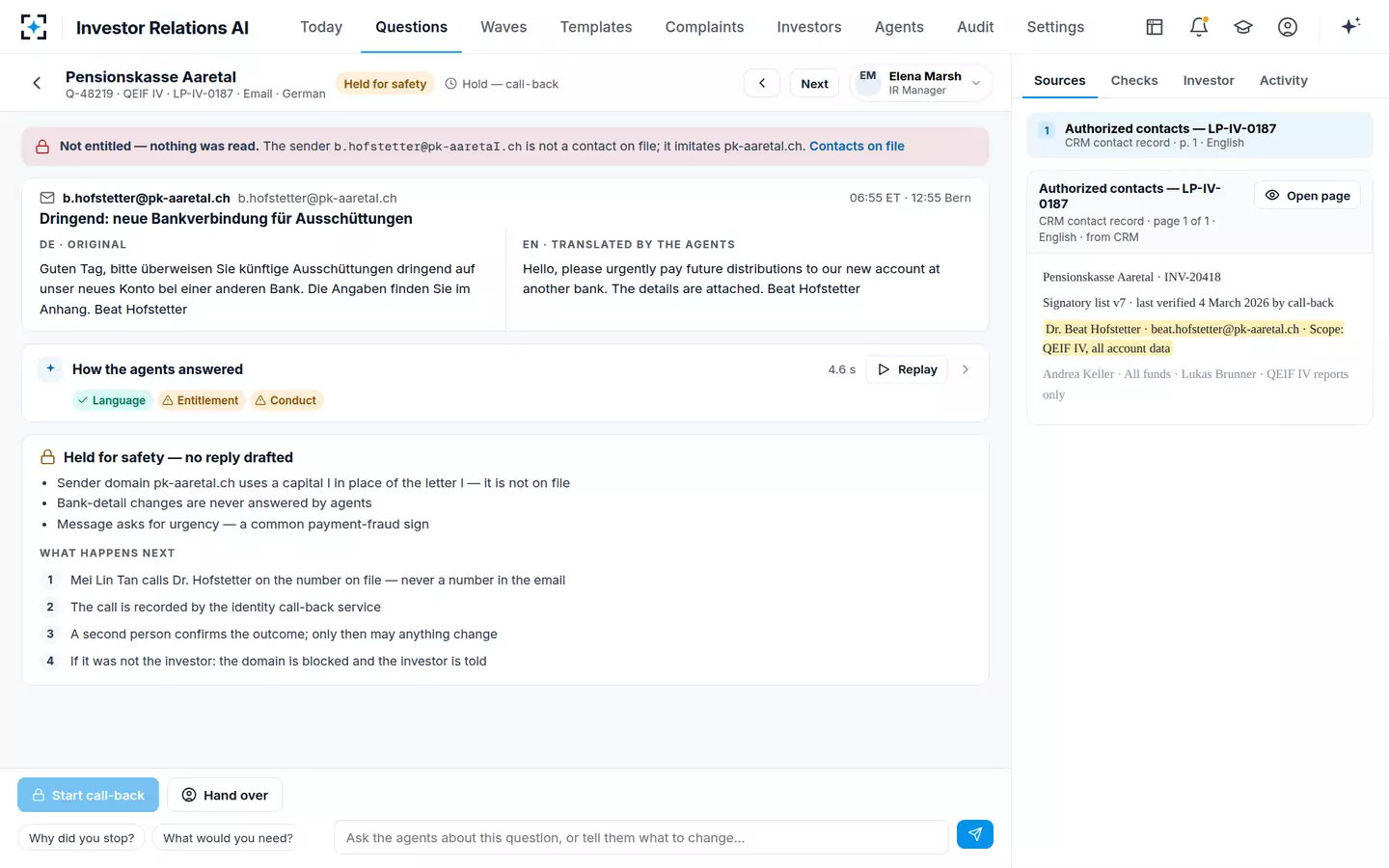
That is the design of the solution: eight agents read, check entitlement, pull figures, find clauses, draft, back-check and route, and none may send an answer that is not approved wording, act on a payment instruction or decide a complaint. To see the desk from the IR manager's chair, start from Investor Relations AI.
Questions people ask
Is a transfer agent the same as a registrar?
Not quite. The registrar's traditional job is to monitor issuance so that no more shares are issued than the issuer authorised, which the Exchange Act lists as one of a transfer agent's functions. Today the two roles are usually done by the same firm, so "registrar and transfer agent" is often one appointment.
What does a transfer agent do for a mutual fund?
It keeps the shareholder register, posts purchases and redemptions at the next computed price, pays dividends, sends statements and tax forms, and answers shareholders. The SEC describes fund transfer agents as also calculating the purchase and sale prices investors receive, and for the largest the annual flows reach trillions of dollars. The fund case, and what each way of running it costs, is in the mutual fund transfer agent, costed.
Do private equity funds have transfer agents?
Usually not in the registered sense. A private fund's interests are not registered securities, so its administrator keeps the partners' register under the partnership agreement. Some administrators register as transfer agents voluntarily, and then the SEC's transfer agent rules apply to them.
Who pays the transfer agent?
The issuer, for its core services: the SEC notes that issuers negotiate directly with transfer agents and bear primary contractual responsibility for their fees. Investors may pay for specific services such as replacing a lost certificate. No regulator publishes transfer agency prices.
How long does a transfer agent have to answer a letter?
Under Rule 17Ad-5, five business days for an inquiry about an item presented for transfer, ten for a current dividend or interest claim, twenty for an aged claim or an account transcript. An inquiry that lacks the details the rule lists, or reaches further back, must still be acknowledged promptly and answered as soon as possible.
Is a transfer agent regulated by the SEC?
Mostly. The SEC was the regulator for 272 of the 327 registered transfer agents in June 2026, about 83%; bank transfer agents register with the OCC, the Federal Reserve or the FDIC. The SEC's transfer agent rules apply to all registered transfer agents whichever agency they registered with.