Investor queries are the questions investors send a fund, a manager or a transfer agent about their own holding and the fund: what was paid, what is the balance, when a document will arrive, how to redeem, why a figure changed. AI agents can answer most of them, but only on three conditions: each agent reads only what the sender is entitled to see, the words that go out on their own are words a person has already approved, and decisions that change an investor's money or rights stay with named people. Botminds' Investor Relations AI is built on those conditions. Eight agents read the question in any language, check entitlement, pull the investor's own figures, find the governing clause, draft, back-check and route; none may send an answer that is not approved wording, act on a payment instruction or decide a complaint. Regulators draw the same line: the SEC's 2026 transfer agent proposal expects transfer agents that adopt AI to put controls around it, describe what it can do accurately and oversee it (SEC, 91 FR 56946; the proposal is read line by line in the SEC transfer agent proposal).
The examples come from the solution's fictional sample data: Quillfield Capital, its funds and investors, on Monday 19 October 2026.
The eight agents in Investor Relations AI: what each reads, what it does, and the line it may not cross
Intake & language agent
May readThe message: email, portal message or call transcript
DoesDetects the language, translates to English, splits multi-question messages, labels each intent
NeverDiscards a message (unclear language goes to a person)
Entitlement agent
May readCRM authorized contacts, the transfer agency register, signatory lists, the sender's domain
DoesDecides whether the sender may see this account and topic, and sets what the others may read
NeverWidens the scope (any doubt holds the message, nothing read)
Investor records agent
May readOnly the asker's own capital account, notices, statements, register entry and tax documents
DoesPulls the figures the answer needs
NeverReads outside the scope set, or changes any record
Fund documents agent
May readThe LPA, side letter, PPM, prospectus or KID, in the original language
DoesFinds the governing clause and its page
NeverInterprets legal meaning beyond the text
Reply drafting agent
May readThe figures, the clause and the approved templates
DoesDrafts in the investor's language with the English beside it, in the right number format
NeverSends, or writes a forecast or a promise
Checking agent
May readThe draft, its sources, the side letter, what other investors were told
DoesBack-translates, recomputes every figure, sets confidence and the route
NeverApproves (it only routes; automatic sending needs an approved template and confidence of 0.92 or more)
Conduct & complaints agent
May readEvery message, in any language
DoesFinds complaints, vulnerability, bank-detail changes, legal threats, press or regulator contact and forecast requests; starts the right clock
NeverReplies to a complaint, or reclassifies one
Template & waves agent
May readRepeated questions and approved answers
DoesGroups waves, proposes templates, personalises each wave answer, samples automatic answers for review
NeverApproves a template (that takes an IR manager and compliance)
Can AI answer investor queries?
Yes, for the large share that are routine and have an approved answer, and only as a draft for the rest. In the solution's sample data, 418 of 642 questions that arrived overnight went out from approved templates, and in a sample September 61.4% of 14,812 questions were answered that way, with 98.6% inside the service level. Those are figures from fictional sample data, not a customer's results; the design target is that every answer, automatic or not, is cited to the investor's own records with a named sender.
The industry is moving the same way, carefully. The Bank of England and FCA's 2026 survey of 196 UK financial firms found agents widespread but rarely trusted to act alone: most deployments recommend and leave the decision to a person, and only one firm in fifty runs agents with broad autonomy (Bank of England and FCA, 2026).
Agents are common in UK financial firms; agents acting on their own are rare
80%
of responding firms have agents in production for decision support: agents recommend, people decide
46%
have agents that execute actions within predefined limits and rules
22%
have agents acting independently but needing human approval for certain actions
2%
have agents with broad autonomy
What may an AI read about an investor's account?
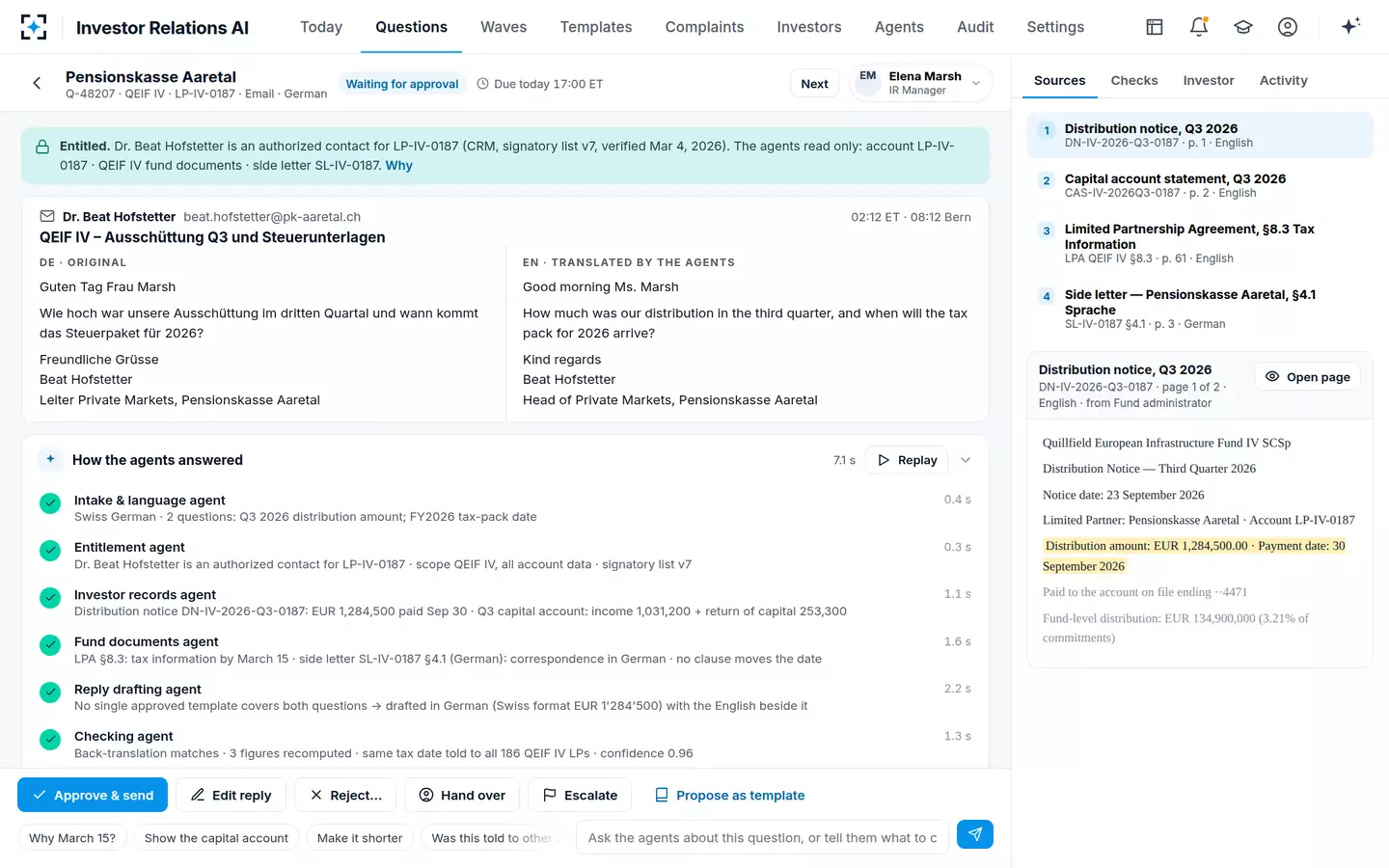
Only what the sender is entitled to see, decided before anything is opened. The Entitlement agent checks the sender against the CRM's authorized contacts, the transfer agency register and the signatory list, and checks the domain; it then sets the read scope for every other agent and writes it on the answer. For the sample German question from Pensionskasse Aaretal, the scope was one account, LP-IV-0187, the Fund IV documents and that investor's side letter, and the checks afterwards confirmed nothing else was opened.
That order matters for privacy law as well as for accuracy. A system that reads every account to answer any question turns one compromised mailbox into a breach of everyone's data, and under the amended Regulation S-P a firm that cannot tell whose information was reached must notify everyone whose information sits in the affected system. The Regulation S-P amendments and who may see investor data covers that rule in detail.
How the agents answered one investor query, step by step, with timings
Who approves an answer before it is sent?
A person, unless the answer is approved wording. The solution sends on its own only when the question matches a template an IR manager and compliance have both approved (a match of 0.90 or more), entitlement has passed, and the Checking agent's confidence is 0.92 or above; one in twenty of those automatic answers is re-read by a person. Everything else is prepared by one person and approved by another, and goes out with a sent-by line naming both.
Four routes for an investor query, and who signs each
| Route | When | Who decides | What the investor sees |
|---|---|---|---|
| Automatic from approved wording | Template match ≥ 0.90, entitlement passed, confidence ≥ 0.92, nothing on the never-automatic list | The IR manager and compliance who approved the template; 1 in 20 re-read | The approved wording with the investor's own figures, each cited |
| Prepared and approved | No template covers it, or confidence is below the threshold | An associate prepares; an IR manager, who did not prepare it, approves | A reply with a sent-by line naming approver and preparer |
| Complaint | Dissatisfaction found, in any language | The complaints officer approves the acknowledgement; the clock is already running | An acknowledgement, then the response the regime requires |
| Held for safety | Sender not entitled, lookalike domain, bank-detail or payment instruction | The transfer agency supervisor, after a recorded call-back, with a second person | Nothing until the call-back; then a person's reply |
Approving once as a template is what makes the routine queue shrink. In the sample, an IR manager approved one answer about a distribution and the date of the tax information, a compliance reviewer co-approved its six language versions, and 37 waiting questions from other LPs were answered with each LP's own figures. Launching investor relations software one approved answer at a time turns that into a rollout plan.
What happens with a bank-detail change request?
It is held before any account is read, and it never goes out on its own. A request to change where distributions or redemption proceeds are paid is the single most dangerous message in an investor inbox, and the controls that stop it are old and simple: call back on a number already on file, never one in the message, and have a second person confirm.
A bank-detail change request, from arrival to release
Agent
Read and translateThe Intake & language agent reads the request and labels it a payment-instruction change.
Never: treat it as a routine question
Agent
Check the senderThe Entitlement agent compares sender and domain with the contacts on file; any mismatch holds the message with nothing read.
Never: read the account for an unconfirmed sender
Agent
Flag the conduct signalsThe Conduct & complaints agent notes the bank-detail change and any urgency, both common in payment fraud.
Never: draft a reply
A person decides
Call back on the number on fileThe transfer agency supervisor calls the investor on the number already held; the call is recorded.
A person decides
A second person confirmsOnly then may the payment details change; if it was not the investor, the domain is blocked and the investor told.
The SEC's examiners have said they will look at identity-theft red flags during account takeovers and fraudulent transfers, and at firms' preparation for cyberattacks that use what the fiscal 2027 priorities call "super intelligence (SI)", including phishing and deepfake voice and video aimed at staff (SEC Division of Examinations). A call-back to a number on file defeats a lookalike domain; it does not defeat a compromised mailbox on its own, which is why the second person matters.
How do agents handle a complaint?
They find it and route it; they never answer it. The Conduct & complaints agent reads every message for dissatisfaction, in any language, before a reply is drafted, starts the clock for the right regime and hands it to the complaints officer with the words that made it a complaint. The agents may never reply to a complaint or reclassify one; calling something "not a complaint" needs a reason and the Head of Compliance's approval, and the clock keeps running. When an investor's question is a complaint under DISP sets out the test and the clocks.
What do FINRA and the SEC expect from AI agents?
That existing rules apply unchanged, and that firms supervise what their tools do. FINRA told broker-dealers in 2024 that its rules are meant to be technologically neutral and that its communications standards apply whether a person or a tool wrote the words (FINRA Regulatory Notice 24-09). Its 2026 oversight report lists the risks agents add: acting without human validation, acting beyond the user's intended scope, multi-step reasoning that is hard to audit, and mishandling sensitive data; and it suggests firms consider how to monitor agents' access to systems and data, where to keep a human in the loop, and how to track agents' actions (FINRA, 2026 Oversight Report).
The SEC's version is in the transfer agent proposal quoted above: controls, accurate claims about what a system can do, and oversight of automated processes. Each of FINRA's risks maps to a limit in the frame at the top of this page: autonomy to approval routes, scope to entitlement, auditability to the audit trail of every step, data sensitivity to the read scope. Forecasts are a separate line. A question asking what a fund will return is answered only by a person with approved wording, because performance promises raise marketing-rule questions; the SEC Marketing Rule's general prohibitions explain why.
How fast must a transfer agent answer investor queries?
For written inquiries to a registered transfer agent, Rule 17Ad-5 sets the clock: five business days for an item presented for transfer, ten for a current dividend or interest claim, twenty for an aged claim or an account transcript (17 CFR 240.17Ad-5). Most fund investor queries fall outside those categories, and the firm's own service levels govern; the solution's sample settings use one business day for routine questions and two for sensitive ones, with escalation to the IR manager on duty two hours before a deadline. What a transfer agent does, seat by seat places the inquiry rule among the desk's other duties.
How accurate is AI at answering from documents?
Less accurate than its fluency suggests, which is why every figure has to be checked against its source. A preregistered, peer-reviewed study of commercial legal research tools built to answer from retrieved sources found they still hallucinated on between 17% and 33% of queries, fewer than a general chatbot but far from none (Magesh et al., 2025). On financial filings, a widely used benchmark found that one leading model with a retrieval system answered incorrectly or refused on 81% of a sample of questions about public companies (FinanceBench, 2023, a preprint). Neither study tested investor queries, and models have improved since; both set expectations for any system that reads documents and answers in fluent prose.
The checks before any answer reaches a person: back-translated, recomputed, compared
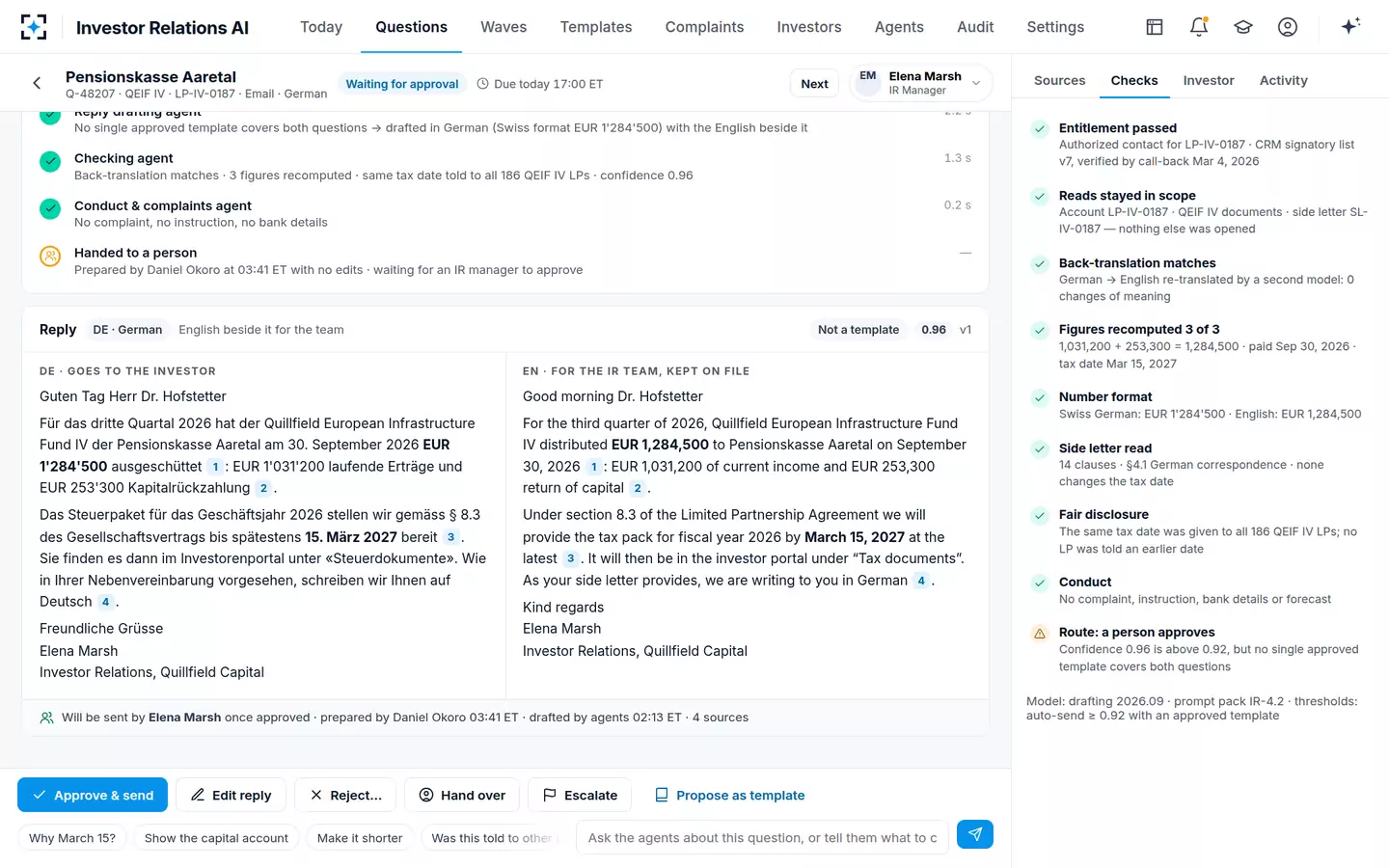
The design answer to those studies is not a better paragraph but a citation and a recomputation on every figure, a back-translation on every language, a comparison with what other investors were told, and a person on every answer that is not approved wording. To see the eight agents work on an investor's question, start from Investor Relations AI.
Questions people ask
What does "investor queries" mean?
The questions investors send about their investment: balances, payments, statements, tax documents, dealing and procedures. For a fund they come by email, the investor portal and the contact centre, and they peak after statements, distributions, capital calls and tax season.
Can an AI chatbot show one investor another investor's figures?
A generic one can, because it does not know who may see which account. In the solution, no record is read until the Entitlement agent has checked the sender against the authorized contacts, the register and the signatory list; in the sample data a contact authorized for one fund who asked about another fund's account was held with nothing read.
Can agents answer investors in their own language?
Yes, if the reply is checked like any other. In the sample, questions arrived in 11 languages; each reply is drafted in the investor's language with the English beside it, back-translated by a second model, and checked for number formats, such as the Swiss apostrophe separator.
Who is responsible if an agent sends a wrong answer?
The firm, as with any answer it sends. That is why the solution sends on its own only approved wording, names the person who approved every other reply, and keeps every step on an audit trail that cannot be changed, for seven years.
Will an AI give an investor a return forecast?
Not in this design. Forecasts, expected returns and performance promises are on the never-automatic list, and the Reply drafting agent never writes one. In the sample, a request for a 2027 return forecast was declined with approved wording and the factual parts answered for an IR manager to approve.