The SEC Marketing Rule general prohibitions are the seven things no investment adviser advertisement may do under Rule 206(4)-1(a): state or imply something untrue, make a material claim the adviser cannot prove on demand, mislead by implication, tout benefits without their risks, cherry-pick specific advice, present performance unfairly, or be misleading in any other way. They apply to every advertisement, whatever else the rule's specific conditions on testimonials, ratings and performance require. They are hard because they are judgement calls made claim by claim, often under a quarter-end deadline. Botminds' SEC Marketing Rule Compliance puts each factsheet or pitch book on the screen with a numbered marker on every claim, and agents fetch the record behind it, so a marketing compliance reviewer scores the evidence rather than the prose.
Read the seven together and a pattern appears. Three of them, (a)(1), (a)(3) and (a)(7), ask whether words or images mislead in the ordinary sense. The other four ask something a red pen cannot answer: whether the adviser could prove a claim, in (a)(2), and whether what sits beside it is fair, in (a)(4) to (a)(6): risks beside benefits, losers beside winners, the full period beside the flattering one. That changes what a review is. Before anyone edits a sentence, someone has to open the record.
The seven general prohibitions, and what each one actually tests
- (a)(1) No untrue statement of a material fact, and no omission that makes a statement misleading
Tests truth against a record. Firm AUM, team size, credentials and inception dates all live in a system somewhere.
- (a)(2) No material statement of fact the adviser cannot substantiate when the SEC asks
Tests the file, not the sentence: is there a document today that would prove the claim tomorrow?
- (a)(3) Nothing likely to cause "an untrue or misleading implication or inference"
Tests what a reader would infer: a logo, a "seen on" banner, a celebrity photograph.
- (a)(4) No benefit without "fair and balanced treatment of any material risks or material limitations"
Tests what sits beside a claim: a risk, a limitation, the condition the benefit depends on.
- (a)(5) No reference to specific investment advice unless it is presented fairly and in balance
Tests the selection: why these holdings or trades, and what the criteria would also have shown.
- (a)(6) No including or excluding results, or choosing time periods, "in a manner that is not fair and balanced"
Tests the arithmetic and the window: gross beside net, the full portfolio beside the extract, the bad year kept in.
- (a)(7) Not "otherwise be materially misleading"
Tests the whole piece as a reader meets it, including type size, placement and what a hyperlink hides.
What are the seven general prohibitions of the SEC Marketing Rule?
The seven general prohibitions are the opening paragraph of the amended Marketing Rule, adopted by the SEC in December 2020 and effective on 4 May 2021, with compliance required eighteen months later, from 4 November 2022 (Release IA-5653). They replaced the old advertising rule's short list of banned practices with principles, and the SEC kept them deliberately broad: they sit above everything else in the rule, so an advertisement can meet every disclosure condition for a testimonial or a rating and still fail one of the seven.
The substantiation test in (a)(2) is the unusual one. It does not ask whether a claim is true. It asks whether the adviser had a reasonable basis to believe it could prove the claim if the Commission demanded it. The SEC chose that wording on purpose: the release says the change was meant to let advisers avoid "the need to develop and maintain a file of substantiating materials for every advertisement". It then says how the Commission will read a claim the adviser cannot prove when asked.
"If an adviser is unable to substantiate the material claims of fact made in an advertisement when the Commission demands it, we will presume that the adviser did not have a reasonable basis for its belief."
SEC, Investment Adviser Marketing, Release IA-5653 (December 2020), on the substantiation requirement
That sentence is the practical centre of the general prohibitions. No file is required in advance, but the risk of not having one sits entirely with the adviser. The release names the obvious way to carry it, noting that an adviser could "make a record contemporaneous with the advertisement demonstrating the basis for their belief". For a reviewer the consequence is a sequence: find every statement of material fact, find the record that proves each, and keep the two together.
What is the definition of advertisement under the SEC Marketing Rule?
An advertisement is any direct or indirect communication by an adviser to more than one person that offers its advisory services with regard to securities to prospective clients or private fund investors, or offers new services to current ones, plus any compensated testimonial or endorsement (Rule 206(4)-1(e)(1)). The general prohibitions apply only to what meets that definition, so the first question in any review is whether the piece is in scope at all.
The definition has a twist for hypothetical performance: a communication with hypothetical performance is an advertisement even when it goes to a single person, unless it answers an unsolicited request or goes one-on-one to a private fund investor. The rule also excludes "Extemporaneous, live, oral communications" and information in a regulatory notice or filing that is reasonably designed to meet that filing's requirements.
Is a one-on-one email an advertisement under the Marketing Rule?
Usually not. An email to one prospect that offers advisory services is not a communication to more than one person, so it falls outside the first prong of the definition. Two things change that. If it contains hypothetical performance, it is an advertisement unless one of the narrow exclusions applies. And if it is really a mass mailing with a name filled in, it never was one-on-one: the release says that "customizing a template presentation or mass mailing by filling in the name of an investor" does not make a one-on-one communication, and that performance inserts reused across "customized" letters are advertisements. A reviewer's intake question is therefore not "who received this?" but "what is it, and how many people received the same thing?"
Substantiation: what does "upon demand by the Commission" require?
Substantiation under (a)(2) means being able to produce, when asked, whatever proves a material statement of fact. For performance the record is not optional: the books-and-records rule requires the adviser to keep the accounts, working papers and other records that show how any advertised performance was calculated, for five years from the end of the fiscal year in which it last used the advertisement (Rule 204-2(a)(16) and (e)(3)).
For statements other than performance, the file is whatever proves them: the AUM report at a stated date, the compliance policy behind a process claim, the credential register behind a team biography. The claims most often unsubstantiated are the cheapest to write. In its April 2024 risk alert the SEC's Division of Examinations listed advertisements saying advisers were "free of all conflicts", statements that a "network of personnel" served clients when one individual did, and awards that were never received (SEC risk alert, 17 April 2024).
Conflict-free is the claim the SEC keeps proving false
4
advisers in the September 2024 sweep charged over conflict-free claims they could not substantiate
$1.24m
combined civil penalties paid by the nine advisers in that sweep
$75k
penalty on an adviser whose website said it refused all conflicts of interest (September 2025)
The conflict-free claim fails for a structural reason. Every adviser has conflicts, beginning with its own fee, and the firm's Form ADV usually says so. A marketing claim that contradicts the firm's own regulatory disclosure cannot be substantiated, and a review that reads Form ADV beside the advertisement catches it in minutes. The full list of orders, and what each objected to, is set out in SEC Marketing Rule enforcement actions.
What does fair and balanced mean under the Marketing Rule?
Fair and balanced means a reader sees enough of the other side to weigh the claim: the risk beside the benefit in (a)(4), the selection criteria beside the chosen holdings in (a)(5), and the full result beside the flattering one in (a)(6). The rule does not prescribe a disclosure; it asks whether the overall impression would survive a reader who knew what was left out.
Three of the seven prohibitions use the phrase, and each attaches it to something different. A benefit claim such as "downside protection" needs the limitation, such as the cost in rising markets. A list of past recommendations needs a way to see the ones that did not work. And performance needs its period and its peers: examiners in 2024 found advertisements whose total net return counted only realised investments and left unrealised ones out, and others that showed returns without saying over what period.
FINRA's rule for broker-dealer communications uses the same idea in different words: communications "must be fair and balanced, and must provide a sound basis for evaluating the facts" (FINRA Rule 2210(d)(1)(A)). For a fund distributed through an affiliated broker-dealer, one factsheet answers to both, and who signs each ad under each regime differs.
Scoring one ad: a sample one-pager, claim by claim
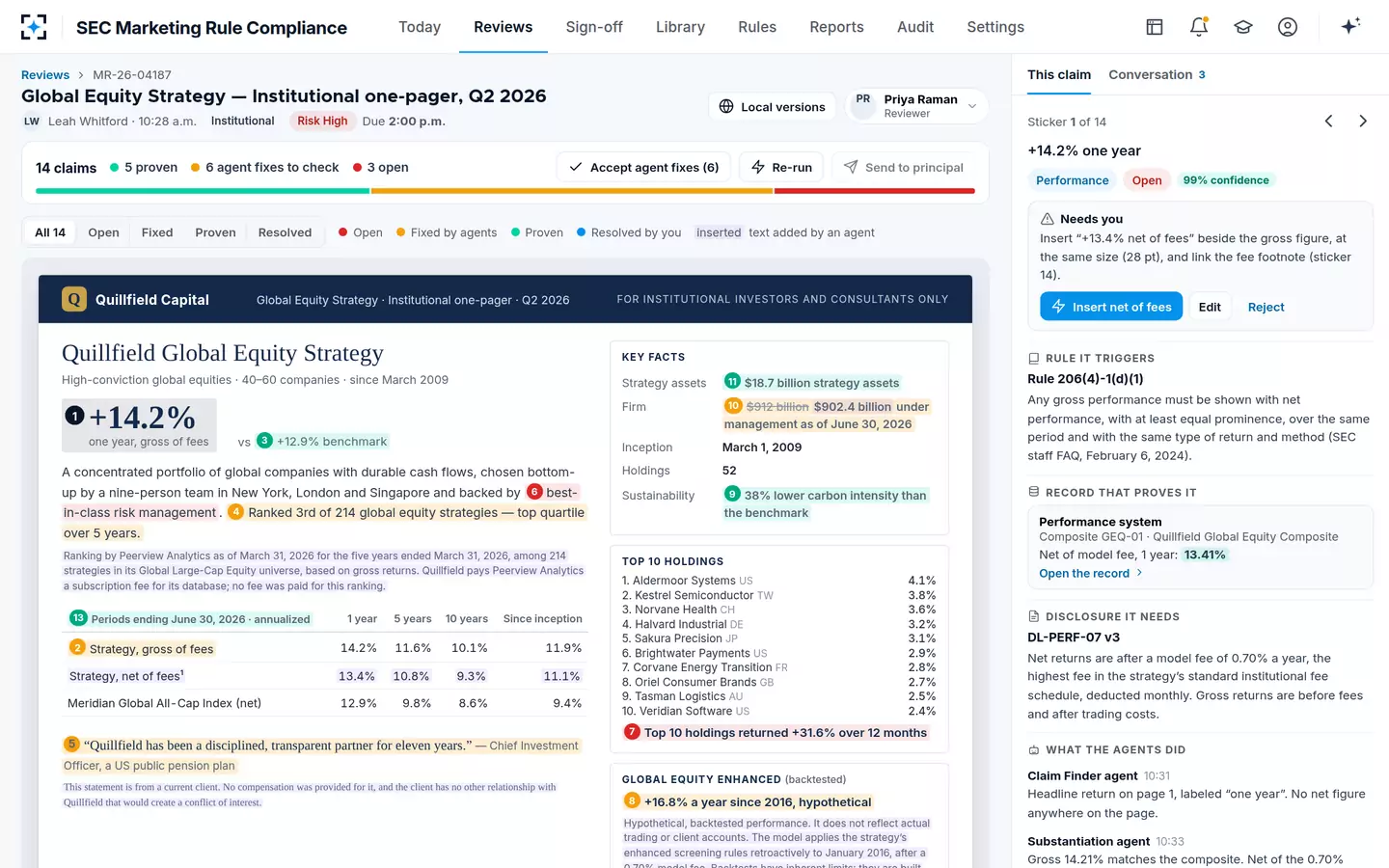
Take a sample institutional one-pager as it runs through the solution: the Global Equity Strategy one-pager of Quillfield Capital, a fictional manager, submitted for review at 10:28 a.m. on 14 July 2026. The agents found fourteen claims on its single page. Nine of them show how the seven prohibitions divide the work.
Nine claims on one sample one-pager, scored against the prohibitions
| Claim on the page | Prohibition it engages | The evidence that decides it | Outcome |
|---|---|---|---|
| +14.2% one year, gross of fees | (a)(6), with the net-of-fees condition in (d)(1) | Composite record: 12 monthly returns, gross 14.21%, net of a 0.70% model fee 13.41% | Net inserted at the same size; reviewer accepted |
| "Best-in-class risk management" | (a)(2) and (a)(4) | None: no record supports "best" | Author chose a rewrite backed by the risk policy |
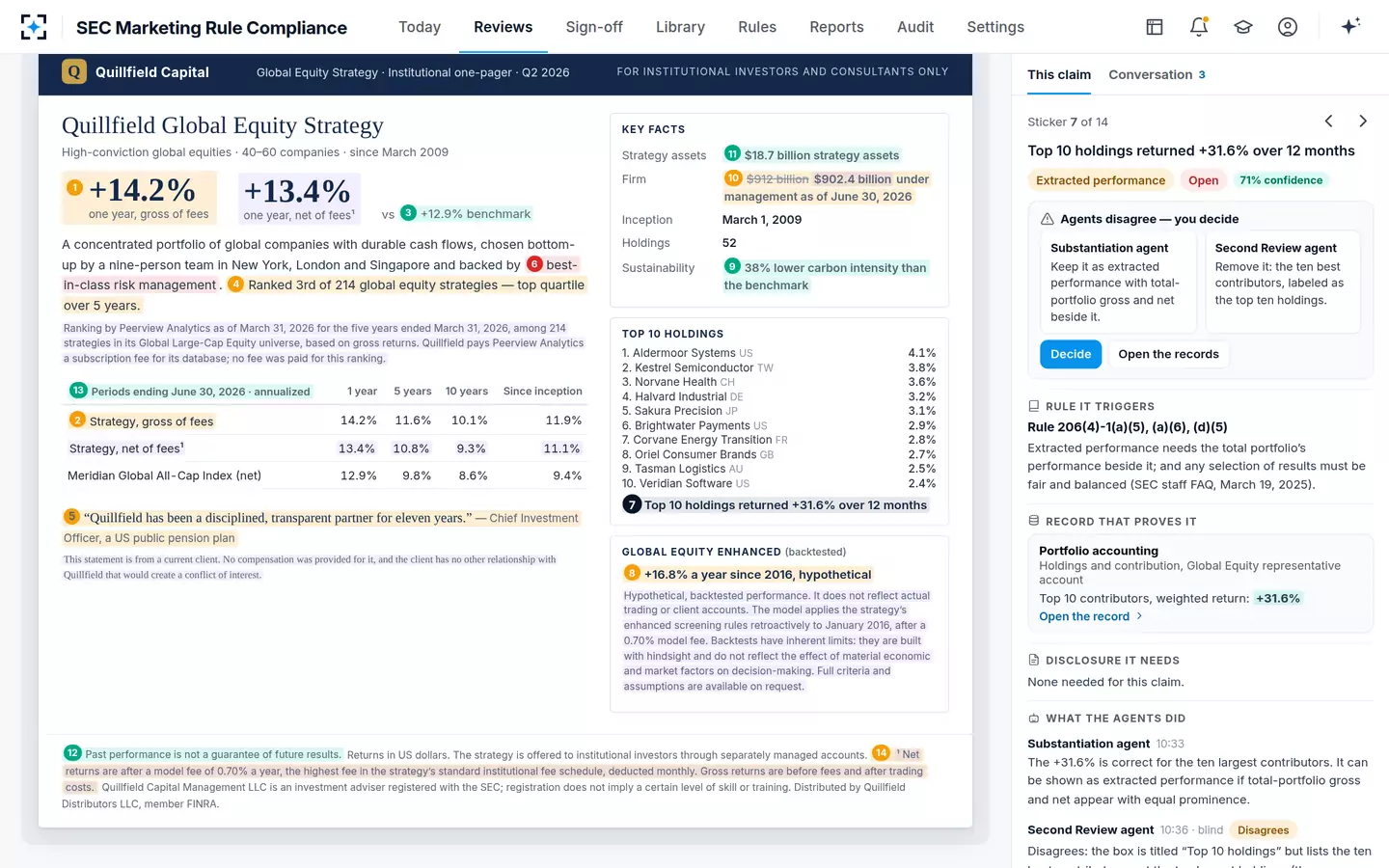
| "Top 10 holdings returned +31.6%" | (a)(5) and (a)(6); extracted performance in (d)(5) | Holdings report: the box listed the ten best contributors; the ten largest returned +17.9% | Removed as selected results |
| $912 billion under management | (a)(1) and (a)(2) | Firm AUM record: $902.4 billion at 30 June 2026; $9.6 billion was model-delivery assets | Corrected to $902.4 billion |
| Ranked 3rd of 214 strategies | (a)(3); the firm's policy also applies the rating disclosures of (c) | Database row: provider, date, five-year period, fee paid | Disclosures confirmed |
| Client quotation | (a)(1); testimonial conditions in (b) | Consent record: current client, no compensation, no conflict | Disclosure confirmed |
| Backtested +16.8% a year since 2016 | (a)(6); hypothetical conditions in (d)(6) | Firm policy on audience; methodology and model fee | Allowed for an institutional audience under the firm's policy |
| 38% lower carbon intensity | (a)(2) | Data feed for portfolio and benchmark at the same date | Proven to the record |
| Missing fee footnote | (a)(7), with the net-of-fees condition in (d)(1) | Approved disclosure text, current version | Footnote inserted from the library |
Read the third column, not the first. Every outcome was decided by a document the reviewer could open: a composite, a holdings report, an AUM record, a consent, a policy. Only one claim, the "best-in-class" superlative, was settled by wording, and even that was settled by finding which wording a record could support. That is why a general-prohibitions review is an evidence check before it is an edit.
Every claim on the page gets a marker, and every marker its rule and record
Can an adviser say it is conflict-free, or that it acts in clients' best interest?
Neither claim is banned in words, but both usually fail. "Conflict-free" is a material statement of fact that almost no adviser can substantiate, which is why it appears in five advisers' Marketing Rule orders since September 2024. "We act in your best interest" is true of every registered adviser, and that is the problem: the 2024 risk alert described advertisements that presented it as a point of difference "without disclosing that all investment advisers have a fiduciary duty to act in their clients' best interests", an inference test under (a)(3).
The same inference test catches visual claims. Examiners described advisers using the SEC logo on websites to imply endorsement, "seen on" banners for appearances that were paid advertisements, and celebrity images implying endorsements that did not exist. None of these contains a false sentence. Each leaves a reader believing something the adviser could not prove.
What examiners found, prohibition by prohibition
The SEC's examiners have published their findings on the general prohibitions twice. In June 2023 they said that any examination reviewing an adviser's marketing would keep testing advertisements against all seven (SEC risk alert, 8 June 2023). In April 2024 they reported what they had seen, prohibition by prohibition.
What the SEC's examiners reported against each general prohibition in 2024
| Prohibition | Examples the staff described |
|---|---|
| (a)(1) and (a)(2) untrue or unsubstantiated | Claims to be "free of all conflicts"; a "network of personnel" run by one person; inflated credentials; ESG mandates and approved lists that did not exist; awards never received |
| (a)(3) misleading inference | Fiduciary duty sold as a differentiator; paid media shown as press coverage; the SEC logo on a website; ratings implying sole top place |
| (a)(4) benefits without risks | Social media posts highlighting performance with no material risks or limitations |
| (a)(5) specific advice | Just the best performers shown, with losers and write-offs left out and no selection criteria in the firm's policies |
| (a)(6) performance and periods | No stated time period; total net return counting realised investments only |
| (a)(7) otherwise misleading | Disclosures in an unreadable font on websites and in videos |
The same alert carried a finding about process rather than content: advisers whose written policies required net-of-fee performance with any performance advertisement, yet whose advertisements showed gross only. A policy that is not tested against the advertisements it governs is the deficiency examiners find most easily, because it is written down. A Marketing Rule checklist, and how to test the reviewer, shows one way to close that gap.
How SEC Marketing Rule Compliance scores a piece against the seven
The solution treats the general prohibitions as a property of each claim rather than of the piece. The Claim Finder agent marks every statement of fact, performance figure, rating, testimonial, superlative and missing legend on every page. The Substantiation agent pulls the record behind each from the performance system, portfolio accounting, data feeds, the CRM and Form ADV, and marks a claim proven only on an exact match. The reviewer decides everything else, with a reason code.
Selection is where a second opinion matters most, because (a)(5) and (a)(6) turn on what was left out. On the sample one-pager, a second agent re-reading the piece blind, on a separate model, disagreed with the first about the top-ten line. The solution did not resolve it. It put both arguments on the marker and let the reviewer choose.
Two agents disagree about a selection; the reviewer decides
What the solution does not do matters as much. It does not decide that a superlative is acceptable, write new disclosure language, or approve a piece; the author chooses wording, the reviewer prepares the review and a registered principal or other approver signs. Its contribution to the general prohibitions is that the reviewer never scores a claim without its record open, and that the record stays with the advertisement for the examiner. To see the whole review, start from SEC Marketing Rule Compliance.
Questions people ask
How many general prohibitions are in the SEC Marketing Rule?
Seven, in Rule 206(4)-1(a)(1) to (a)(7). They cover untrue or misleading statements, unsubstantiated material facts, misleading inferences, benefits without risks, unbalanced references to specific advice, unfair inclusion or exclusion of performance and periods, and anything otherwise materially misleading. The SEC's examiners list all seven as a standard part of any marketing review.
Do the general prohibitions apply to institutional and private fund advertisements?
Yes. The seven apply to every advertisement the rule covers, whoever the audience. Some specific conditions differ by audience, such as the one-, five- and ten-year periods, which do not apply to private fund performance, but the general prohibitions have no audience carve-out.
Is a claim that is true but undocumented a violation?
It can be. Rule 206(4)-1(a)(2) asks whether the adviser had a reasonable basis to believe it could substantiate a material statement of fact on demand, and the SEC said it would presume no reasonable basis where the adviser cannot substantiate the claim when asked. In 2024 examiners treated an adviser's inability to substantiate a statement during an exam as a breach of (a)(2) in its own right.
Can disclosures be put behind a hyperlink?
Not where the rule requires them to be clear and prominent. In adopting the rule the SEC said hyperlinked disclosures would not meet that standard for testimonials, endorsements and third-party ratings, and in December 2025 examiners reported hyperlinked and smaller-font disclosures as deficiencies. Elsewhere, a disclosure so hard to find or read that the piece misleads can breach (a)(7).
Does the SEC Marketing Rule ban superlatives such as "best"?
No word is banned outright. A superlative is a material statement of fact that must be substantiated and must not mislead, and most cannot be proven. Many firms list restricted words in their own marketing policies; the sample firm in the solution treats "best" as one, so a reviewer must either find a record or ask the author for wording a record supports.