FINRA Rule 2210 changed in 2026 in one way that is approved and another that is only proposed. On 15 October 2026 the SEC approved SR-FINRA-2026-004, a fourth exception to Rule 2210's ban on predicting or projecting performance: broker-dealers will be able to show projected performance or targeted returns, under conditions taken almost word for word from the SEC Marketing Rule's hypothetical-performance test, once FINRA announces the start date (SEC Release 34-106675). Separately, Regulatory Notice 26-14 proposed replacing the requirement that a principal approve every retail communication before use with risk-based supervision; its comment period closed on 11 September 2026 (FINRA Regulatory Notice 26-14). For a firm whose factsheets are reviewed under both the SEC's adviser rule and FINRA's broker-dealer rule, both changes alter the review path. Botminds' SEC Marketing Rule Compliance classifies each piece under both rules at intake, so the path follows the rule that applies.
Eight months from filing to approval, and the clock still not started
- Filed 10 Feb, published 25 Feb15 d
- Comments to 18 Mar21 d
- To proceedings, 20 May63 d
- To Amendment No. 1, 30 Jun41 d
- To approval, 15 Oct107 d
- Published 9 Jul, comments to 11 Sep64 d
What changed in FINRA Rule 2210 in 2026?
The approved change adds paragraph (d)(1)(F)(iv) to Rule 2210. Until now the rule barred any member communication that predicts or projects performance, with three exceptions: hypothetical illustrations of mathematical principles, investment analysis tools that meet Rule 2214, and price targets in research reports (FINRA Rule 2210). FINRA has long read that ban to cover targeted returns as well. The new exception lets a member project performance or give a targeted return for a security, a portfolio, or an asset allocation or other strategy, if three conditions are met.
It is the third attempt. FINRA asked for comment on a narrower version, for customised planning illustrations, in Regulatory Notice 17-06 in February 2017. It filed a second, limited to institutional communications and certain qualified purchasers, in November 2023 as SR-FINRA-2023-016. The 2026 filing dropped the list of eligible investor types and borrowed the SEC Marketing Rule's structure instead, which is why the approved text reads like the SEC's (FINRA's notice of filing, 91 FR 9308).
Can a broker-dealer show targeted returns now?
Yes, once FINRA names the implementation date, and only to an audience its written policies say the projection suits. Until that date the existing prohibition still applies, and FINRA said when it filed that "If the Commission approves the proposed rule change, FINRA will announce the implementation date of the rule change in a Regulatory Notice". By the end of October 2026 that notice had not appeared, so the date is the first thing to confirm.
The conditions are three. The member must adopt and implement written procedures that make sure the projection suits the finances and goals of the investors it is aimed at. It must give enough information for that audience to understand the criteria and assumptions behind the projection, and its risks and limitations. And it must keep, with its other Rule 2210 records, information on the source of any projection or targeted return. FINRA told the SEC that, under such policies, projections should generally not reach mass or general retail audiences; the approved exception is for investors with the resources and expertise to analyse them, as our guide to market commentary also notes.
What was dropped along the way, and what that leaves to the firm
FINRA's Amendment No. 1 of 30 June 2026 removed three things from the original filing. It took out the requirement to disclose whether a projection is net of anticipated fees and expenses, the requirement to explain why a projection might differ from actual results, and an express "reasonable basis requirement" for the criteria and assumptions, with written records supporting them. In their place it put the narrower record of "the source of any projection of performance or targeted return" (SEC approval order).
FINRA's reasoning was that Rule 2210's general standards already forbid unreasonable projections: communications must be fair and balanced, and may not contain a "false, exaggerated, unwarranted, promissory, or misleading" claim. That is a fair reading of the rule, but it moves work from the rule to the reviewer. A projection with no stated basis and no fee assumption is not banned by the new paragraph. It has to be caught by a reviewer applying the general standards, so a firm's written procedures should say what basis and fee disclosure it expects even though the rule no longer does.
Does FINRA 2210 now allow backtested performance?
No. The exception covers projections and targeted returns only. The SEC's order records that FINRA deliberately limited it, "not expanding to include at this time additional categories of performance information suggested by commenters, such as backtested, model, related, and extracted performance", so that FINRA could gain experience first and consider expanding later.
That leaves the clearest gap between the two regimes. An adviser may show a backtest under the SEC Marketing Rule if its hypothetical-performance policies are met. A broker-dealer distributing the same piece gets no permission for it from the new exception, and whether Rule 2210's general standards allow it remains a question for the FINRA reviewer. For a fund factsheet distributed by an affiliated broker-dealer, the backtest that compliance cleared under the SEC rule can still fail the FINRA review. Hypothetical performance under the SEC Marketing Rule covers the adviser side.
Projections under FINRA's new exception and the SEC Marketing Rule, side by side
FINRA Rule 2210, new exception: Projected performance and targeted returns only. Backtested, model, related and extracted performance stay outside the exception.
SEC Marketing Rule: All hypothetical performance: model portfolios, backtests, and targeted or projected returns.
FINRA Rule 2210, new exception: Written policies reasonably designed to make the communication relevant to the likely financial situation and investment objectives of the intended audience.
SEC Marketing Rule: The same test, in the same words; the SEC said advisers generally could not meet it for a mass audience.
FINRA Rule 2210, new exception: Enough information to understand the criteria and assumptions, and the risks and limitations.
SEC Marketing Rule: The same two conditions, with risks and limitations offered on request for private fund investors.
FINRA Rule 2210, new exception: No requirement to say whether the figure is net of fees; general standards apply.
SEC Marketing Rule: Gross needs net beside it at equal prominence, hypothetical figures included.
FINRA Rule 2210, new exception: No express reasonable-basis condition; keep the source of any projection.
SEC Marketing Rule: Material facts must be substantiable on demand; keep the records behind any performance and the information provided under (d)(6).
FINRA Rule 2210, new exception: To be announced by FINRA in a Regulatory Notice.
SEC Marketing Rule: In force since the compliance date of 4 November 2022.
Regulatory Notice 26-14: the end of principal pre-use approval?
Regulatory Notice 26-14, published on 9 July 2026, is a request for comment, not a rule. It proposes that FINRA "replace the prescriptive principal pre-use approval requirement with more modernized, risk-based standards for supervising retail communications", streamline retail-communication filings, and change the standard for communications that contain recommendations. Comments closed on 11 September 2026; FINRA would still have to file a rule change with the SEC.
Today Rule 2210(b)(1)(A) requires an appropriately qualified registered principal to approve each retail communication before the earlier of its use or its filing with FINRA. Under the proposal, a firm's written procedures would decide which categories need approval before use, weighing risk factors such as product complexity, the preparer's qualifications and the use of performance data. Some approvals would remain: retail research reports before first use, and any communication before it is filed. A firm that stops pre-approving some categories would need training, documentation, and surveillance with follow-up instead.
The notice would also move investment company retail communications that carry self-published rankings or comparisons from filing before first use to filing within 10 business days of first use, change when a new member's one-year pre-use filing period starts, and stop treating interactive social media differently from other communications. None of this is in force. A firm planning its review process for 2027 should treat it as a direction of travel and keep principal pre-approval in its procedures until a rule change is approved.
Rule 2210's three classes still decide the review
Neither change touches the classification that decides how a piece is reviewed. Rule 2210 sorts written communications by audience, and the class sets whether a principal approves before use, whether FINRA sees it, and when.
FINRA Rule 2210's communication classes and what each one triggers today
| Class | Who receives it | Principal review | Filing with FINRA |
|---|---|---|---|
| Retail communication | More than 25 retail investors within any 30 calendar-day period | Approval before the earlier of use or filing | Investment company pieces that promote a specific fund: within 10 business days of first use; pieces with self-published fund rankings: 10 business days before use |
| Correspondence | 25 or fewer retail investors within any 30 calendar-day period | Under Rule 3110 review procedures, not pre-approval | None |
| Institutional communication | Only institutional investors | Written procedures for principal review; where not all are pre-reviewed, training and surveillance | None |
One piece, two rule books: what a dual registrant has to do
An investment adviser whose funds are distributed by an affiliated broker-dealer applies both rules to the same factsheet. The SEC rule requires policies and records but no pre-approval; FINRA requires a principal's approval of a retail communication and, for fund pieces, a filing. The projections exception narrows one difference: a targeted return in an institutional pitch book may soon pass both. The backtest difference remains, and so does the difference in who signs, set out in who signs each ad.
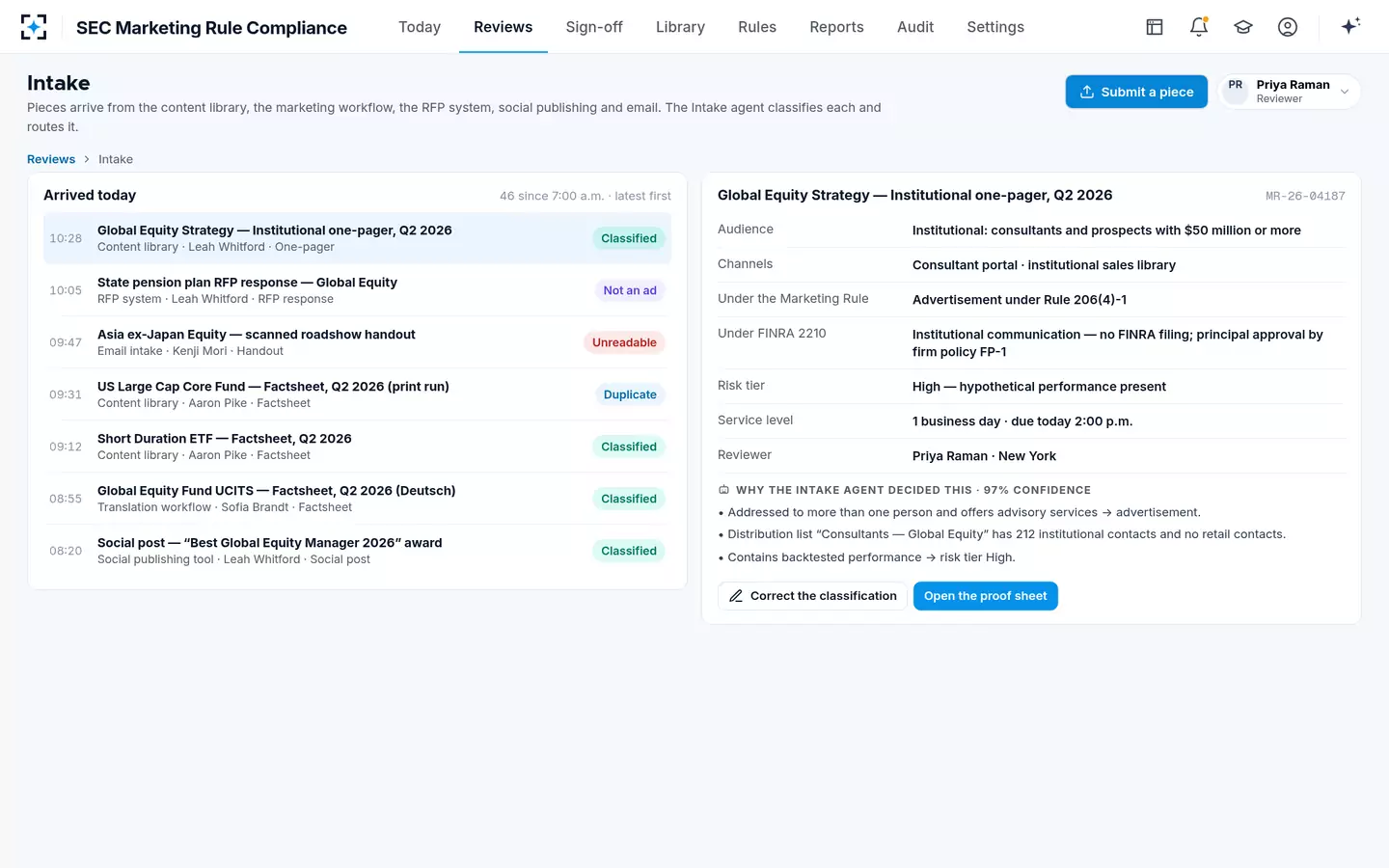
Intake classifies each piece under both rules, with the reasons shown
What to change now, and what to wait for
The approved change is a permission, not an obligation: nothing breaks on the implementation date for a firm that does not use projections. A firm that intends to use them, or that runs an adviser and a broker-dealer side by side, has work to do before that date, and the date belongs on the same calendar as the other moved deadlines in the RIA compliance calendar for 2026.
Preparing for the FINRA Rule 2210 changes
- Decide whether you will use projections or targeted returns at all
If not, write that into procedures and keep the current prohibition as your control.
- Write the audience policy before the first piece
Define who counts as having the resources and expertise, how you know, and how distribution is limited to them. The SEC side can reuse the same policy if the wording matches.
- Set your own fee and basis expectations
The rule dropped them; your procedures can keep them. State whether projections are shown net of anticipated fees.
- Add the source of each projection to the communication record
Rule 2210(b)(4)(A) records already list the source of statistical tables, charts and graphs; projections join them.
- Review backtests in broker-dealer pieces on their own terms
The new exception does not cover them, including in SEC-compliant adviser pieces your affiliate distributes.
- Watch FINRA's Regulatory Notices for the start date
Do not change your review until the date is announced.
- Keep principal pre-approval in place
Regulatory Notice 26-14 is a proposal; until a rule change is approved, Rule 2210(b)(1) is unchanged.
How SEC Marketing Rule Compliance handles both rules
The solution reads each submission's distribution list and classifies it under both rules: advertisement or not under Rule 206(4)-1; retail, correspondence or institutional under Rule 2210; whether a FINRA filing is needed and its clock. A piece carrying hypothetical performance is marked high risk and tested against the firm's own policy for its audience, and because both classifications sit side by side, a reviewer sees before reading a word that a backtest is headed for a broker-dealer channel. The firm's rules are settings, so when the projections exception takes effect, the change is a policy update approved by the chief compliance officer, not a software release.
Prepared by one person, approved by another, with the FINRA class on the record
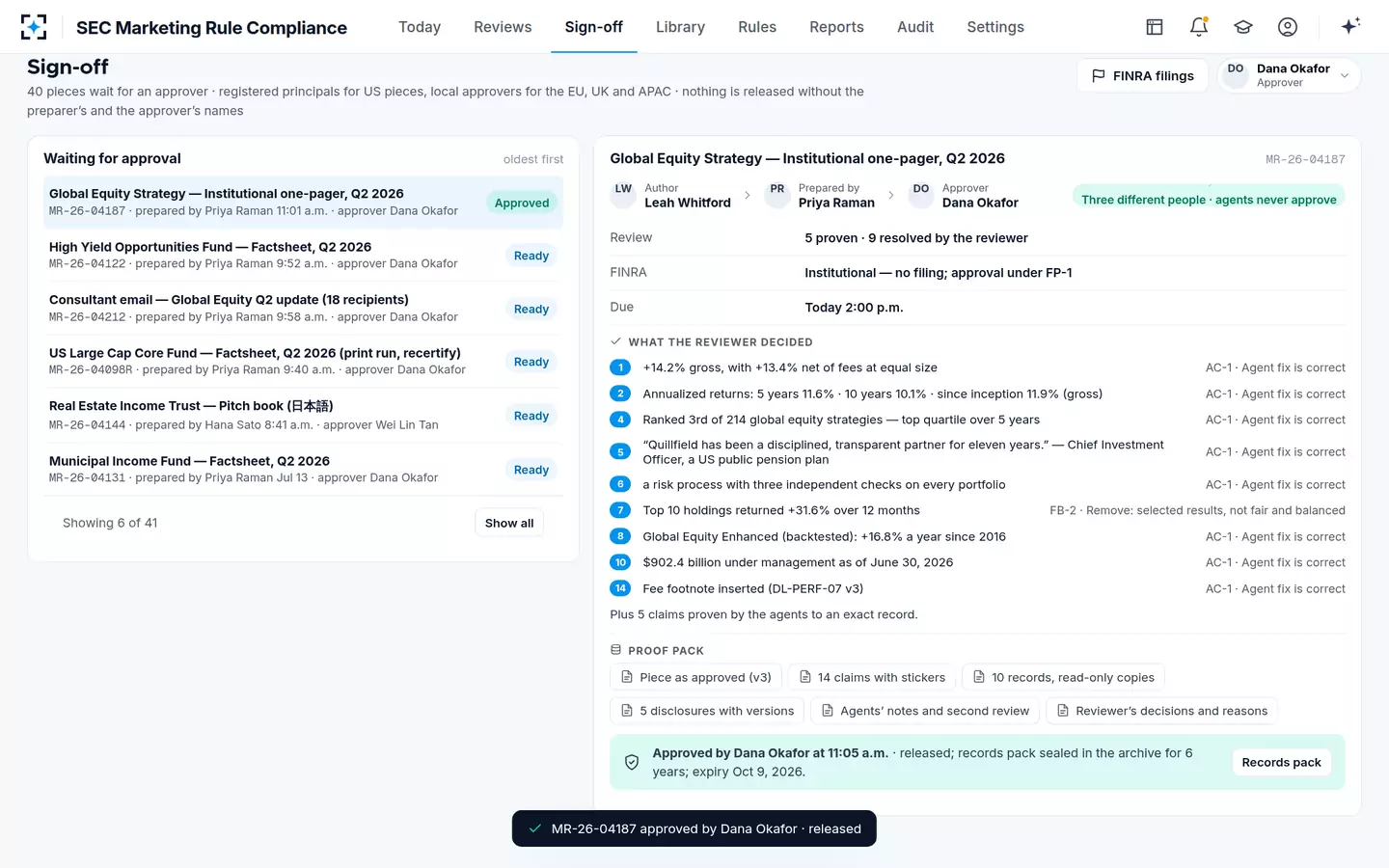
It does not decide whether a projection suits an audience, write the policy, or approve the piece; those stay with the firm's principals and compliance officers. What it adds is that both rule books are applied at intake, every time, and that the reasons are written down. See the full review at SEC Marketing Rule Compliance.
Questions people ask
When do the FINRA 2210 projection changes take effect?
FINRA will announce the date in a Regulatory Notice; it said so when it filed the change. The SEC approved the change on 15 October 2026, and by the end of that month FINRA had not published the notice. Until then the prohibition on projecting performance in Rule 2210(d)(1)(F) applies without the new exception.
Can a broker-dealer use projections with retail investors under the new rule?
Generally not. The condition is that written policies make the projection relevant to the likely financial situation and investment objectives of its intended audience, and FINRA told the SEC that this would generally rule out mass or general retail audiences. The exception is meant for investors who can analyse a projection independently.
What happened to FINRA's earlier projections proposal?
FINRA filed SR-FINRA-2023-016 in November 2023, which would have allowed projections only in institutional communications and certain communications to qualified purchasers or knowledgeable employees. After comments urging closer alignment with the SEC Marketing Rule, FINRA filed the 2026 version, which replaced the investor list with an audience-relevance policy test.
Does Rule 2210 apply to communications drafted with AI tools?
Yes. In Regulatory Notice 24-09 (June 2024) FINRA said Rule 2210 judges the content, not the author: a communication produced with a technology tool meets the same standards as one a person wrote. A projection drafted by a model needs the same audience policy, disclosures and source record as one drafted by an analyst.
Does an institutional communication need principal approval under FINRA 2210?
Not necessarily before use. Rule 2210(b)(3) requires written procedures for review by an appropriately qualified registered principal; where they do not require review of every institutional communication before use, they must include education and training, documentation, and surveillance and follow-up. Many firms pre-approve institutional pieces anyway as a matter of policy.