To write market commentary that clears review first time, write it in four moves in a fixed order: what the portfolio returned against its benchmark, what drove the difference, what the manager did, and how the portfolio is now positioned. Then make every sentence one of six types, each with a source it must tie to and a rule it can break: a return ties to the official returns, a driver to one cell of the signed attribution, a cause to a note or a filing, a view to the portfolio manager's own words. The work is hard because it is done in the days after quarter end, for dozens or hundreds of strategies, and no reviewer can prove sixteen numbers per strategy by eye. Botminds' Portfolio Commentary Generation exists for that gap: agents draft each commentary from final attribution and the PM's notes, and tie every sentence to the place it came from.
The examples on this page come from a fictional manager, Quillfield Capital, as its third-quarter 2026 cycle runs through the solution. Its Global Core Equity strategy returned 3.93% after fees against 3.47% for its index, and its commentary is ten sentences long.
Six sentence types: each needs its own source, and each can break its own rule
Return
ExampleClass I returned 3.93% after fees (4.12% before) against 3.47% for the index.
Must tie toOfficial returns by share class, and the benchmark from the same file and period
Can breakNet beside gross for the same period; working papers kept (Advisers Act rule 204-2(a)(16))
Driver
ExampleStock selection in Industrials added 38 basis points.
Must tie toOne cell of the signed-final attribution: effect, sector, period, unit
Can breakA statement of fact you can substantiate; the effect named as the model names it
Cause
Example… led by Vossberg Antriebstechnik, which rose 21.4% after raising its full-year guidance on August 6.
Must tie toThe holding’s return from portfolio accounting; the reason from the issuer’s own release or the PM’s note
Can breakA key factor, not a market tour (Form N-1A Item 27A(d)(1)); no reason that no source gives
Action
ExampleDuring the quarter we added to Japanese industrials and trimmed US software.
Must tie toFilled orders from the order management system, for the period
Can breakSpecific advice shown fairly: winners and losers alike, if the piece is an advertisement
View
ExampleWe remain modestly overweight Japan, and we are watching the path of interest rates closely.
Must tie toThe PM’s own words; positioning checked against holdings and the house view
Can breakOpinion marked as opinion (CFA Standard V(B)); no prediction of performance
Disclosure
ExampleViews are those of the portfolio manager as of September 30, 2026 and are subject to change.
Must tie toThe firm’s disclosure library, by audience and jurisdiction
Can breakPresent, current and as prominent as the claim it qualifies
What is market commentary, and what should a fund commentary include?
Market commentary is the manager's written account of a period: how the portfolio performed against its benchmark, why, what the manager did about it and where the portfolio now stands. A fund commentary should include those four things and very little else, because the regulators that write rules for it ask for the explanation, not the weather report.
The plainest statement of what to include is the US annual shareholder report. Form N-1A asks every open-end fund to "Briefly summarize the key factors that materially affected the Fund’s performance during the reporting period, including the relevant market conditions and the investment strategies and techniques used by the Fund’s investment adviser" (Form N-1A, Item 27A(d)(1)). That section, the management's discussion of fund performance, must appear in the annual report and may be left out of the semi-annual one; an annotated tailored shareholder report shows where it sits among the report's other parts. Notice the order of the nouns: market conditions are relevant only as one of the key factors, and the adviser's own strategies and techniques are named beside them.
"Do not include a lengthy, generic, or overly broad discussion of the factors that generally affected market performance during the reporting period."
SEC Form N-1A, Item 27A(d)(1), Instruction 1
The same discipline serves every other format. A quarterly letter to an institutional client, a factsheet paragraph and an adviser note are not governed by Item 27A, but each is read by someone who wants to know what happened to this portfolio. A paragraph that would be equally true of every global equity fund in the market tells that reader nothing, and it is also the paragraph most likely to drift into a forecast.
The four moves: return, drivers, actions, positioning
The structure that survives review is the one the reader's questions impose. First the result, then the explanation, then the decisions, then the present. Each move has a natural length, and each has a sentence type that tends to go wrong in it.
Return. One or two sentences: the share class or composite, the period, the return after fees, the return before fees if the house shows it, and the benchmark named in full. "Class I returned 3.93% after fees (4.12% before) against 3.47% for the Halden Global Developed Index" carries five facts, each of which a reviewer can tie to one file. The failure here is a mismatch of bases: a gross portfolio return set against a net index, or a class that is not the one the reader holds.
Drivers. Two to four sentences that decompose the difference. In a Brinson-style attribution the difference splits into allocation (being over- or underweight a sector) and selection (picking better or worse stocks inside it), plus currency for an unhedged global portfolio. "Stock selection drove the outperformance, adding 54 basis points, while sector allocation added 2" is a driver sentence. The failure is a mislabel, such as calling a sector's total effect its allocation effect, which is exactly the error worked through on one figure's journey from attribution to print.
Actions. One or two sentences on what the manager bought, sold or changed, drawn from filled orders for the period. "We added to Japanese industrials and trimmed US software after strong gains" is checkable against the order blotter. The failure is an action described from memory that the trades do not show, or a decision credited for a result it did not cause.
Positioning. One or two sentences on where the portfolio stands at period end, relative to the benchmark. "We remain modestly overweight Japan" can be tested against holdings: 9.8% of the portfolio against 6.1% of the index in the sample. The failure is the line that slides from positioning into prediction, which the section on views below takes apart.
Generic market commentary against commentary a reviewer can sign
Generic: true of any fund: Global equities rose in the quarter as investors grew more optimistic about the economy.
Specific: true of this one: Energy was the index’s strongest sector, up 9.57%, and the portfolio’s underweight in it cost 11 basis points.
Generic: true of any fund: Strong stock selection contributed positively to relative performance.
Specific: true of this one: Stock selection added 54 basis points, led by Industrials (38) and information technology (21).
Generic: true of any fund: Some positions faced headwinds.
Specific: true of this one: Selection in Health Care cost 24 basis points, chiefly Orrelle Biotherapeutics, which fell 18.2% after a delayed trial readout.
Generic: true of any fund: We expect markets to remain volatile but see attractive opportunities ahead.
Specific: true of this one: We remain modestly overweight Japan and are watching the path of interest rates closely.
Every sentence is one of six types, and each has its own test
A reviewer signs faster when the writer has already sorted the sentences, because each type has a different test and a different source. The six types in the table at the top of this page cover almost every sentence in a performance commentary: return, driver, cause, action, view and disclosure.
Return and driver sentences are statements of fact about performance, and they carry the heaviest record-keeping duty. A registered adviser must keep the working papers that show how it calculated every performance figure it publishes, and the rule names an "investment letter, bulletin, or other communication" among the places those figures appear (17 CFR 275.204-2(a)(16); its full wording is in client reporting software best practices). Those papers stay on file for five more years after the fiscal year in which the commentary last appeared. If the attribution file behind a basis-point figure was a preliminary run later restated, the working paper and the sentence no longer agree.
When the commentary is used as an advertisement, the marketing rule adds a sharper test. An advertisement may not state a material fact unless the adviser reasonably believes it could prove that fact if the SEC asked (17 CFR 275.206(4)-1(a)(2)). For a commentary, that means every factual claim needs its source on file before the piece goes out, not reconstructed when an examiner asks.
Cause sentences are where commentary most often overreaches. A cause links a driver to an event: Vossberg rose after raising guidance; the yen rose against the dollar. Each needs a source for the event and a source for the link, and the link should be no stronger than the evidence. "Rose 21.4% after raising its full-year guidance" states a sequence the issuer's release supports. "Rose 21.4% because of our engagement with management" would need evidence the file does not hold. Why wins tend to be explained as skill and losses as luck looks at the research on that pattern.
How to write a market summary without writing a generic one
Write the market paragraph last, and only from the drivers. Once the attribution has told you that Industrials and information technology selection carried the quarter and Health Care and the Energy underweight cost it, the market sentences you need are the ones that explain those four effects: the oil price for Energy, the trial readout for Health Care, the guidance cycle for Industrials. A market summary written first, from the news, tends to describe the quarter everyone had rather than the quarter this portfolio had.
Item 27A's instruction gives a practical test: if a sentence would sit as comfortably in a competitor's report as in yours, it is generic. Two more tests help. Does each market sentence connect to a number further down the page? And does the paragraph name the benchmark's behaviour, not just "markets"? The index rose 3.47% in the sample quarter; Energy, at 9.57%, was its strongest sector, which is why being underweight it cost 11 basis points. That is a market summary, and it took two sentences.
The same instruction asks funds to use "graphics or text features, such as bullet lists or tables" where they help. A short table of the three largest contributors and detractors, in basis points, often replaces a paragraph of adjectives, and it is easier to check.
Numbers in commentary: basis points for effects, percent for returns, net before gross
The number errors that survive drafting are seldom arithmetic. They are units, labels and bases, and a house style that fixes the conventions removes a whole class of them before anyone writes.
The usual convention is percent for returns and basis points for effects, so that 0.38% in the attribution file becomes 38 basis points in the sentence and is never written as "0.38 basis points" or "38%". Returns are stated for a named share class and period, net of fees first, with gross beside it on the same basis if the house shows gross at all. For advertisements, the SEC's marketing rule requires that gross performance be accompanied by net, and its staff have set out conditions for showing characteristics such as attribution gross of fees; what the rule says about gross and net attribution is covered in detail by the Performance Attribution Analysis guides.
Sixteen figures in one ten-sentence commentary, and the file each one comes from
Sixteen figures from four systems is why checking a commentary can take as long as writing it. Each figure has five properties a reviewer should be able to confirm: the value, the unit, the sign, the period, and whether the file it came from was final. In the sample, the first draft wrote a currency move as 6.1% where the closing rates gave 4.1%, and credited the Financials overweight with 12 basis points, which was the sector's total effect; allocation alone was 9. Both sentences read perfectly well.
How long should a fund commentary be?
As long as the key factors need, and usually shorter than writers expect. Item 27A asks the US annual report to "Briefly summarize". In the sample, the master commentary for Global Core Equity runs to 236 words in ten sentences; the factsheet paragraph cut from it is capped at 900 characters; the plain-language version for wealth advisers is 140 words.
Length is better set by the number of effects that matter than by a word count. A rule of thumb that works: one sentence for the result, one for each driver above a materiality line the house sets (say 10 basis points), one for each action that changed positioning, and one or two for positioning. A quarter in which three effects explain the result needs a short commentary. A quarter in which a dozen small effects cancel out needs a sentence saying so, not a dozen sentences.
Views and forecasts: write the portfolio manager's opinion as opinion
A view is the one sentence type that belongs to the portfolio manager alone, and it is the one most often rewritten in review. The professional standard is simple to state: CFA Institute members must keep fact and opinion visibly apart when they present investment analysis and recommendations (CFA Institute Standards of Professional Conduct, V(B)). A view written as fact, or a fact written as a view, fails it.
The harder line is between positioning and prediction. FINRA Rule 2210 says member communications "may not predict or project performance, imply that past performance will recur" (FINRA Rule 2210(d)(1)(F)), subject to narrow exceptions. On 15 October 2026 the SEC approved a fourth exception for projected performance and targeted returns under written policies and disclosure conditions, but FINRA said the change generally would not permit them in communications "for a mass audience or intended for general circulation, including a general retail investor audience" (SEC Release 34-106675). Under the FCA's conduct rules, information that indicates future performance must be "based on reasonable assumptions supported by objective data" and carry a prominent warning that forecasts do not reliably indicate future performance (COBS 4.5A.14R). A sentence in a fund commentary is rarely built to meet either set of conditions.
The sample shows the line in one edit. The first draft's tenth sentence, taken from the PM's note, read: "We expect the rally in Japanese equities to continue well into 2027 and see significant further upside." The PM rewrote it as: "We remain modestly overweight Japan, and we are watching the path of interest rates closely." The second sentence states a position the holdings prove and a concern the reader can weigh. It predicts nothing, and it is still recognisably the manager's view. The UK version of that test, sentence by sentence, is in fair, clear and not misleading for commentary.
What a compliance reviewer checks before signing commentary
A reviewer signs when the writer can answer the checks below without opening another file. The list is ours, built from the rules quoted on this page; a firm's own procedures will add to it.
Eight checks a reviewer runs on a fund commentary
- Every return names its class, period and basis
Net after fees first; gross beside it on the same period if shown; the benchmark named in full.
- Every effect matches its cell in the final attribution
Value, unit (basis points), sign, effect type and sector, from a file signed final, not a preliminary run.
- Every cause has a source
An issuer release, a market data series or the PM’s note; no reason the file does not give.
- Detractors are explained as fully as contributors
A commentary that names three winners and no losers is not fair and balanced, whatever the arithmetic.
- Actions match the trades
Purchases and sales described are in the period’s filled orders.
- Views are labelled and predict nothing
Positioning stated against the benchmark; no return expectation, target or “poised to outperform”.
- Disclosures fit the audience and the jurisdiction
Views disclaimer, past performance warning, currency warning where returns are in another currency.
- The working papers are filed
Attribution, returns and sources kept with the published text, for the retention period the rules set.
Where Portfolio Commentary Generation does the drafting and the proving
The solution writes the four moves and the six sentence types as described here, and it is honest about which of them it may write. The Drafting agent plans the story from final attribution and writes return, driver, cause and action sentences, each from a source; it never writes a view the PM has not written. A separate Fact-check agent, with different instructions, recomputes every figure against its cell and sends wrong sentences back. A Tone checker compares views with the house view and flags predictions, and proposes wording, but the PM rewrites his own line.
The writing room: the draft on the left, the attribution on the right, a line between them
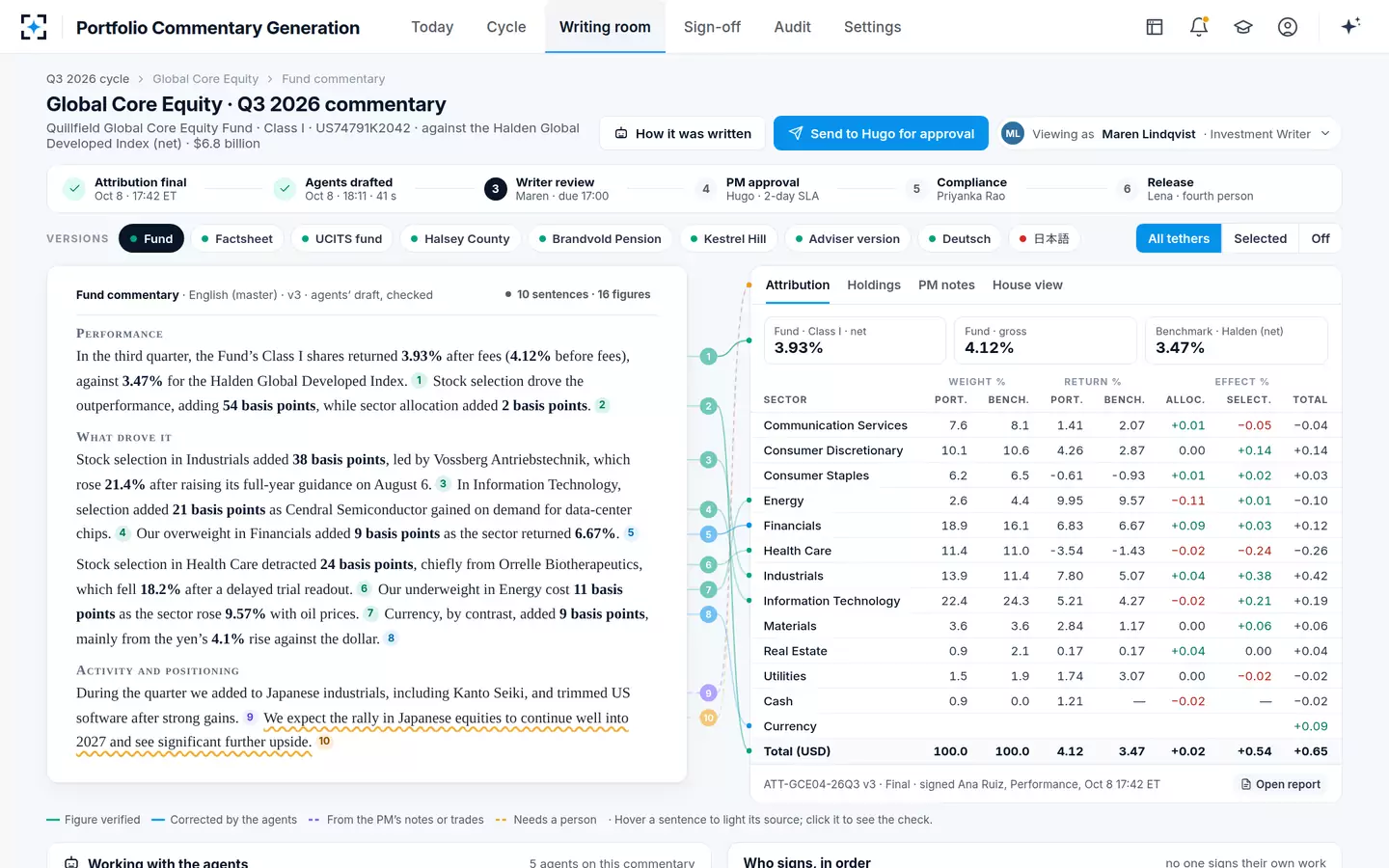
What the reviewer sees is the evidence the checklist asks for, attached to each sentence. Clicking a sentence opens its check: the cell, the unit conversion, the period, the attribution's final status and the source of any reason given.
The check behind one driver sentence
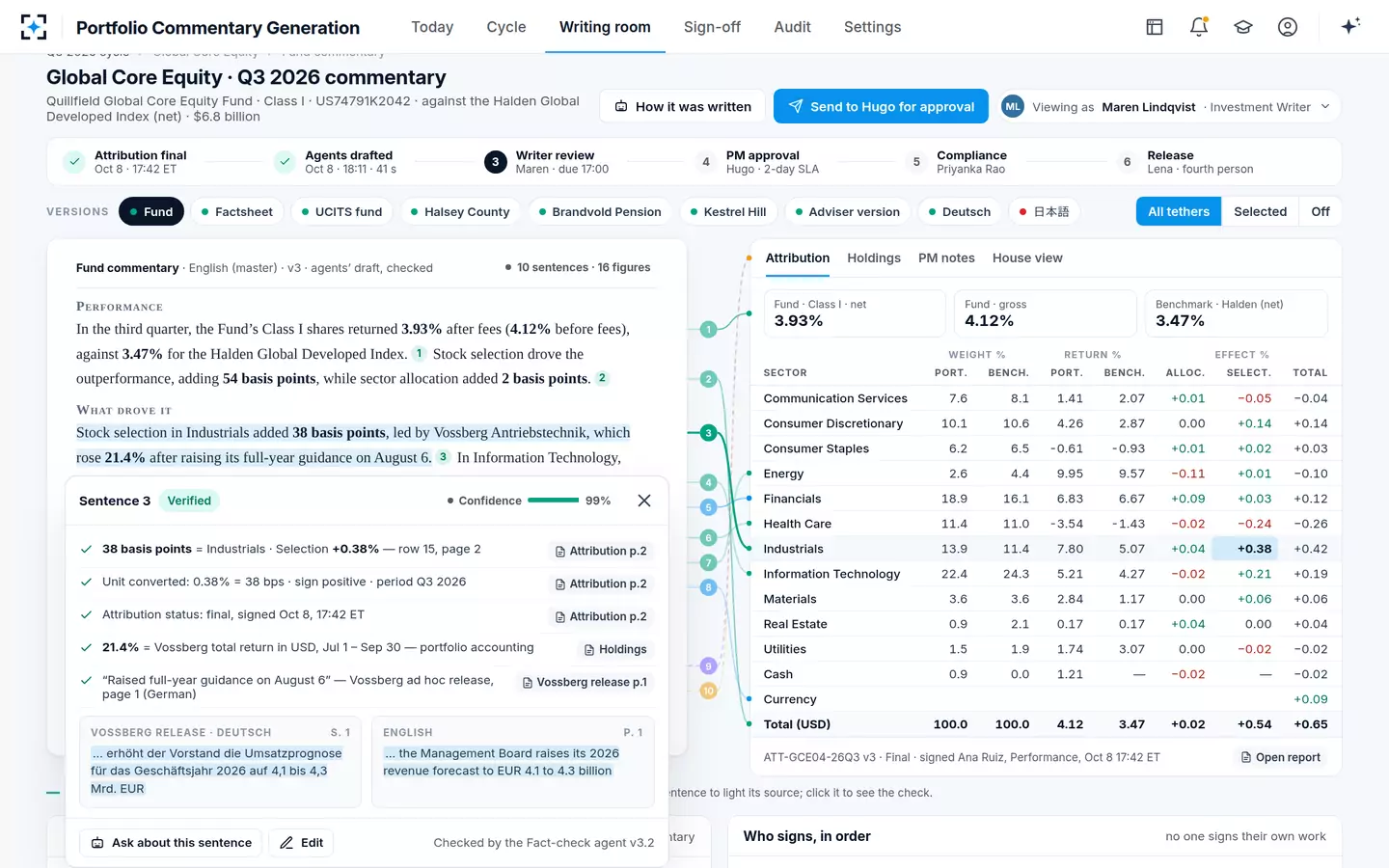
The limits matter as much as the drafting. The agents never draft from preliminary or restated attribution, never invent a reason, never change a PM's view and never clear a compliance flag. When the deadline is the problem rather than the writing, where the days after quarter end go follows the calendar. To see the writing room on your own strategies, start from Portfolio Commentary Generation.
Questions people ask
How do you write a market report for a fund?
Start from the performance attribution, not the news. State the return against the benchmark, decompose the difference into its largest effects, explain each with a sourced cause, then describe the manager's actions and current positioning. Form N-1A's instruction for the US annual report, to summarize the key factors and avoid a generic market discussion, is a good standard for any fund market report.
Is market commentary an advertisement under the SEC Marketing Rule?
It depends on what it does. The SEC said in adopting the rule that whether a communication is an advertisement "depends on the facts and circumstances", chiefly whether it offers the adviser's services, and that generic market commentary would generally fall outside the definition. Commentary sent to existing clients that offers nothing new is usually outside it too, but the anti-fraud provisions of section 206 still apply to every communication.
What is providing commentary in finance?
It is the written or spoken explanation a manager, analyst or strategist gives of what happened to markets or a portfolio and why. In asset management it most often means the periodic performance commentary that accompanies a fund report, factsheet or client letter. Because it contains performance figures, the records behind it must be kept for five years, counted from the end of the fiscal year it was last sent, under Advisers Act rule 204-2.
Should a commentary show returns before or after fees?
After fees first, and before fees only beside it on the same period and basis. The SEC's marketing rule requires that any presentation of gross performance in an advertisement be accompanied by net performance, and UK rules require the effect of charges to be disclosed where an indication of past performance is based on gross figures. Attribution effects are usually computed gross, which is why the house should say so in the sentence.
Can a commentary say a sector is "poised to outperform"?
Not in most retail communications. FINRA Rule 2210 bars predictions and projections of performance, with narrow exceptions, and the 2026 exception for projections and targeted returns generally does not reach mass or general retail audiences. A positioning statement, such as an overweight held against the benchmark, says what the manager has done without forecasting the result.