A tailored shareholder reports example is easiest to read as a stack of prescribed lines: a cover with the fund, class and period, a costs table for a $10,000 investment, a short account of what drove performance with a ten-year graph and a returns table against an appropriate broad-based index, four fund statistics, a holdings graphic, any material fund changes, and a statement of where to find the rest online. Since July 24, 2024, every mutual fund and ETF registered on Form N-1A sends one of these for each share class, twice a year, and Item 27A of the form fixes what each line says and in what order. The hard part is not the design; it is that each class report repeats the fund's report with a handful of class figures changed, and those figures must tie to the financial statements. Botminds' Tailored Shareholder Reports drafts each class report and ties every figure to its page, so the people who sign see the source before they approve.
The example below follows one class of a fictional fund through an annual report: Class C of Quillfield Municipal Income Fund, fiscal year ended August 31, 2026, from the sample data the solution runs on. The figures are sample figures.
From a book to a leaflet: the length the rule was written to fix
134pages
average annual shareholder report before the rule, by SEC staff analysis
3–4pages
the SEC's estimate for the new annual report
29,046
authorized mutual fund share classes in December 2021, each now with its own report
What is in a tailored shareholder report? Nine parts in a fixed order
A tailored shareholder report contains the parts lettered (b) to (i) in Item 27A of Form N-1A, in that order, and nothing the item does not require or permit. The annual report must contain all of them; the semi-annual report must contain the cover, the costs table, the fund statistics, the holdings graphic, any change of accountants and the availability statement, and may add the others. The sole optional extra in an annual report is (j), the householding explanation.
Order is not a matter of style. Instruction 1 says to disclose the parts "in the same order as these items appear", and for a report read on a screen to give each part "similar prominence as that provided by the order prescribed". The SEC staff reminded funds of it in their first-cycle review, ADI 2024-14: funds "are required to present the information in shareholder reports in the same order as is required under Item 27A of Form N-1A."
Item 27A at a glance: what the annual and semi-annual reports must carry
| Part | Annual report | Semi-annual report | What trips funds up |
|---|---|---|---|
| (b) Cover or beginning | Required | Required | The website address goes to the home page instead of the class materials |
| (c) Fund expenses | Required | Required | Dollars computed on $10,000 instead of the average account; cents shown |
| (d) Management's discussion of fund performance | Required (money market funds may omit) | Optional | ETFs adding market-price returns, which are not permitted |
| (e) Fund statistics | Required, including advisory fees paid | Required, advisory fees optional | Portfolio statistics placed under the holdings heading |
| (f) Graphical representation of holdings | Required | Required | Percentages with no basis; credit quality with no method |
| (g) Material fund changes | Required if any occurred | Optional | A description without the cover statement, or the reverse |
| (h) Changes in and disagreements with accountants | Required if applicable | Required if applicable | Rarely triggered; omitted when inapplicable |
| (i) Availability of additional information | Required | Required | Broken links; links that do not reach the item |
| (j) Householding | Optional | Not listed | — |
One class's annual report, annotated: the line, the rule, the source
Cover
Quillfield Municipal Income Fund · Class C · QMNCX · Annual shareholder report
The ruleItem 27A(b)(1)–(3): fund and class name, the class ticker, and the words "annual shareholder report"
SourceProspectus and the share class master file
Cover
"This annual shareholder report contains important information about … for the period of September 1, 2025 to August 31, 2026 …"
The ruleItem 27A(b)(4): a fixed legend with a website address, a toll-free number and, as applicable, an email address
SourceWebsite address that lands on the class materials, not the home page
Cover
This report describes changes to the Fund that occurred during the reporting period.
The ruleItem 27A(b)(5): bold-face, and only if part (g) describes a material change
SourceCounsel's ruling on the year's changes
Costs
Class C · Costs of a $10,000 investment $164 · Costs paid as a percentage 1.64%
The ruleItem 27A(c): expense ratio from the audited financial highlights, times the average account value, rounded to the dollar
SourceFinancial highlights, Class C, page 47
Performance
What affected performance: three short points; line graph of $10,000 over 10 years; 1-, 5- and 10-year returns with and without the sales charge, beside the index
The ruleItem 27A(d)(1)–(2): key factors only, no generic market discussion; an appropriate broad-based index for the same periods
SourceClass returns and index returns for the period end
Performance
The Fund's past performance is not a good predictor of its future performance.
The ruleItem 27A(d)(2)(iii)(A): a statement to this effect, made noticeable and prominent
SourceFixed wording, set in a larger or contrasting style
Statistics
Net assets · Number of holdings · Total advisory fees paid · Portfolio turnover 18%
The ruleItem 27A(e): these four first, then optional statistics such as duration or average credit quality
SourceStatement of assets and liabilities, schedule of investments, statement of operations, financial highlights
Holdings
Holdings by sector and by credit quality, each chart naming its basis
The ruleItem 27A(f): categories and the basis stated; for credit quality, how it was determined
SourceCustodian holdings at the period end
Changes
Effective December 1, 2025, the adviser lowered the Class C expense limitation from 1.69% to 1.64%.
The ruleItem 27A(g)(3) with its legend pointing to the next prospectus
SourceProspectus supplement of November 24, 2025
More information
Additional information is available at … including the prospectus, financial information, holdings and proxy voting information
The ruleItem 27A(i): a plain English statement and a link specific enough to reach each item
SourceForm N-CSR Items 7–11 posted at the cover's address
The cover: who, which class, which period, and where to find more
The cover tells a shareholder which document this is before anything else. Item 27A(b) requires the fund's name and the class, the class's ticker (and, for an ETF, the principal US market where it trades), the words "annual shareholder report" or "semi-annual shareholder report", and a fixed legend: "This [annual or semi-annual] shareholder report contains important information about [the Fund] for the period of [beginning date] to [end date]." The legend continues with the website address and a toll-free number.
The address is the line that fails in practice. Instruction 2 to Item 27A(b) requires it to be "specific enough to lead shareholders directly to the materials that are required to be accessible under rule 30e-1, rather than to the home page". A central page with prominent links is allowed. In the sample data, one semi-annual report pointed its link at the fund family's home page and is being refiled on Form N-CSR/A.
The last cover element is conditional and set in bold: if the report describes material fund changes, it must say "This report describes changes to the Fund that occurred during the reporting period." The material fund changes that trigger the bold sentence are a list of six, and the cover and the description must travel together.
What were the Fund costs for the last year? The $10,000 table
The costs table is the first piece of substance, and it is prescribed down to its heading: "What were the Fund costs for the last [year/six months]?" followed by "(based on a hypothetical $10,000 investment)". It has one row, for the class the report covers, and two figures: the cost in dollars and the cost as a percentage.
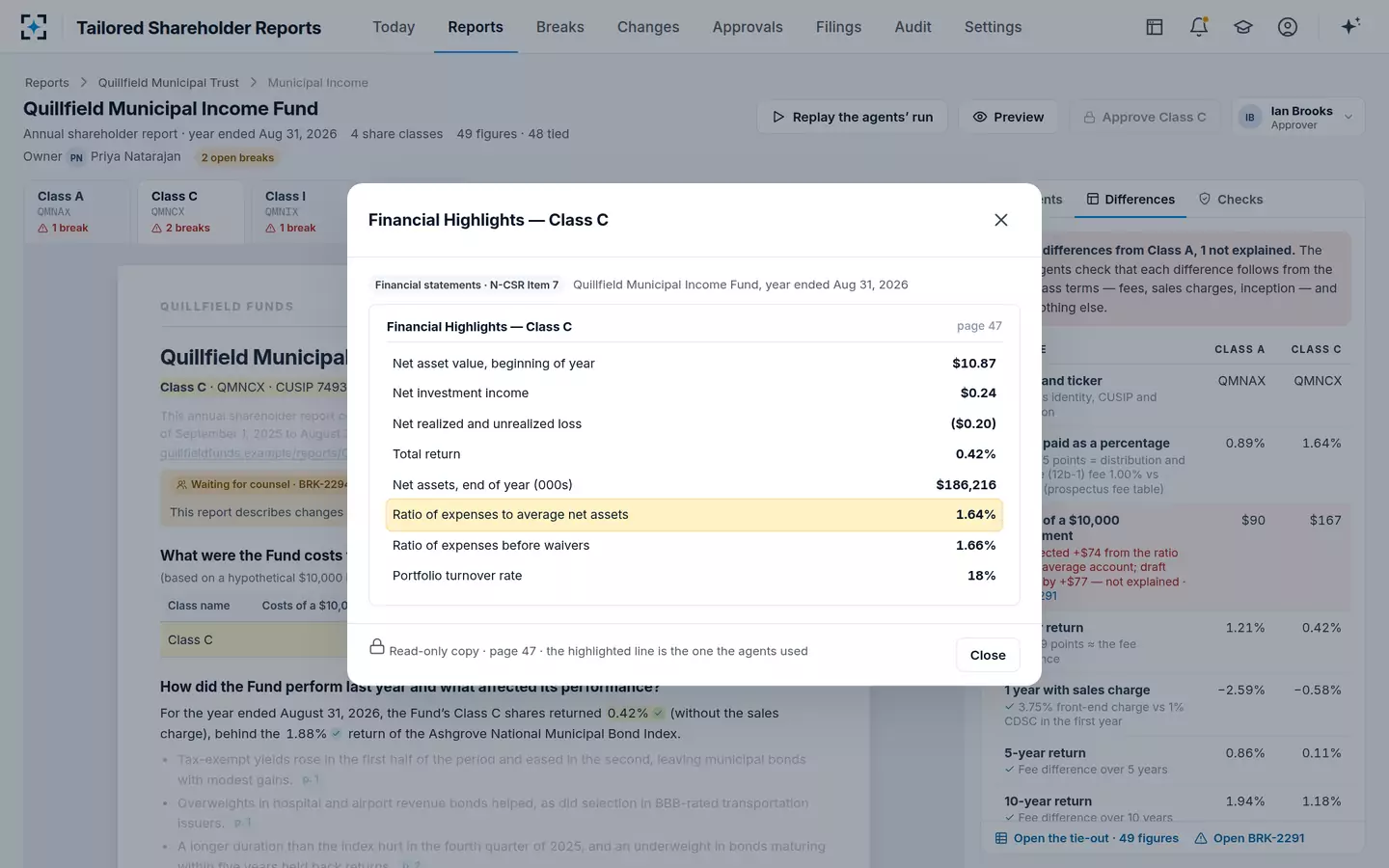
The percentage is the class's expense ratio. In an annual report it is the ratio printed in the fund's latest audited financial statements or financial highlights (Instruction 2(c)); in the sample, 1.64% on page 47 of the financial highlights. The dollar figure is that percentage multiplied by the average account value of a $10,000 investment over the period, not by $10,000, and rounded to the nearest dollar. That one sentence produced the most common error the staff found in the first cycle, and how the $10,000 line is calculated is worked through separately.
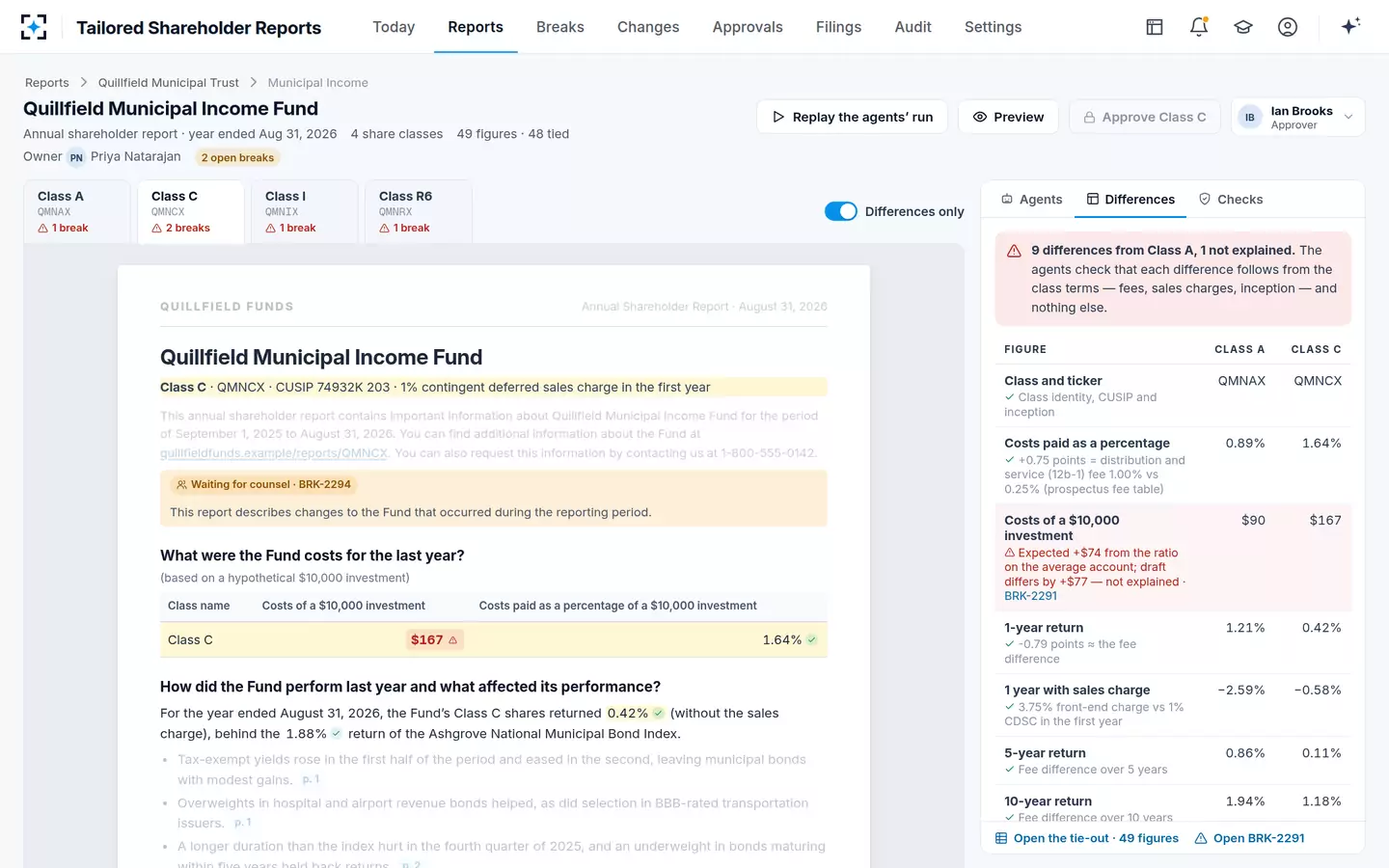
One fund report, a tab per share class, with the differences lit
How did the Fund perform? The paragraph, the graph and the table
Management's discussion of fund performance, part (d), has three pieces, and the rule restrains the first more than most writers expect. Item 27A(d)(1) asks for a brief summary of the key factors that materially affected the fund's performance in the period, and its first instruction rules out a long, generic tour of what moved markets in general; how to write market commentary quotes both and shows the difference sentence by sentence. Three or four specific points, each tied to a position or a decision, meet the test; a page on the economy does not.
The second piece is a line graph of a $10,000 investment over the last ten fiscal years (or the life of the fund), beside the same $10,000 in an appropriate broad-based securities market index. The third is a table of average annual total returns for one, five and ten years, with and without sales charges, and the index's returns for the same periods. The sample Class C report shows 0.42% for the year without the deferred sales charge and −0.58% with it, against 1.88% for a national municipal bond index. Which index qualifies is a narrower question than it looks, and the SEC's broad-based index test sets out what the staff accepts.
Two statements must accompany the graph and table: that past performance is not a good predictor of future performance, made "noticeable and prominent", and that the figures do not reflect taxes a shareholder would pay. The staff found that "many funds do not use text features to make the statement noticeable and prominent." For ETFs, the staff found that "many ETFs also disclose their performance based on market value", and added: "This additional presentation is not permitted to be included in the shareholder reports."
Fund statistics and the holdings graphic: four numbers and a basis
Part (e) asks for four figures in a fixed order: net assets, the total number of portfolio holdings, the total advisory fees paid (in the annual report) and, unless the fund is a money market fund, portfolio turnover. After those, a fund may add statistics it believes help shareholders, such as tracking error, maturity, duration, average credit quality or yield, provided they are reasonably related to the strategy and are derived from the latest financial statements where they could be. The staff saw funds put average maturity and average credit rating under the holdings heading; they belong under "Fund Statistics".
Part (f) is a table, chart or graph of holdings by "reasonably identifiable categories", as a percentage of net asset value, total investments or total exposure, with the basis stated. A fund that groups holdings by credit quality must say how quality was determined and, where agency ratings are used, how they were selected. Both omissions appear in the staff's review: percentages with no basis, and credit-quality charts without the explanation. A fund may also list its ten largest holdings.
Every figure opens the page it came from
Material fund changes, accountants and the link that has to land
Part (g) covers material changes since the period began in six areas: the name, the objectives, expenses and fees (a fee waiver or reimbursement starting or ending counts), the principal strategies, the principal risks and the adviser. Each description must be detailed enough for a shareholder to see what changed and how it may affect them, followed by a legend pointing to the next prospectus. In the sample, the adviser's lowering of the Class C expense limitation from 1.69% to 1.64% on December 1, 2025 appears here, found in a November 2025 prospectus supplement.
Part (h) applies only when the fund has to report a change in or disagreement with its accountants on Form N-CSR, and then needs two short statements. Part (i) closes the report: a plain English statement that the prospectus, financial information, holdings and proxy voting information are on the website, with means of reaching each one. Rule 30e-1 requires Items 7 to 11 of Form N-CSR, the financial statements and related items, to be publicly accessible at the cover's address no later than 60 days after the period end. The staff's review found "broken links", links that did not reach the item, and cases where "the staff was unable to find all of the required information on the specified website."
What can't go in a tailored shareholder report?
Anything Item 27A does not require or permit, which is the rule that keeps the report short. The instruction is blunt, and it is the one compliance reviewers quote most:
Do not include information in an annual or semi-annual shareholder report other than disclosure that Item 27A and its Instructions require or permit in annual or semi-annual shareholder reports, as applicable, or as provided by rule 8b-20 under the Investment Company Act [17 CFR 270.8b-20].
Form N-1A, Item 27A(a), Instruction 3
The rule 8b-20 exception lets a fund add what is "necessary to make the required disclosure items not misleading", and the staff noted that the Commission said such additions "generally should be brief". What the staff found instead were "extraneous and sometimes lengthy disclosures such as disclaimers or risk disclosures that are not required or permitted". Three further limits follow from the instructions: a report may not incorporate anything by reference (Instruction 5); it must be written in plain English, with "short sentences and paragraphs", "definite, concrete, everyday words" and "active voice" (Instruction 6); and materials sent with it may not upstage it, since the report "must be given greater prominence" than most accompanying documents (Instruction 12).
How long is a tailored shareholder report?
Usually three or four pages, though no rule says so. The SEC estimated that the annual report "would be approximately 3 to 4 pages in length" and the semi-annual report the same "or shorter", and expected funds to mail it as a trifold. The release is explicit that the annual report "will not be subject to page or word limits"; length is controlled indirectly, by the closed list of permitted content and the plain English instruction.
The comparison point is the old report. The staff measured the average annual report at about 134 pages and the average semi-annual report at 116, much of it financial statements for many series bundled together. Those statements did not disappear: they moved to Form N-CSR, filed with the SEC and posted online, and are delivered free on request. What a shareholder now receives is the class-level summary, and what the fund's team now produces is one summary per class, which for a fund family with hundreds of classes multiplies the number of documents even as each one shrinks.
Tailored Shareholder Reports: one report per class, every figure to its page
The rule's structure is what makes the work automatable and also what makes it error-prone. Instruction 4 requires "a separate annual or semi-annual shareholder report for each Class within the Series", so a fund with four classes produces four reports that are identical except for a handful of figures: the class name and ticker, costs, returns with and without sales charges, the graph's starting value and any class-specific statistic. The sample fund's Class C differs from Class A in nine. In the sample family, 74 funds produce 400 class reports a cycle.
Tailored Shareholder Reports drafts each fund's report once and each class variant in Item 27A order, then shows a reviewer only what differs between classes, with a check that each difference follows from the class terms: Class C costs 0.75 percentage points more than Class A because its distribution and service fee is 1.00% instead of 0.25%. Every figure carries a link to its page in the financial statements. A second agent recomputes each expense example and return from the raw class data without seeing the first agent's working, and any disagreement becomes a break that a fund administration analyst fixes and the treasurer approves. Counsel rules on material changes; the agents only propose them.
Ten checks on a tailored shareholder report before it is signed
- Parts in Item 27A order, nothing extra
No disclaimers or risk text beyond what Item 27A or rule 8b-20 allows.
- Cover address lands on the class materials
A specific page or a central page with prominent links, never the home page.
- Bold cover statement if, and only if, part (g) has content
The staff found both halves missing in different funds.
- Expense ratio equals the audited highlights
Annual report; for the semi-annual, computed from the half-year and annualized.
- Dollar cost on the average account, to the dollar
Semi-annual dollars cover the six months, not a year.
- Index is broad-based; narrower indexes only in addition
Growth, value, sector and size indexes do not qualify as the required index.
- Past performance statement is visibly prominent
Larger type, a colour or a box, not body text.
- ETF returns on net asset value only
Market-price returns are not permitted in the report.
- Statistics in order; portfolio statistics under Fund Statistics
The four required figures first.
- Holdings basis stated; credit-quality method explained
Net asset value, total investments or exposure, named.
To see a class report drafted and tied to its pages on your own funds, start from Tailored Shareholder Reports.
Questions people ask
Where are the tailored shareholder report instructions?
They are Item 27A of Form N-1A, "Annual and Semi-Annual Shareholder Report", with its lettered paragraphs (a) to (j) and the instructions under each. Rule 30e-1 under the Investment Company Act requires the report and sets the website and delivery duties, and Form N-CSR Item 1 is where the report is filed. The SEC staff's ADI 2024-14 and its frequently asked questions add the staff's reading.
Do money market funds send tailored shareholder reports?
Yes, if they are registered on Form N-1A, but with less in them. Item 27A(d) says a money market fund "is permitted but not required" to include management's discussion of fund performance, and Item 27A(e) drops portfolio turnover for money market funds. The cover, costs, statistics, holdings and availability parts still apply.
Can one document cover several share classes?
Not as a single report: Instruction 4 requires a separate report for each class. The staff's FAQ allows a fund to bind, staple or stitch together the separate reports of funds or classes an investor actually holds, and suggests a table of contents when it does.
Is the semi-annual report the same as the annual one?
It is shorter. It must carry the cover, costs, fund statistics (without the advisory fee figure, which is annual only), holdings and availability parts, plus accountant changes if any; the performance discussion and material fund changes are optional. If a fund includes an optional part, it must follow the same order and instructions as in the annual report.
Can a tailored shareholder report include a letter from the portfolio manager?
Not as a separate letter. Instruction 3 limits the report to what Item 27A requires or permits, and the place for the manager's view is the brief key-factors summary in part (d)(1), which must stay specific to the fund rather than survey the markets. Other material may accompany the report, provided the report is given greater prominence.
When did tailored shareholder reports become mandatory?
For reports transmitted to shareholders on or after July 24, 2024, the compliance date of the SEC's October 2022 rule. The staff's FAQ adds that a report transmitted before that date is filed as it was sent, even if the Form N-CSR is filed afterwards.