A semi annual shareholder report is the report a mutual fund or ETF must send to shareholders after the first half of its fiscal year: since July 24, 2024, a few pages per share class covering the costs of a $10,000 investment, key fund statistics, a holdings graphic and where to find the full financial statements online. Rule 30e-1 requires it to be transmitted within 60 days after the half-year ends, the fund's Form N-CSR Items 7 to 11 must be on its website by the same day, and Form N-CSR must be filed within 10 days after the report is sent, certified by the fund's principal executive and principal financial officers. That is one fixed clock, run twice a year, with a handoff between fund accounting, financial reporting, counsel and the treasurer at every step. Botminds' Tailored Shareholder Reports drafts and ties out each class's report and Form N-CSR items so the people on that clock spend their days on decisions rather than re-checking figures.
A semi-annual shareholder report season, day 0 to day 70
Day 0
DateThu Apr 30
Fiscal half-year ends. Net asset values for the period are struck.
WhoFund accounting
Days 1–10
DateMay 1–10
Half-year books closed: class expenses, average net assets, holdings from the custodian, final index values.
WhoFund accounting, administrator
Days 5–25
DateMay 5–25
Unaudited financial statements and the other Form N-CSR Items 7–11 drafted.
WhoFinancial reporting
Days 15–35
DateMay 15–Jun 4
A report per share class: costs, statistics, holdings graphic; optional performance discussion and material changes.
WhoFund administration analysts
Days 30–50
DateMay 30–Jun 19
Every figure tied to the statements; counsel reads the narrative; links tested; Inline XBRL prepared.
WhoFinancial reporting, counsel
Days 45–58
DateJun 14–27
Treasurer approves; printer proofs; e-delivery and mail files built by class.
WhoTreasurer, printer, transfer agent
By day 60
DateMon Jun 29
Reports transmitted; Items 7–11 publicly accessible at the cover's web address.
WhoRule 30e-1
Within 10 days of sending
Dateby Thu Jul 9
Form N-CSR filed with the reports, Items 7–11, Inline XBRL and two officer certifications.
WhoRule 30b2-1, rule 30a-2
What is a semi annual shareholder report?
It is the half-year counterpart of the fund's annual shareholder report, required by rule 30e-1 under the Investment Company Act: "Every registered management company shall transmit to each stockholder of record, at least semi-annually, a report containing the information required to be included in such reports by the company's registration statement form" (17 CFR 270.30e-1(a)). For mutual funds and ETFs registered on Form N-1A, the registration form's answer is Item 27A, and the reporting period is "the Fund's most recent fiscal half-year".
In practice it is the leaner of the two reports. It covers one share class, carries no audited figures, and leaves out the parts Item 27A makes optional for half-years. Its financial statements, which used to fill most of the old semi-annual report, now live in Form N-CSR and on the fund's website, and "need not be audited" when they cover a fiscal half-year.
Semi annual shareholder report requirements: what it must and may contain
Item 27A(a) of Form N-1A sets the list: "Every semi-annual shareholder report required by rule 30e-1 must contain the information required by paragraphs (b), (c), (e), (f), (h), and (i) of this Item". That is the cover, the costs table, fund statistics, the holdings graphic, any change in accountants and the statement about additional information online. The total advisory fees paid, one of the four required statistics in the annual report, is optional in the semi-annual one.
Two parts are optional: management's discussion of fund performance (d) and material fund changes (g). A fund may include them, but only on the annual report's terms: the form says optional information must meet "the requirements of the relevant paragraph" and not be "incomplete, inaccurate, or misleading", and Instruction 2 requires it in the same order as the annual report. A semi-annual report that adds a performance discussion therefore also adds the ten-year graph, the returns table, the broad-based index and the prominent past-performance statement.
When are fund shareholder reports due? Three clocks from one date
Three deadlines run from the same half-year end, and the third runs from whenever the first is met. The report must be transmitted "within 60 days after the close of the period for which such report is being made" (rule 30e-1(d)). Items 7 to 11 of Form N-CSR must be publicly accessible on the fund's website "no later than 60 days after the end of the fiscal half-year" (rule 30e-1(b)(2)(i)). And Form N-CSR must be filed within ten days of the day the reports go out (rule 30b2-1(a)); the Form N-CSR filing deadline guide follows that last step and the private-fund and UCITS calendars beside it.
The regulatory windows of one half-year: 60 days to send, 10 more to file
- Prepare and transmit≤ 60 days
- Then the filing window
- Post at the cover's address≤ 60 days
- Then the filing window
- Waits for transmission
- File≤ 10 days
A fourth clock is less visible. Rule 30a-3(b) requires management, with the principal executive and principal financial officers, to evaluate the fund's disclosure controls "within the 90-day period prior to the filing date of each report on Form N-CSR" (17 CFR 270.30a-3), and the certification says the officers did so. The evaluation is easy to treat as boilerplate; it is the formal moment at which the officers state that the process producing these figures works.
Who certifies Form N-CSR, and what they sign
The principal executive officer and the principal financial officer, each separately. Rule 30a-2(a) says: "Each principal executive and principal financial officer of the investment company, or persons performing similar functions, at the time of filing of the report must sign a certification" (17 CFR 270.30a-2). In most fund complexes that is the fund's president and its treasurer. Rule 30a-2(b) adds a second certification under 18 U.S.C. 1350 for reports that contain financial statements, which the two officers may sign jointly.
Based on my knowledge, this report does not contain any untrue statement of a material fact or omit to state a material fact necessary to make the statements made, in light of the circumstances under which such statements were made, not misleading with respect to the period covered by this report
Form N-CSR, Item 19(a)(3), the certification each officer signs
"This report" includes every class report filed as Item 1. A treasurer of a family with hundreds of classes is therefore certifying hundreds of short documents twice a year, which is why the useful question at sign-off is not "did we review them" but "can I see, for any figure, the page it came from". The SEC's own burden estimates give a sense of scale: it counts 2,766 registered funds with 14,298 portfolios under rule 30b2-1 (91 FR 61267, September 2026) and estimates 7.75 hours per Form N-CSR filing, twice a year, for 13,052 respondents (91 FR 12478, March 2026). Those are Paperwork Reduction Act estimates, which the SEC itself says rest on no comprehensive or representative survey, so read them as scale, not as a benchmark.
Who carries the season: five seats
The season is a relay, and each seat has a different worst week. The analyst's is the drafting window, when every class template is filled from the books; the financial reporting manager's is the tie-out, when every figure is checked against statements that may still be moving; counsel's is the narrative and the changes; the two officers' is the last week, when everything arrives at once for a signature.
Five seats in the semi-annual season, before and with the agents
Today
Fills a template per fund and class from spreadsheets fed by fund accounting, then re-keys corrections into every class built from the same row.
With agents
Starts from drafts and from breaks that arrive with two independent workings; proposes each fix as maker.
Still theirs: Ownership of the fund's figures; never approves a fix she proposed.
Today
Re-ties report figures to the half-year statements on printed proofs, and prepares Form N-CSR.
With agents
Settles only the figures where the two agents disagree; sees each approved fix land in the report, Form N-CSR Item 1, the website copy and the XBRL fact.
Still theirs: The Form N-CSR package, as preparer.
Today
Reads the period's supplements and minutes to decide whether to include optional material-change disclosure, and reviews any narrative.
With agents
Rules on candidate changes listed with their source pages, and approves any cut to narrative.
Still theirs: Every materiality judgment.
Today
Receives the reports in the last two weeks and certifies Form N-CSR.
With agents
Approves fixes with a reason code, approves clean reports after ticking a risk-based sample, certifies with each figure one click from its page.
Still theirs: Approval, certification and release.
Today
Co-certifies Form N-CSR, relying on the treasurer's process.
With agents
Certifies a filing whose reports are approved and whose breaks are closed.
Still theirs: The second certification.
Three semi-annual traps that the annual report does not have
The semi-annual report differs from the annual one in a few rules that are easy to get backwards because the templates look alike. The SEC staff's first-cycle review, ADI 2024-14, found the first of them in several funds.
Checks that only the semi-annual report needs
- Dollars for six months, percentage annualized
The staff found funds that "annualized the expenses in dollars paid on a $10,000 investment in their semi-annual shareholder report". The percentage, by contrast, must be annualized.
- The ratio comes from the half-year, not the annual highlights
Instruction 2(c) to Item 27A(c): computed by the Item 13(a) method from the half-year's expenses, then annualized. There are no audited highlights to copy.
- Optional parts carry their full rules
A performance discussion brings the graph, the index and the prominent statement; material changes bring the bold cover sentence.
- Advisory fees paid are optional
Required only in the annual report; if shown, from the half-year statement of operations.
- Unaudited statements, same posting duty
Items 7–11 need not be audited for a half-year, but must still be on the website by day 60.
The first check is worked through in how the $10,000 cost line is calculated, including why the six-month dollar figure is roughly half the annualized one. The staff also suggested a reader's courtesy: noting in the semi-annual report that the percentage is an annualized figure.
How to read a semi annual shareholder report as a shareholder
Read it in four stops. First, the cover: check that the class and ticker are yours, because each class has its own report, and look for the bold sentence saying the report describes changes to the fund. Second, the costs table: the dollar figure is what a $10,000 account cost over the six months; the percentage is the annual rate. Third, the statistics and holdings: net assets, number of holdings and turnover, then what the fund owned at the half-year end and on what basis the percentages are measured.
Fourth, the closing statement and its link, which lead to the financial statements, the full holdings, the prospectus and proxy voting information. Those documents are no longer in the report, but rule 30e-1 makes them free on the website and by request, with a paper or electronic copy due "within three business days after receiving a request". A semi-annual report may have no performance section at all; performance is required only in the annual report, and the fund's website or the prospectus is the place to look between reports.
Where Tailored Shareholder Reports shortens the season
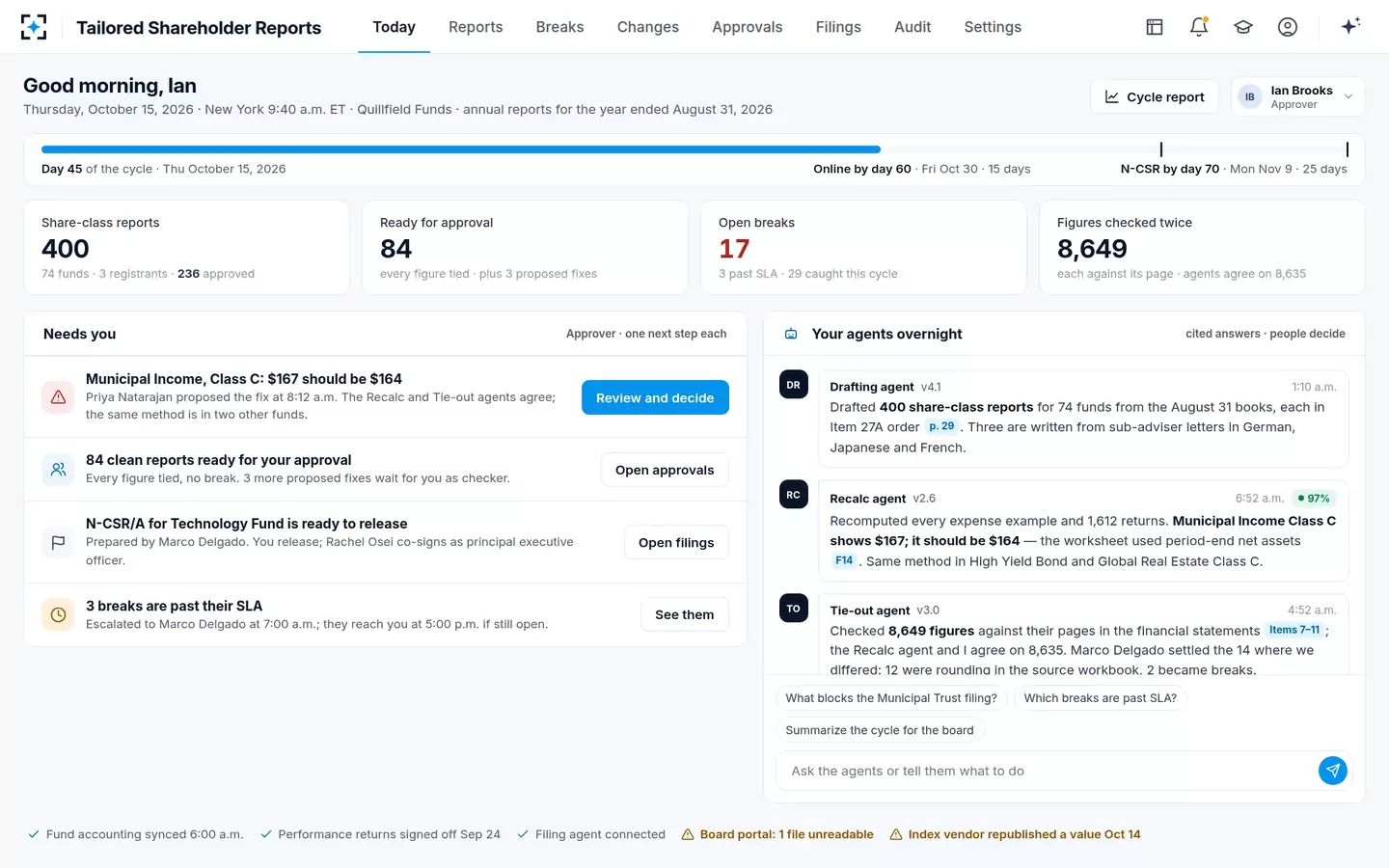
The calendar's fixed points do not move; what changes is how much of the window the checking consumes. In Tailored Shareholder Reports the agents draft every class report overnight once the half-year books are final, recompute each expense example and return from the raw class data, and tie each figure to its page in the financial statements with a second agent checking independently. The Filing coordinator runs the 60-day and 10-day clocks, routes each item to a checker who did not prepare it, and shows the treasurer what blocks each registrant's filing. The design target for the sample family is sign-off ready by day 45, with 15 days to spare before day 60; that is a target, not a measured result.
The treasurer's morning: the clock, the counts and what needs a decision
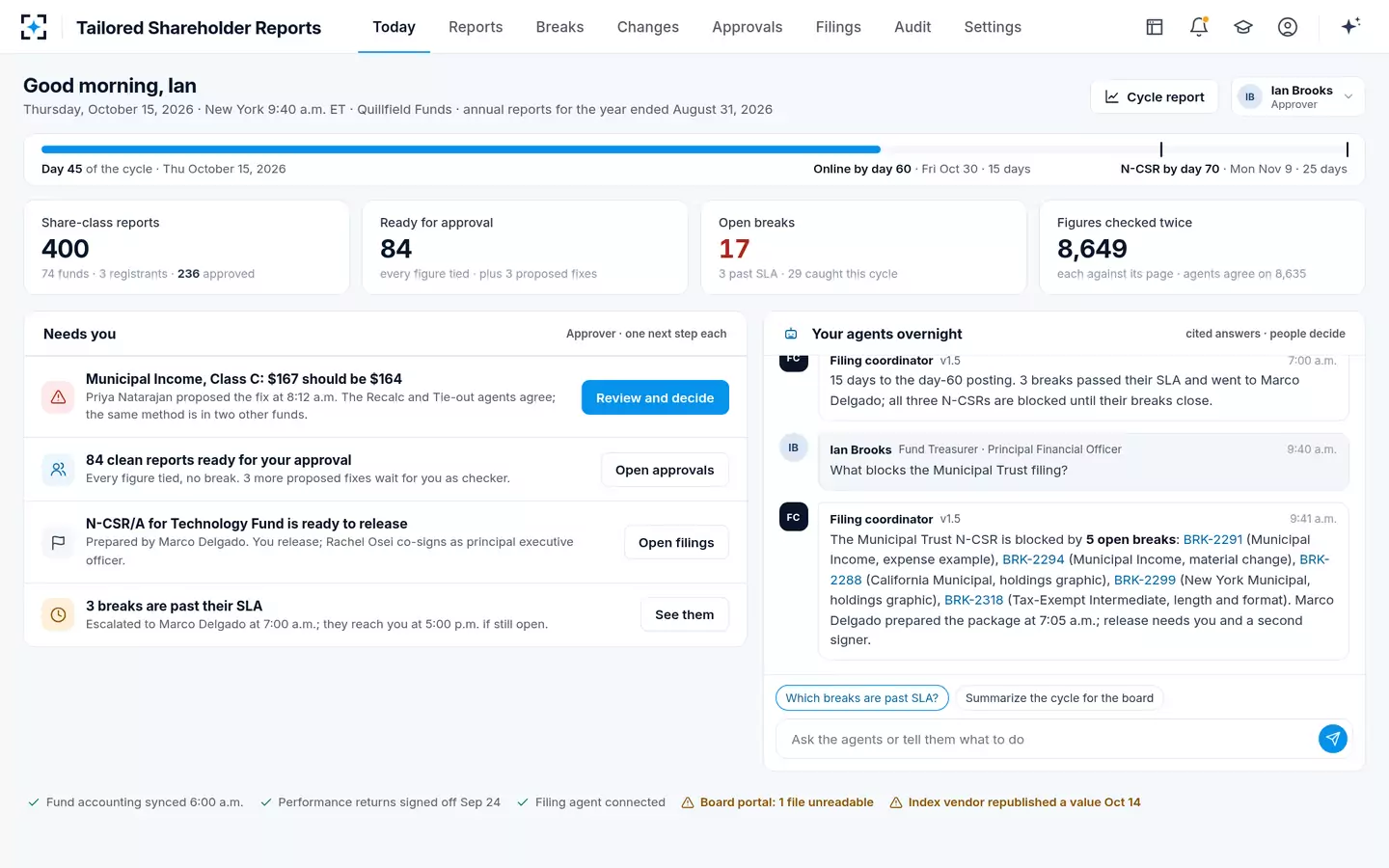
Ask what blocks a filing, and get the breaks with links
The full annual version of the same report, with every part annotated, is in the tailored shareholder reports example. To see a season run on your own classes, start from Tailored Shareholder Reports.
Questions people ask
What does a semi annual shareholder report mean for an investor?
It is the fund's report on the first half of its fiscal year for your share class: what the class cost over six months on a $10,000 account, how large the fund is, what it held at the half-year end and whether anything material changed, if the fund chose to say. The full financial statements are a link away, not in the report.
What is the N-CSR filing deadline?
Not later than 10 days after the shareholder report is transmitted, under rule 30b2-1(a). Because the report itself is due within 60 days of the period end, the latest possible filing date is day 70, but a fund that sends its reports earlier must file earlier too.
How often are mutual fund financial statements sent to shareholders?
The shareholder report is sent at least twice a year, but since July 24, 2024 it no longer contains the financial statements. For Form N-1A funds those are filed on Form N-CSR twice a year, posted on the fund's website within 60 days of each period end, and sent free on request within three business days.
Is the semi-annual shareholder report audited?
No. The financial statements and highlights filed for a fiscal half-year "need not be audited", under the instructions to Form N-CSR Item 7. The annual report's statements must be audited and accompanied by the accountant's report.
Can a fund get more time to send its report?
Rule 30e-1(e) lets the Commission extend the period "upon written request showing good cause therefor". Without an extension, the 60-day limit applies.
How much work does a semi-annual cycle take?
No regulator measures it per cycle. The SEC's Paperwork Reduction Act estimate for rule 30e-1 is 107 internal hours a year per open-end fund, covering both reports, at a blended $580 an hour, plus $12,924 of outside costs (91 FR 21585, April 2026); a fund family should measure its own hours per class report.