The Form N-CSR filing deadline is ten days after a registered fund transmits its annual or semi-annual shareholder report, and the report itself must go out within 60 days of the period end, so the filing is due at the latest on day 70. For a fund with an August 31 year-end that means shareholder reports by October 30 and Form N-CSR by November 9. Around it sit other clocks: Form N-CEN within 75 days of the fiscal year-end, a private fund's audited statements to its investors within 120 days, and four months for a UK authorised fund's annual report. The calendar is fixed by rule; what varies is how much of those 70 days a reporting team spends drafting and re-checking numbers already checked. Botminds' Fund Financial Statements drafts and ties each fund's statements overnight from the administrator's final trial balance, so the season's days go to the differences, the auditor and the signatures.
The calendar on this page follows the reporting manager of the solution's fictional sample manager, Quillfield Capital, through one year-end: 180 funds, of which the US trusts close on August 31, 2026.
The 70 days of an August 31 year-end, desk by desk
- Close and pricedays 1–20
- Final trial balancesto day 40
- Templates, mappingdays 1–20
- Draft and tiedays 21–50
- Re-tie, signdays 51–60
- Planningdays 1–25
- Fieldworkdays 26–55
- Opinion55–60
- Waitingto day 60
- Certify, file60–70
What is Form N-CSR?
Form N-CSR is the form a registered management investment company uses to file its certified shareholder reports with the SEC. In the SEC's 2026 description, it "is a combined reporting form used by registered management investment companies" to file certified shareholder reports under both the Investment Company Act of 1940 and the Securities Exchange Act of 1934 (91 FR 28694, May 18, 2026). Since the 2022 tailored shareholder report amendments, it also carries what used to sit in the report itself: the complete financial statements in Item 7(a), the financial highlights in Item 7(b), and Items 8 to 11.
The scale is large and concentrated. In a September 2026 notice the SEC estimated "2,766 funds, with a total of 14,298 portfolios" governed by Rule 30b2-1, the filing rule (91 FR 61267). Each portfolio files twice a year, and most fund complexes share a fiscal year-end across a trust, so one team often meets dozens or hundreds of day-70 deadlines on the same day.
The clocks around Form N-CSR
60days
to transmit the shareholder report after the period ends
10days
after transmission to file Form N-CSR
75days
after the fiscal year-end to file Form N-CEN
120days
for a private fund's audited statements under the custody rule
When is the Form N-CSR filing deadline?
It is set by two rules that count from different events. Rule 30e-1 says each shareholder report "shall be transmitted within 60 days after the close of the period for which such report is being made" (Rule 30e-1(d)). Rule 30b2-1 then requires a fund to "file a report on Form N-CSR ... not later than 10 days after the transmission to stockholders of any report that is required to be transmitted" under Rule 30e-1 (Rule 30b2-1(a)); the form's own rule repeats it (17 CFR 274.128). Seventy days is therefore the latest date, not a fixed one: a fund that mails on day 45 must file by day 55.
The same arithmetic applies to the semi-annual report, counted from the end of the fiscal half-year. Since the 2022 amendments the statements must also be online, with Items 7 to 11 of the form, no later than 60 days after the period end. The SEC's adopting release confirmed that the 70-day outer limit for filing the complete form did not change (87 FR 72758). The transmission period can be extended by the SEC "upon written request showing good cause therefor" (Rule 30e-1(e)), which is a request to make in advance, not a remedy for a missed date.
The season, seat by seat: who carries the 70 days
Four desks carry the calendar, and their work overlaps at the end. The administrator closes the books and delivers final trial balances; the reporting team drafts, ties and answers the auditor; the auditor tests and reports; the officers certify. The squeeze is in the last ten days before day 60, when the auditor's proposed adjustments arrive and each one means a redraft and a re-tie of numbers the team has already checked.
Who carries a fund's year-end, and what changes when the tie-out runs overnight
Today
Owns the cycle for every fund: reviews drafts, clears breaks, answers the auditor and chases the administrator for late trial balances.
With agents
Starts each day with every number already ticked and only the open ones to explain, grouped by cause across funds.
Still theirs: Clearing a break, changing a mapping, releasing an answer to the auditor.
Today
Builds the statements from the trial balance and ticks each number by hand against the books and last year's report.
With agents
Reviews the agents' ticks and evidence; prepares the foreign-language editions and clears ticks as maker.
Still theirs: Preparing; never also reviewing the same fund.
Today
Approves mapping changes and signs each fund's statements after review.
With agents
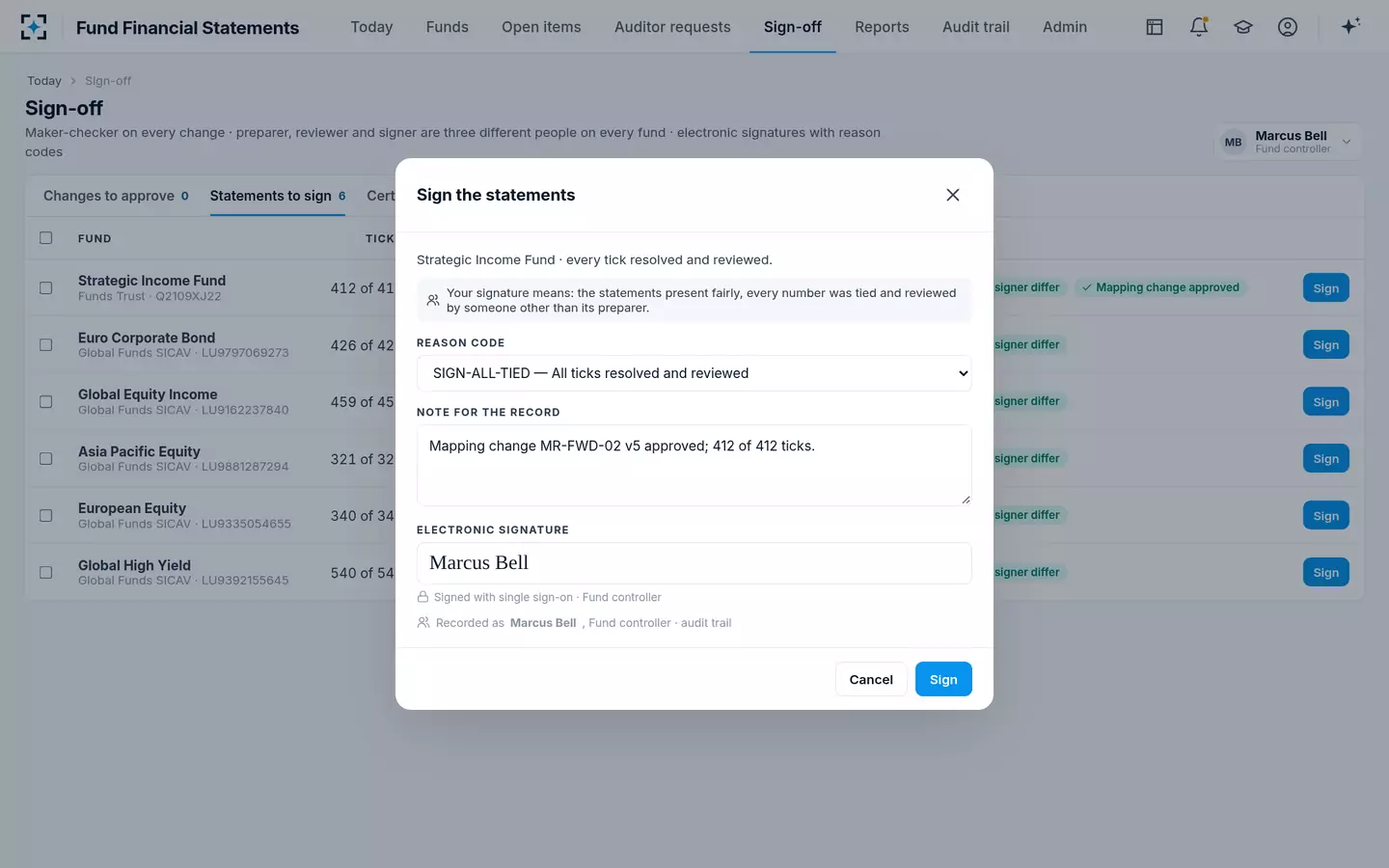
Approves each mapping change someone else made, then signs with every tick and its evidence a click away.
Still theirs: The signature, and the checker role on every change.
Today
Certifies each Form N-CSR and briefs the audit committee on the season.
With agents
Sees each family's deadline and days to signing; certification unlocks only when every series is signed.
Still theirs: The certification and its liability.
Today
Issues the request list, tests the statements, proposes adjustments.
With agents
Reads the engaged funds' ticks and evidence, and receives only answers the reporting manager released.
Still theirs: The opinion.
N-CSR vs N-CEN: two filings, two purposes
Form N-CSR is the certified shareholder report; Form N-CEN is an annual report about the fund's structure and operations. Every management investment company "must file an annual report on Form N-CEN ... not more than seventy-five calendar days after the close of each fiscal year" (Rule 30a-1), five days after the N-CSR outer limit. N-CEN carries data such as which service providers a fund uses and whether it used swing pricing, which is how the SEC could report in 2026 that no fund had swung its NAV (91 FR 5545); it does not carry financial statements.
The two must not contradict each other. A fund whose statements disclose a change of auditor, a new administrator or a swing pricing policy reports the same facts on N-CEN days later, often prepared by a different team. A season plan that lists the N-CEN answers that depend on the statements, and checks them against the signed set, closes a gap that otherwise shows up in an examiner's comparison.
Who certifies Form N-CSR?
The fund's principal executive officer and principal financial officer. In the SEC's words, they "are required to certify the financial and other information included on Form N-CSR, and these individuals are subject to liability for material misstatements or omissions on Form N-CSR" (87 FR 72758). Since 2024 the certified filing contains the complete financial statements, so the certification now covers every number in them directly, not by reference to a shareholder report.
That makes the treasurer's last ten days the most exposed of the season. The certification is per filing, and where a trust files for many series at once, one unsigned series holds the filing. In the solution's sample data the treasurer's certification for a 64-series trust stays locked until all 64 series are signed, which turns a calendar risk into a visible list of what is still open.
Sign-off: three people per fund, and a reason code on each signature
Custody rule audit requirement: 120 days for private funds
A private fund adviser with custody can meet most of the custody rule through an annual audit. The rule spares the adviser the client notice and account statement requirements, and deems the surprise examination met, for a pooled vehicle that is audited "At least annually and distributes its audited financial statements prepared in accordance with generally accepted accounting principles to all limited partners (or members or other beneficial owners) within 120 days of the end of its fiscal year," by an accountant registered with and inspected by the PCAOB, and again at liquidation (17 CFR 275.206(4)-2(b)(4)). Registered funds are outside the rule altogether.
A proposal of October 6, 2026 would keep 120 days for most funds but give funds of funds 180 days and funds of funds of funds 260, because their auditors "may be unable to complete their work until the audited financial statements for the underlying funds are available." The SEC also set out its view that missing the deadline "due to reasonably unforeseeable circumstances generally would not be considered to be a violation of the audit provision, provided that the audited financial statements are promptly delivered upon resolution," and proposed dropping the PCAOB registration requirement for the auditor (91 FR 63870). Comments close on December 7, 2026. Until a final rule says otherwise, 120 days and a PCAOB-registered auditor stand.
UCITS annual report deadline, and the UK and AIF clocks
Outside the US the clock is longer and set by the fund regime. The UCITS Directive requires the annual report within four months of the financial year-end and the half-yearly report within two months (Directive 2009/65/EC, Article 68(2)). The UK's authorised funds have the same periods: the manager "must, within four months after the end of each annual accounting period and two months after the end of each half-yearly accounting period respectively, make available and publish the long reports" (FCA Handbook, COLL 4.5.14R). A UK AIF manager must make its annual report available "no later than six months after the end of the financial year" (FUND 3.3.3R).
Deadlines for fund financial statements, by regime
| Fund and regime | Annual | Half-year | Rule |
|---|---|---|---|
| US registered fund: shareholder report | 60 days | 60 days | Rule 30e-1(d) |
| US registered fund: Form N-CSR | 10 days after transmission (day 70 at the latest) | Same | Rule 30b2-1(a) |
| US management investment company: Form N-CEN | 75 days | None | Rule 30a-1 |
| US private fund, custody rule audit route | 120 days (proposed: 180 for funds of funds, 260 for funds of funds of funds) | None | 17 CFR 275.206(4)-2(b)(4); 91 FR 63870 (proposal) |
| UCITS (EU Directive text) | 4 months | 2 months | Directive 2009/65/EC, Art. 68 |
| UK authorised fund | 4 months | 2 months | COLL 4.5.14R |
| UK AIF (full-scope UK AIFM) | 6 months | None | FUND 3.3.3R |
For a manager with US and European ranges, these clocks overlap rather than queue. In the sample data a Luxembourg SICAV with a June 30 year-end publishes its annual report by October 31, in English, German and French, the same week the US trusts post their August statements online. The language editions add a check of their own: every figure in each edition must match the English master. Which statements each fund owes in the first place is covered in the status test guide.
Where the season's hours go
Most of the 70 days is waiting and re-checking, not writing. A fund's statements are a few hundred numbers; each one is drafted from the trial balance and ticked against the books, against last year's filed report and against the other statements. When the auditor proposes an adjustment late in the season, every number it touches is re-tied, and the same check is run again by someone who already ran it. The solution's own estimate for a mid-size bond fund is 300 to 600 numbers at two to three minutes each by hand, 10 to 30 hours of tie-out per fund; no regulator or independent study publishes a measured figure.
The government's only number is a paperwork estimate. For Form N-CSR the SEC estimates 7.75 hours per filing, twice a year, and cautions that the estimates do not come from any comprehensive or representative survey (91 FR 28694); it counts preparing and filing the form, not producing the statements inside it. How to build a real cost figure from your own hours is worked through in the guide to what a fund report costs.
How Fund Financial Statements runs the season
The solution moves the drafting and the first tie-out off the critical path. The Intake agent watches each administrator for the final trial balance and will not draft from a preliminary one; the Drafting agent builds the statements overnight; the Tie-out and Cross-foot agents tick every number and trace each break to its cause. In the sample cycle, the reporting manager's Monday shows 149 of 180 funds drafted and tied, 58,904 numbers ticked overnight and 37 open ticks in 9 funds, eleven days before the October 30 shareholder report date.
Deadlines are settings, not memory: alerts run at ten, five and two days before each shareholder report, Form N-CSR, UCITS annual report and custody rule delivery, and an open tick escalates to the fund controller after two business days. A late adjustment from the auditor becomes a re-tie the agents run in minutes, with the changed figures shown, rather than a second pass by hand.
Questions people ask
Is the semi-annual Form N-CSR due on the same timetable?
Yes. The semi-annual shareholder report must be transmitted within 60 days of the end of the fiscal half-year, and Form N-CSR filed within 10 days of that, so day 70 at the latest. The semi-annual financial statements need not be audited, but they are still certified.
What happens if the shareholder report goes out early?
The Form N-CSR clock starts earlier. The filing is due 10 days after transmission, whatever day that is, so a fund that transmits on day 45 must file by day 55. Teams that send reports early to spread the workload should plan the filing date from the actual transmission date.
Do ETFs file Form N-CSR?
Yes, if they are registered management investment companies, which most ETFs are. They follow the same tailored shareholder report rule as mutual funds, with the full financial statements on Form N-CSR and online within 60 days. Rule 30b2-1 applies to registered management investment companies, so an ETF organised as a unit investment trust is outside it.
What is the custody rule audit exemption?
It is the audit provision of the custody rule: an adviser to a pooled vehicle that is audited annually by a PCAOB-registered and inspected accountant, and distributes GAAP statements to investors within 120 days, need not meet the client notice and account statement requirements and is deemed to meet the surprise examination. The same distribution is required on liquidation.
Can the 60-day shareholder report deadline be extended?
Rule 30e-1(e) lets the SEC extend the period for transmitting a report "upon written request showing good cause therefor." It is a request to the SEC in advance, not an automatic extension, and Form N-CSR then follows within 10 days of the actual transmission.