Investment company financial statements are the annual and interim statements of a vehicle that accounts as an investment company: a statement of assets and liabilities with every investment at value, a schedule of investments, a statement of operations, statements of changes in net assets for two years, financial highlights, and a statement of cash flows only where accounting principles require one. Which of those a vehicle owes, and on what measurement basis, is decided before the first number is drafted, by its status: registered under the Investment Company Act, within the scope of ASC 946, or an investment entity under IFRS 10. Get the status wrong and every statement after it is built on the wrong frame. Botminds' Fund Financial Statements exists for the work that follows the status call: it drafts the statements from each administrator's trial balance under the framework set for the fund family, and ties every number back to its source before anyone signs.
The examples on this page use the solution's fictional sample data: Quillfield Capital, a manager closing 180 funds this season under US GAAP, IFRS and Luxembourg GAAP.
How many vehicles prepare investment company financial statements
13,648
registered funds filing Form N-PORT, period ending March 2026
58,891
private funds reported to the SEC, fourth quarter of 2025
90%+
of hedge funds and private equity funds already audited, in the SEC's 2023 description
What are investment company financial statements?
They are a fund's balance sheet, income statement and equity roll-forward, rebuilt around one idea: the fund holds investments for their value, so value is the measure. Section 30(e) of the Investment Company Act, as the SEC summarised it in 2022, requires a fund's reports to include "a statement of assets and liabilities, a schedule of investments that shows the amount and value of each security owned by the fund on that date, a statement of operations, and a statement of changes in net assets" (87 FR 72758). The annual set is audited, and the financial highlights sit beside it.
Regulation S-X then fixes the form for registered funds and business development companies. Its Article 6 applies "to financial statements filed for registered investment companies and business development companies" (Rule 6-01), and the balance sheet "shall reflect all investments at value, with the aggregate cost of each category of investment" shown in brackets beside it (Rule 6-03(d)). Private funds outside the 1940 Act reach a similar set because the custody rule's audit route requires statements prepared under generally accepted accounting principles, which the SEC has long read as US GAAP.
The five investment company financial statements, and what each one answers
| Statement | What it answers | Where the rule sits for a registered fund |
|---|---|---|
| Statement of assets and liabilities | What the fund owns and owes at the period end, investments at value, and net asset value per share | Regulation S-X Rule 6-04; at value under Rule 6-03(d) |
| Schedule of investments | Each holding, its quantity and value, grouped by type and by industry, country or region | Rule 12-12 and the related schedules for derivatives and short positions |
| Statement of operations | Investment income, expenses, and realized and unrealized gains and losses for the period | Rule 6-07 |
| Statements of changes in net assets | How operations, distributions and share dealing moved net assets, for two years | Rule 6-09 |
| Financial highlights | Per-share results, total return, expense and income ratios and portfolio turnover | Form N-1A Item 13, filed on Form N-CSR Item 7(b) |
Why the status test comes before the first statement
Status changes three things at once, and none can be patched later. It decides whether controlled investees are consolidated line by line or carried as a single investment at fair value. It decides whether the schedule of investments and financial highlights are required at all. And it decides when a trade is recognised: on the trade date, not when it settles.
The SEC set out the US position in its October 2026 custody proposal: "for pooled investment vehicles within the scope of the FASB ASC Topic 946, U.S. GAAP requires presentation of a schedule of investments and financial highlights and the measurement of trades on the trade date (as opposed to the settlement date) that may not be required under other accounting principles" (91 FR 63870). Every one of those is a drafting decision: a template with or without a highlights table, a holdings feed cut on trade date, a consolidation step that runs or does not.
IFRS is blunter about consolidation. An investment entity "shall not consolidate its subsidiaries or apply IFRS 3 when it obtains control of another entity. Instead, an investment entity shall measure an investment in a subsidiary at fair value through profit or loss in accordance with IFRS 9" (IFRS 10, paragraph 31). A fund that fails the test produces consolidated accounts of every company it controls, which is a different set of statements with different preparers and a different audit.
What is ASC 946, in the SEC's own words?
ASC 946 is Topic 946 of the FASB Accounting Standards Codification, "Financial Services—Investment Companies": the US GAAP topic that tells an entity whether it is an investment company and, if it is, how to measure, present and disclose. Its text is the FASB's own and is read on the FASB's site; this guide relies on how the SEC describes its effect, because that description is public and binding on what the SEC expects to see.
Three SEC statements carry most of the weight. First, the presentation and measurement consequences quoted above: a schedule of investments, financial highlights and trade-date accounting. Second, its reach into registered funds: in its 2026 performance-fee proposal the SEC wrote that ASC 946 "requires that performance fees be accrued based on actual performance through the accrual date" and that "This requirement applies to all regulated funds" (91 FR 63676). Third, its place in private funds: it "has been the Commission's longstanding view that, except in the limited circumstances discussed below, audited financial statements would need to be prepared in accordance with U.S. GAAP" for the custody rule's audit route (91 FR 63870).
Three routes to investment company financial statements
Registered fund or BDC: Registration under the Investment Company Act, or election as a BDC; Article 6 of Regulation S-X then applies to its statements.
Private fund or IFRS investment entity: An assessment of purpose and fair-value management: ASC 946 scope for US GAAP, IFRS 10 paragraph 27 for IFRS.
Registered fund or BDC: Regulation S-X, "notwithstanding any provision" of the charter or trust deed that says otherwise (Rule 6-03(a)).
Private fund or IFRS investment entity: The accounting framework itself; for the custody rule audit route, generally accepted accounting principles.
Registered fund or BDC: Shareholder report within 60 days; Form N-CSR within 10 days of sending it.
Private fund or IFRS investment entity: Custody rule audit route: audited GAAP statements to investors within 120 days of year-end.
Registered fund or BDC: The fund's principal executive and financial officers certify Form N-CSR.
Private fund or IFRS investment entity: The manager presents; the auditor reports. No SEC certification.
Registered fund or BDC: Not applicable.
Private fund or IFRS investment entity: Other GAAP is accepted if "substantially similar" to US GAAP with material differences reconciled, a reconciliation the 2026 proposal would also deliver to US investors.
What are the IFRS 10 investment entity criteria?
IFRS 10 defines an investment entity by three elements, all required. In the standard's words, an investment entity is an entity that "(a) obtains funds from one or more investors for the purpose of providing those investor(s) with investment management services; (b) commits to its investor(s) that its business purpose is to invest funds solely for returns from capital appreciation, investment income, or both; and (c) measures and evaluates the performance of substantially all of its investments on a fair value basis" (IFRS 10, paragraph 27, as adopted by Regulation (EU) No 1174/2013).
Four further features are "typical characteristics": more than one investment, more than one investor, investors that are not related parties of the entity, and ownership interests in the form of equity or similar interests. They are not a second pass mark. "The absence of any of these typical characteristics does not necessarily disqualify an entity from being classified as an investment entity," paragraph 28 says; an entity missing one gives additional disclosure under IFRS 12 instead.
The shape matters for US readers too. The IASB's staff recorded that the project "was undertaken jointly with the FASB, with the aim of achieving alignment between IFRS and US GAAP", and that "The IASB finalised its requirements before the FASB had completed its deliberations" (IFRS Foundation staff, Project Summary and Feedback Statement, October 2012). The two tests were built together; they are not word for word the same, so a vehicle reporting under both should document the assessment against each framework's own text.
The status test, question by question
Is the vehicle registered under the Investment Company Act, or a business development company?
YesRegulation S-X Article 6 applies to its financial statements, whatever its charter says.
NoGo on to the business-purpose test.
Did it raise money from investors in order to manage that money for them?
YesFirst element met (IFRS 10, paragraph 27(a)).
NoNot an investment entity: an operating company or holding company consolidates.
Is its committed purpose to invest solely for capital appreciation, investment income, or both?
YesSecond element met. The offering memorandum is the usual evidence (B85B).
NoA purpose such as developing products with investees fails the test.
Does management measure and judge substantially all investments at fair value?
YesThird element met. Fair value is how decisions are made, not only how they are reported (B85K).
NoNot an investment entity under IFRS 10.
Does it have several investments and investors, unrelated investors and equity-like interests?
YesTypical profile; the status is straightforward.
NoStill possible, but it needs more judgement and, under IFRS 12, more disclosure.
Where the test bites: one investor, a service subsidiary, a parent that is not a fund
The hard cases are the ordinary ones of a fund's life. A new fund holding one asset, a wind-down vehicle with one investor left, a feeder that holds only its master: each fails a typical characteristic. The standard anticipates them. "Holding a single investment does not necessarily prevent an entity from meeting the definition of an investment entity," it says, giving as an example an entity that "is in its start-up period and has not yet identified suitable investments" (B85P).
The business purpose is read from documents, not from intent. "Documents that indicate what the entity's investment objectives are, such as the entity's offering memorandum, publications distributed by the entity and other corporate or partnership documents, will typically provide evidence," while "an entity that presents itself as an investor whose objective is to jointly develop, produce or market products with its investees has a business purpose that is inconsistent" with the status (B85B). A fund whose marketing promises operational synergies with its portfolio companies has written itself an argument with its auditor.
Two structural rules catch groups. A subsidiary that provides services relating to the investment entity's own investment activities is still consolidated (paragraph 32), so an in-house advisory or financing vehicle sits inside the consolidated statements while the portfolio companies sit outside at fair value. And "A parent of an investment entity shall consolidate all entities that it controls, including those controlled through an investment entity subsidiary, unless the parent itself is an investment entity" (paragraph 33): the manager's own group accounts look nothing like the fund's.
Registered funds: Regulation S-X decides the form, not the trust deed
For a registered fund the status question is answered by registration, and the presentation question by Regulation S-X. Its special rules apply "notwithstanding any provision of the articles of incorporation, trust indenture or other governing legal instruments specifying certain accounting procedures inconsistent with those required" (Rule 6-03(a)). The notes it demands are specific: the methods used to value investments, the policy on restricted securities, the fund's status as a regulated investment company with gross unrealized appreciation and depreciation on a tax-cost basis, and, for a trust of many series, the information "as if each class or series of such investment company were a separate investment company" (Rule 6-03(j)).
That last rule is where a fund complex's workload comes from. A trust with 64 series is, for its statements, 64 investment companies sharing a cover; the SEC has said a trust may file multicolumn statements on Form N-CSR covering several series "provided such financial statement presentation is consistent with Regulation S-X" (87 FR 72758), which saves typesetting but not one tie-out. Each series still has its own trial balance, holdings and capital stock records to agree.
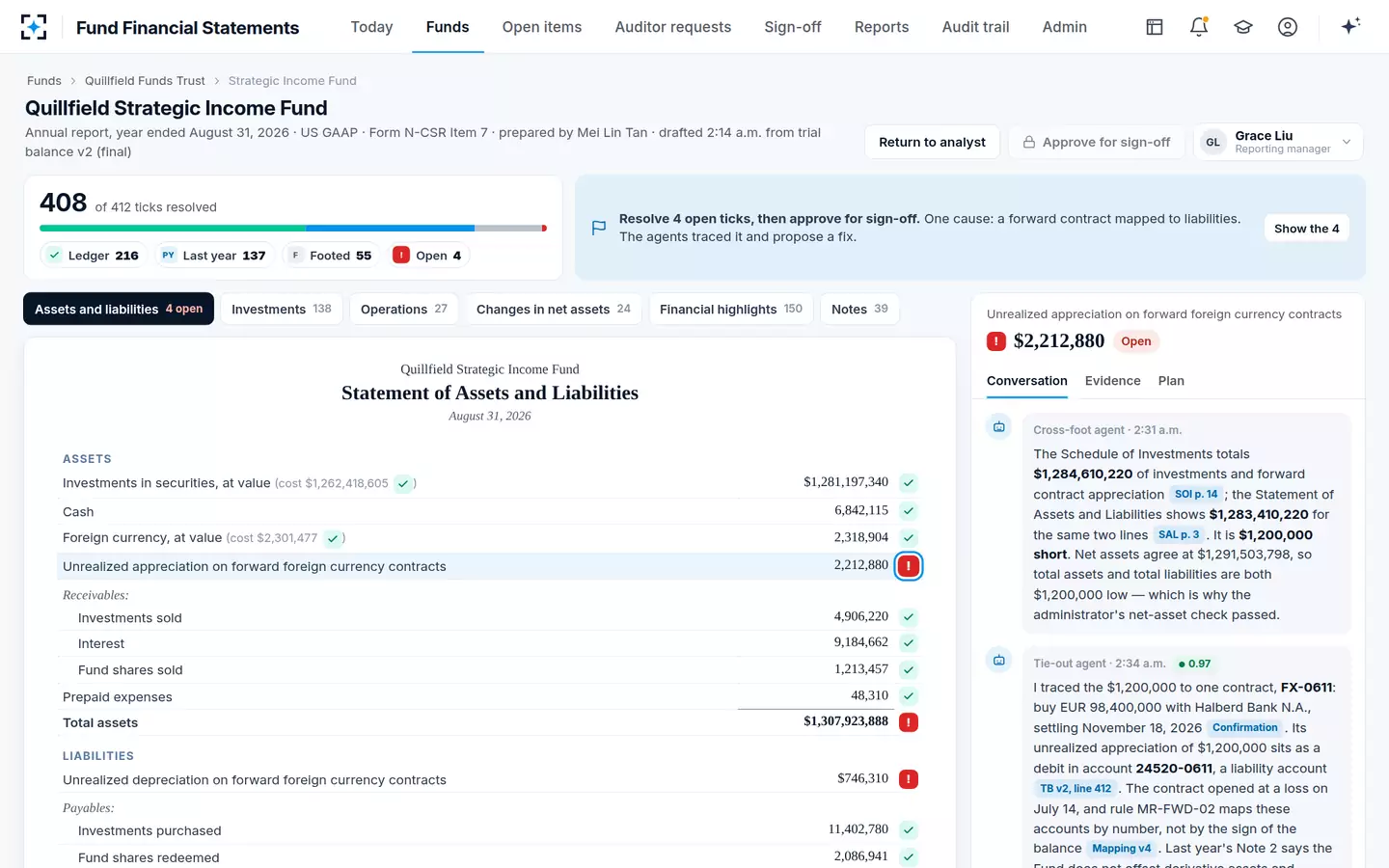
A registered fund's statements, drafted and ticked under the framework set for its family
Private funds: audited GAAP statements for the custody rule
Most private funds prepare investment company financial statements because the custody rule makes an annual audit the practical route to compliance. The pooled vehicle must be audited at least annually and send its audited statements, prepared under generally accepted accounting principles, to all its investors within 120 days of its fiscal year-end, and again promptly after a liquidation audit (17 CFR 275.206(4)-2(b)(4)).
The October 6, 2026 proposal would change the calendar, not the content. It would "extend the current 120-day delivery deadline for annual audited financial statements to 180 days for funds of funds and 260 days for funds of funds of funds," and write into the rule that non-US vehicles may use other principles if their statements contain information substantially similar to US GAAP, "including a reconciliation to U.S. GAAP for material differences" (91 FR 63870). Comments close on December 7, 2026; until a final rule is adopted, 120 days stands. The deadlines are set out desk by desk in the Form N-CSR filing deadline guide.
Structure shows up in the statements too. In a master-feeder arrangement, the SEC noted in 2023, "master fund financials may be attached to the feeder fund financials and delivered to investors in the feeder fund," citing ASC 946-205-45-6 (88 FR 63206). A feeder's tie-out therefore includes the master's statements it carries, and its own investment in the master must agree to the master's net assets attributable to it.
How Fund Financial Statements applies the framework each fund family has chosen
The solution does not decide a fund's status; people do, with the auditor. What it does is hold the decision as a setting per fund family and apply it every time a statement is drafted. In the sample data, Quillfield's US mutual funds and ETFs run under US GAAP, ASC 946 and Regulation S-X for Form N-CSR; a Luxembourg SICAV under Luxembourg GAAP in three languages; an Irish ICAV under IFRS; and private funds under US GAAP for the custody rule audit.
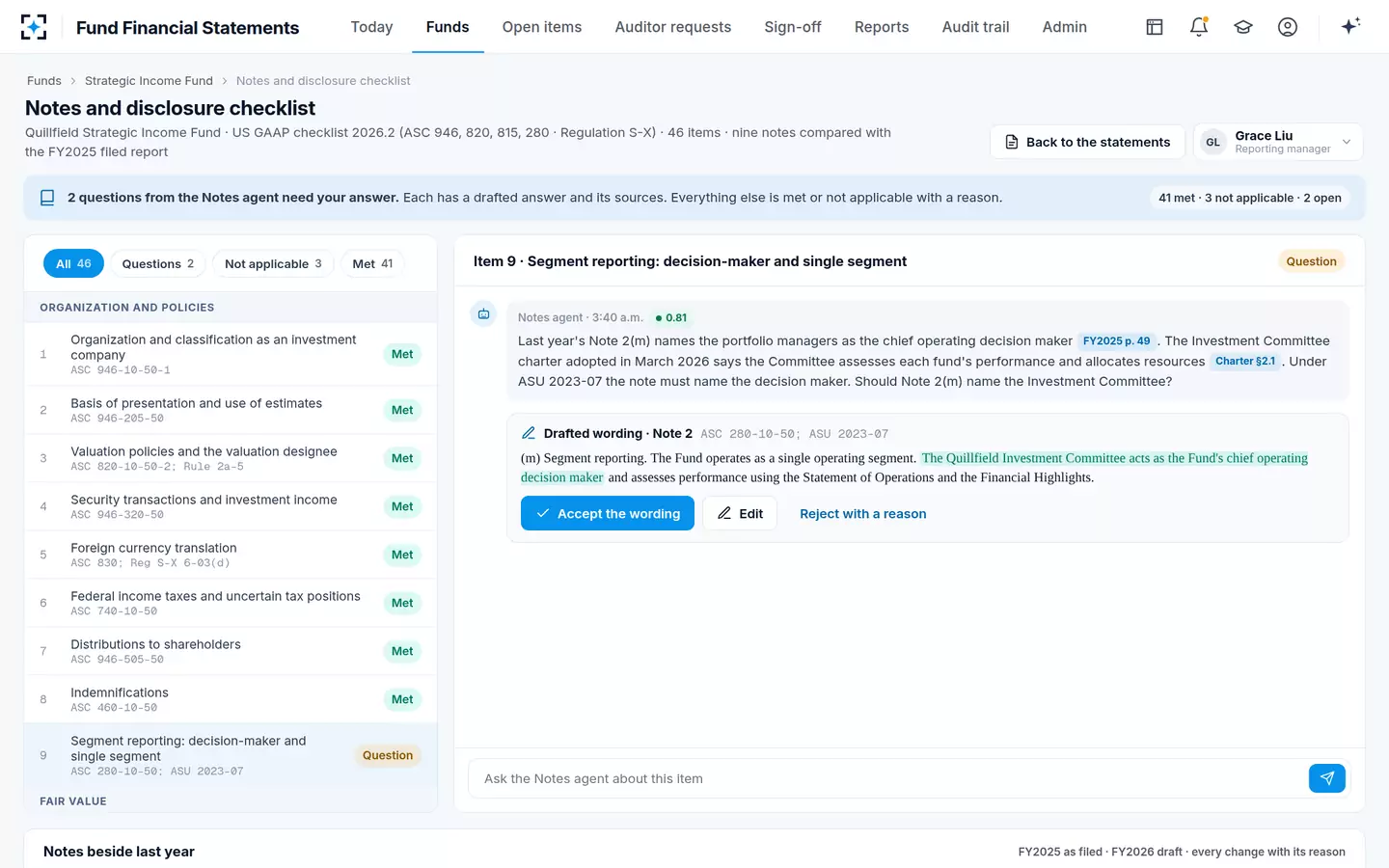
The framework drives the template, the mapping from the administrator's chart of accounts and the disclosure checklist. The Drafting agent builds the statements and notes from the final trial balance and the versioned mapping; the Tie-out agent agrees every number to the trial balance, holdings, capital records or last year's filed report; and the Notes agent answers each checklist item with where it is met. A status change is therefore a change of settings, approved by a fund controller and recorded, not a quiet edit to a spreadsheet template. How each line of the most distinctive statement is sourced is shown in the schedule of investments example, and how the per-share table is recomputed in the financial highlights guide.
The disclosure checklist starts with the status itself
A status file the auditor can test
A status conclusion is only as strong as the evidence filed with it, and it has to be revisited. IFRS 10 requires a parent to "reassess whether it is an investment entity" when facts change in any of the three elements or the typical characteristics (paragraph 29), and a change is accounted for "prospectively from the date at which the change in status occurred" (paragraph 30). A fund that loses its last outside investor, or starts lending to its portfolio companies, has a reassessment to make in that period, not at the next audit.
What to keep in the status file for each vehicle
- The route
Registered or BDC (cite the registration), or an assessment under ASC 946 or IFRS 10, named.
- The business-purpose evidence
Offering memorandum, partnership agreement and marketing material, with the passages that state the objective.
- The fair-value evidence
Board or investment committee papers showing performance is measured and decisions made on fair value.
- Each typical characteristic
Number of investments and investors, related parties, form of interests; and the reason the status holds where one is missing.
- Subsidiaries by type
Which provide services to the fund and are consolidated, and which are investments carried at fair value.
- The reassessment trigger
Who reviews the conclusion when investors, investments or activities change, and when it was last done.
Questions people ask
What is ASC 946?
ASC 946 is the US GAAP topic for investment companies in the FASB Accounting Standards Codification. The SEC describes it as requiring, for entities within its scope, a schedule of investments, financial highlights and trade-date measurement of trades. In 2026 the SEC also wrote that its requirement to accrue performance fees on actual performance "applies to all regulated funds".
Do investment companies consolidate their subsidiaries?
Under IFRS 10, an investment entity does not consolidate its subsidiaries; it measures them at fair value through profit or loss. The exception is a subsidiary providing services related to the fund's own investment activities, which is consolidated. A parent that is not itself an investment entity consolidates everything it controls, including through the fund.
Do hedge fund financial statements have to follow US GAAP?
For a US adviser relying on the custody rule's audit route, the SEC's longstanding view is that the audited statements are prepared under US GAAP. A non-US vehicle may use other principles if its statements are substantially similar to US GAAP with material differences reconciled, a point the October 2026 proposal would write into the rule.
Is a statement of cash flows required for a fund?
Not always. The SEC's list of a registered fund's audited statements includes a statement of cash flows only "if necessary to comply with generally accepted accounting principles". Whether it is necessary turns on the conditions in GAAP and on the fund's own facts, so it is a question to settle with the auditor each year rather than a template default.
Can a fund with one investor be an investment company?
It can. Under IFRS 10, having more than one investor is a typical characteristic, not a requirement, and its absence calls for more judgement and disclosure rather than failing the test. Start-up and wind-down periods are the usual reasons, and the status file should say which applies.
What happens when a fund stops being an investment entity?
The change is accounted for prospectively from the date the status changed; earlier periods are not restated for it. From that date the former investees it controls are consolidated, so the statements, the mapping and the disclosure checklist all change in the same period.