A financial statement tie out tool agrees each number in a draft set of statements to the record it comes from, the trial balance, a sub-ledger or last year's filed report, and to every other place the same figure appears, and marks it with a tick that carries its evidence. Done by hand, a tie-out is thousands of small traces with a pencil and two screens; a fund's statements alone hold a few hundred numbers each, and a fund complex ties all its funds in the same weeks. A tool is worth buying only if it does two things a spreadsheet does not: it shows the evidence behind every tick, and when a number does not tie it finds out why. Botminds' Fund Financial Statements is built that way: its agents draft each fund's statements from the administrator's trial balance, tick every number, and trace each break to a cause a person can approve or reject. This page follows one number all the way through.
The number comes from the solution's fictional sample data: the Quillfield Strategic Income Fund, annual report at August 31, 2026, 412 numbers to tie, net assets of $1,291,503,798.
One number traced: from drafting to signature in two sittings
- Draft and tie17 min
- Flag, trace3
- Re-foot2
- Maker applies fix6 min
- Re-tie2
- Approve; 2 funds4
- Checker approves7
- Sign2
What is a financial statement tie out?
A tie out is the proof that each number in the statements came from where it should and says the same thing everywhere it appears. Each number gets a mark, the auditor's tick, naming what it was agreed to: a trial balance account, a sub-ledger total, last year's filed page, or the footing of the column it sits in. In the solution's vocabulary those are four tick types, and the counter on the sample fund read 216 tied to the general ledger, 137 to last year, 55 footed and 4 open.
For investment company statements the regulator writes some of the ties into the rules. The schedule of investments' total must equal the investments on the balance sheet (Regulation S-X Rule 12-12, note 6), and so must the total of the forward currency schedule's appreciation and depreciation column (Rule 12-13B, note 4). Others come from the arithmetic of the statements: the statement of changes in net assets must end where the balance sheet does, and the financial highlights must begin where last year's ended. A tie-out tool that does not know these cross-statement ties checks columns but not statements.
Four kinds of tick on one fund, and what each proves
| Tick | On the sample fund | What it proves | What it does not |
|---|---|---|---|
| Tied to the general ledger | 216 | The line equals the trial balance accounts mapped to it, at $0 | That the mapping put each account on the right line |
| Tied to last year | 137 | The comparative or opening figure equals last year's filed report | That last year was right |
| Footed | 55 | The total or subtotal re-adds, at a $1 rounding tolerance, in code | That the lines it adds are right |
| Open | 4 | Nothing yet: the number did not tie and the agents traced why | Anything, until a person clears it with evidence |
Step one: the red tick, and why the administrator's check passed
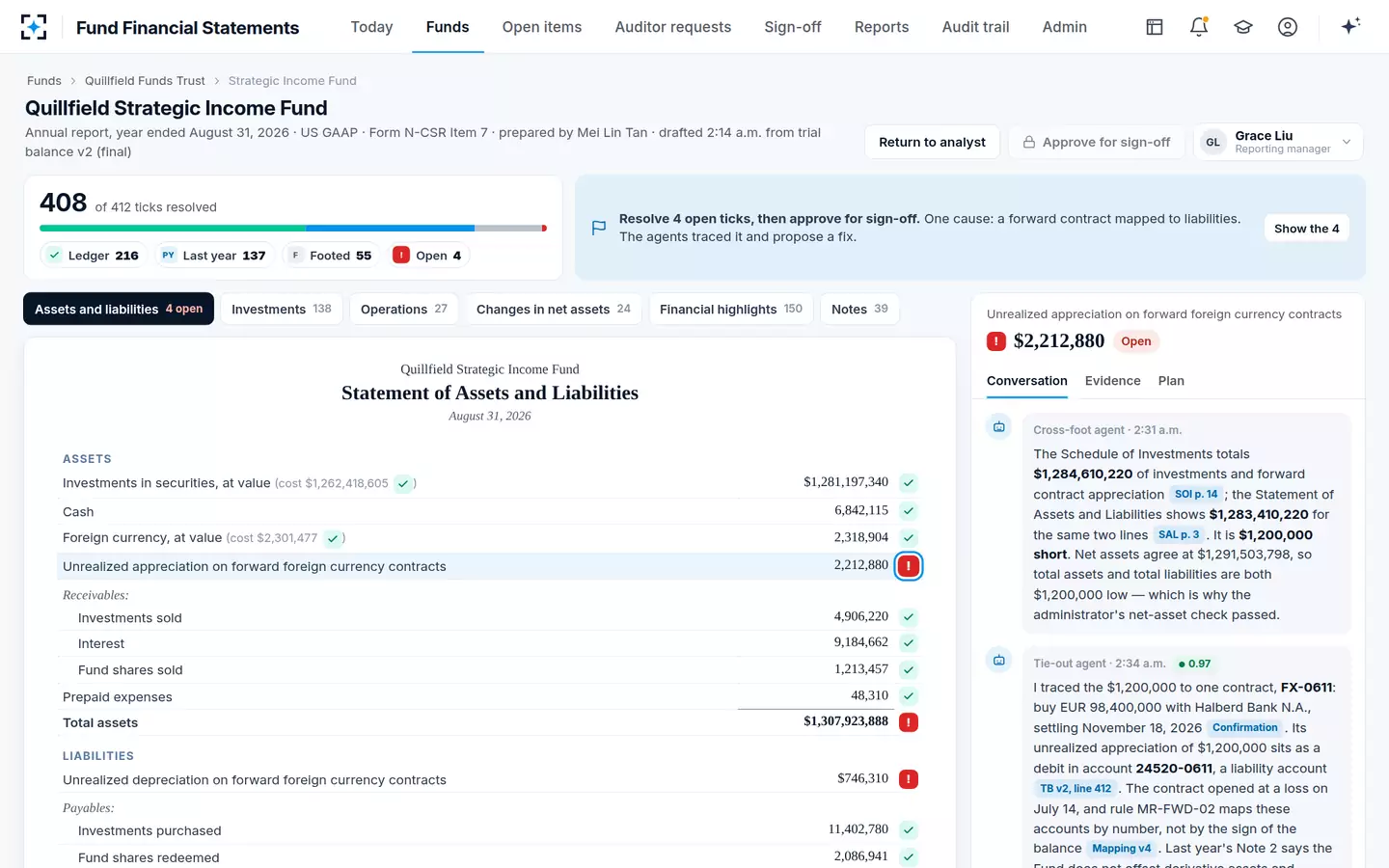
The number was unrealized appreciation on forward foreign currency contracts, shown in the draft statement of assets and liabilities as $2,212,880 and marked red. The Cross-foot agent had compared the schedule of investments with the balance sheet: the schedule totalled $1,284,610,220 of investments and forward contract appreciation; the balance sheet showed $1,283,410,220 for the same two lines. The difference was $1,200,000.
Net assets agreed at $1,291,503,798, and that is the point. Total assets and total liabilities were both $1,200,000 low, so any check built on net assets, including the administrator's own, passed. Regulation S-X separates the two sides on purpose: forward contracts appear as an asset under caption 3(b) and as a liability under caption 9(d) of the balance sheet (Rule 6-04), and the forward schedule is filed "in support of captions 3(b) and 9(d)" (Rule 6-10(c), Schedule VI). A tool that ties the net position will never find a gross misclassification.
The red tick, and the agents' explanation beside it
Step two: from the difference to one contract
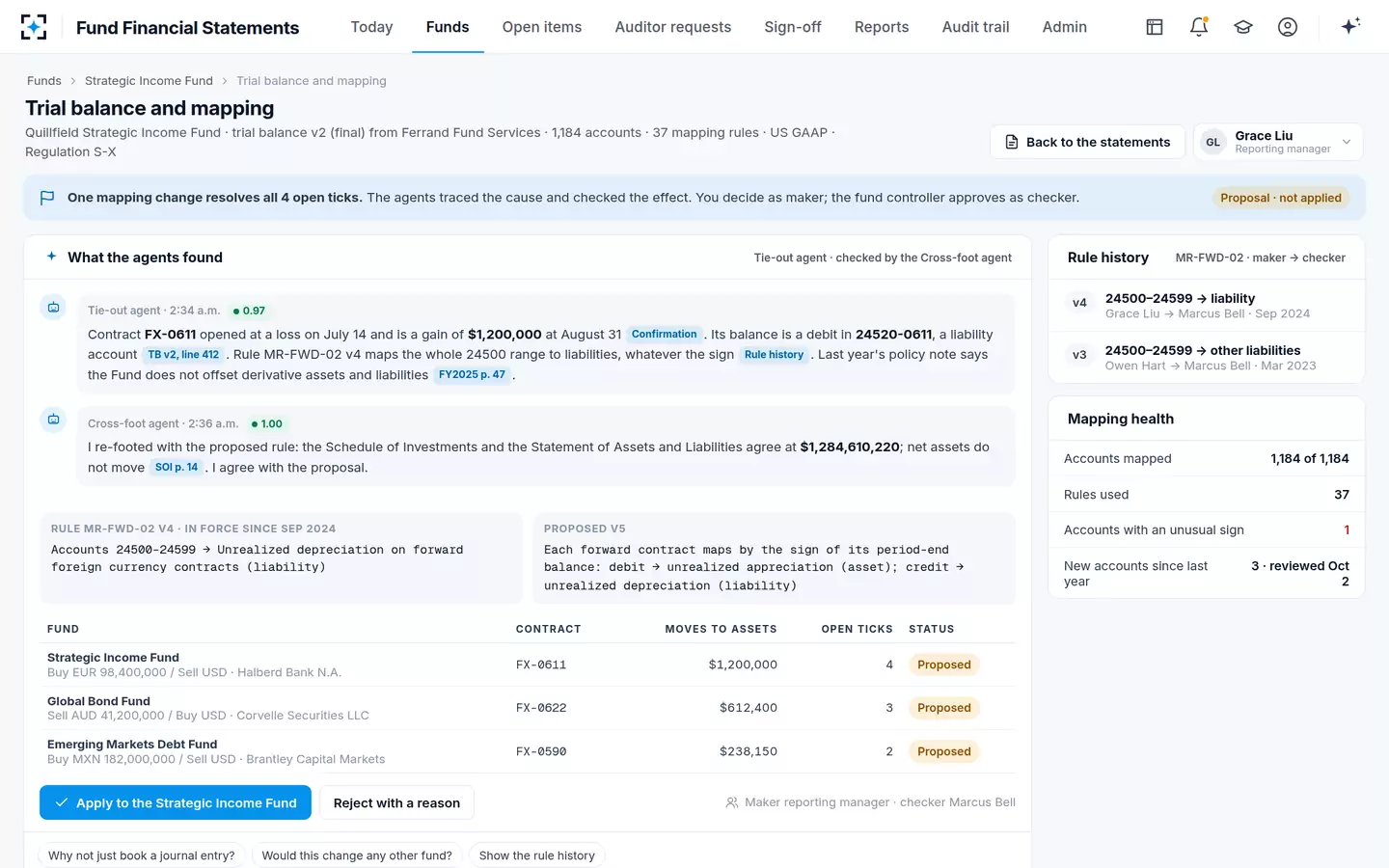
A difference is not a cause. The Tie-out agent walked the $1,200,000 through the trial balance accounts for forward contracts and found one that did not belong: contract FX-0611, a purchase of EUR 98,400,000 against dollars settling November 18, 2026. It had opened at a loss on July 14 and stood at a gain of $1,200,000 at August 31, so its balance was a debit sitting in liability account 24520-0611. The mapping rule in force, MR-FWD-02 version 4, assigned the whole 24500 account range to liabilities, whatever the sign of the balance. Last year's policy note said the fund does not offset derivative assets and liabilities, so netting it was not an option either.
That trace needs four kinds of record at once: the trial balance line, the mapping rule's version history, the counterparty confirmation, and last year's filed note. Each appears in the agent's explanation as a citation a person can open. The Evidence tab sets the schedule and the balance sheet side by side and lists every forward contract account with its balance and the line it maps to, so the reviewer can see the one debit among the credits.
The mapping rule in force, the proposed version, and every fund it touches
Step three: the fix is a proposal, and a person makes it
The agents did not post a journal entry or edit the mapping. They proposed a new version of the rule: "Each forward contract maps by the sign of its period-end balance: a debit to unrealized appreciation (asset), a credit to unrealized depreciation (liability)." The Cross-foot agent re-footed the statements under the proposal and confirmed that the schedule and the balance sheet would agree and net assets would not move. Then the decision went to people, in a fixed order.
Who does what between the red tick and the signature
Agent
Cross-foot agentRe-adds totals and compares the schedule with each balance sheet caption in code; flags the $1,200,000 gap.
Never: estimates or rounds beyond the tolerance
Agent
Tie-out agentTraces the gap to FX-0611, the liability account and mapping rule v4; proposes v5 with its effect; finds the same cause in two more funds.
Never: clears a red tick
A person decides
Reporting manager, as makerReads the evidence, applies rule v5 with a reason code and a note; approves the fund for sign-off once 412 of 412 tie.
A person decides
Fund controller, as checkerApproves the mapping change he did not make, then signs the statements with a reason code.
Agent
Auditor-request agentDrafts the answer to the auditor's request on forward contracts, attaching the confirmations and the approved change.
Never: sends anything without release
The same cause was in two other funds: the Global Bond Fund's contract FX-0622 ($612,400, three open ticks) and the Emerging Markets Debt Fund's FX-0590 ($238,150, two). Each was shown with what the fix would change before it was applied. With one rule change approved once, open ticks across the cycle fell from 37 to 28 and funds with open items from nine to six. That is the difference between a tie-out tool and a tie-out list: the list finds three breaks, the tool finds one cause.
What should a tie out tool check?
Before buying, ask the vendor to run one of last year's funds and show, for a handful of numbers you pick, what each tick was agreed to and what happened when one did not agree. The checklist below is what a fund reporting team should be able to see on the screen, not on a slide. A structured way to run that test over a whole report is in the pilot guide.
What a financial statement tie out tool should show you
- The evidence behind each tick
One click from a number to the trial balance lines, sub-ledger record, prior-year page or footing that supports it.
- Gross, not only net
Asset and liability captions tied separately, and every schedule total tied to each balance sheet caption it supports.
- Cross-statement ties
Schedule to balance sheet, operations to changes in net assets, changes in net assets to the balance sheet, highlights to the capital records, notes to schedules.
- Arithmetic in code
Footing and cross-footing by deterministic calculation, with the tolerance stated, not by a language model's reading.
- A cause, not just a difference
The account, mapping rule, transaction or policy behind a break, with its sources, and the same cause found in other funds.
- Proposals, not edits
Fixes shown with their effect and applied by a person; read-only access to the ledgers; maker and checker kept apart.
- Last year as filed
Comparatives tied to the filed report, not to a working file.
- A record the auditor can read
Every tick, change and approval with who, when, why and the evidence, exportable without retyping.
What does tie out mean in accounting, and in auditing?
In accounting, to tie out a number is to agree it to its support and mark that it was agreed. In an audit the same word describes the auditor's own procedures on the client's statements, with the auditor's tick marks in the working papers. The two are not the same work, and a preparer's tie-out does not replace the auditor's. What it changes is what the auditor finds: a set of statements tied before it reaches the auditor turns proposed adjustments from discoveries into confirmations.
Auditors are looking at tools for the same task. In 2024 PCAOB staff reported that audit firms saw possible future uses of generative tools including "evaluating the completeness of financial statement disclosures, and comparing amounts in the financial statements or notes to the financial statements with audited amounts", and that "some firms are designing their GenAI tools to document the relevant underlying source data used" (PCAOB staff Spotlight, July 2024). The second point is the one to hold any tool to: a comparison without its source data is not evidence.
What a tie-out tool cannot do
It cannot decide what the right number is when the records disagree for a reason that needs judgement: a late trade the administrator booked after the final trial balance, a valuation the committee revised, a policy question such as whether to offset. It can show that the records disagree, trace where, and propose; the decision, and the reason for it, belong to a person. Nor can it make a disclosure adequate: it can show that a note's figures agree with the schedule, not that the note says enough.
The records it reads must be kept anyway. Rule 31a-2(a)(1) has a registered fund keep its journals and ledgers for good, with the latest two years close at hand (17 CFR 270.31a-2), and the trail of ticks and decisions is the bridge between those records and the filed statements. In the solution that trail is append-only, kept seven years under its standard settings, and exported with a hash index so a reviewer can show nothing changed.
Where Fund Financial Statements fits, and where it does not
It sits between the administrator's fund accounting platform and the composition and filing agent. It reads final trial balances, holdings and capital records by secure file transfer or API, the management company's fee accruals, custodian confirmations, pricing files and last year's filed reports, and it is read-only on every set of books. It does not keep the books, value the portfolio, typeset the report or file on EDGAR. Those stay where they are; the solution's job is the evidence that the statements those systems produce agree with each other.
It also does not replace the reporting team's judgement about what the statements should say. The chat window that most teams have already tried on a set of statements reads the page and nothing behind it; why that matters is set out in the guide to what a chatbot misses. The tolerances it ties against are settings, $0 for statement lines, $1 for footing, $0.01 per share and 0.01% of net assets in the sample configuration, changed only by a versioned approval.
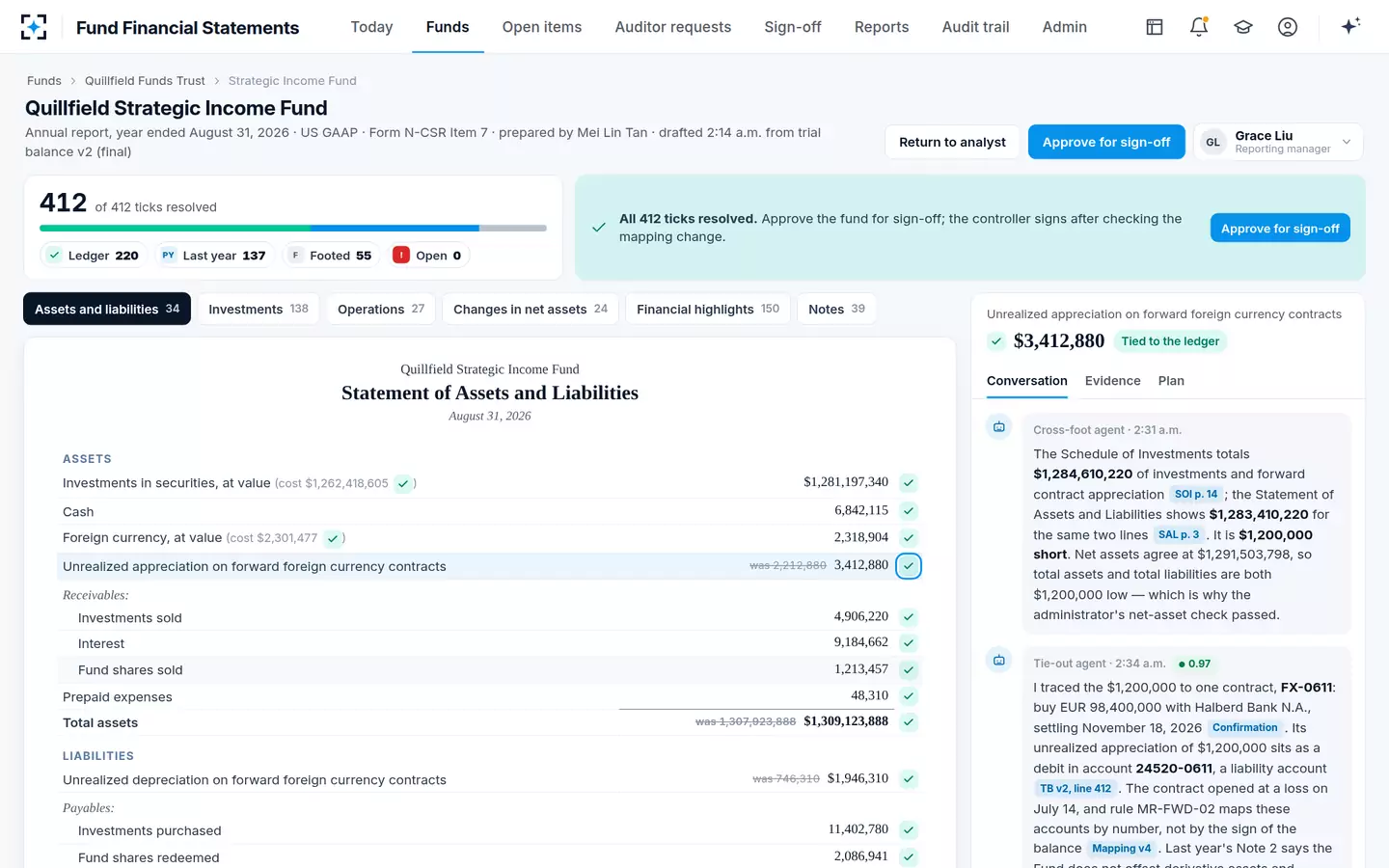
After the fix: 412 of 412 tied, the old figures still visible
Questions people ask
What is the difference between a tie-out and a reconciliation?
A reconciliation explains the difference between two balances that should agree, such as the books and a custodian statement. A tie-out agrees each number in a report to its support. A tie-out that finds a break often needs a reconciliation to explain it, which is why a tool that stops at "does not tie" leaves the hard half of the work to a person.
How long does a fund tie-out take by hand?
No regulator or independent study publishes a measured figure. The solution's own estimate for a mid-size bond fund is 300 to 600 numbers at two to three minutes each, 10 to 30 hours, before any re-tie after audit adjustments; its design target is about four hours of review per fund. Time your own team on two funds to get a real number.
Can a spreadsheet tie out financial statements?
A spreadsheet can hold the ties and foot the columns. It cannot show the evidence behind a tick unless someone pastes it in, it does not trace a break to its cause, and it records nothing about who changed what. For a few funds that is manageable; for a complex filing on the same day, the weak point is the re-tie after late changes.
What tolerance should a tie-out use?
Zero for statement lines against the trial balance, because they should be equal; a small rounding tolerance for footing, because presented figures are rounded; and the presentation unit for per-share data, usually one cent. Whatever the tolerances, they should be written down, versioned and approved by someone other than the person who uses them.
Does a tie-out tool need write access to the books?
It should not. Reading the trial balance, sub-ledgers and prior reports is enough to tie and trace; a fix to a mapping or an entry is a decision for a person in the system that owns it. In the solution the agents are read-only on every set of books and every change is made by a named maker and approved by a different checker.