The way to test financial reporting automation tools for an investment fund is to give them last year's work: the final trial balances, holdings and capital records behind last year's annual report, and the report as filed. A tool that re-produces the signed statements from those records, and explains every number it does not reproduce, has shown on your own funds what no demonstration can. Every difference has one of two owners: the tool got it wrong, or last year's report did, and both are worth knowing before the next season. A pilot built this way needs checkpoints that can fail, agreed before it starts, and a baseline of your own hours. Botminds' Fund Financial Statements is piloted exactly so: its agents draft and tie last year's funds from your own trial balances and filed reports, and you decide on what you measured.
Eight checkpoints a fund reporting pilot must be able to fail
Inputs load
What is measuredEvery pilot fund's final trial balance, holdings and capital records load; debits equal credits; last year's filed report is attached.
PassAll funds loaded with no manual retyping
A fail meansYour data needs work before any tool will help
Draft equals filed
What is measuredEach number of the drafted statements compared with last year's filed report.
PassEvery difference explained: a tool error, or a fact about last year
A fail meansUnexplained differences: the mapping or the template is not ready
Known breaks found
What is measuredLast year's auditor adjustments and a few planted breaks, by type.
PassEach found, with its cause traced to an account, rule or transaction
A fail meansA break type missed: the tool cannot yet be relied on for it
Evidence opens
What is measuredA sample of ticks chosen by the reviewer, not the vendor.
PassEach opens to the record line, page or footing behind it
A fail meansA tick without evidence is a claim, not a check
Same input, same result
What is measuredOne fund run twice from the same files.
PassIdentical ticks and findings
A fail meansOutput that varies cannot be audited
Controls hold
What is measuredA self-approval attempted; an unreleased answer to the auditor attempted; a write to the books attempted.
PassEach blocked and recorded
A fail meansSegregation of duties depends on good behaviour
Hours measured
What is measuredReview hours per fund against the baseline timed before the pilot.
PassMeasured on your funds, reported as measured
A fail meansOnly the vendor's estimate exists
The auditor can read it
What is measuredYour auditor reviews the trail exported for one fund.
PassThe auditor can follow a number to its evidence without the tool
A fail meansEvidence the auditor cannot use saves nobody time
What are financial reporting tools, and which kind are you piloting?
"Financial reporting tools" covers at least four kinds of software in a fund complex, and a pilot has to test the right one. Fund accounting platforms keep the books and produce the trial balance. Document tools assemble, typeset and tag the report and file it. Disclosure checklists track required items. Drafting and tie-out tools build the statements from the trial balance and prove each number against its source. A pilot of the fourth kind on last year's report tests the claim that matters most to the people who sign: that the numbers are right and the evidence shows it.
The checkpoints above assume that kind of tool. For a document tool, the pilot is narrower: does the typeset report match the approved source, are the tags right, does the filing pass. For any tool, the principle is the same: a demonstration on the vendor's data tests the vendor; a pilot on your last report tests the tool against a known answer.
Why last year's report is the right test
It is the only set of fund statements with a known, independently checked answer. It was audited, certified and filed, and for a registered fund it sits on EDGAR. The SEC made that point about Form N-CSR in 2022: filing the information there gives shareholders and other market participants "access to historical, immutable data regarding the fund on EDGAR" (87 FR 72758). The records behind it are kept too: a registered fund preserves its journals and general and auxiliary ledgers permanently (Rule 31a-2(a)(1)), so the trial balances the report was drafted from are available to feed the pilot.
Preparers already test new technology this way. PCAOB staff reported that some preparers described governance for generative tools as similar to that for other technology, for example "running technology in a parallel environment prior to deployment," and that some "are testing individual use cases to understand the extent of controls that would be needed before GenAI is more widely integrated in the financial reporting processes" (PCAOB staff Spotlight, July 2024). A pilot on last year's report is a parallel run with the answer already known.
What should a pilot of financial reporting automation prove?
Three things, in order: that the tool can reproduce what you filed from what you had, that it finds what was wrong and says why, and that its evidence would satisfy the people who sign and the auditor who reports. The eight checkpoints split those into measurements. The second is the core: every number in the drafted statements is compared with the filed report, and every difference gets an owner.
The third checkpoint is where a pilot earns its cost. Last year's auditor almost certainly proposed adjustments; each one is a break the original draft contained and the auditor found. Load the pre-adjustment trial balance where you have it, and the tool should find each of them before it is told. Add a handful of planted breaks of the kinds your team fears most: a derivative mapped by account rather than sign, a trade booked after the final trial balance, a missing fee waiver, a comparative column taken from a working file, a per-share figure a cent off. Score each by type; a tool that finds four of five types has told you which one still needs a person.
Breaks to plant, and what finding each one proves
| Planted break | Where it shows | What finding it proves |
|---|---|---|
| A forward contract with a gain left in a liability account | Total assets and liabilities both low; net assets unchanged | The tool ties gross captions, not only net assets |
| A trade booked after the final trial balance | Holdings and trial balance disagree on one position | It reads more than one source and knows which is final |
| A fee waiver missing from the trial balance | Advisory fee and expense ratio both off | It ties the statement of operations to the fee terms, not just to itself |
| A comparative column taken from last year's working file | Prior-year figures differ from the filed report | It ties comparatives to the filed report |
| A per-share figure a cent off the capital records | One class's highlights column | It ties per-share data to the capital stock records at the presentation unit |
| A note figure that differs from its schedule | A fair value or derivative note | It cross-checks notes against statements |
What data do you need to pilot fund reporting software?
The data you already keep for the audit, for a handful of funds that between them cover your hard cases. Choose funds with derivatives, with several share classes, with a different administrator from the rest, and if you publish them, with language editions. Five to ten funds is enough to see the pattern; more is a rollout, not a pilot.
What to bring to a pilot on last year's report
- Final trial balances
As delivered by each administrator for last year's year-end, and the pre-adjustment version if you kept it.
- Holdings and capital stock records
The holdings sub-ledger and the transfer agent's share and NAV records at the year-end, by class.
- The chart-of-accounts mapping
However it is kept today, including the spreadsheet; the pilot is where it becomes explicit.
- Last year's filed report
From EDGAR for registered funds; the issued statements for private funds and non-US funds.
- The disclosure checklist you used
With last year's answers, so the notes can be compared item by item.
- The auditor's adjustments and requests
Proposed adjustments, the request list and your answers: the known breaks and the evidence the auditor wanted.
- A baseline of hours
Your team's time on the same funds by task, from timesheets or a timed sample, agreed before the pilot runs.
How long does a financial reporting automation pilot take?
Weeks, not months, if the data is ready, and the data is usually what takes the time. Most of the effort sits in the first fortnight: getting last year's files in and making the mapping from each administrator's chart of accounts explicit. The run itself is short; the review of every difference is the part that needs your people.
A pilot on last year's report, week by week
- Set upweek 1
- Load and mapweeks 2–3
- Run and compareweek 3–4
- Breaks, controlsweek 4
- Auditor, decideweek 5
Schedule the pilot outside the season. A pilot that competes with the live year-end for the same reviewers will be cut short, and the measurement of hours will measure the season, not the tool. For funds with an August or December year-end, the months after the filings are the natural window.
Every difference has two possible owners
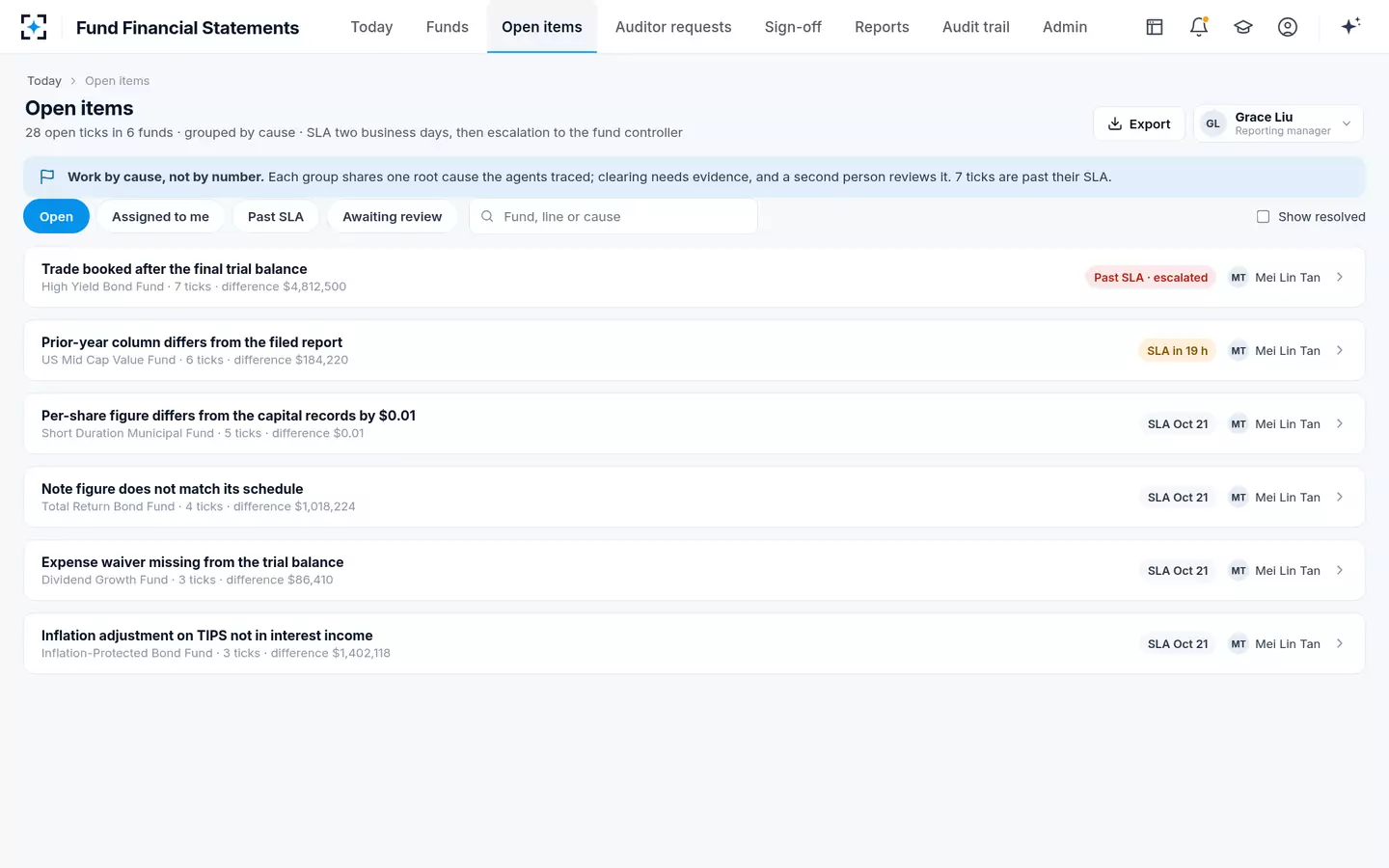
When the drafted statements differ from the filed report, either the tool is wrong or last year was. Most differences in a first run are the tool's: an account mapped to the wrong caption, a template missing a line, a policy the tool was not told. Those are the pilot doing its job, and each should end with a fix and a re-run. Some differences may be last year's: a comparative that was never tied, a note figure that did not match its schedule. Those are findings, and they go to the people who own last year's statements and, where they matter, to the auditor.
Agree before the pilot how a last-year finding will be handled, so nobody is surprised. The pilot is not a re-audit, and most such findings will be small; but a reporting team that discovers one should record it, assess it and decide with the controller what follows, as it would any error found after filing. The point for the pilot is narrower: a tool that surfaces such a difference, with its evidence, is doing what it will be asked to do every season.
Differences grouped by cause, each with an owner and a clock
What does the auditor need to see from a new reporting tool?
Evidence they can follow without the tool, and controls they can test. The PCAOB staff's account of audit firms' concerns is a useful list: firms "emphasized the importance of the auditability of both the underlying source data ... and GenAI-created content," and preparers questioned whether the output of some tools could be audited at all. A reporting tool that hands the auditor ticks which open to the trial balance line, the sub-ledger record or the filed page, and a trail of who changed what and why, gives the auditor something to rely on; one that hands over conclusions gives them more to test.
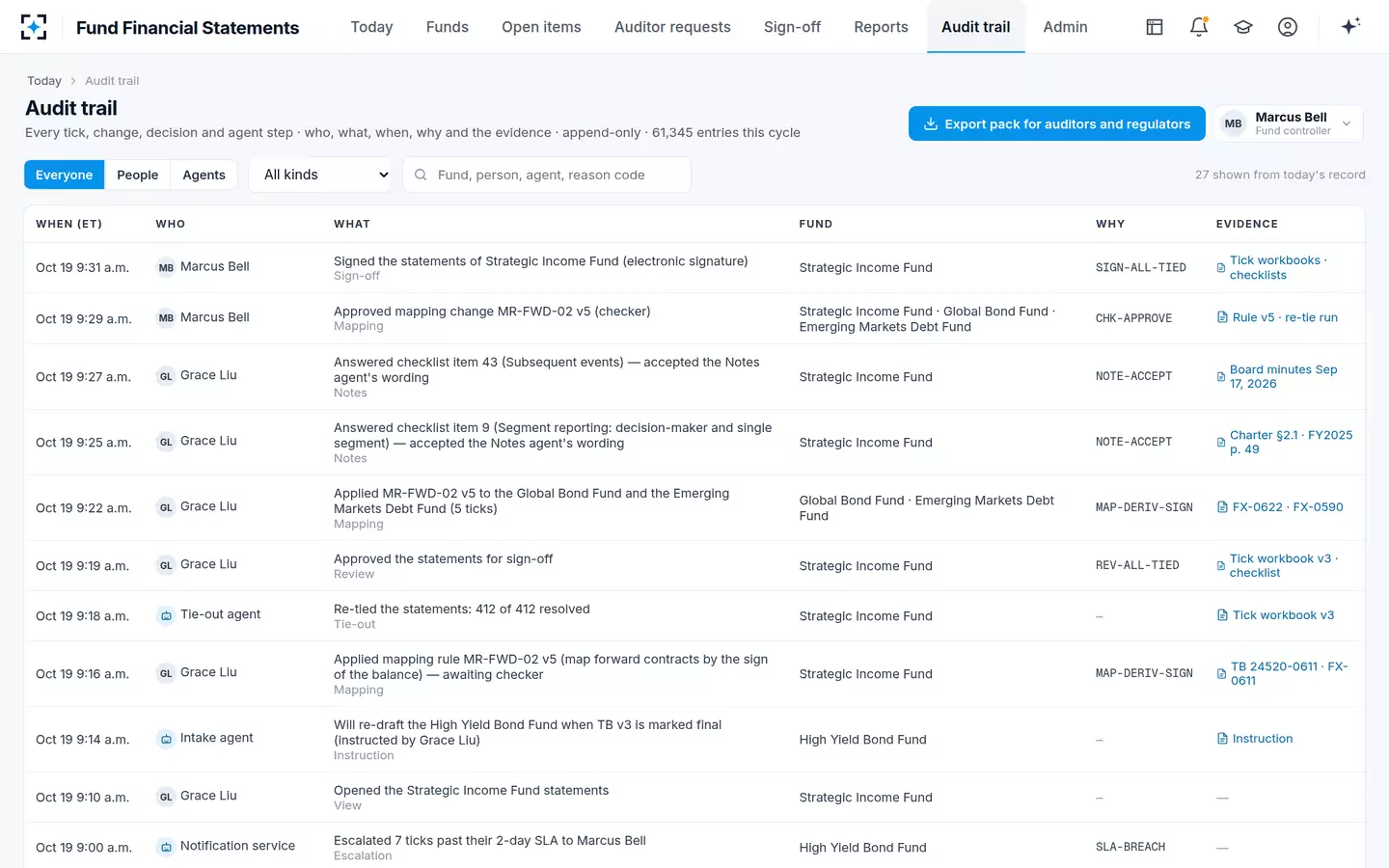
Invite the auditor to the last week of the pilot, not the first. Show one fund's exported trail: every tick with its evidence, every mapping change with its maker and checker, every release of an answer. Ask what they would need to rely on it next season, and write the answer into the decision. A tool your auditor cannot use will not shorten the season, however fast it drafts.
The trail an auditor reads: who, what, when, why and the evidence
Deciding after the pilot
Decide on the checkpoints, not on impressions. If every checkpoint passed, the next step is a limited live run, usually the next semi-annual report for the pilot funds, with your team reviewing every tick as well as its own work. If a checkpoint failed, the failure says what to do: unexplained differences mean the mapping is not ready; a missed break type means that check stays manual until the tool is retested on it; evidence that does not open means the tool is not ready to be relied on at all.
Write down what was measured and call it measured: hours per fund on your funds, breaks found by type, differences by owner. Anything still an estimate, including the vendor's, should be labelled one in the business case. How to turn those measurements into a total-cost comparison is in the guide to what a fund report costs, and what to ask of the tie-out itself is in the tie-out tool guide.
How Botminds runs a pilot of Fund Financial Statements
On your files, not ours. The solution is set up with your chart-of-accounts mappings, last year's filed reports and your disclosure checklists, connected to the systems you already use: each administrator's fund accounting platform, the general ledger for fee accruals, custodian confirmations, pricing files and your filings archive. Its agents then draft and tie last year's funds, trace each difference to its cause and show it with evidence; your reporting manager and controller decide what each one is.
The controls the pilot tests are the ones the solution runs every season: preparer, reviewer and signer are three different people, the maker of a mapping change cannot approve it, the agents are read-only on every set of books, and nothing reaches the auditor until a person releases it. New versions of the agents are themselves tested on a fixed set of funds before a fund controller approves their release, which is the same idea as the pilot applied to the tool's own updates. The design targets, every number tied before the fund controller signs and about four hours of review per fund, are what the pilot measures against your baseline; they are targets until your funds have shown them.
Questions people ask
Why not pilot on the current year's report?
Because there is no known answer yet, and the reviewers are busy. Last year's report was audited and filed, so every difference can be adjudicated, and the pilot can run outside the season. Run the current year in parallel only after the pilot has passed.
How many funds should a pilot cover?
Enough to include your hard cases: funds with derivatives, multiple share classes, a second administrator and, if relevant, language editions. Five to ten funds usually covers them. More funds add hours to adjudicate without adding new kinds of difference.
What if the pilot finds an error in last year's statements?
Treat it as you would any error found after filing: record it, assess it with the controller and, where it may matter, raise it with the auditor. Agree that process before the pilot starts. Most such differences are small, and finding them is evidence the tool does what it is for.
Should the vendor or our team run the pilot?
The vendor sets up the tool; your team chooses the funds, the planted breaks and the sample of ticks to open, and adjudicates every difference. A pilot in which the vendor also picks the test cases measures the vendor's preparation, not the tool.
What does a passed pilot not prove?
That the tool handles what the pilot did not include: an instrument you did not hold last year, a new framework, a rule change. Keep a short list of what was not tested, and test each item before relying on the tool for it.